Risk Management through CLM
Client Lifecycle Management plays a central role in how financial institutions identify, understand and control risk across client relationships. By coordinating client identity, structure and lifecycle activity, CLM provides the foundation through which institutions manage financial crime risk, regulatory permissions and exposure to complex client networks.
CLM as an enterprise risk-enabling capability
CLM sits at the centre of the bank’s risk and execution model, maintaining the integrity of client relationships and enabling other functions to operate on a trusted, current foundation.
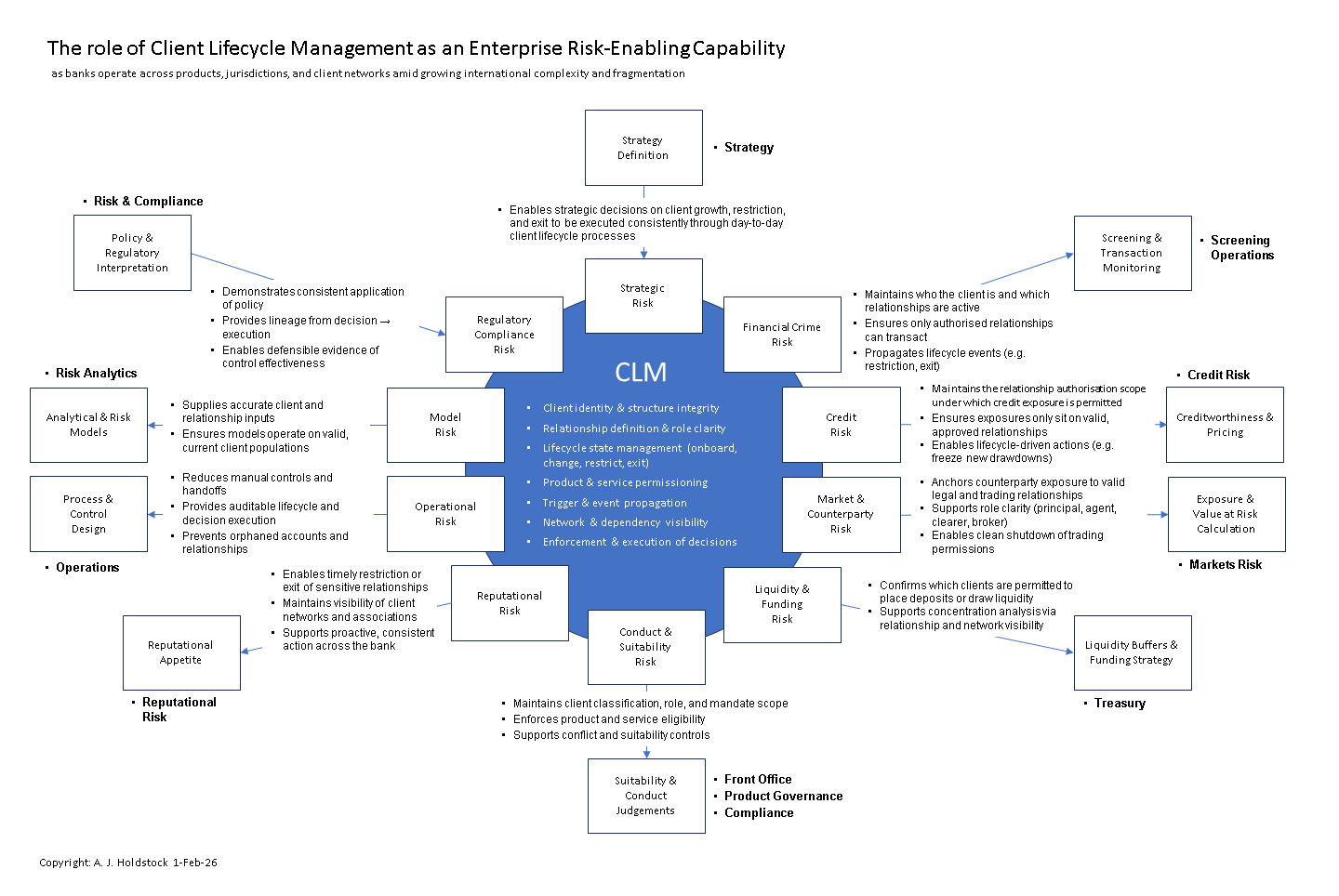
CLM does not assess risk — it ensures that risk decisions can be executed consistently, defensibly, and at scale.
What CLM controls
CLM is responsible for:
Client identity and structural integrity
Relationship definition and role clarity
Lifecycle state management (onboard, change, restrict, exit)
Product and service permissioning
Trigger and event propagation
Network and dependency visibility
Enforcement of lifecycle and risk decisions
Why CLM has become critical for enterprise risk management
Historically, banks could operate without a coherent CLM capability because complexity was lower and control gaps were tolerable.
That is no longer the case.
International fragmentation, heightened geopolitical sensitivity, networked client risk, and regulatory expectations have made relationship control as important as transaction control.
CLM is the missing capability that allows banks to operate safely in this environment.