Business Under Control
How banking institutions maintain coherent business participation under complexity.
Complexity | Control | Participation | Why CLM Is Core | Failure | Investment | Business Under Control
Complexity
Modern institutions operate within increasingly complex networks of clients, counterparties, products, jurisdictions, obligations and risk exposures.
These networks are constantly changing.
Ownership structures evolve. Risks emerge. Regulations develop. Products expand. New relationships are established while others end.
The challenge is no longer simply onboarding clients or satisfying compliance requirements.
The challenge is maintaining control as complexity increases.
Control
Control is not achieved through policy alone.
Institutions must continuously maintain confidence in:
who they are dealing with,
what relationships exist,
what business activity is permitted,
what risks are present,
and what requires action.
Without this understanding, decision-making becomes slower, risk becomes harder to manage and operational efficiency deteriorates.
Control depends upon maintaining an accurate and current understanding of the institution's relationships.
Participation
Banks exist to participate in economic activity.
Every transaction, product, service, exposure and client interaction depends upon the institution maintaining valid relationships with the parties involved.
Business participation is therefore not simply a commercial challenge.
It is also an operational, risk and control challenge.
The institution must continuously ensure that participation remains valid, governed and appropriately controlled.
Why Institutions Struggle
Many institutions continue to manage onboarding, KYC, lifecycle management, risk management, operations and commercial activity as separate disciplines.
The result is often fragmentation.
Common symptoms include:
inconsistent client information,
duplicated activity,
delayed reviews,
conflicting risk assessments,
unclear ownership,
operational bottlenecks,
and reduced confidence in decision-making.
Technology alone rarely solves these problems.
Most failures originate from fragmented operating models rather than isolated process weaknesses.
Why CLM is Core
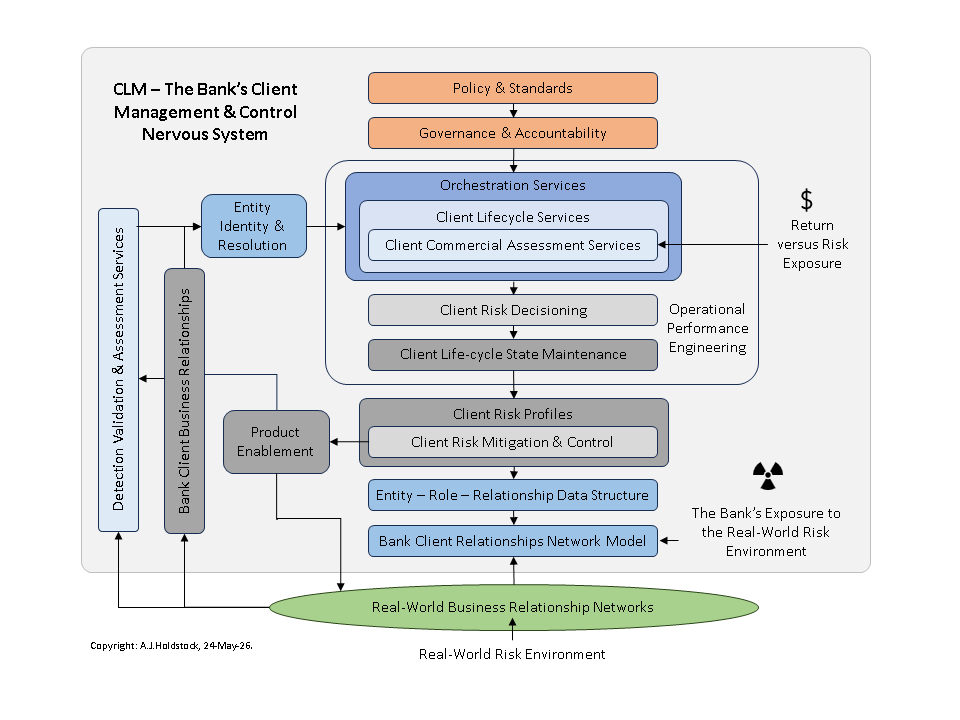
Client Lifecycle Management provides the mechanisms through which institutions maintain the validity, scope and permissions of their client relationships over time.
It enables organisations to:
establish relationships,
maintain lifecycle validity,
respond to change,
coordinate action,
manage permissions,
and support business activity under control.
Without these capabilities, institutions struggle to maintain confidence in the relationships upon which business activity depends.
CLM is therefore not simply an onboarding process, a compliance activity or a technology platform.
It is a core institutional capability.
Investment and Capability
Strong institutions recognise that relationship management, lifecycle management, risk management and operational control are interconnected.
They invest in:
governance,
operating models,
data structures,
lifecycle capabilities,
orchestration,
risk management,
and enabling technology
as components of a broader institutional capability.
Their objective is not process completion.
Their objective is maintaining effective participation in business activity under changing conditions.
Business Under Control
The ability to understand, manage and control client relationships has become fundamental to institutional effectiveness.
When this capability is strong:
business activity can be enabled with confidence,
risk becomes more visible,
operations become more effective,
decisions become more consistent,
and change becomes easier to manage.
When it is weak, fragmentation emerges across the institution.
This is why CLM has become essential banking infrastructure.
It is one of the capabilities through which institutions maintain business under control.
Explore Further
The Relationship System
How banks understand, manage and control their external relationships.
What CLM Must Do
The capabilities required to maintain effective client lifecycle management.
How CLM Works
How information, decisions and activity move through the lifecycle.
Frameworks
Detailed models, structures and design approaches.