The System
CLM sits at the heart of the bank's relationship system, enabling the institution to understand, manage and control its external relationships.
Overview | Reality | The System | Relationships | Events | Risk | Publishing | CLM Role | Institutional Capability
Overview
Banks operate within a complex world of organisations, individuals, ownership structures, legal relationships, commercial arrangements and economic activity.
To serve clients, manage risk and maintain control, institutions need more than processes and technology. They need a coherent understanding of the relationships that connect them to the outside world.
This understanding does not emerge naturally. It must be created, maintained and governed.
That is the role of the bank's relationship system.
Representing Reality
The real world is complex.
Organisations own other organisations. Individuals exercise control through legal structures. Economic activity creates dependencies, exposures and obligations. Relationships evolve over time.
Banks cannot manage this complexity directly.
Instead, they create a relationship model that represents the aspects of reality relevant to the institution.
This model includes:
Entities
Roles
Relationships
Business arrangements
Client groups and networks
Identifiers
Coverage and ownership structures
Together, these provide a structured representation of the bank's external relationships.
The Relationship System
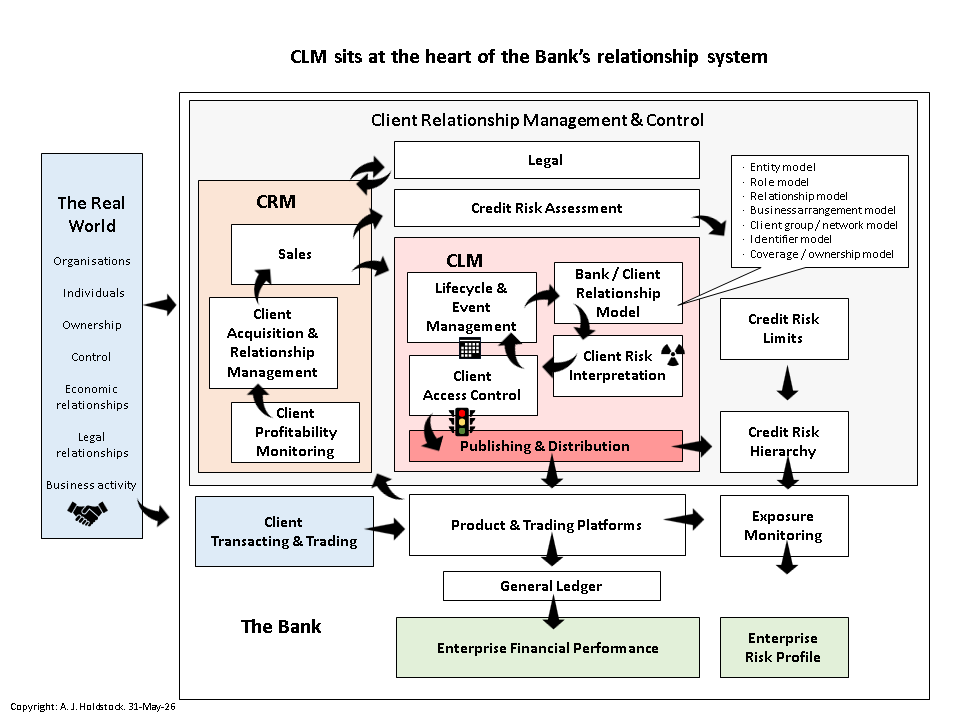
The relationship system connects the real world to the Banking institution.
It enables the bank to create and maintain a structured representation of the clients, counterparties, relationships, arrangements and activities that matter to the business.
This representation becomes the foundation upon which relationship management, lifecycle management, risk management and operational control depend.
Managing Relationships
Relationships must be established, maintained and, where necessary, exited.
This responsibility spans both commercial and control activities.
Customer Relationship Management (CRM) focuses on acquisition, service and commercial value.
Client Lifecycle Management (CLM) focuses on validity, permissions, risk and control.
Although often treated as separate disciplines, both manage different aspects of the same relationship.
Together, they enable the institution to manage relationships throughout their lifecycle.
Responding to Change
Relationships are not static.
Ownership structures change. Directors change. Products change. Risk profiles change. Regulatory requirements evolve.
The institution must continuously identify, assess and respond to these events.
Lifecycle and event management provide the mechanisms through which the relationship system remains accurate, relevant and current.
Interpreting Risk
Risk does not exist independently of relationships.
Client risk, financial crime risk, credit risk, network risk and concentration risk all emerge from the structure and characteristics of the relationship itself.
The relationship model therefore provides a common foundation for multiple risk disciplines.
Each interprets the relationship through its own lens, but all depend upon a consistent understanding of the underlying relationship.
Publishing Trusted Information
The outputs of the relationship system extend far beyond CLM.
Product platforms, trading systems, finance, legal, operations, risk functions and regulatory reporting all depend upon trusted relationship information.
The relationship system therefore acts as a source of governed information that can be distributed across the institution with confidence.
As complexity grows, the ability to publish consistent and trusted information becomes increasingly important.
The Role of CLM
CLM is often viewed as an onboarding process, a compliance activity or a technology platform.
These perspectives are incomplete.
CLM sits at the centre of the relationship system because it maintains the validity, scope and permissions of the bank's relationships over time.
Without this capability, the institution cannot reliably determine:
Who it is dealing with
How those parties are connected
What products and services are permitted
What risks are present
What actions are required
CLM is therefore more than an operational process. It is a core component of the bank's relationship system.
An Institutional Capability
Institutions succeed when they can understand and manage their relationships effectively.
When the relationship system works well, information becomes more reliable, decisions become more consistent, risks become more visible and operations become more efficient.
When the relationship system is fragmented, every part of the institution is affected.
The challenge is not improving onboarding, KYC or risk management in isolation.
The challenge is building and maintaining a relationship system capable of supporting the institution as a whole.