CLM Performance


Is CLM Delivering What The Organisation Needs?
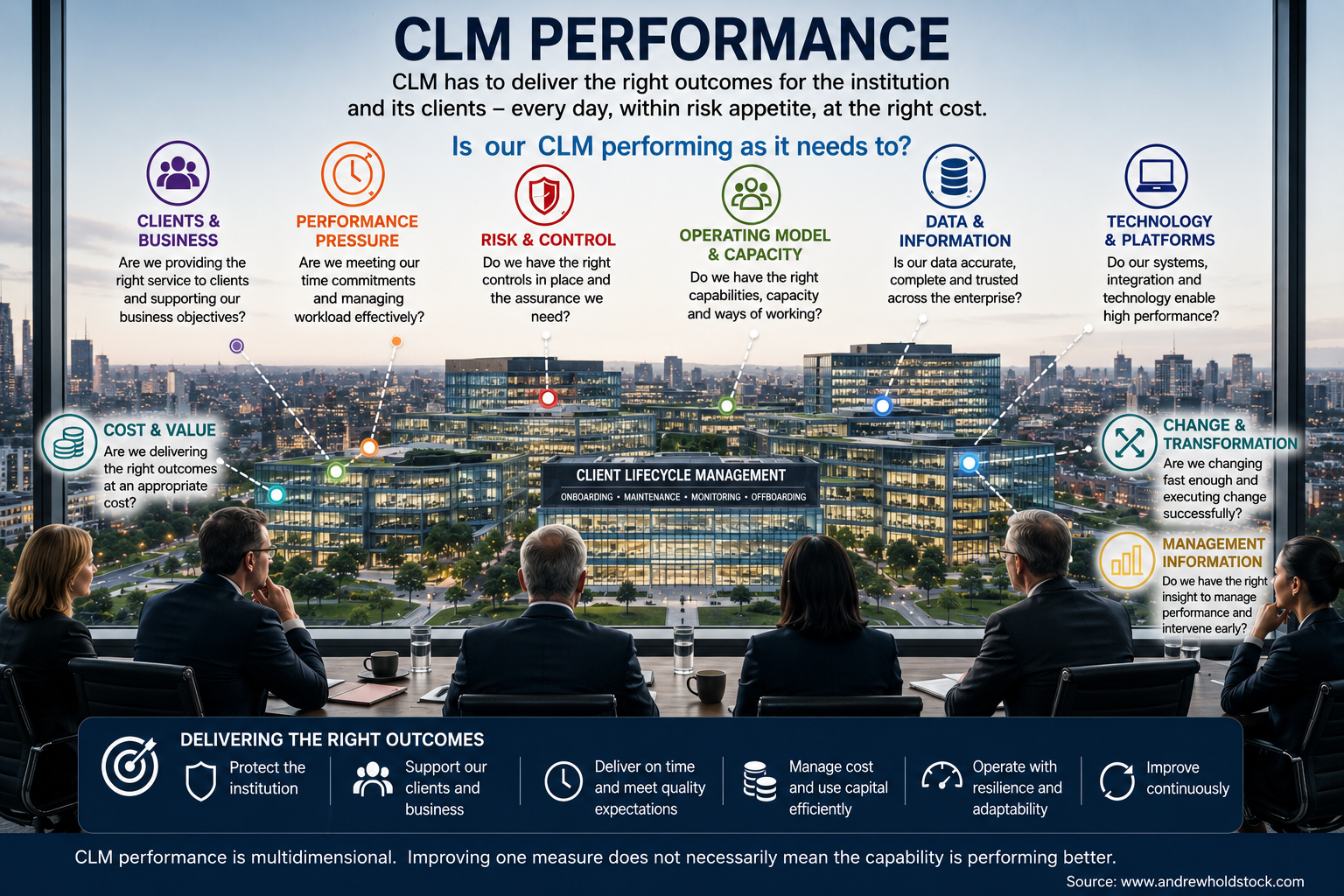
CLM performance is often judged through individual measures such as onboarding time, review completion, quality or cost. Each matters, but none on its own tells us whether the capability as a whole is performing well.
A high-performing CLM capability must protect the institution, support clients and the business, meet its control and service commitments, use resources effectively, and continue to perform as demand and circumstances change.
The question for senior management is broader: Is CLM delivering the outcomes the institution needs, reliably, within risk appetite and at an appropriate cost?
Improving one measure does not necessarily mean CLM is performing better. Faster processing may increase risk or rework. Additional control may increase cost or damage service. Higher utilisation may leave too little capacity to respond when demand changes.
CLM performance is multidimensional. It has to be understood and managed as a whole, but different stakeholders see CLM performance from different perspectives.
Different Perspectives
Performance looks different depending on where you sit.
Front Office, Operations, Compliance, Risk, Technology and Finance all depend on CLM, but they do not judge its performance in the same way.
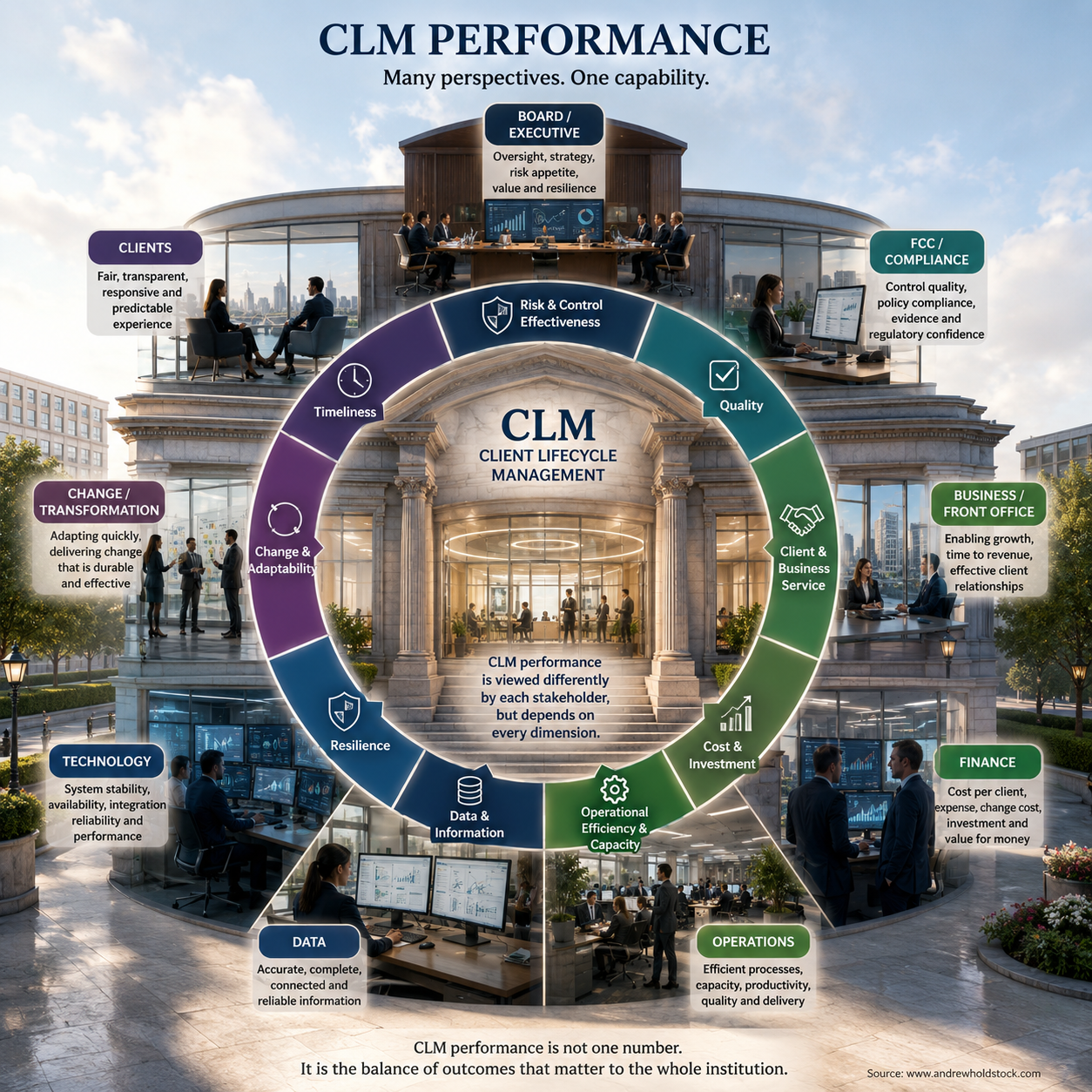
Front Office may focus on responsiveness and client experience. Operations may focus on capacity, throughput and consistency. Compliance and Risk will be concerned with whether risks are identified, assessed and controlled to the required standard and within the required time. Technology will look for stability, scalability and sustainable change. Finance will consider operating cost, change cost and the use of investment.
Each perspective is legitimate, but none is sufficient on its own.
A high-performing CLM capability has to work for the institution as a whole, not optimise one stakeholder’s measure at the expense of the others. Those different expectations inevitably create tension.

Competing Demands
CLM Performance is always in tension.
Improving one aspect of CLM can put pressure on another. Faster execution can increase capacity or control pressure. Greater flexibility can make standardisation harder. Additional controls can increase effort, cost and client friction. Investment in technology may improve future performance but consume scarce funding today.
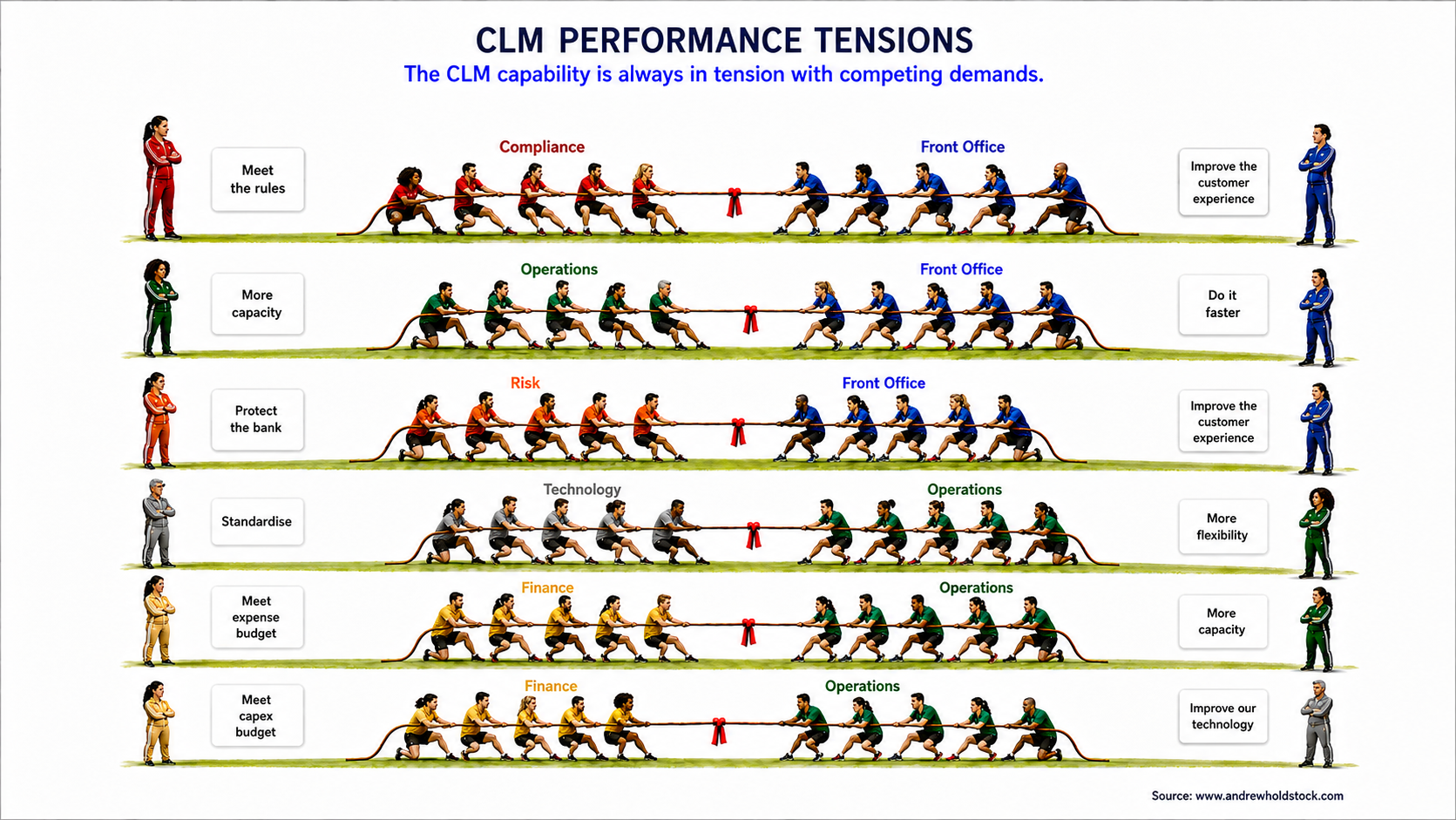
These tensions are not necessarily evidence that CLM is badly designed. They arise because different parts of the institution are asking the same capability to deliver different outcomes at the same time.
The objective is therefore not to maximise every measure independently. It is to understand the trade-offs, decide which outcomes must be protected, and manage the capability so that competing demands remain within acceptable boundaries.
High-performing CLM manages these tensions deliberately rather than allowing one objective to improve at the expense of another.
Not every demand has equal weight, and some requirements establish boundaries that cannot simply be traded away.
Different environments need different guardrails
Some requirements cannot simpy be traded away.
CLM does not operate in an environment where every performance objective carries equal weight. Legal and regulatory obligations, risk appetite, control standards and critical deadlines establish boundaries within which service, efficiency, flexibility and cost must be managed.
Those boundaries also differ between jurisdictions. Some regulatory regimes allow firms greater scope to apply risk based judgement. Others deliberately prescribe more detailed rules and controls. That does not necessarily reflect the sophistication of the regulator. It may reflect the degree of discretion the regulator considers appropriate for the financial and business environment it oversees.
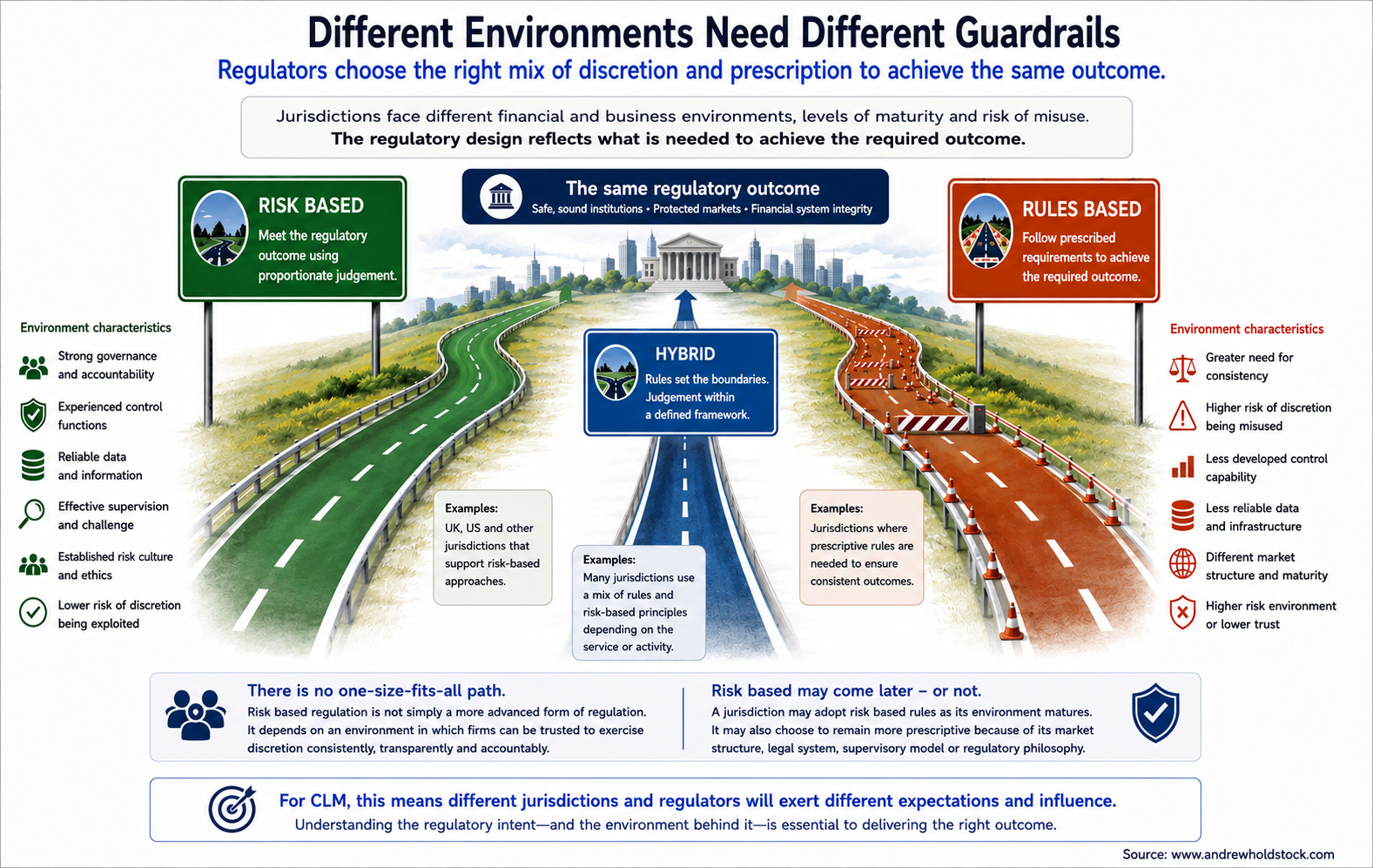
A rules based approach can therefore be a deliberate means of achieving a regulatory outcome where greater discretion could create unacceptable inconsistency or risk.
Good CLM performance starts by understanding which requirements are fixed, where judgement is permitted, and what can genuinely be optimised.
Even where regulation permits judgement, the organisation still has to decide how much discretion its own CLM operating model can safely support.
Earned Discretion
Risk-based execution depends on trust.
Even where regulation allows judgement, the organisation may not be willing to exercise that discretion fully.
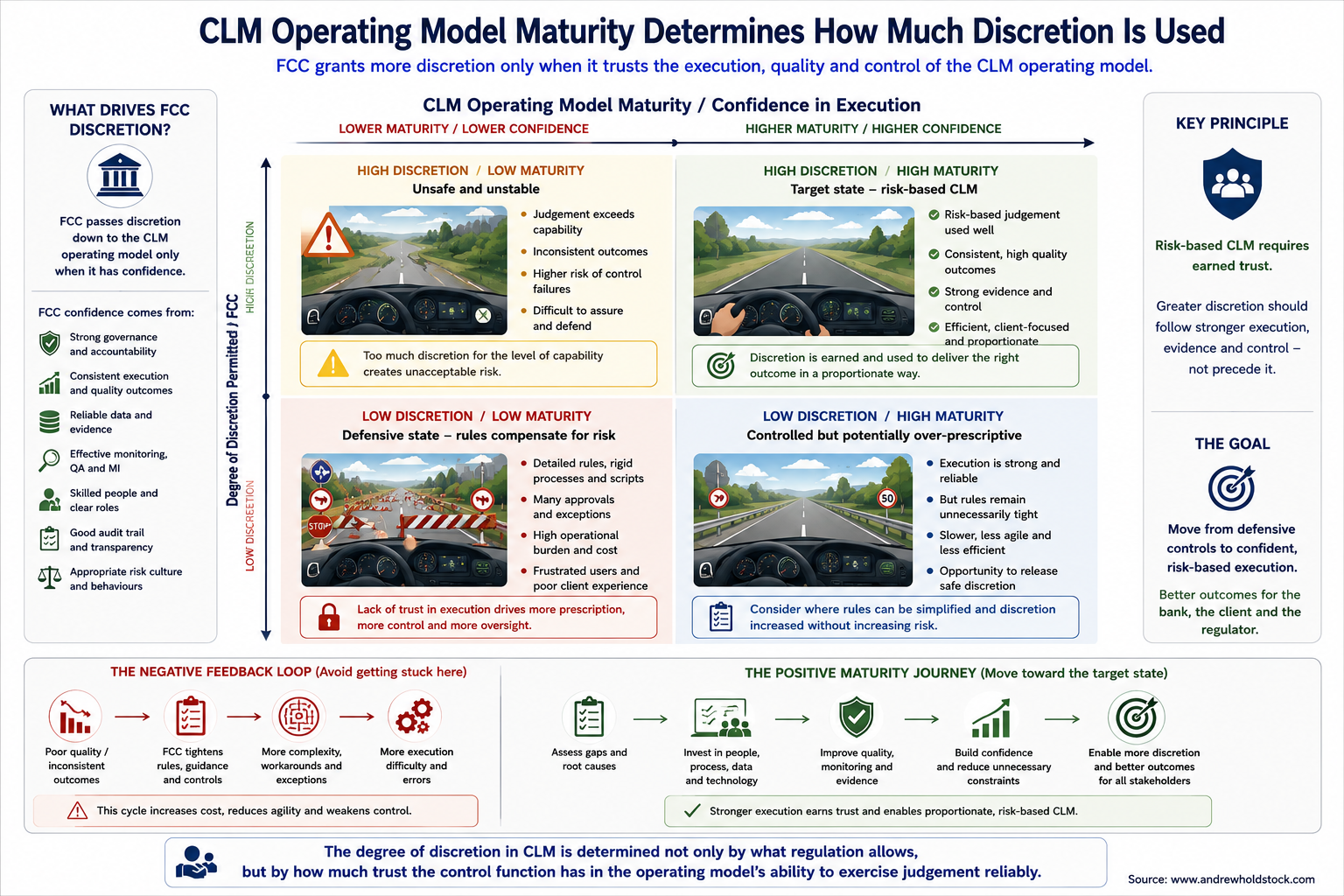
FCC does not have confidence in the quality, consistency or evidence produced by the CLM operating model, it is likely to compensate through tighter policy, more detailed guidance, additional approvals and less room for individual judgement.
That can be entirely rational. Greater discretion only works where the organisation can rely on capable people, good data, clear accountability, effective monitoring and strong control over how decisions are made.
As those capabilities mature, the control model can change. FCC can place greater reliance on judgement because it has evidence that the operating model can apply that judgement consistently and responsibly.
Risk based CLM is therefore not achieved simply by removing rules. Greater discretion has to be earned through reliable execution and demonstrable control.
Once those boundaries and levels of discretion are understood, the next question is how management knows whether CLM is actually performing within them.
Staying Within Control
High performance means knowing when CLM is moving outside acceptable limits.
Strong CLM performance is not about maximising every individual measure. It is about delivering the required outcomes while keeping quality, risk, service, cost and capacity within acceptable operating ranges.
That requires management to know what matters, define the tolerances within which the capability should operate, and recognise when performance begins to move away from them.
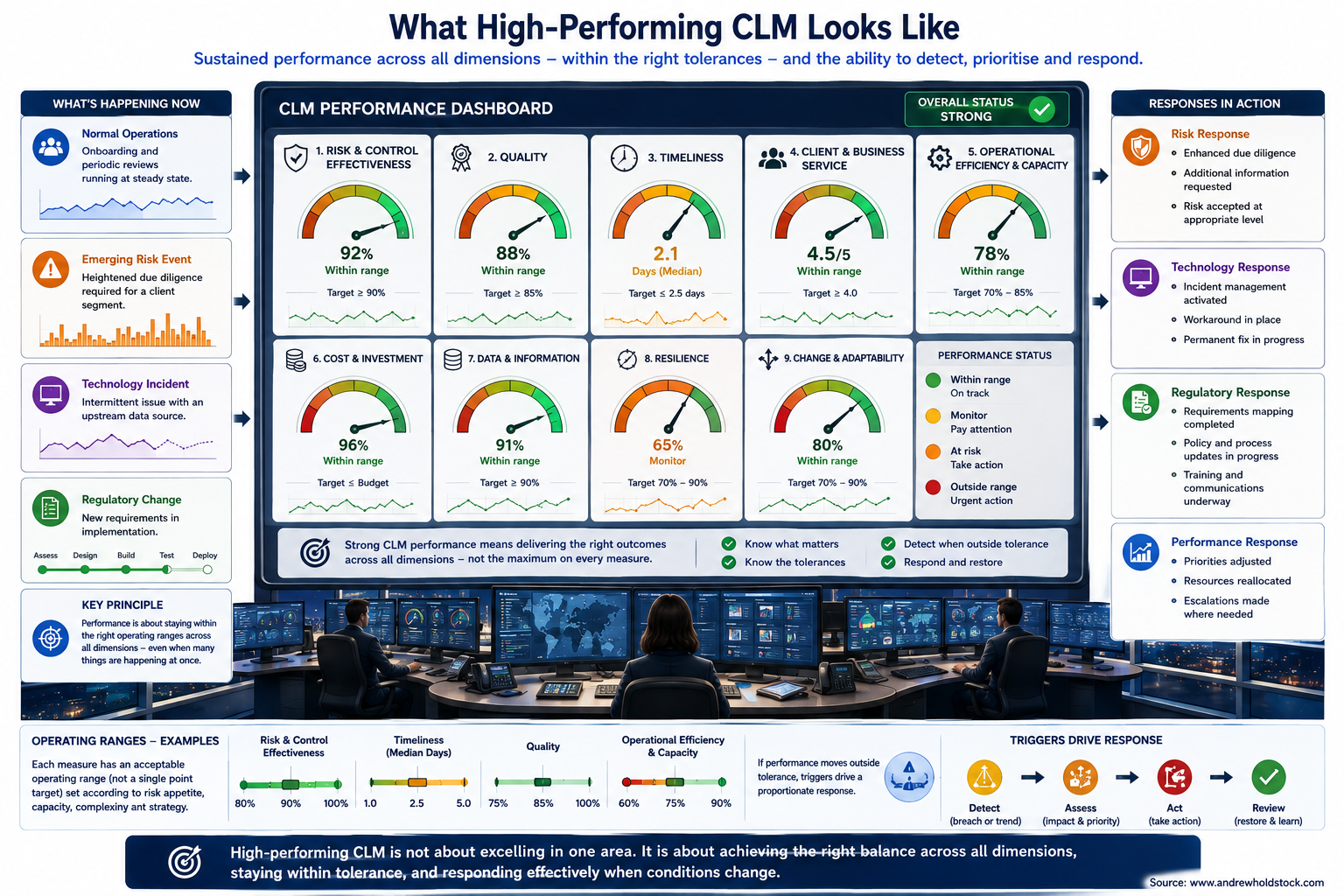
Some movement will be normal. Other changes may signal increasing workload, deteriorating quality, emerging control weakness or insufficient capacity. The important capability is to detect the difference early enough to respond.
This shifts performance management away from retrospective reporting. Measures become part of an active control system: they identify pressure, trigger investigation and support proportionate intervention before required outcomes are lost.
High-performing CLM stays within control by detecting change early and responding before performance failure becomes the outcome. That becomes particularly important when the level, type or urgency of demand changes.
Performance Under Changing Demand
Performance has to hold when conditions change
CLM does not operate under constant demand. Alongside normal onboarding, reviews and maintenance, it must absorb regulatory and policy change, client events, remediation activity, volume peaks, technology failures and unexpected risk events.
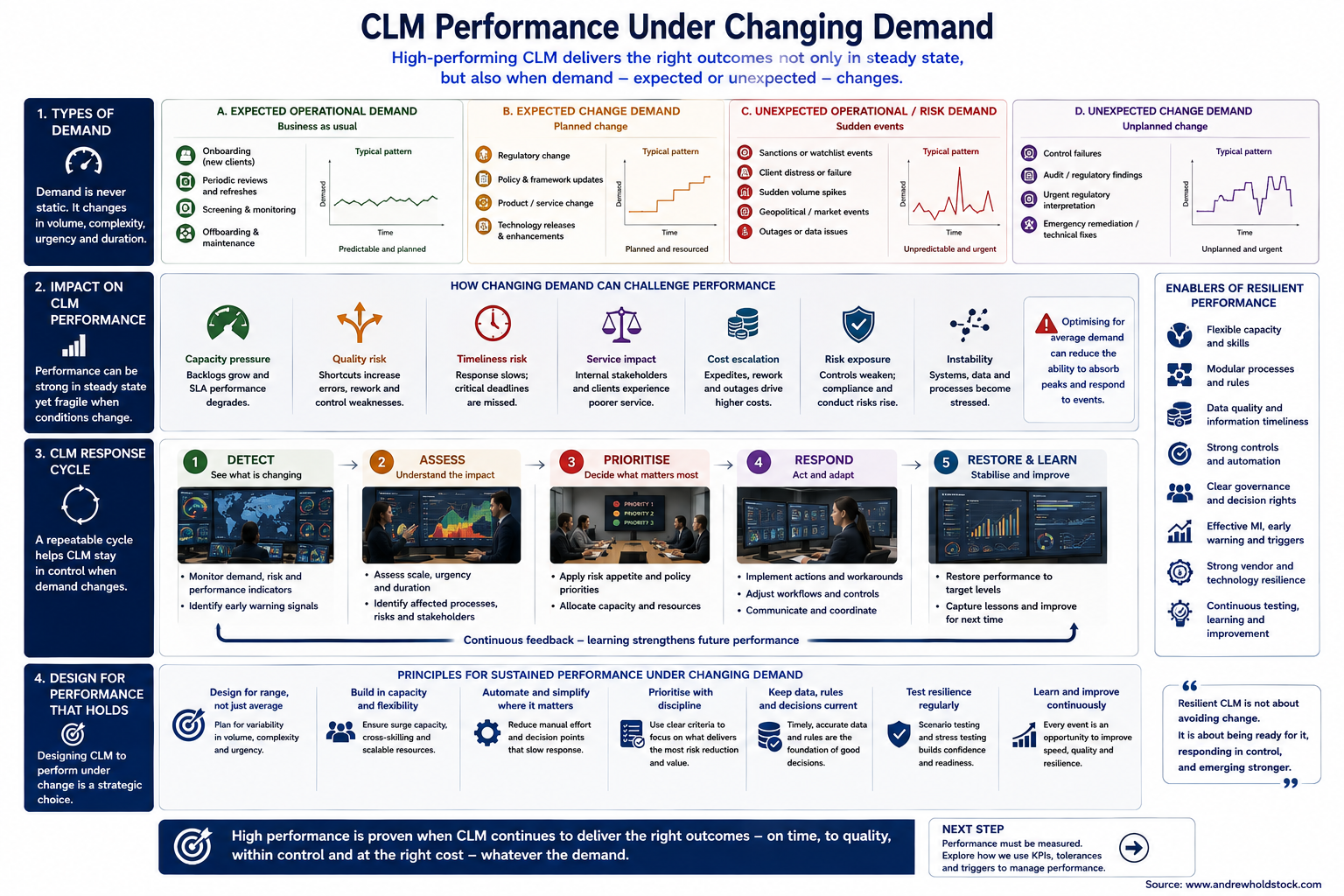
A capability can therefore appear to perform well in steady state and still be fragile. If it has been optimised too tightly around normal demand, there may be insufficient capacity, flexibility or decision-making speed when circumstances change.
High-performing CLM must be able to detect changing conditions, assess their significance, reprioritise work and respond while continuing to protect its critical obligations.
That means resilience is more than keeping the technology running. It includes the ability of the whole operating model to absorb different types and levels of demand without losing control of quality, risk or service.
CLM performance is demonstrated not only in normal conditions, but in how effectively the capability responds when those conditions change.
That response ultimately depends on whether the workload being created can be matched by sufficient capacity or improved productivity.
Demand, Capacity & Productivity
Demand has to be matched by capacity or productivity.
CLM workload does not increase only when client volumes rise. It also grows as cases become more complex, requirements increase, controls expand and demand becomes less predictable.
Yet two important performance dimensions have limited room to move. Quality and control standards cannot simply be relaxed, and many time requirements are fixed by regulation, risk acceptance or business commitments. That puts direct pressure on capacity. More people, technology or external support can increase capacity, but those options are constrained by cost and budget.
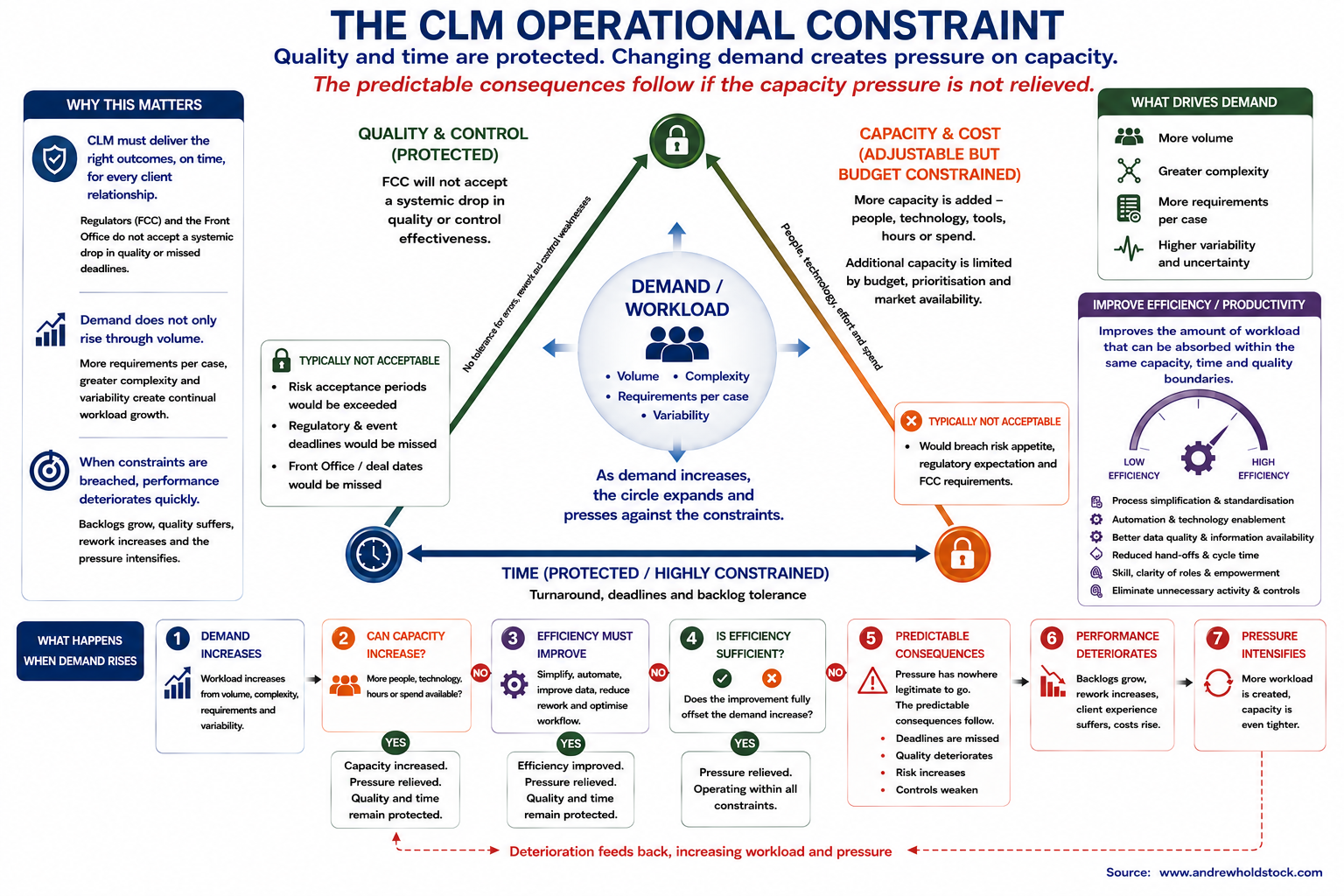
Where capacity cannot increase, productivity has to improve. Better data, simpler processes, reduced rework, clearer responsibilities and appropriate automation allow more work to be absorbed without sacrificing quality or time.
If neither capacity nor productivity keeps pace with demand, the consequences are predictable: queues grow, deadlines are missed, quality deteriorates and additional rework creates still more demand.
When quality and time cannot move, rising demand must be absorbed through capacity or productivity. If it is not, performance will deteriorate somewhere in the system.
Management therefore needs measures that show when this pressure is building and when intervention is required.
Know When to Intervene
KPIs are management instruments, not the definition of performance.
Once the required outcomes, constraints and tolerances are understood, management needs information that shows whether CLM remains within them.
That means looking beyond activity volumes and headline turnaround times. Measures should reveal quality, control effectiveness, service, capacity, cost, resilience and the pressures building across the capability.
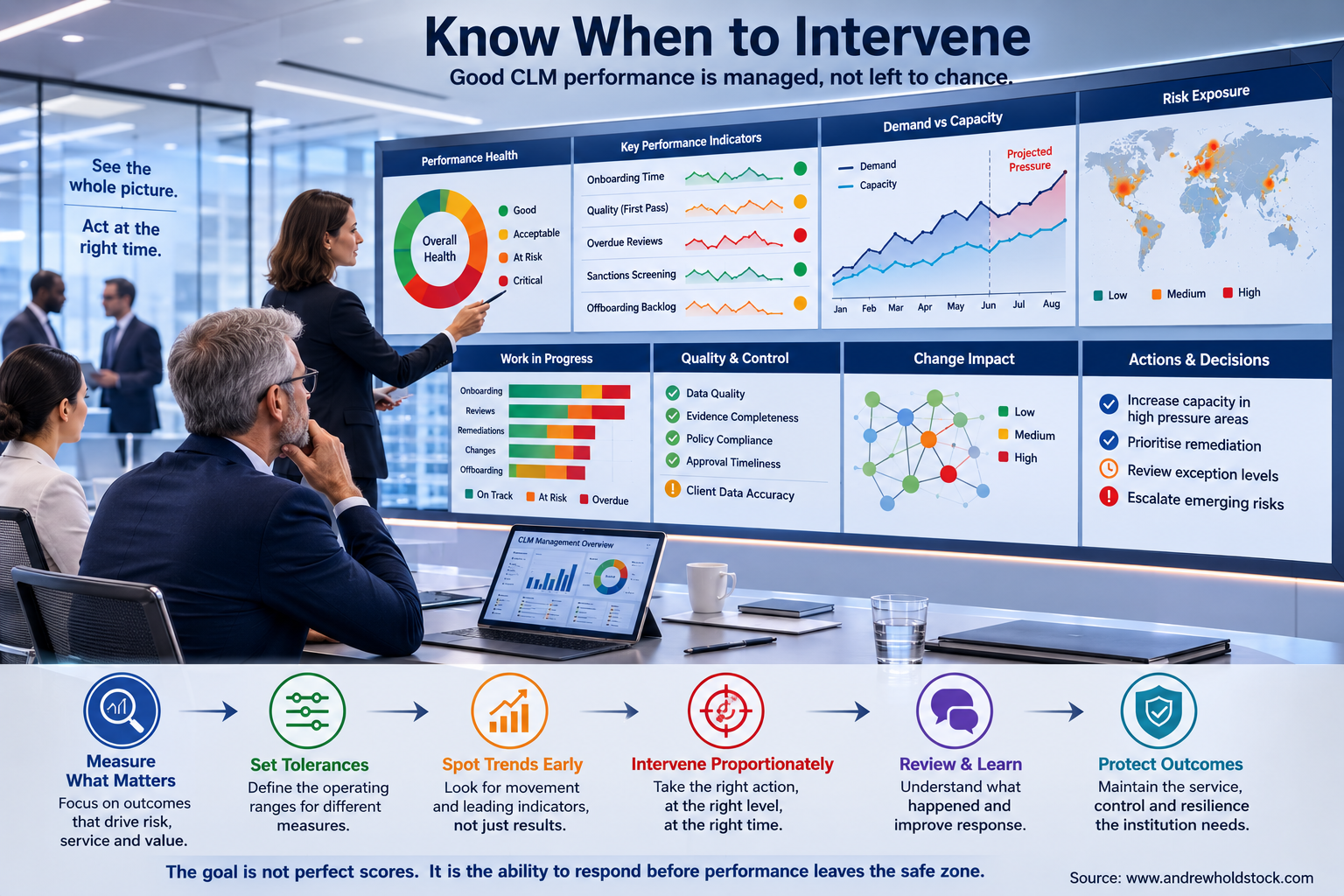
The most useful indicators show not only what has happened, but whether performance is moving towards an unacceptable position. Trends, thresholds and control levels should therefore trigger investigation and action before a breach or failure occurs.
Different measures will require different responses. Some may call for immediate intervention; others for closer monitoring, additional capacity, process change or a review of underlying causes.
Good CLM performance management is about knowing what to watch, where the limits are, and when to act.
The next step is to translate these principles into a practical KPI framework, operating ranges and management triggers.