About


Making Operating Models Work
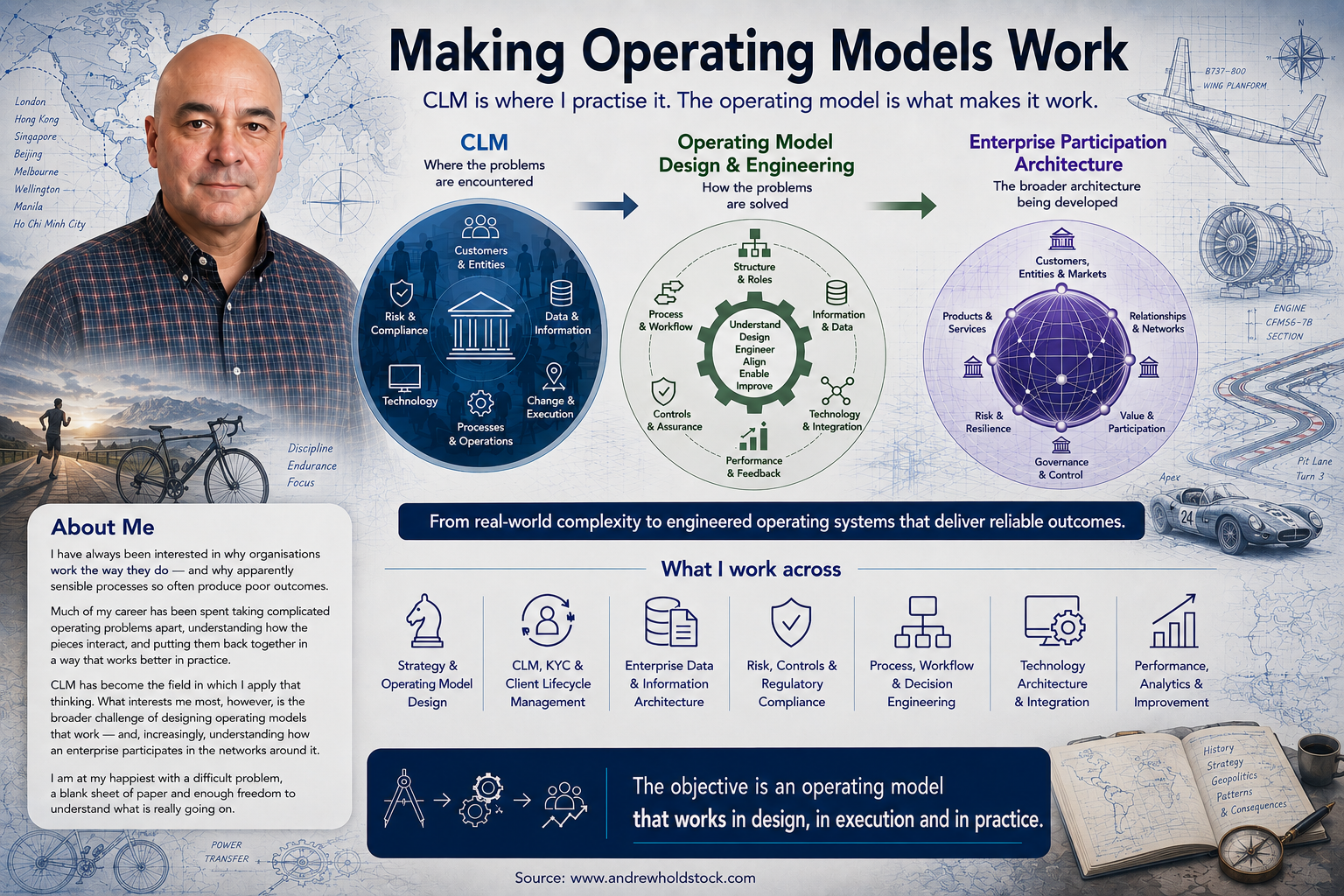
I have spent much of my career working with operating models — running them, changing them, designing them and trying to understand why they behave as they do.
One belief has become increasingly important to me:
If an operating model needs to work, it has to be designed to work.
That sounds obvious. In practice, organisations often design processes, technology, data, controls, organisational structures and individual responsibilities separately, and then expect them to work effectively as a whole.
They do not always do so.
What interests me is what happens between those components: how information flows, how decisions are made, where work accumulates, how people respond to incentives and constraints, how controls affect behaviour, and why apparently sensible designs sometimes produce poor outcomes.
I think of this increasingly as Operating Model Engineering — understanding how an operating model behaves as a system and deliberately designing the conditions that allow it to work in practice.
CLM is where I have increasingly applied that thinking.
Why This Website Exists
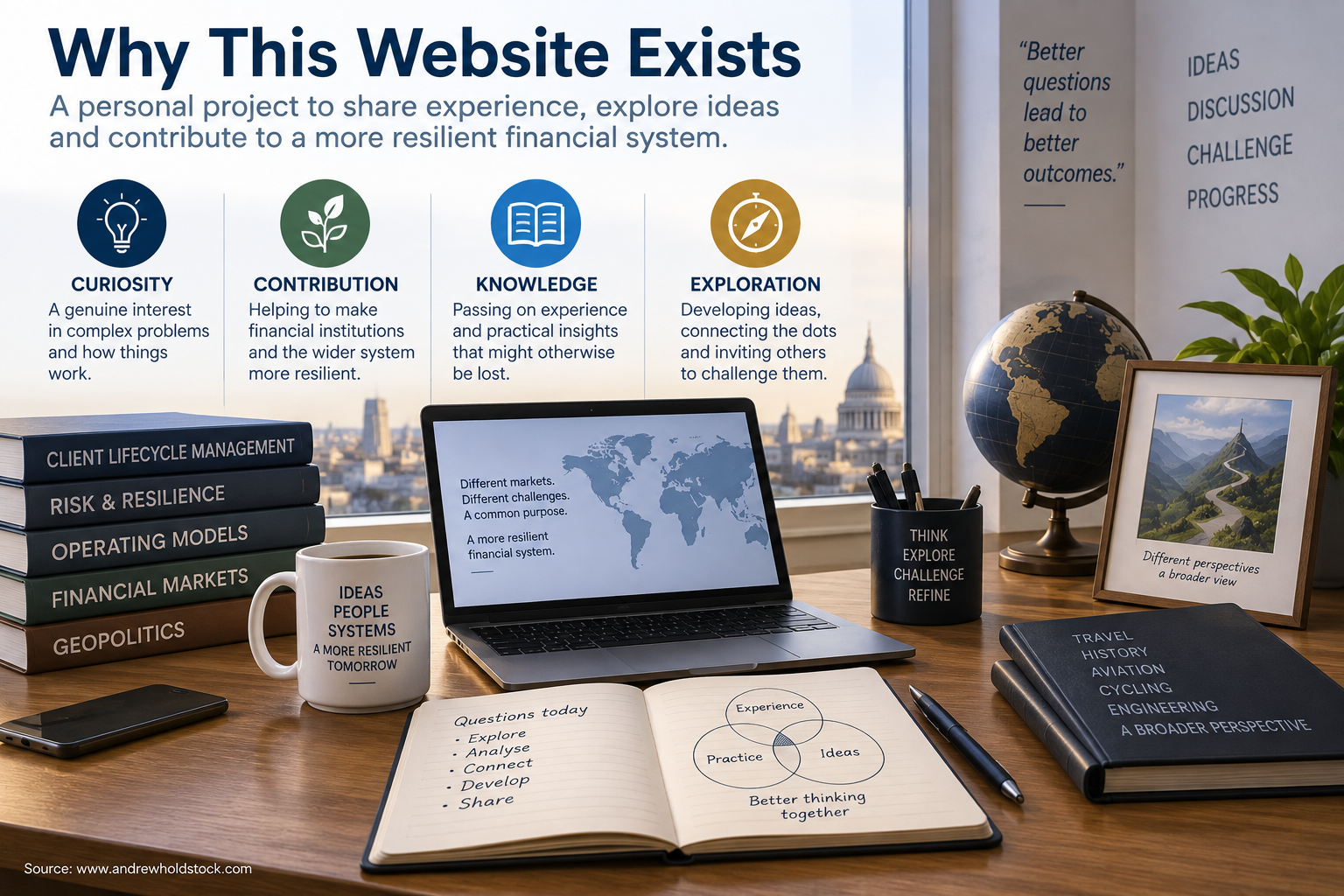
There are several reasons for this website.
Part of it is simply personal interest. I enjoy thinking about CLM, operating models, banking and how complex organisations work. Building a website about those subjects is, in that sense, also a side project and something I enjoy doing.
But there is a more serious purpose.
I believe Client Lifecycle Management is considerably more important to a Financial Institution than its traditional association with onboarding and KYC suggests.
CLM influences how a bank understands who it is doing business with, how those relationships are structured, what business is permitted, how circumstances change and how effectively the institution can respond when they do.
That matters even more in a world that is becoming increasingly interconnected, technologically complex and geopolitically uncertain.
I cannot change that environment. But I can contribute some of what I have learned about how Financial Institutions might understand their relationships, information and operating models better, and perhaps help make the financial system a little more resilient to the consequences when things go wrong.
Even a small contribution seems worthwhile.
Sharing, Challenging & Developing Ideas
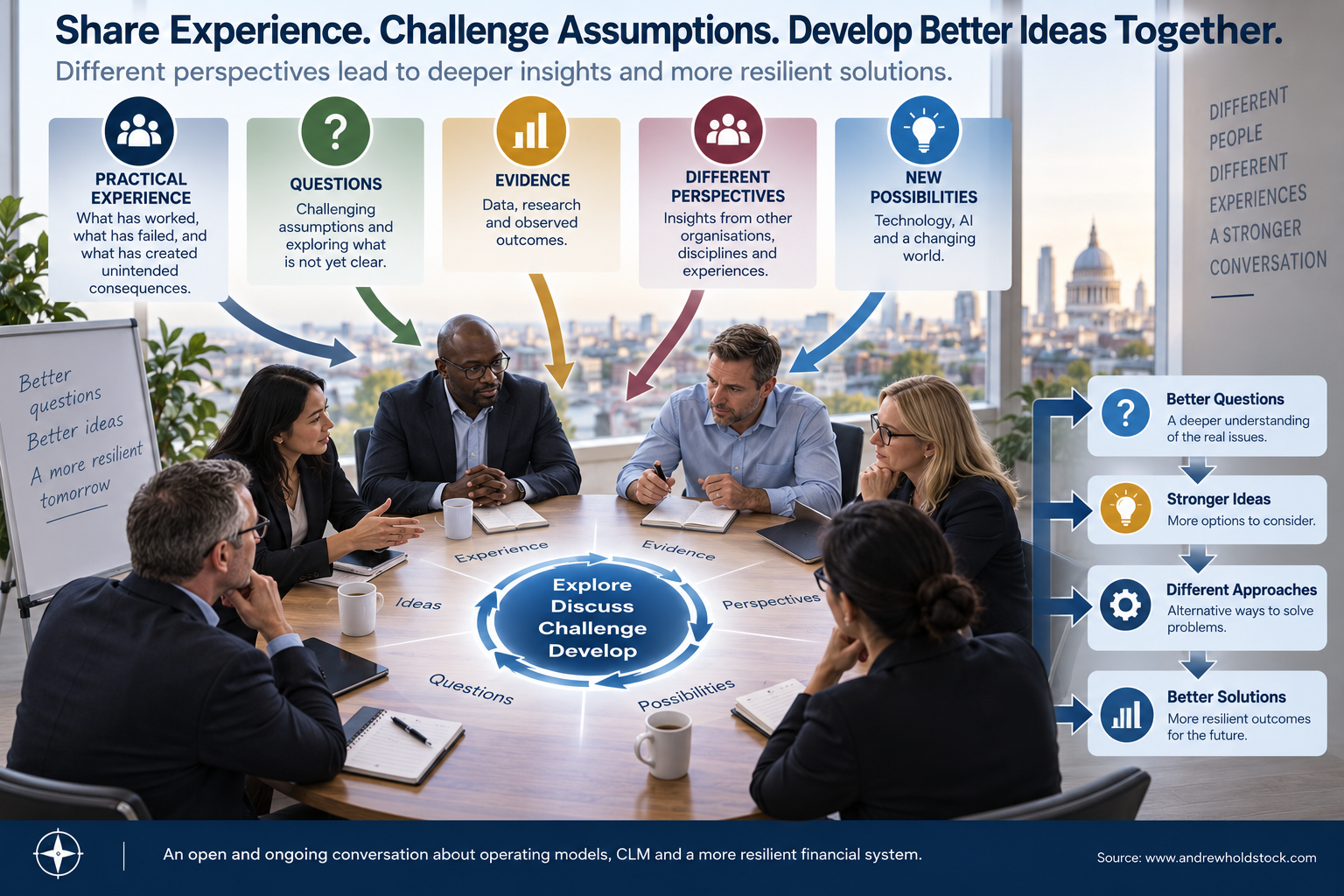
Operating models are often understood through experience: seeing what works, what fails, what creates unintended consequences, and what appears straightforward until it has to operate across businesses, jurisdictions, systems and large volumes of activity.
That experience is valuable, but it is only one perspective.
This website provides a place to put observations, questions and ideas into the open so they can be explored alongside evidence, different experiences and alternative ways of looking at the problem.
The objective is not simply to share conclusions. It is to create a continuing exchange in which assumptions can be challenged, ideas refined and different approaches considered.
Financial Institutions are different, circumstances change and there is rarely only one reasonable answer. New technology — particularly AI — can also make approaches possible that would previously have been impractical.
The aim is therefore to contribute experience and ideas to a wider conversation, while remaining equally open to learning from the experience and perspectives of others.
Better questions, stronger ideas and more resilient solutions often emerge from that exchange.
Developing The Thinking
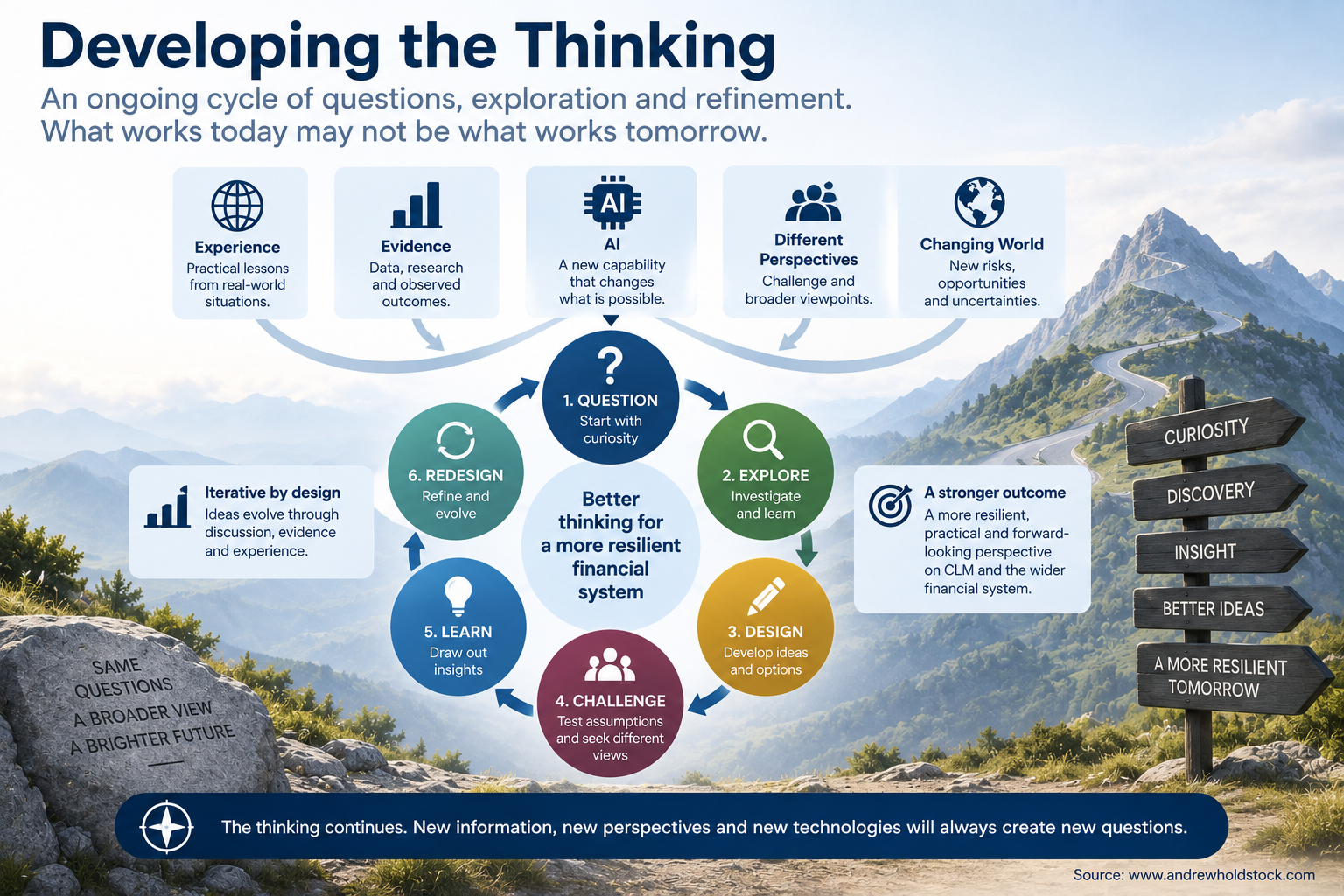
The website is also somewhere to develop ideas.
Some of the material reflects established practice and experience. Other areas are propositions that I expect to continue testing, refining and developing.
Operating Model Engineering is the broader discipline that interests me.
Client Lifecycle Management is an important field in which I apply it.
Enterprise Participation Architecture is one emerging architectural idea: extending the view beyond client relationships to understand the wider ways in which a bank participates in the economic and financial system.
But none of these ideas should be treated as fixed.
Design is iterative. The environment changes, technology changes, organisations change and new possibilities emerge. An approach that works well today may not be the best approach tomorrow.
AI is a good example. It is not simply another technology to add to an existing operating model. It can enable ways of collecting information, interpreting data, supporting decisions and organising work that would previously have been impractical or impossible. That means some assumptions underlying current operating models may need to be reconsidered rather than simply automated.
The ideas on this site should therefore be explored rather than accepted uncritically.
I may not always have the answer right. Readers should challenge the assumptions, test the reasoning against their own experience and consider whether there is a better way.
Different perspectives are particularly valuable for that reason. A useful idea should withstand evidence, challenge and alternative ways of looking at the problem. Where a different perspective improves the thinking, the thinking should change.
The objective is not to defend a particular design. It is to keep looking for the design that works best for the circumstances that exist at the time.
I think that final sentence is particularly important. It makes the website feel like a living body of thinking, rather than a collection of conclusions.
A Personal Project
This website is a personal side project and is not a commercial venture.
The views, ideas and materials presented here are my own. They are not produced for, endorsed by, or representative of any current or former employer or client.
No confidential or proprietary information belonging to any organisation is intentionally included.
About Andrew Holdstock

Away from work experiencing the cold beauty of Svalbard.
My experience spans CLM operations, operating model design, business architecture, process engineering, data, technology, risk and transformation.
I have worked both within operating environments and on programmes intended to change them, as well as holding broader operations and transformation leadership roles across multiple countries and markets.
That combination has shaped the perspective behind this website: strategy and architecture matter, but ultimately an operating model has to work when real people, real clients, real systems and real constraints meet.
The objective is an operating model that works in design, in execution and in practice.
Continue the Conversation
This website is intended to encourage exploration, challenge and different perspectives.
If something here prompts a question, suggests a different approach, or highlights an area that would be useful to explore further, I would be interested to hear it.
I can be contacted on the LinkedIn button above or by email to andrewjholdstock@gmail.com