The client


The World Changes Both Sides of the Client-Bank Relationship
A bank and its clients operate in the same changing world.
Political, economic, financial, technological and societal forces affect both — but not necessarily in the same way or at the same time.
Clients respond by changing strategy, entering or leaving markets, reorganising businesses, acquiring and divesting companies, forming new entities and joint ventures, changing funding, adopting new technologies and adjusting how they operate.
Banks face their own changing environment: new risks, regulatory expectations, market conditions, capital constraints and demands for greater resilience.
Where those two changing organisations meet is the bank-client relationship.
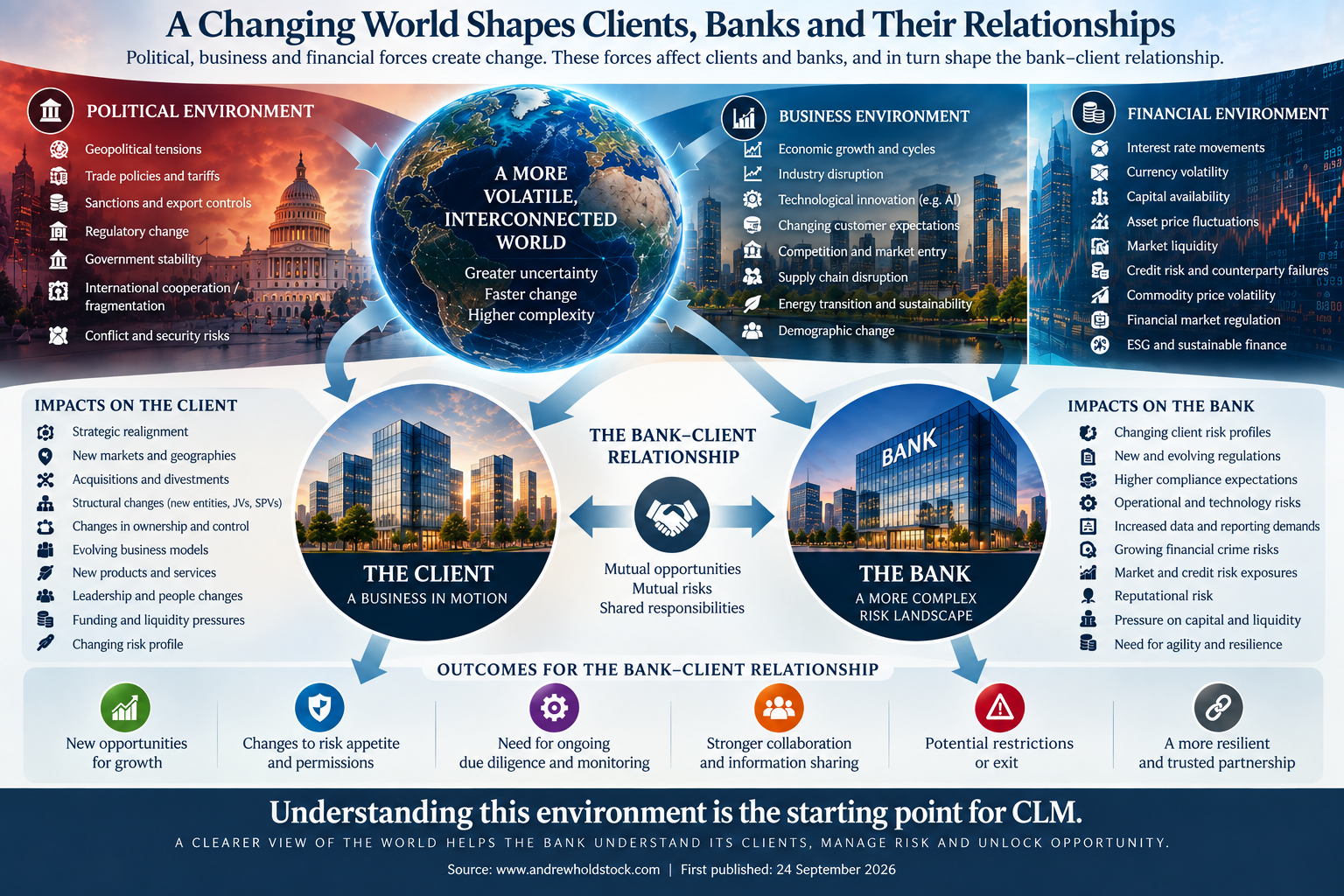
The relationship therefore cannot be understood as something fixed.
Changes on the client side can alter the risk the bank has taken, the products and services required, the entities and people involved and what the bank is prepared to permit.
Changes within the bank can equally alter what it is willing or able to provide.
The relationship continuously has to accommodate both.
The client is changing. The bank is changing. The relationship between them must change too.
What Drives Client Change?
Clients do not all change at the same speed.
Clients do not all change at the same speed.
The pace of change depends on three interacting factors:
External change: what is happening in the world around the client.
Client exposure: how directly the client is affected by those forces.
Client response : how quickly and extensively the client chooses, or is forced, to adapt.
The result can be change in structure, activity, geography, people, ownership, funding and risk.
A global trading business, a domestic utility, an asset manager and an acquisition-led private company may therefore experience very different rates and types of change even when they operate in the same wider environment.
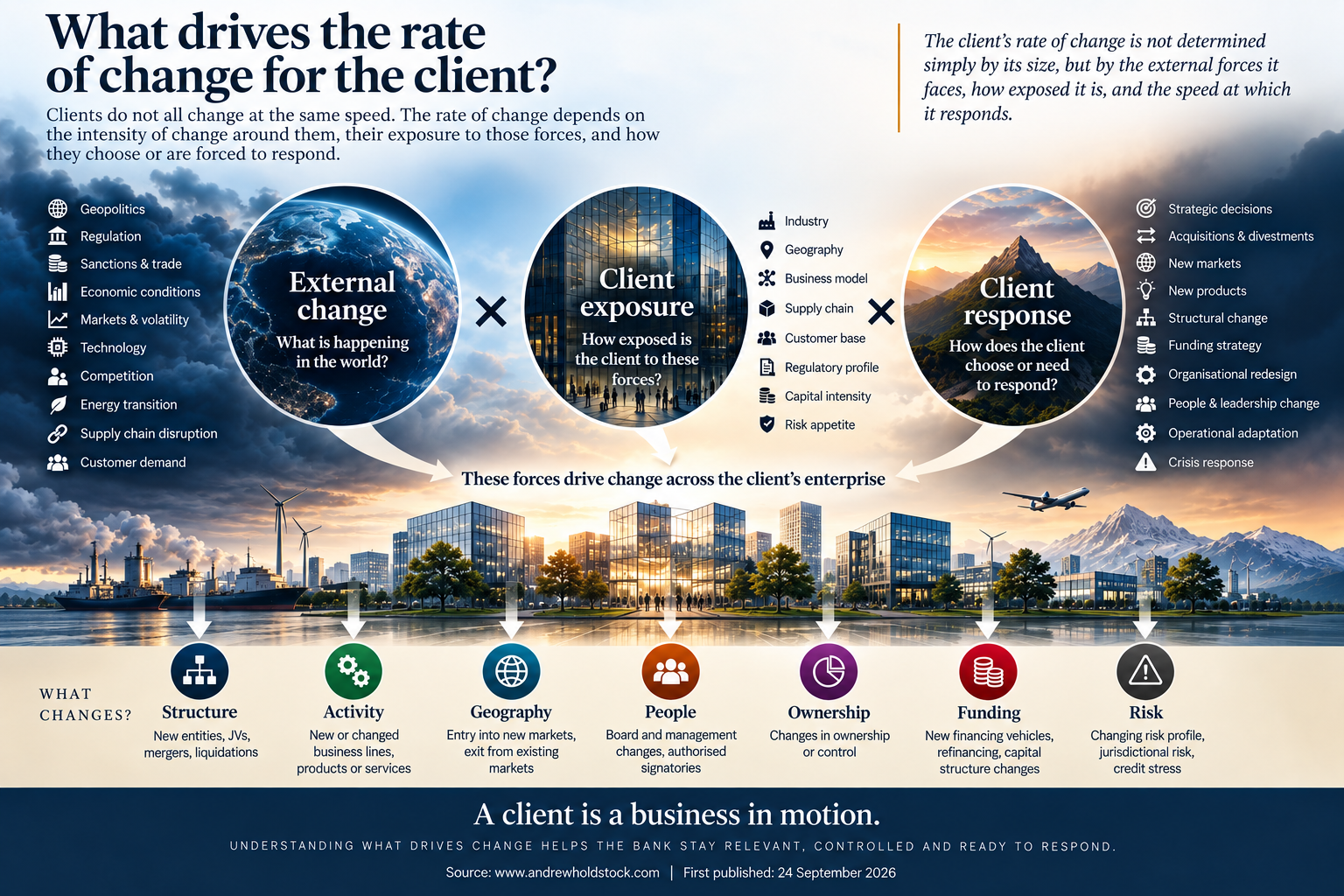
The client is a business in motion.
The Client is a Business in Motion
Change does not remain outside the client.
It becomes visible in the way the client is structured, financed, governed and operated.
New entities are created. Businesses are sold. Joint ventures are formed. Treasury activity moves. Leadership changes. New jurisdictions are entered and old ones exited. Funding structures evolve.
For the bank, these are not simply changes in a corporate organisation chart.
They can alter who the bank is dealing with, who controls the relationship, which activities are permitted, what risks the bank faces and what support the client needs.
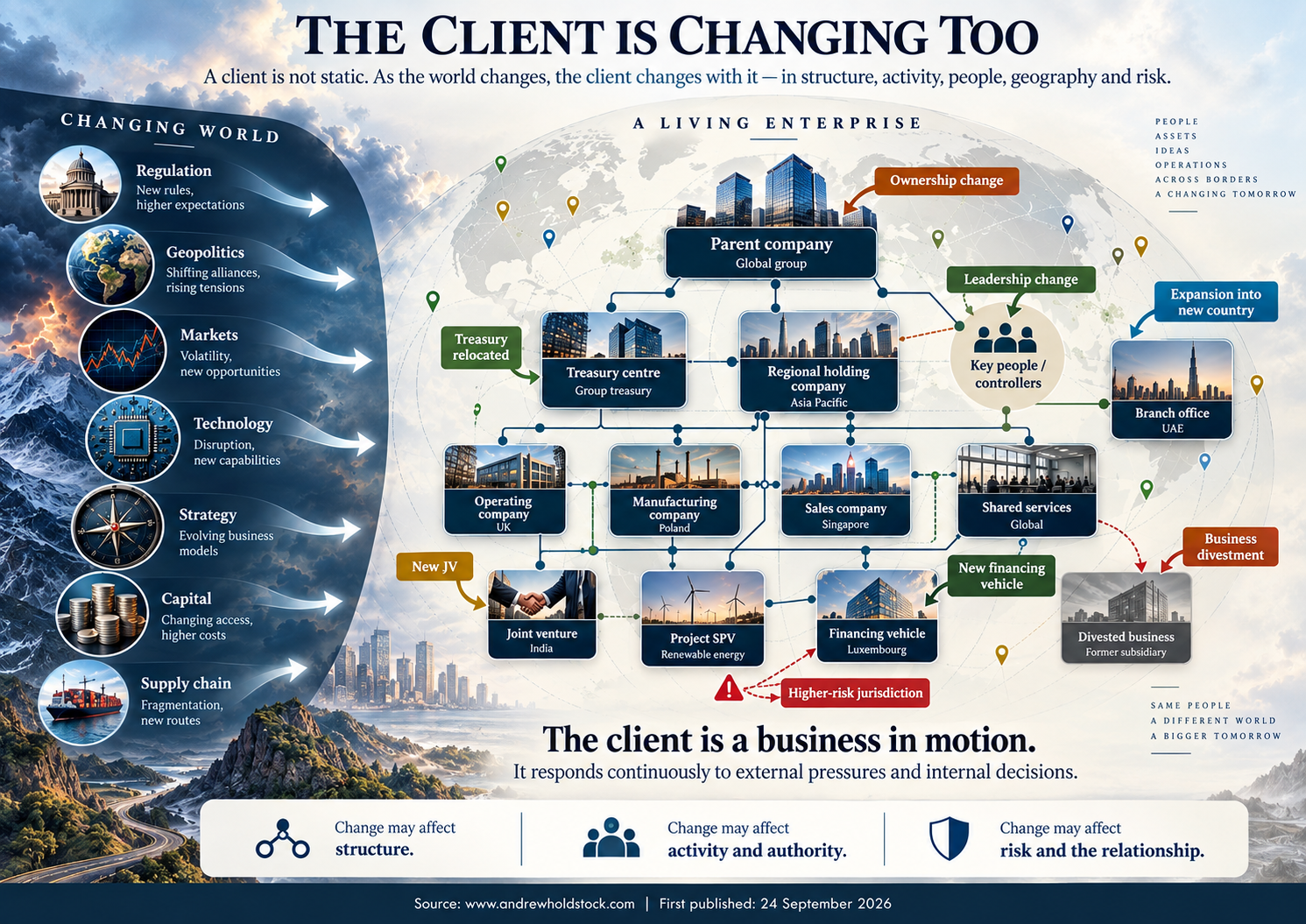
The client is not a static object to be onboarded and periodically reviewed. It is a living enterprise that changes continuously over time.
What is a Client
The client is more than a legal entity
In simple cases, the client may be a single legal entity.
In corporate and institutional banking, the client is often a wider commercial relationship spanning multiple entities, people, roles and arrangements.
The bank therefore needs to distinguish between the client it is trying to understand and serve and the components through which that relationship operates.
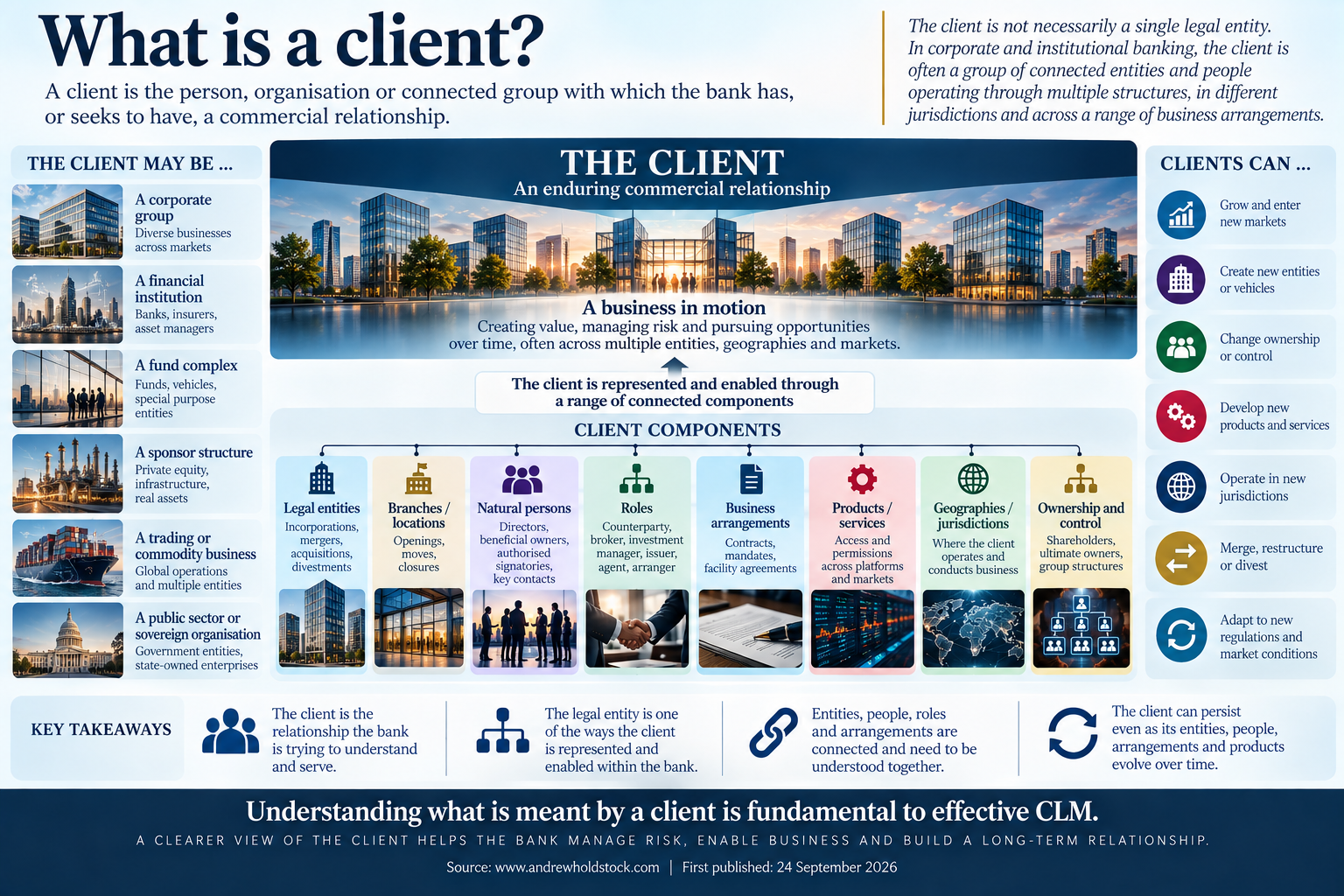
The client is the enduring commercial relationship. The entities, people, roles and arrangements are how that relationship is expressed.
The Client Relationship Endures
The relationship can continue even as its entities, people, products and arrangements change.
A client relationship may continue for many years even as the entities, people, products, arrangements and jurisdictions within it change.
Those constituent parts have their own lifecycles. They can begin, change and end at different times while the wider relationship continues.
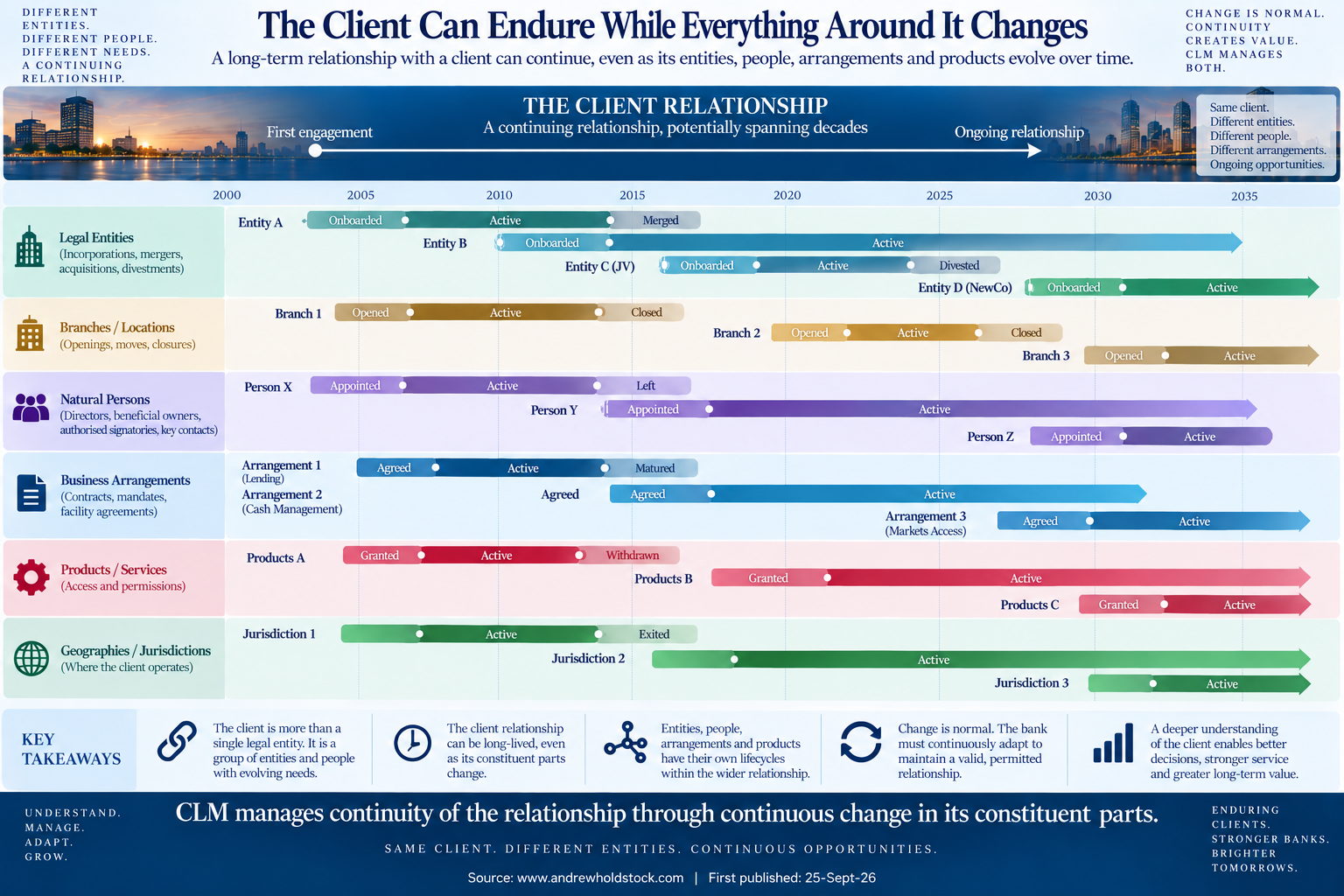
CLM therefore has to maintain continuity of the bank-client relationship as the constituent parts of the client evolve.
What Clients Need from Their Banks
As clients change, they need banks that can understand, respond and stay with them.
Clients do not experience the bank through its internal processes. They experience whether the bank can keep pace with what they are trying to do.
That means understanding the client, responding quickly, reusing information already held, being clear about what is possible, and supporting the relationship as circumstances change.
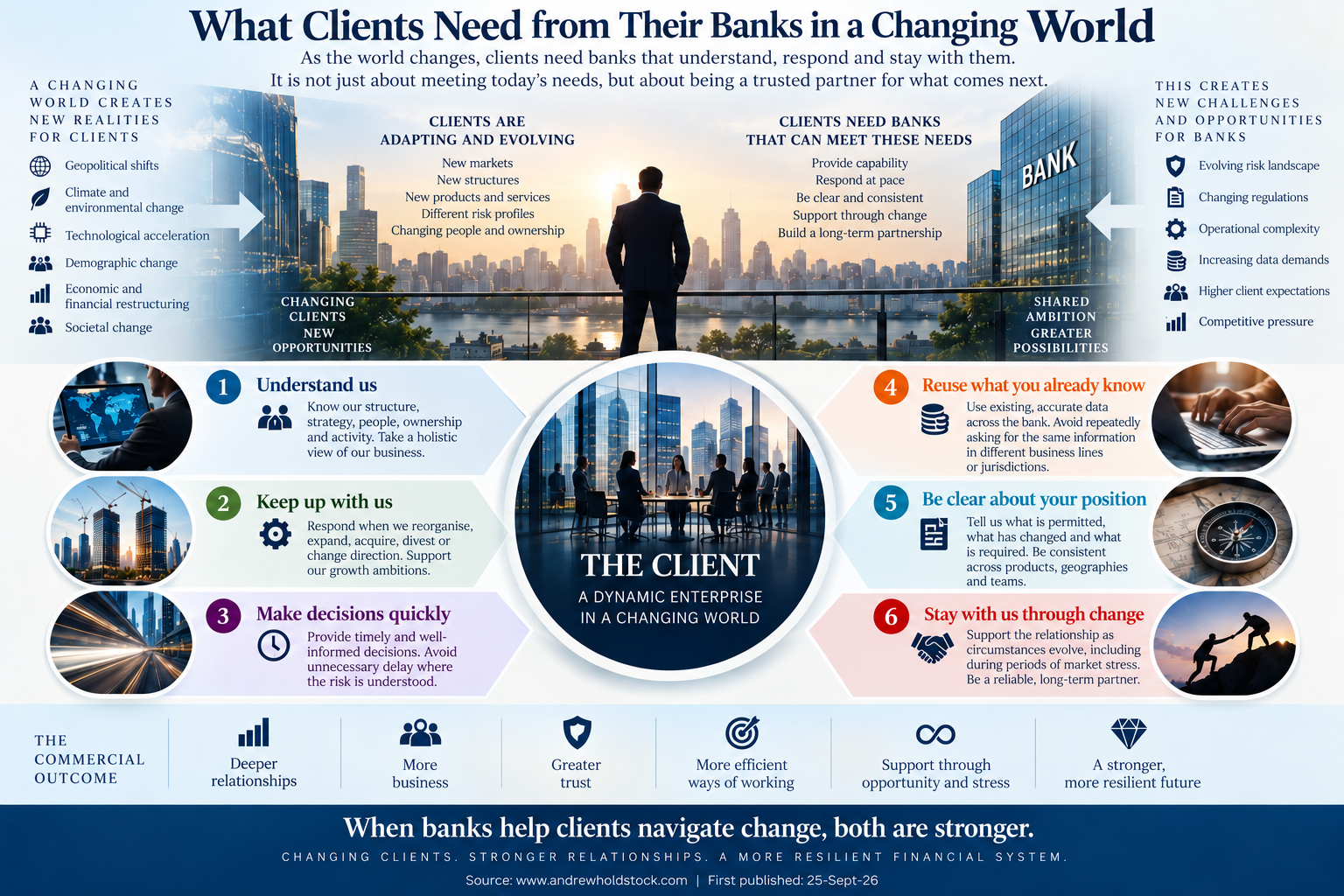
The bank that responds well to a changing client becomes easier to work with, more trusted and more relevant over time to the client.
How Clients Choose Their Banks
Different clients value different things, but some qualities consistently shape who earns the relationship.
Clients do not choose banks on a single criterion.
Financial strength, credit capacity, geographic reach, product capability and price may determine which banks are considered. But the factors that win and deepen the relationship are often different.
Clients also value whether a bank understands their business, executes reliably, responds quickly, is easy to deal with and can be trusted through periods of change.
The capabilities that get a bank onto the shortlist are not always the capabilities that make it the client’s go-to bank.
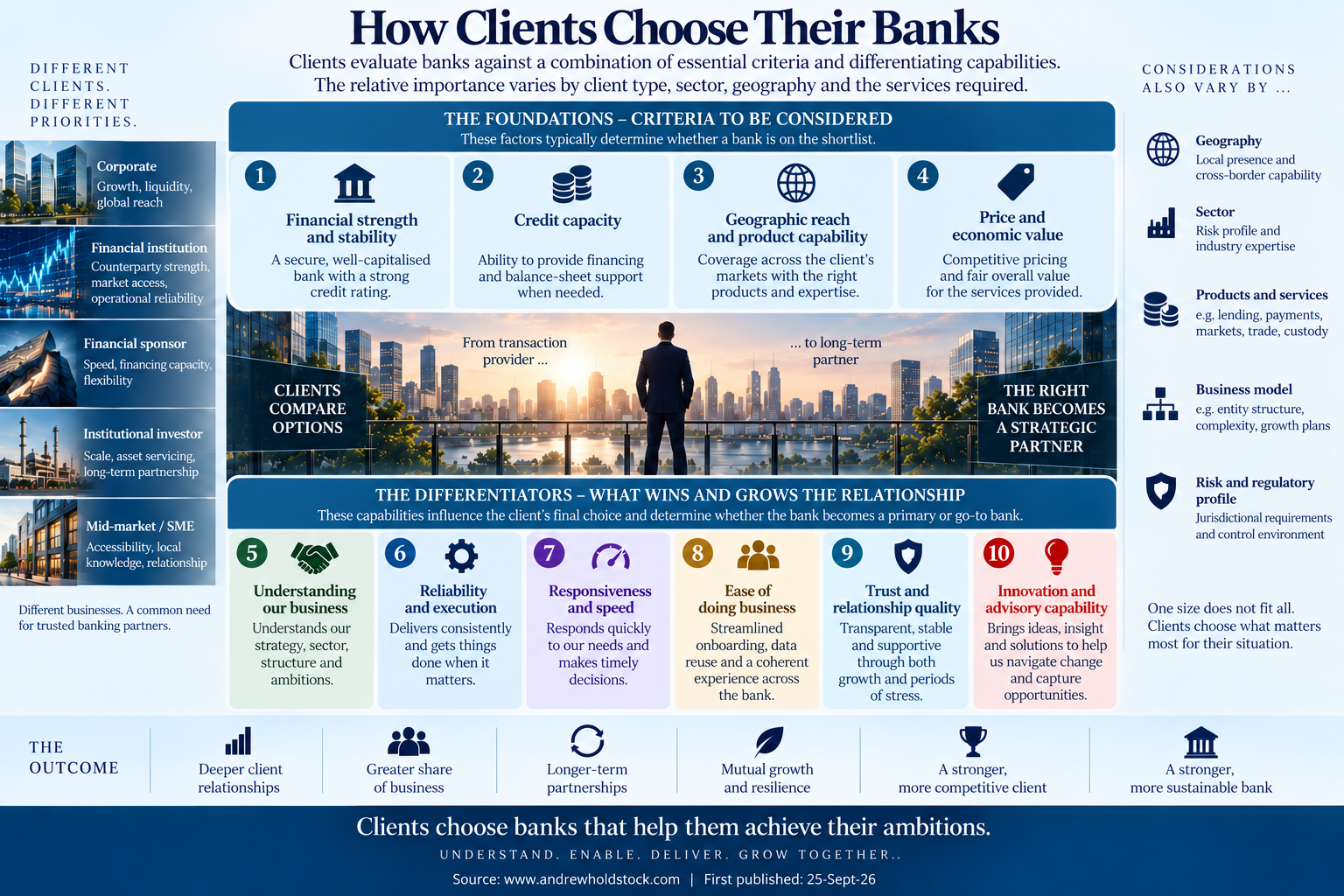
What matters most will vary by client type, sector, geography, business model and the services required.
For the bank, the opportunity is to combine financial capability with a relationship model that makes the client want to do more business over time.
How Banks Choose Where and How to Compete
Banks make deliberate choices about which clients, markets and capabilities they want to serve.
Just as clients choose their banks, banks choose the clients and opportunities they want to pursue.
Different strategies lead to very different models: global, universal, specialist, regional, country-focused or network-based.
Those choices shape which clients the bank targets, where it operates, what products it provides, how much capital it deploys, what risks it accepts and how deep a relationship it seeks to build.
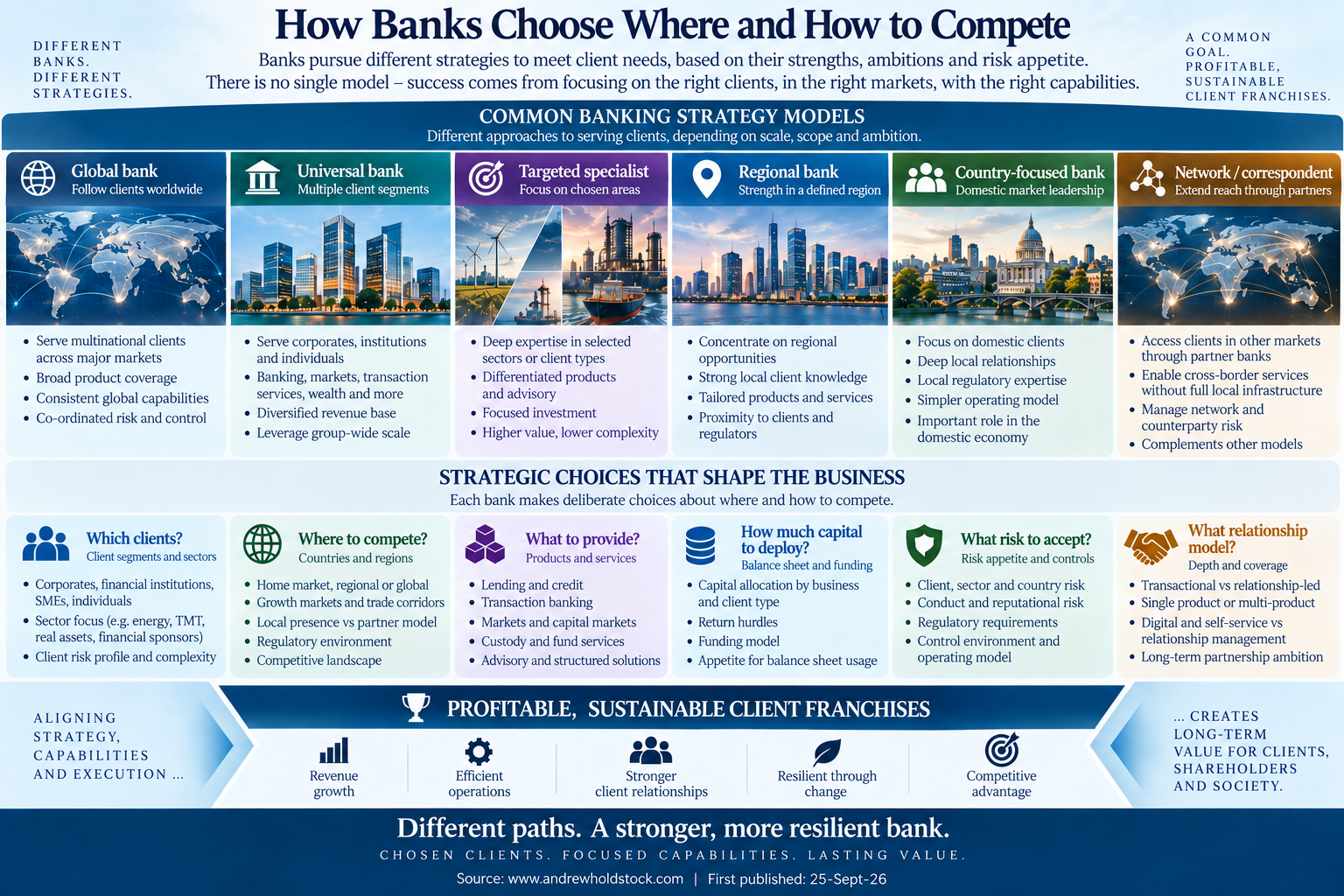
There is no single model for a successful bank. The challenge is to align strategy, capabilities and execution around the clients and markets the bank has chosen to serve.
That alignment is what turns client demand into a profitable and sustainable franchise.
How the Client and the Bank Engage
Engagement turns client need into a relationship that can create value for both sides.
The client brings needs, ambitions and opportunities. The bank brings capital, products, expertise, infrastructure and risk appetite.
Engagement is where those two sides meet.
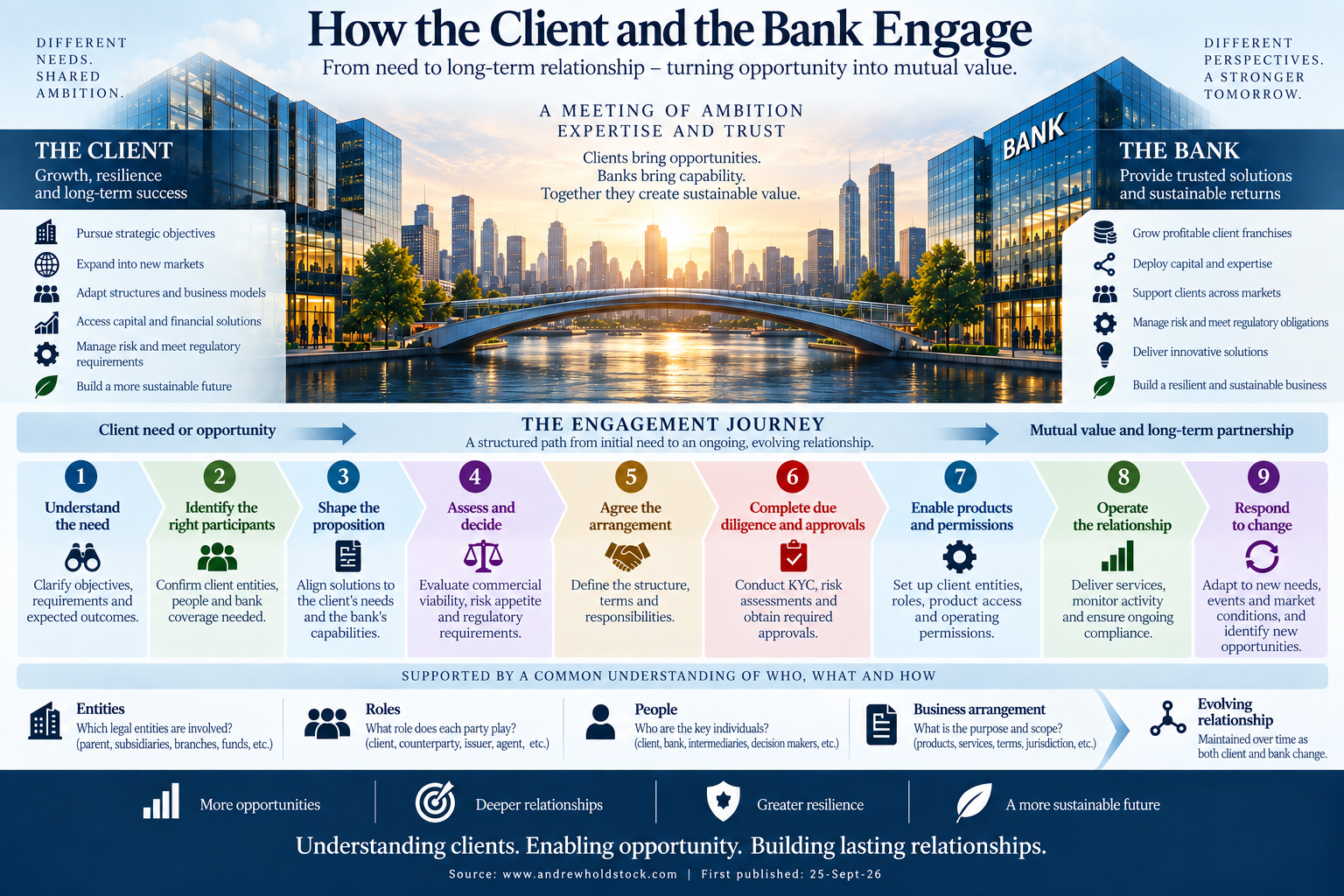
The bank must understand the need, identify the relevant participants, shape the proposition, assess commercial and risk considerations, agree the arrangement, complete due diligence, enable products and permissions, and then operate the relationship over time.
A bank-client relationship is not created by onboarding alone. It is built through a sequence of decisions, arrangements and interactions that continue as both sides change.
What makes that relationship work is a shared understanding of the entities, people, roles and business arrangements involved.
How the Bank Organises Around the Client
The client experiences one bank, even when many teams contribute to the relationship.
A bank brings together relationship management, product teams, servicing, execution, specialists, risk, compliance and CLM to support the client.
Each function has a different role, but the client experiences the quality of the whole.
The stronger the coordination across the bank, the more coherent, responsive and reliable the relationship feels to the client.
That requires clear ownership, joined-up processes, shared information and consistent decisions across teams.
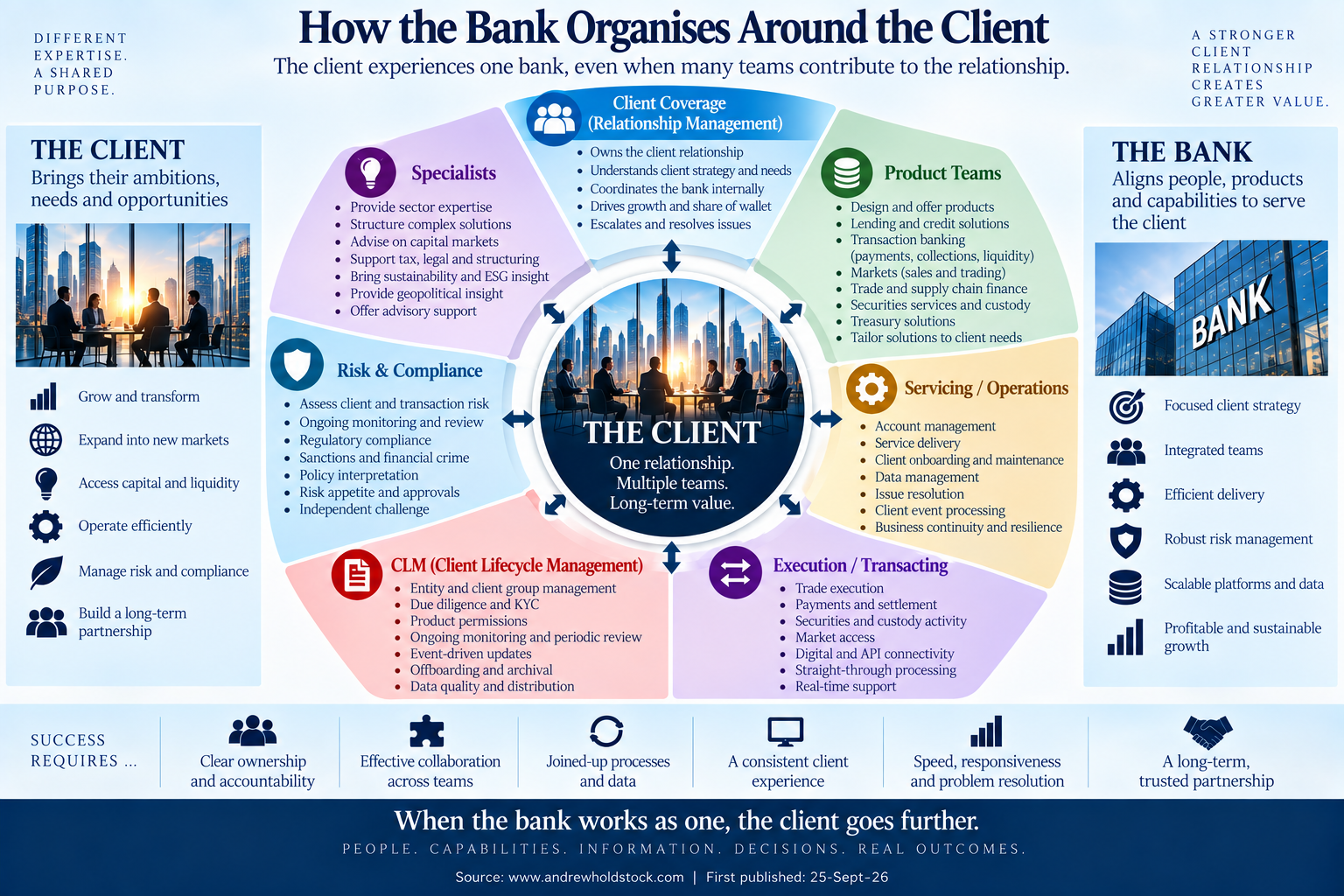
The objective is not to make every function do the same thing. It is to make different capabilities work together around one client relationship.
How the Bank Organises to Engage with the Client
The client interacts with selected teams, but the whole bank supports the relationship.
Clients usually engage directly with relationship managers, product specialists, servicing teams, execution teams and advisers.
Behind those interactions sit the capabilities that keep the relationship joined up: CLM, onboarding, data, permissions, event management, risk, compliance, legal, operations and technology.
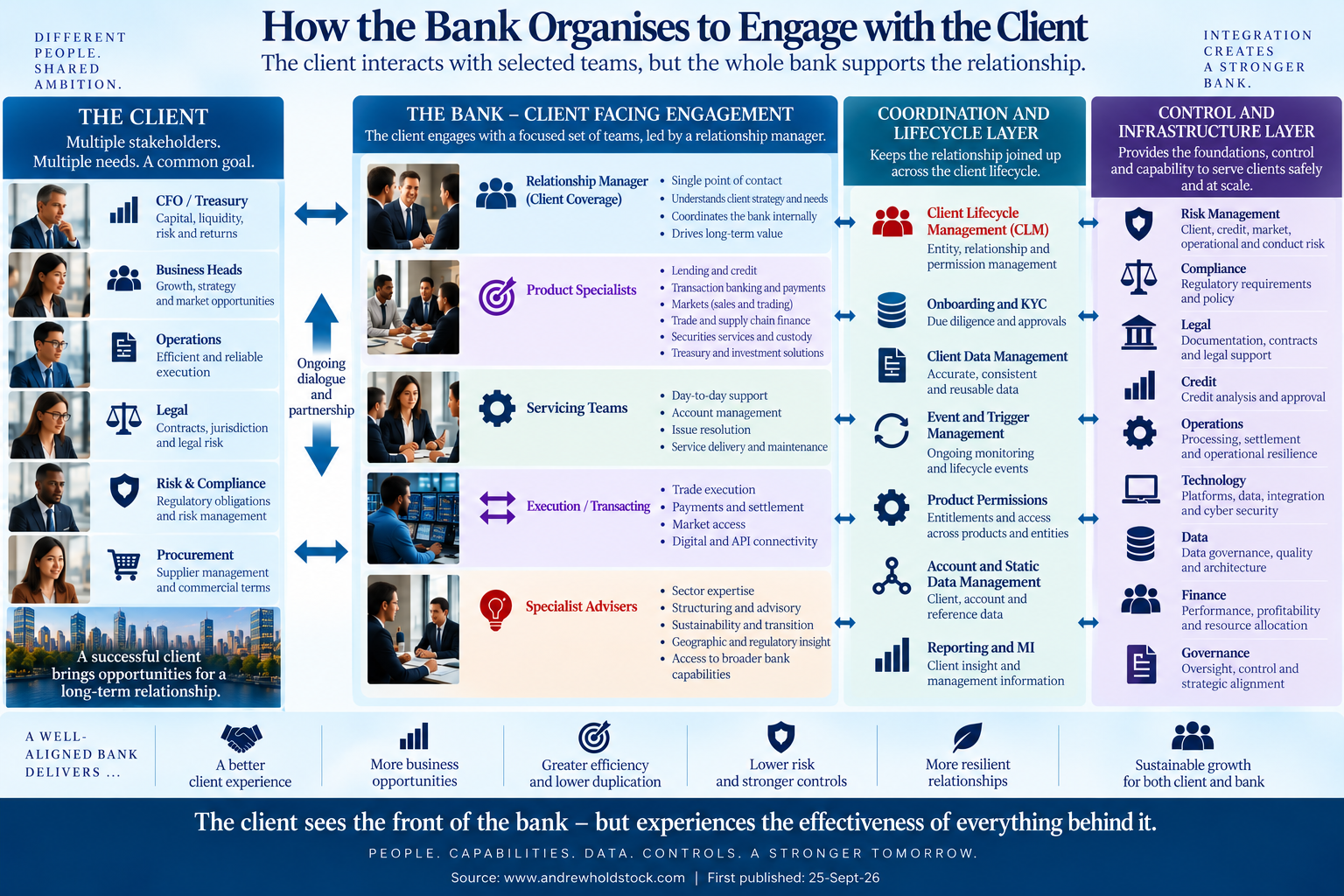
The client sees the front of the bank, but experiences the effectiveness of everything behind it.
The challenge is therefore not simply to organise client-facing teams well. It is to ensure that the wider bank works coherently behind them, with shared information, clear responsibilities and coordinated decisions.
How Clients Organise to Run Their Business
Different structures often contain similar functions, responsibilities and decision rights.
Clients organise themselves in very different ways.
A global corporate, financial institution, asset manager and private capital group may have very different legal and operating structures. But beneath that variation, familiar functions usually remain: leadership, finance, treasury, operations, risk, legal, technology, people and third-party management.
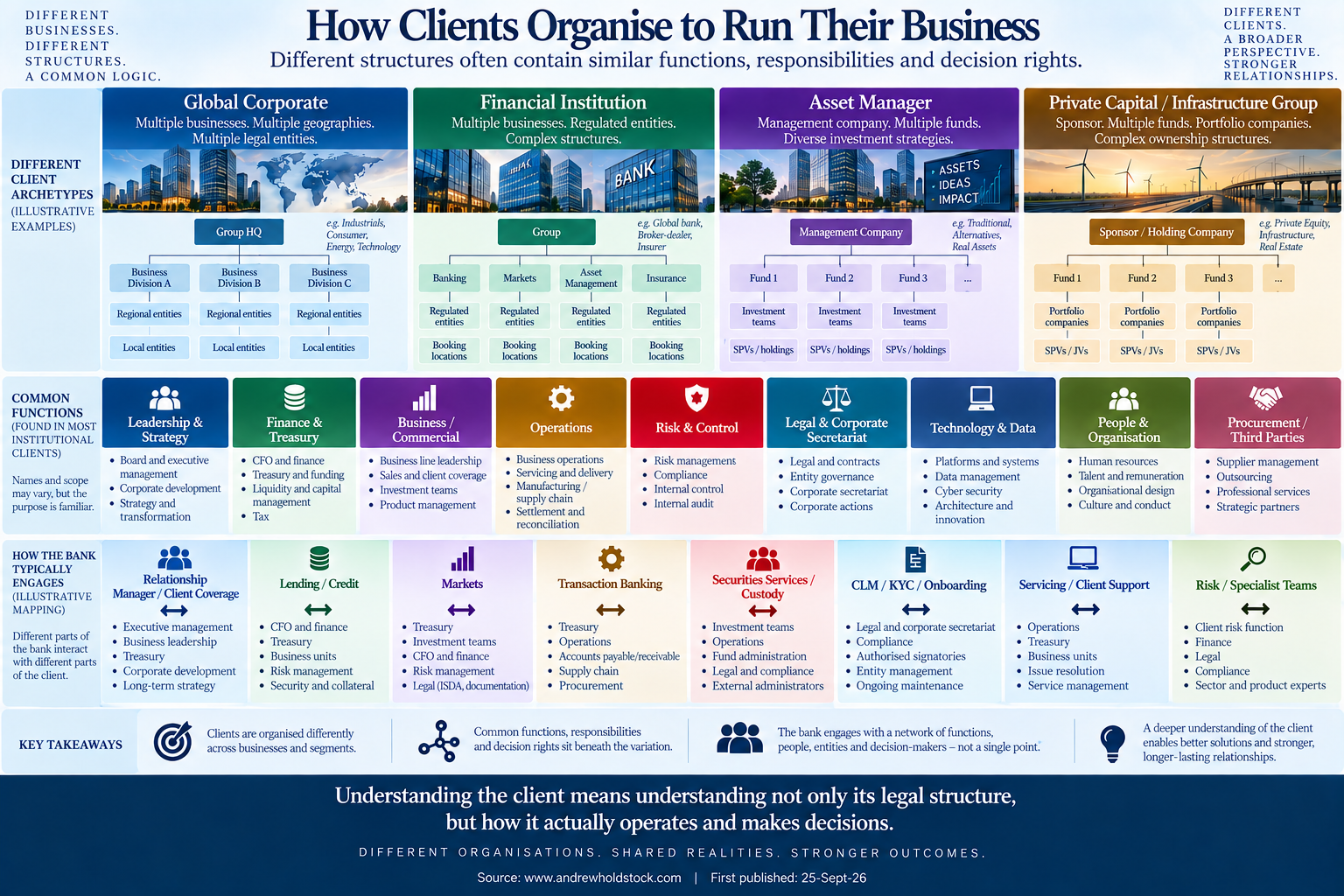
For the bank, understanding the client therefore means more than understanding its legal entities.
It means understanding how the client actually operates, where decisions are made, and who has the authority to act.
That matters because different parts of the bank will need to engage with different parts of the client organisation. The better the bank understands that operating reality, the better it can align its own people, products and services around the relationship.
Engage the Client the Way the Client Is Organised
Good engagement reflects the client’s operating model, decision rights and internal structure.
A bank should not force every client through the same engagement model.
The right approach depends on how the client is structured, where authority sits, who makes decisions and which entities and functions are involved.
That means aligning the right relationship managers, product specialists, servicing teams, advisers, risk and CLM resources with the right people on the client side.
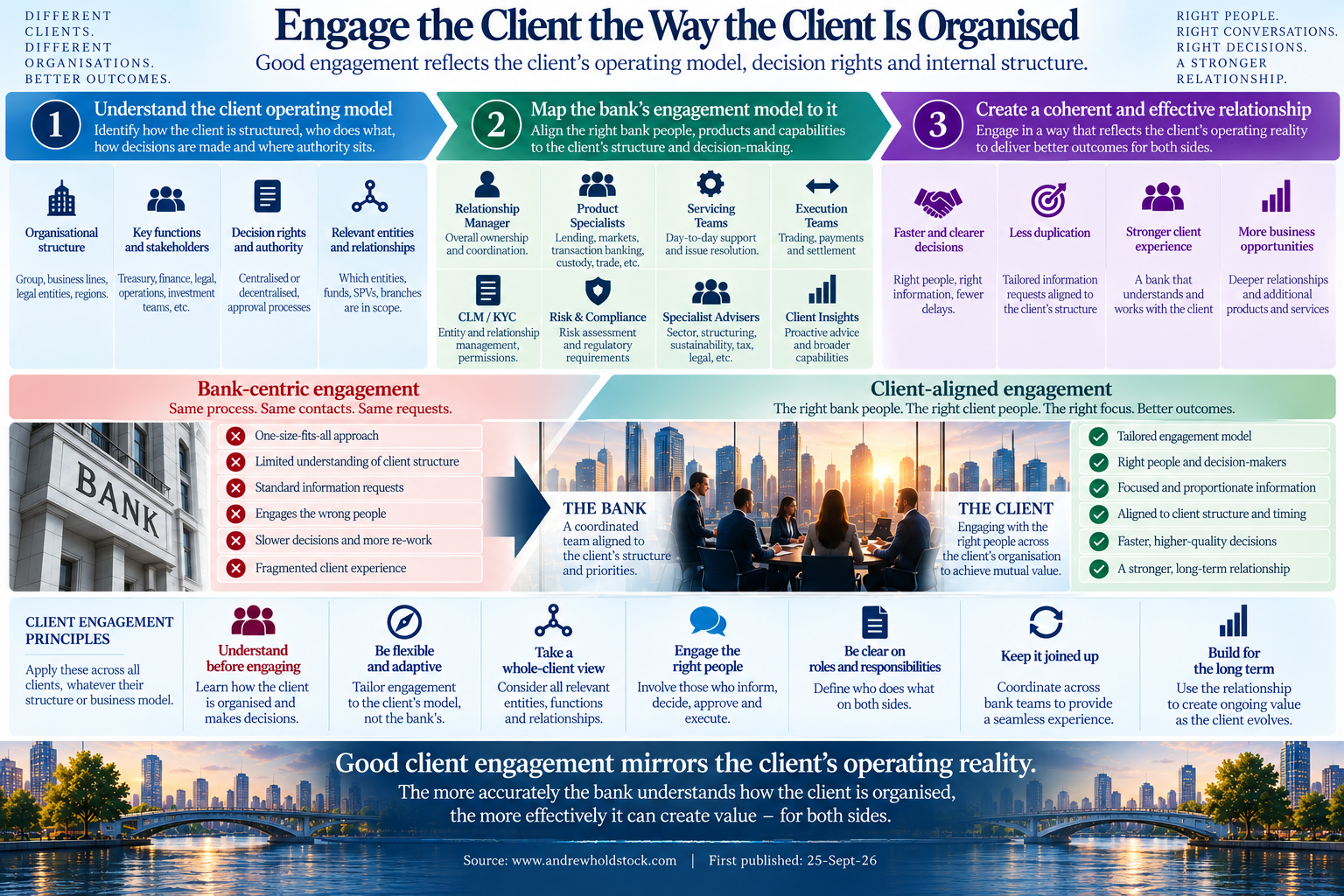
The better the bank understands how the client operates, the better it can engage the right people, ask for the right information and make better decisions.
Client-aligned engagement reduces duplication, speeds up decisions and creates a more coherent experience across the relationship.
From Client Engagement to a Bankable Relationship
Engagement turns opportunity into a relationship the bank can understand, approve and operate.
A client need or opportunity does not become a banking relationship immediately.
The bank must identify the relevant entities and people, understand their roles and relationships, agree the business arrangement, complete the required due diligence and enable the products, permissions, accounts and identifiers needed for activity.
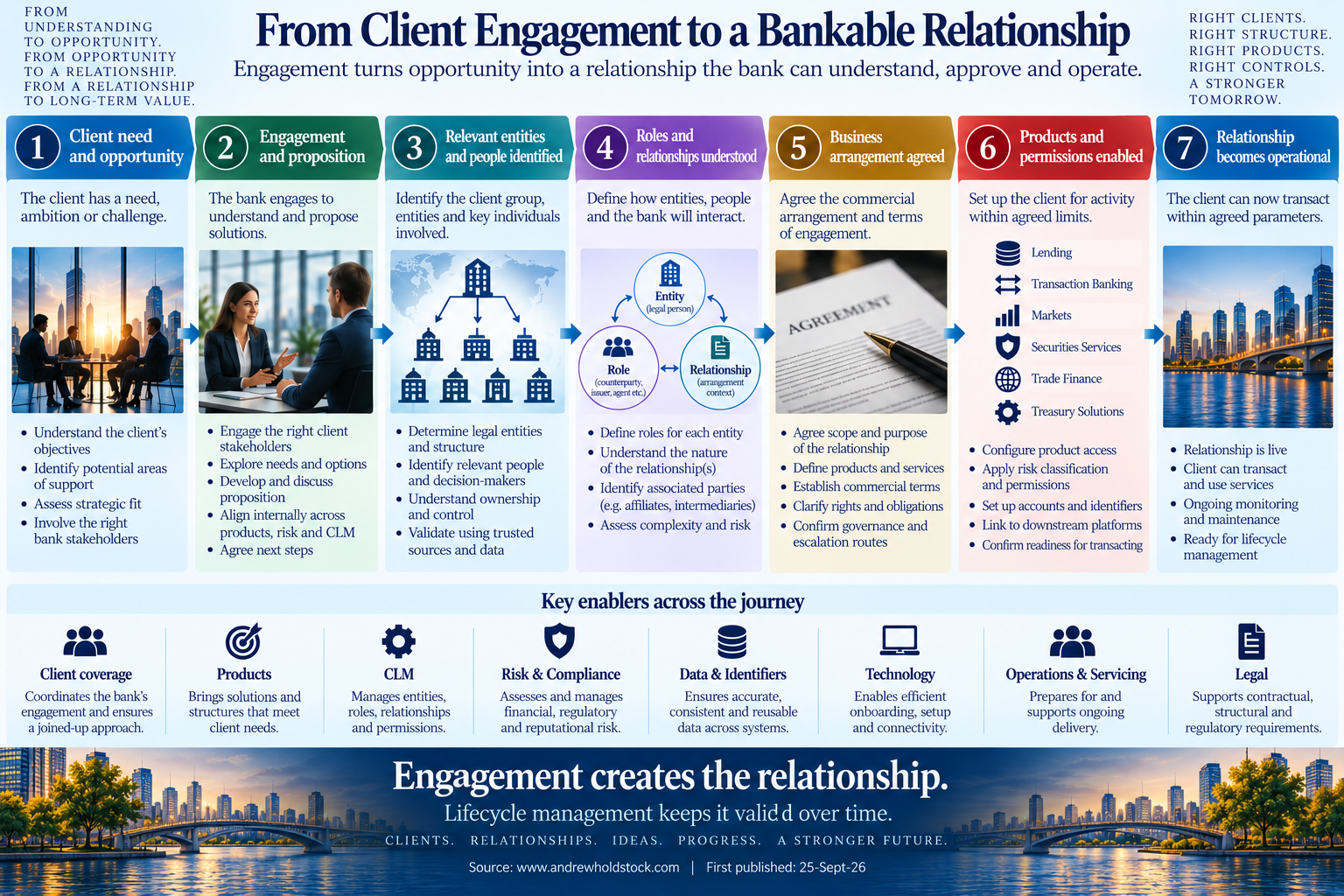
Engagement creates the relationship. Lifecycle management keeps it valid over time.
Once those elements are in place, the relationship becomes operational — and the ongoing work of maintaining it begins.
The Client Lifecycle
The relationship evolves over time, with different entities, people and arrangements moving through different stages.
A client relationship does not end when onboarding is complete.
It moves through prospecting, onboarding, active use, maintenance, periodic review, exit, archival and, in some cases, re-onboarding.
For a complex client group, those stages do not always happen once or in sequence for the whole client. Different entities, people, products and arrangements can be at different points in the lifecycle at the same time.
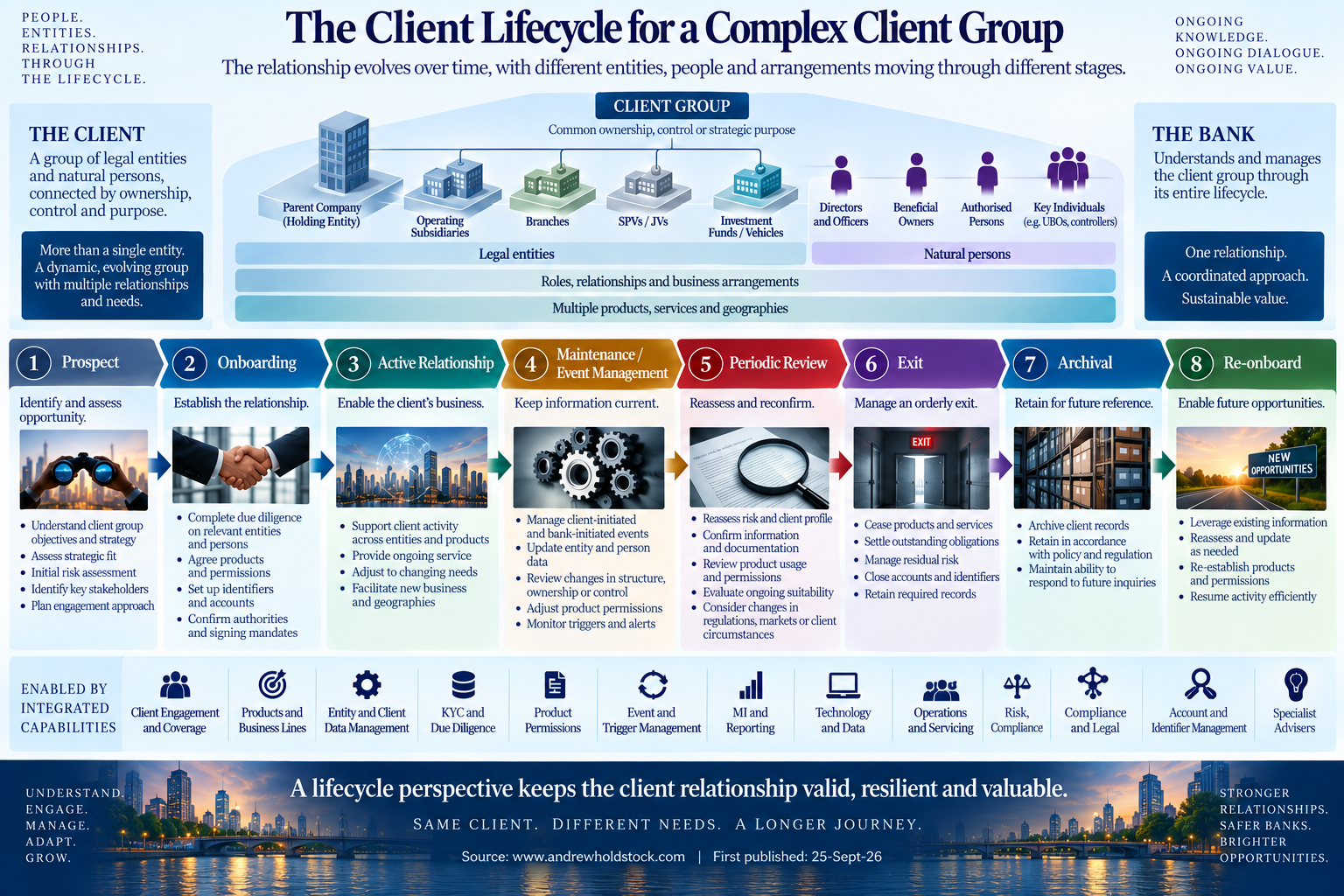
The client lifecycle is therefore a continuing relationship, not a single case moving through a process.
CLM keeps that relationship understood, valid and able to operate as its constituent parts change over time.
What is Client Lifecycle Management?
CLM keeps the client relationship understood, valid, appropriately permitted and able to operate over time.
Client Lifecycle Management is the capability through which a bank establishes, maintains, governs and adapts its client relationships.
It manages the connected entities, people, roles, relationships, business arrangements, products, permissions and identifiers that enable the client to operate with the bank.
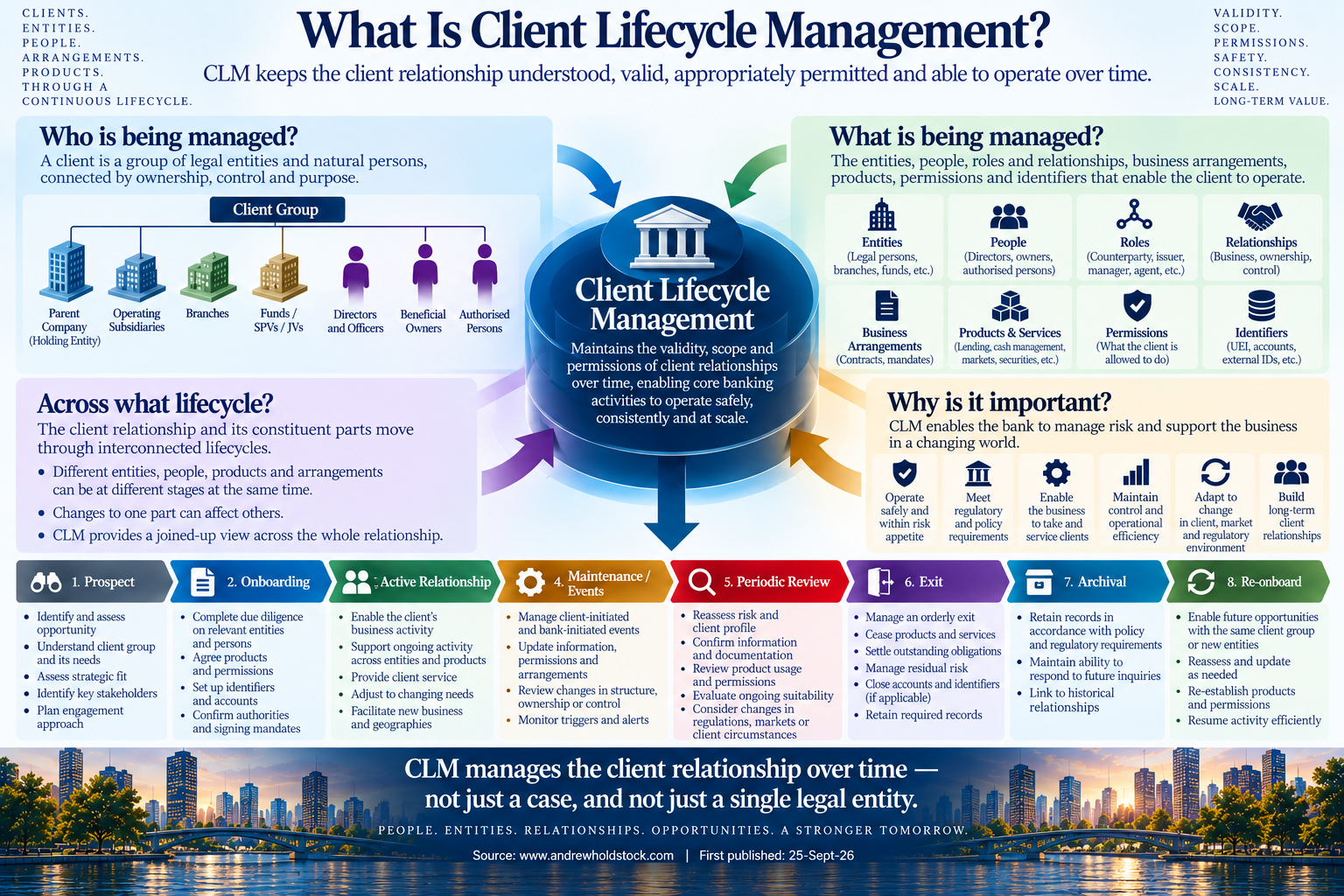
It also manages those elements across the full lifecycle — from prospecting and onboarding through active use, maintenance, review, exit, archival and re-onboarding.
CLM maintains the validity, scope and permissions of client relationships over time, enabling core banking activities to operate safely, consistently and at scale.
CLM is therefore broader than onboarding or KYC. It is the capability that keeps the relationship aligned with reality as the client, the bank and the surrounding environment change.
Clearing the Misconceptions
CLM is broader than KYC, onboarding, case management or any single system or function.
CLM is often understood too narrowly.
It is not just KYC, onboarding, periodic review or case management. Nor is it simply a technology platform or the responsibility of one operational or control team.
CLM is a cross-functional capability that manages the client relationship across entities, people, roles, arrangements, products, permissions and lifecycle events.
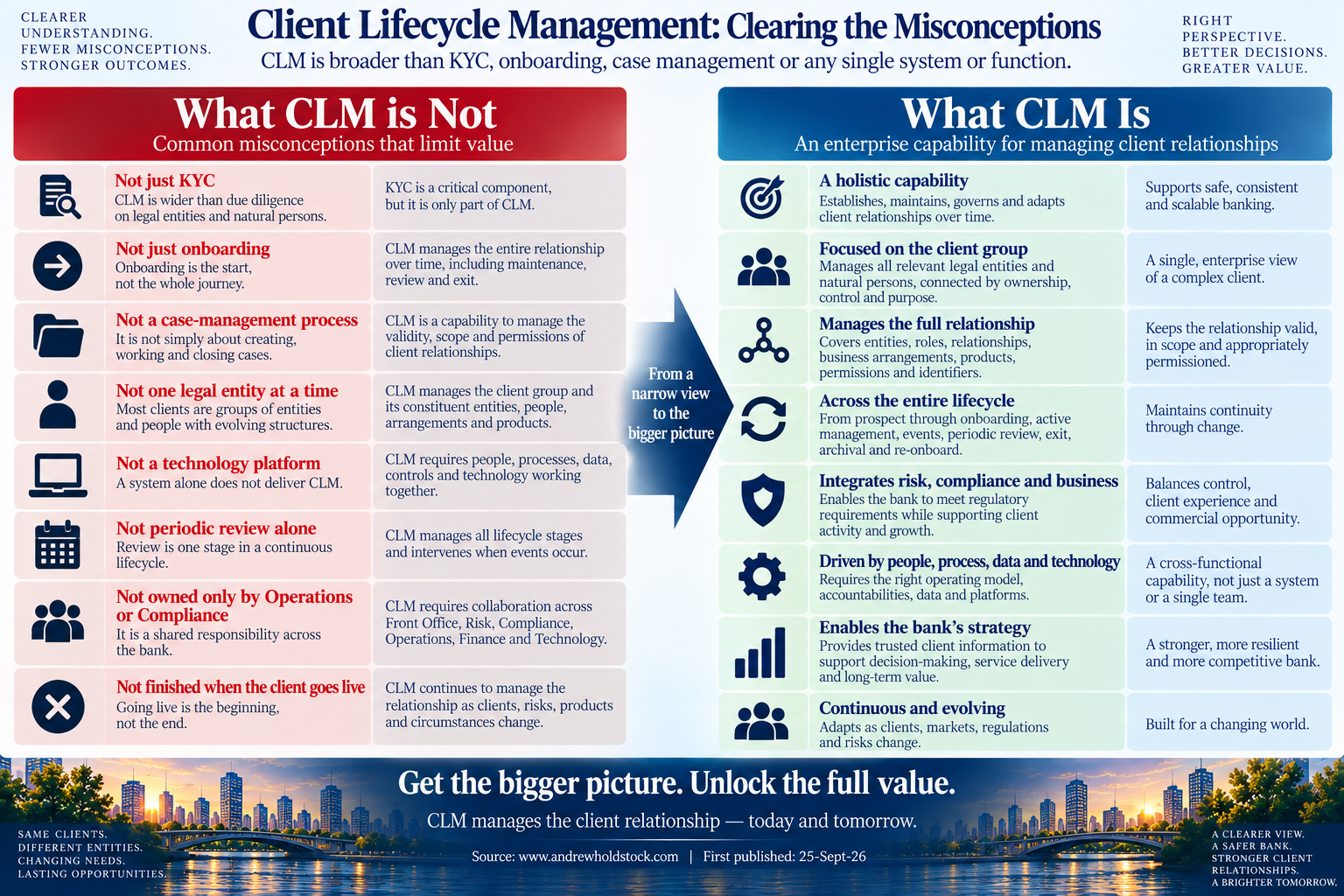
The narrower the definition of CLM, the more of the same complexity simply sits somewhere else in the bank.
What matters is not where every organisational boundary is drawn, but whether the capabilities needed to manage the client relationship work together coherently over time.