Client Lifecycle Management

CLM: Critical Infrastructure for a Connected World
Client Lifecycle Management (CLM) enables Banks and other Financial Institutions to understand who they are doing business with, how those relationships are connected, what business is permitted, and how the risks arising from them are changing.
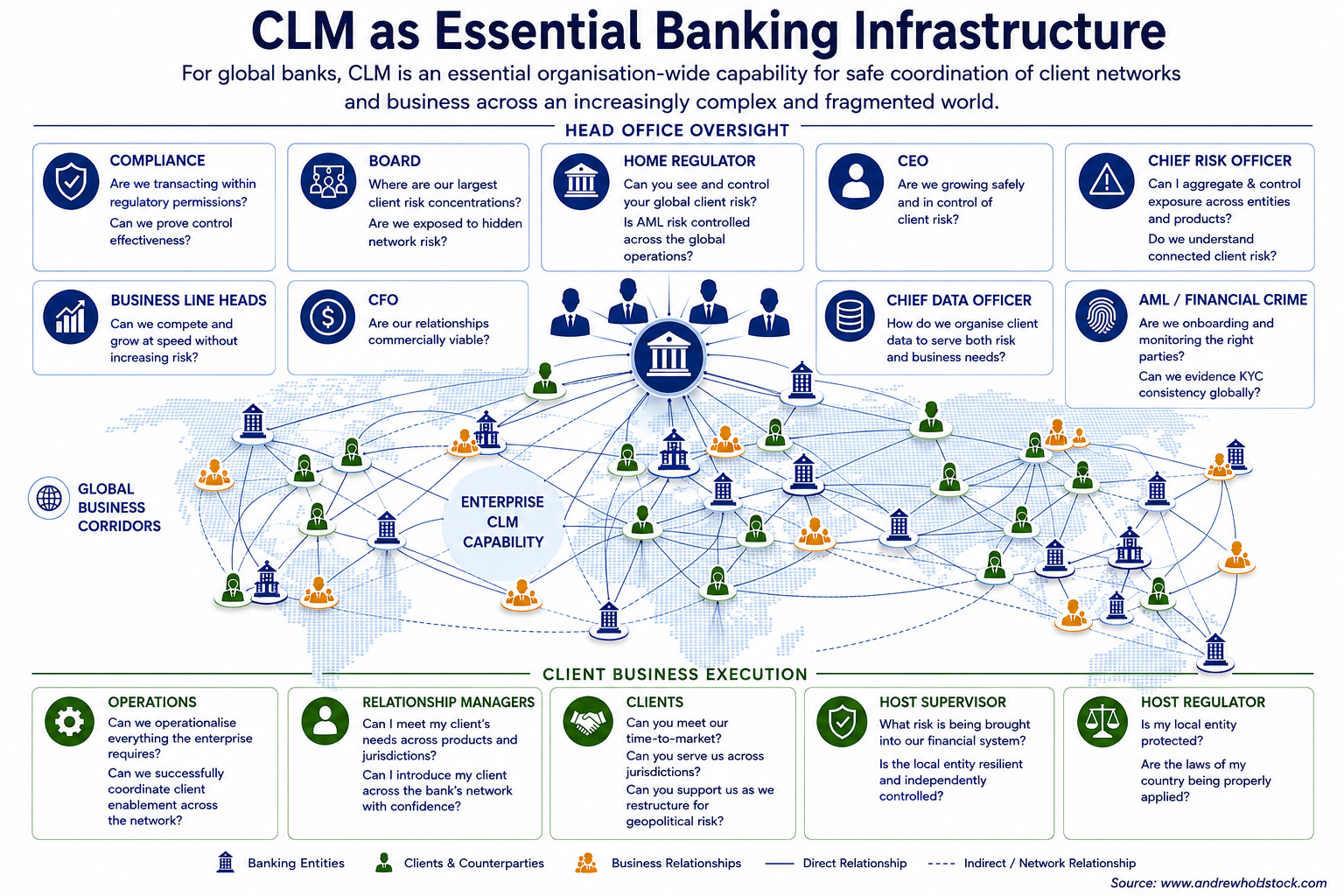
In stable economic and financial market conditions, CLM supports safe growth, regulatory compliance and effective client service. It enables the Financial Institution to establish relationships, determine what business may be conducted, maintain the information and controls supporting those relationships, and respond as circumstances change.
When conditions become more difficult, those same capabilities become increasingly important. The Financial Institution may need to identify affected clients and entities, understand relationships and activities, reassess what is permitted, and take action quickly.
CLM is therefore not simply an onboarding or KYC capability. It forms part of the infrastructure through which the Financial Institution understands and controls its participation in client relationships over time.
This site considers CLM from that wider perspective, covering strategy, operating model, architecture, data, technology, risk and transformation. It also considers how CLM needs to evolve as the external environment, technology and the nature of financial services continue to change.

What This Site is For
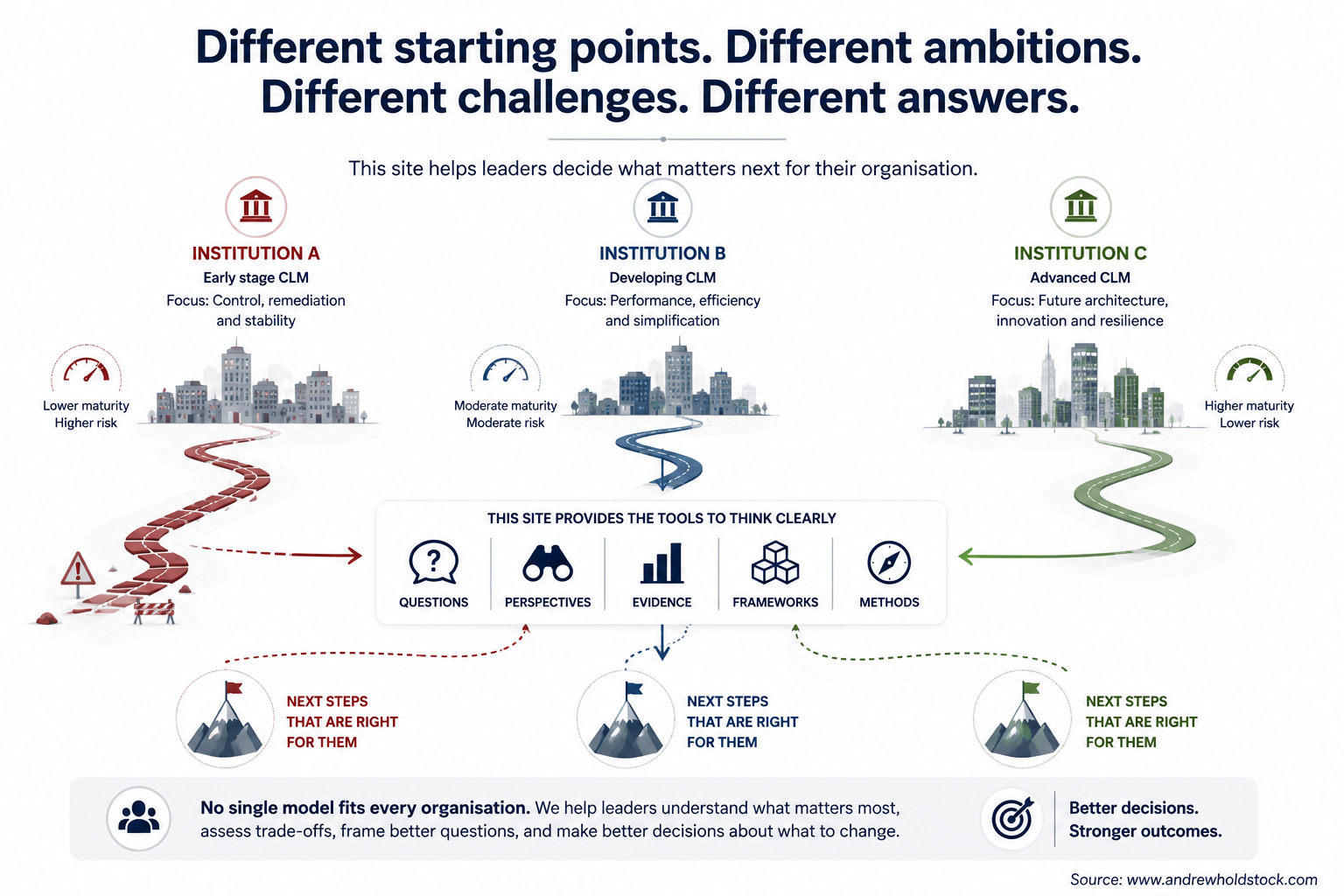
There is no single model of CLM that is right for every Financial Institution.
Financial Institutions are at different stages of maturity, have different ambitions, and operate with different levels of CLM performance. Their client populations, businesses, jurisdictions, operating models, technology environments, risks, and organisational constraints also differ.
What one bank or financial institution needs to do next with CLM may be very different from another.
This website is intended for senior leaders who need to make decisions about how CLM supports their organisation. Senior leaders who should care about CLM include CEOs, COOs, CROs, Boards, Financial Crime & Compliance Leaders, Business Heads, CLM Operations Leaders, Transformation Executives, and Business and Enterprise Architects.
These leaders may approach CLM from different perspectives but many of the questions are shared between them;
Is the organisation in control?
Is CLM supporting the business effectively?
Where are the greatest risks, constraints, and performance issues?
What should change next, and in what order?
This website does not attempt to cover everything about CLM or prescribe specific answers. Instead, it aims to provide ways of thinking about CLM strategy, design, performance and delivery using questions, perspectives, evidence, frameworks, and methods that can be applied to an organisation’s own perspectives.
The aim is to help leaders understand what matters most, assess the trade-offs, frame better questions about CLM, and make better decisions for their organisations about what to change.
Understanding CLM
CLM is the capability through which a Financial Institution establishes, understands, and maintains control over its client relationships.
CLM connects the client, the bank, its decisions and the information needed to manage the relationship throughout its life.
It brings together customer, entity and relationship structures; lifecycle management; due diligence, risk and compliance; products, services and business enablement; data, documents, evidence and identity; and the controls, workflows and governance needed to make and execute decisions.
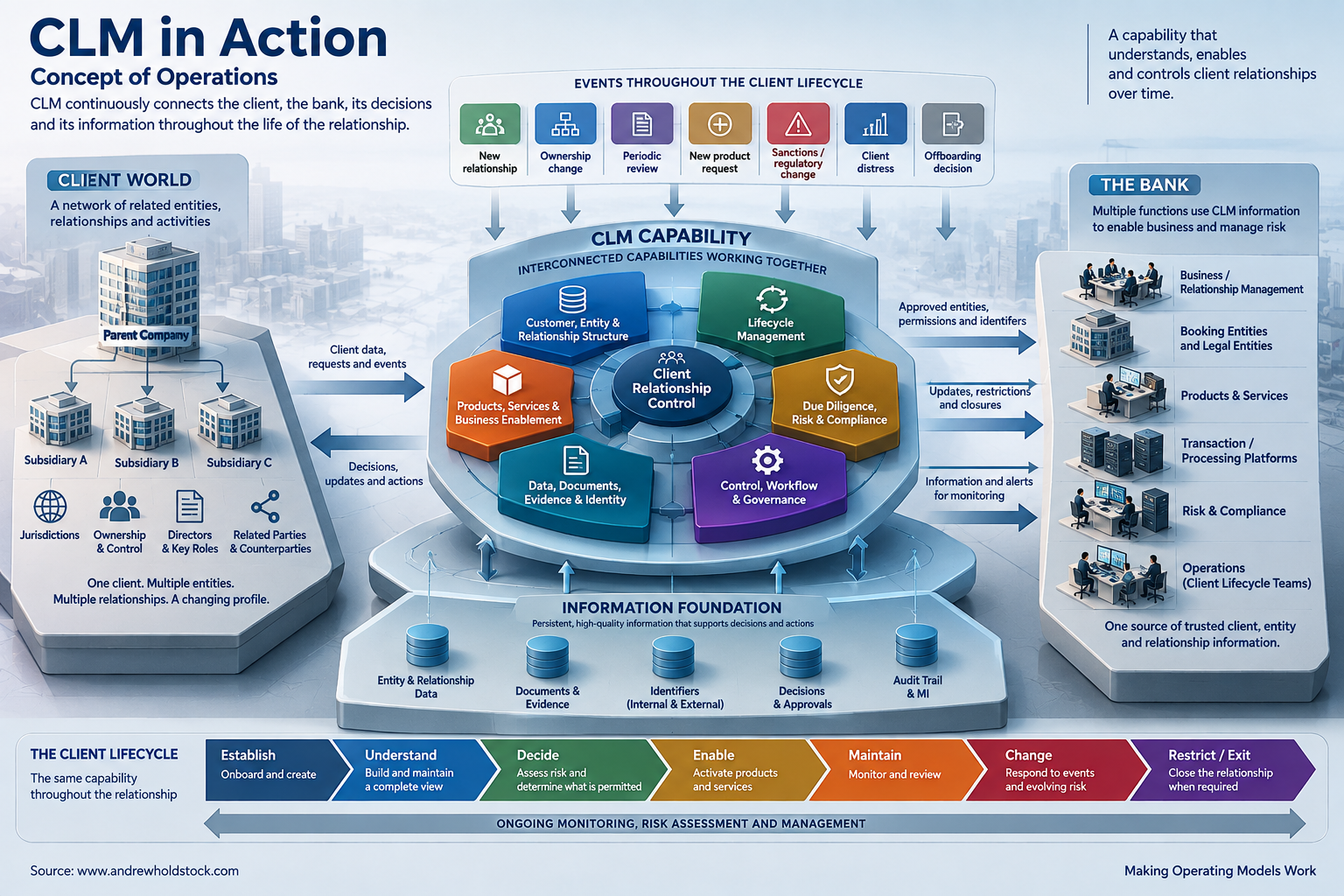
The diagram shows CLM as an operating capability rather than a single process or technology platform.
Client information, requests and events enter the capability throughout the lifecycle. CLM uses the available information and controls to understand the relationship, assess what is permitted, make decisions, enable or restrict activity, distribute information and maintain an auditable record.
The same capability continues to operate as circumstances change — whether through a new product request, ownership change, periodic review, regulatory event, client distress or an eventual decision to exit the relationship.
CLM is therefore much broader than onboarding or KYC. Its purpose is to maintain control of the organisation’s participation in its client relationships over time.
Improving CLM
Poor CLM performance is rarely caused by one process or one system.
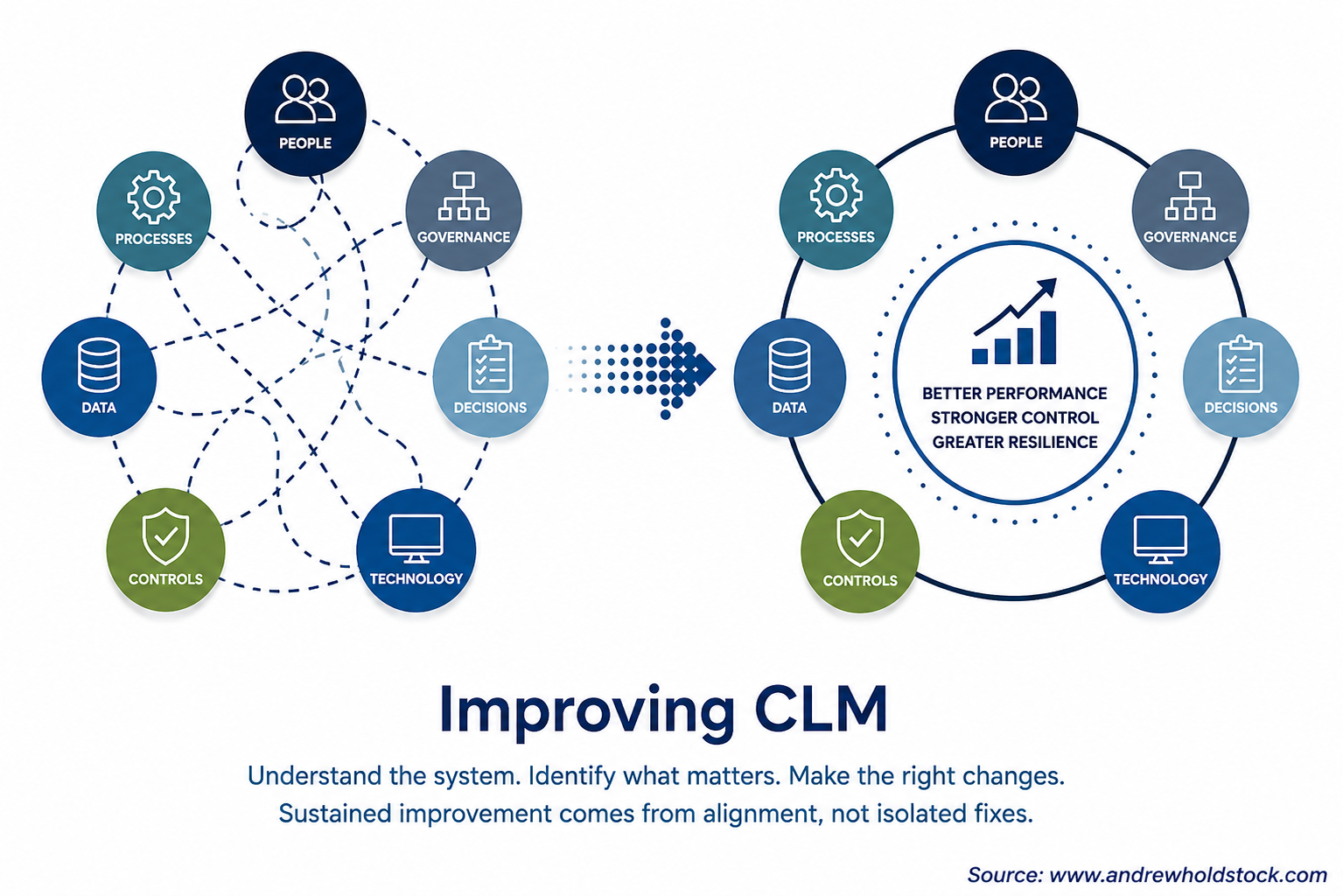
High cost, long onboarding times, rework, poor client experience, control weaknesses, and unsuccessful transformation can arise from the interaction between the operating model, processes, governance, data, technology, decision making, and incentives.
Improvement therefore starts by understanding the system producing the outcome. Changing one part of the system in isolation may move a problem elsewhere, create unintended consequences, or improve an individual measure without improving CLM as a whole.
This section explores how to diagnose CLM performance, identify the causes that matter most, and focus change where it can have the greatest effect.
CLM will need to evolve for a more connected, dynamic and technology-enabled environment.
Forces Shaping the Future of CLM
AI, new data architectures, modular platforms, and greater automation will change how client information is collected, interpreted, shared, and acted upon.
At the same time, increasing interconnectedness, geopolitical change, and faster moving risk will place greater demands on the Financial Institution’s ability to understand clients, relationships, and events across the organisation.
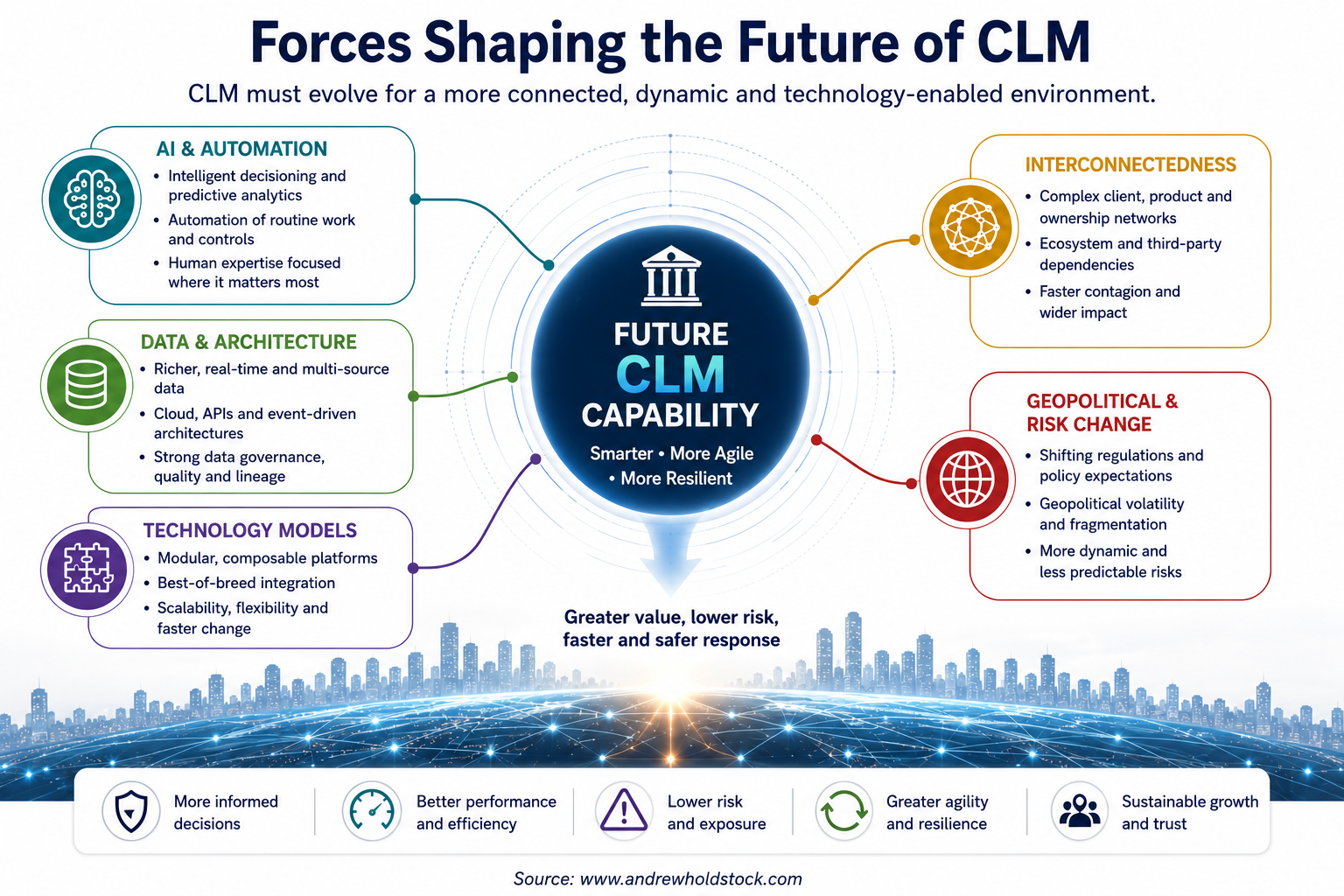
The challenge is therefore not simply to improve today’s CLM, but to design CLM capabilities that are more adaptive, better connected, and able to respond as both technology and the external environment continue to change.
This section explores the ideas, architectures, and emerging capabilities which may shape the next generation of CLM.
Questions and Challenges
Explore the questions that CLM leaders, COOs, and practitioners need to answer.
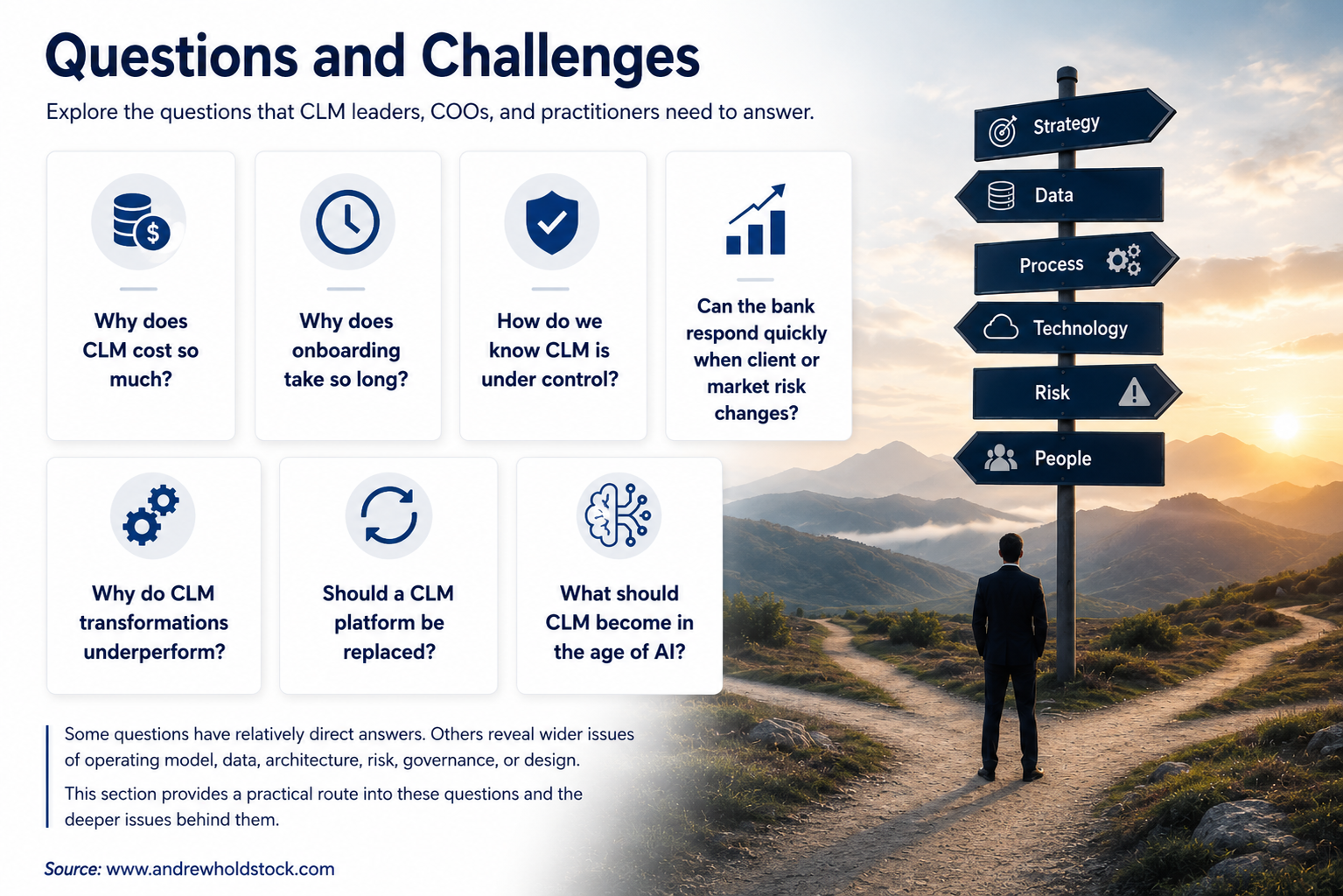
Some questions have relatively direct answers. Others reveal wider issues of operating model, data, architecture, risk, governance, or design.
This section provides a practical route into these questions and the deeper issues behind them.
CLM is a System, not a Process
CLM outcomes emerge from the way the whole system works together.
A single process or platform does not determine CLM performance. Performance emerges from the interaction between clients and entities, relationships, events, data, decisions, controls, people, operating models and technology. For major Banks, these interactions can extend across multiple businesses, booking locations and jurisdictions.
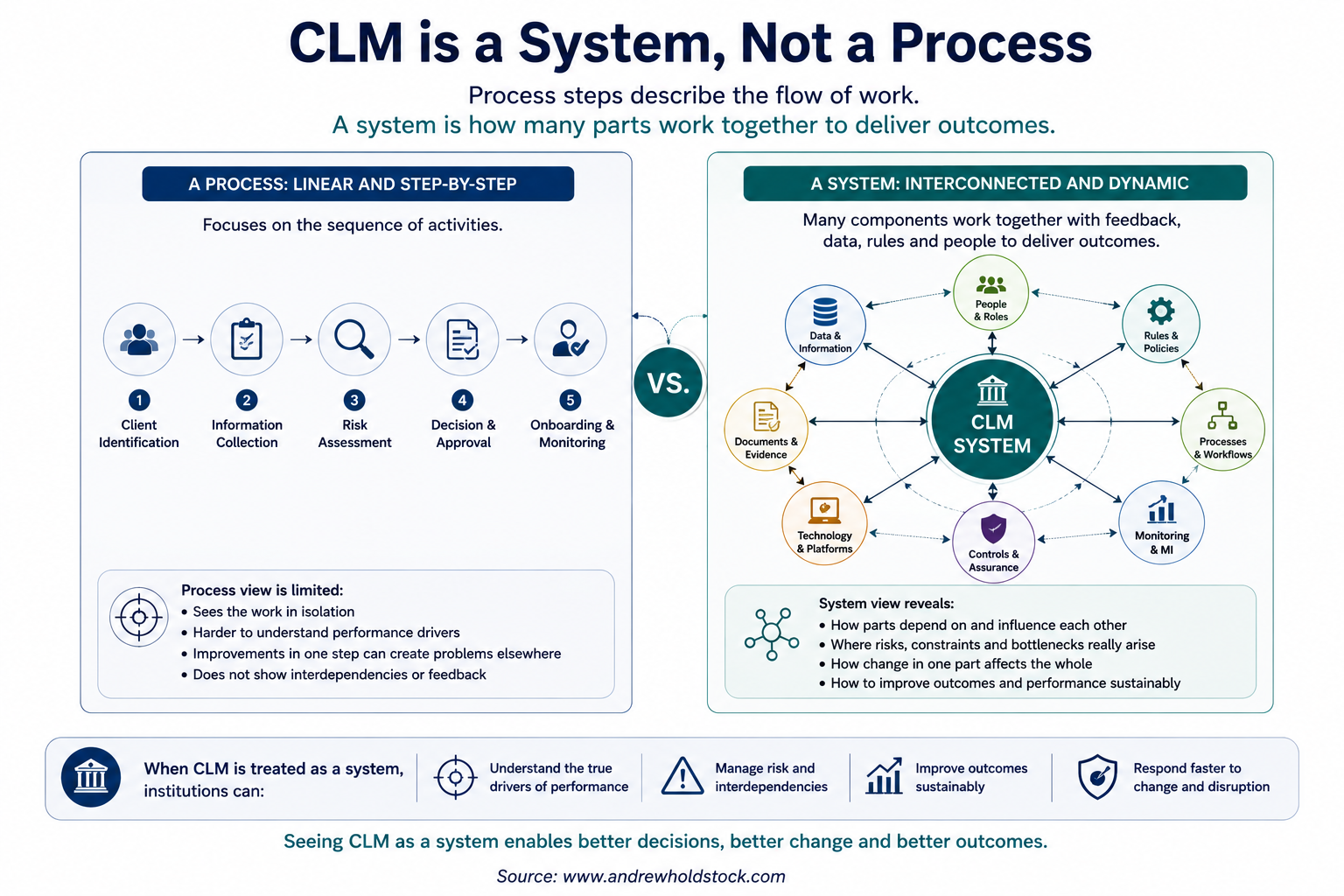
As the number of CLM interactions increases, reflecting the interactions that exist in the business world, the complexity of managing them also increases. Improving one part of CLM in isolation can therefore move or create a problem elsewhere.
Understanding CLM as a system makes it possible to design for better performance, stronger control and greater organisational resilience.
From CLM to Enterprise Participation
The client is often only one part of a wider network of relationships, dependencies, and exposures.

Banks participate in interconnected economic, financial and business networks. A client relationship may itself connect the Financial Institution to ownership structures, funding relationships, supply chains, markets, counterparties, infrastructure and shared dependencies.
Understanding the client therefore does not always provide a complete understanding of the organisation’s participation.
The broader question is how the Financial Institution is connected to the network around the client, where dependencies exist, what activities and relationships create exposure, and how changes elsewhere may affect the organisation.
This section develops that broader perspective from Client Lifecycle Management towards understanding and managing the organisation’s participation in a connected system.

Understanding What Drives Performance
Good diagnosis combines operational evidence with an understanding of the mechanisms that shape performance.
Process maps, metrics, and operating data can show where problems appear. Evidence, theory, and mechanism help explain what is causing them.
The underlying issue can be queueing, incentives, decision rights, data quality, control design, network effects, cognitive load, or something else.
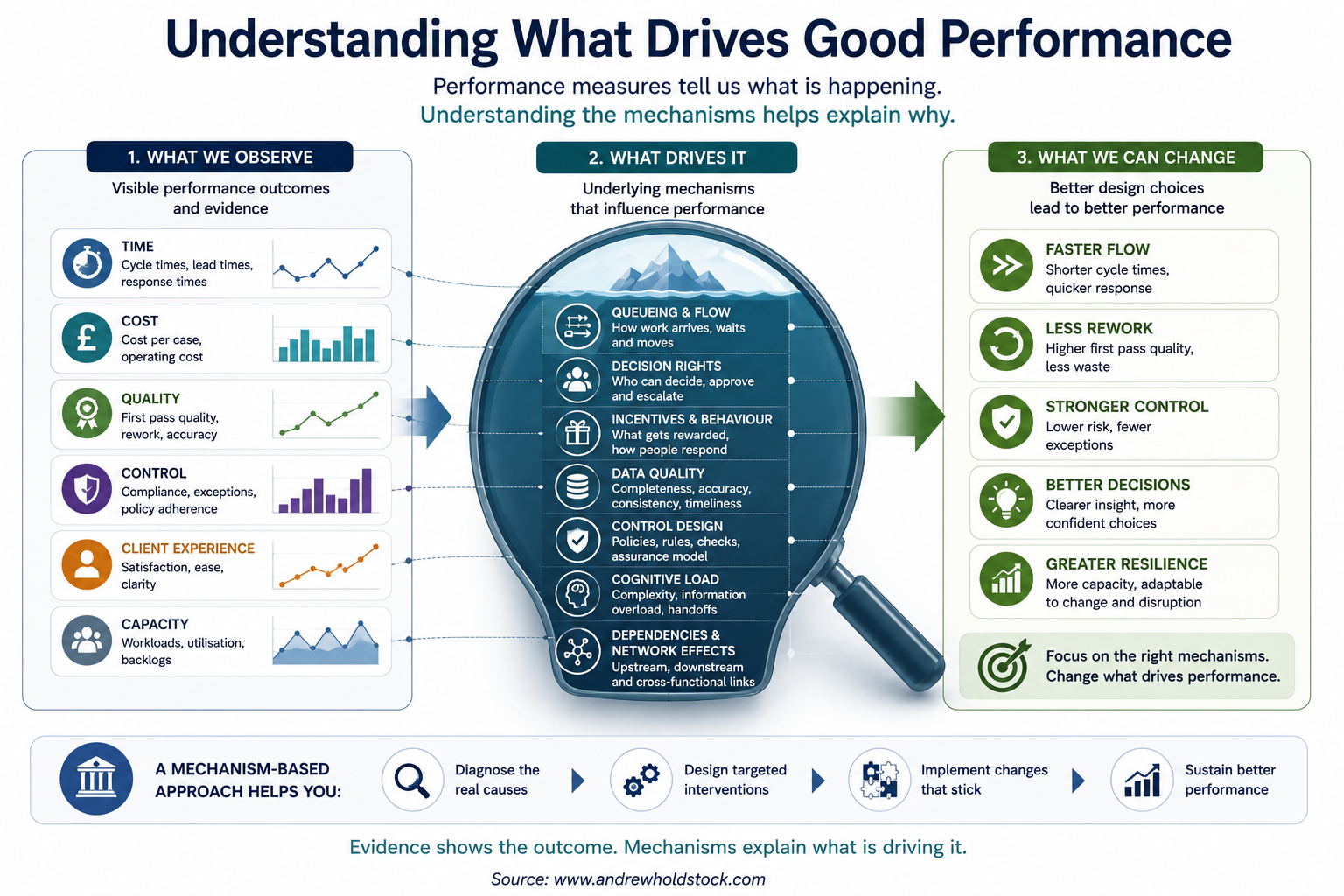
Practical delivery and theory are complementary. Many of the systems we rely on today are built on ideas that were first observed, tested, and shown to work.
Using evidence and proven mechanisms gives CLM design a stronger basis for deciding what to change, why it should work, and what consequences to expect.
Frameworks for Diagnosis, Design and Delivery
Good frameworks provide a consistent way to diagnose problems, make design choices, and guide delivery.
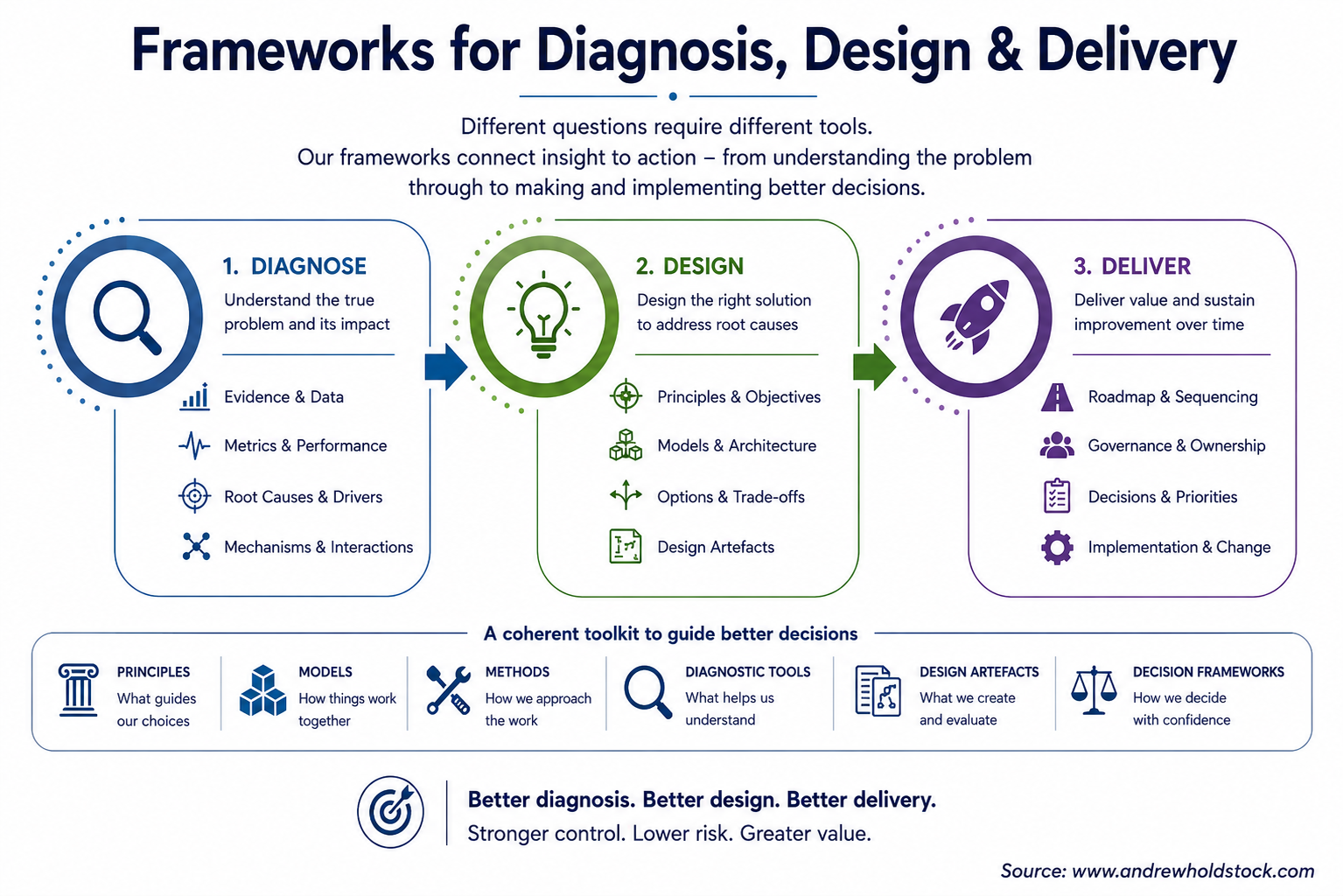
Good frameworks help organise complexity, making assumptions explicit, and create a common basis for discussion and decision making.
Different problems require different tools. Principles, models, methods, design artefacts, and diagnostic frameworks can each help translate broad objectives into practical choices about operating models, processes, data, controls, architecture, and technology.
The aim of this website is not to suggest a single methodology but to use the right approach for the question being asked.
Perspectives on What Comes Next
CLM must now evolve for a more connected, dynamic, and technology-enabled environment.
AI, new data capabilities, changing technology architectures, increasing interconnectedness, and a more volatile risk environment are changing both what CLM needs to do and what may be possible.
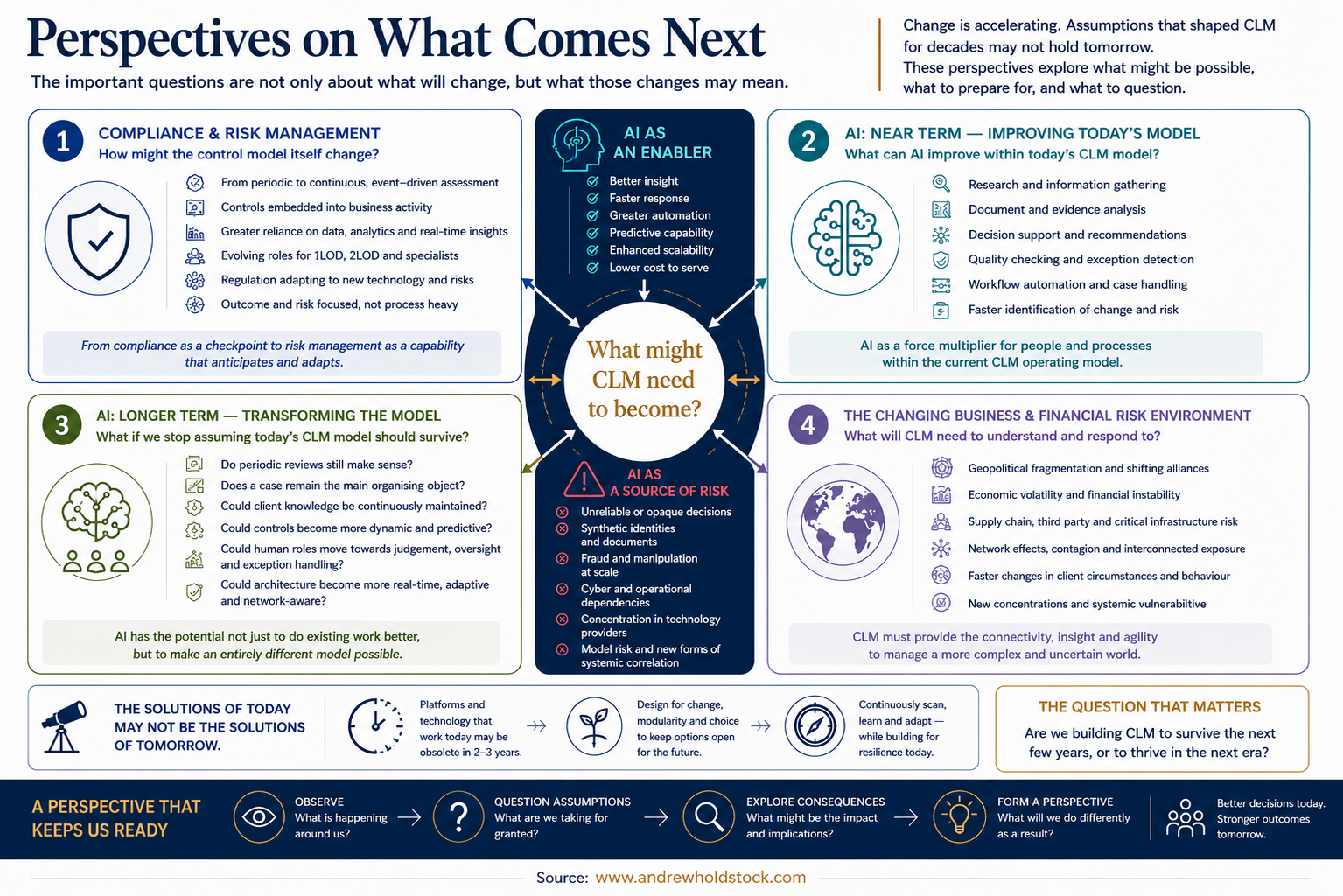
Some of these opportunities are explored in the Perspectives section covering the ideas, questions, and developments that may influence the next generation of CLM operating models.
The purpose of the Perspectives section is not to predict a specific future, but to assess the possibilities early enough to make decisions today which prove sound as the future plays out.
Expertise from Strategy to Execution
A perspective shaped by both operating within CLM and transforming it.
The author’s experience spans CLM operations, risk, operating model design, business architecture, data, technology and transformation.
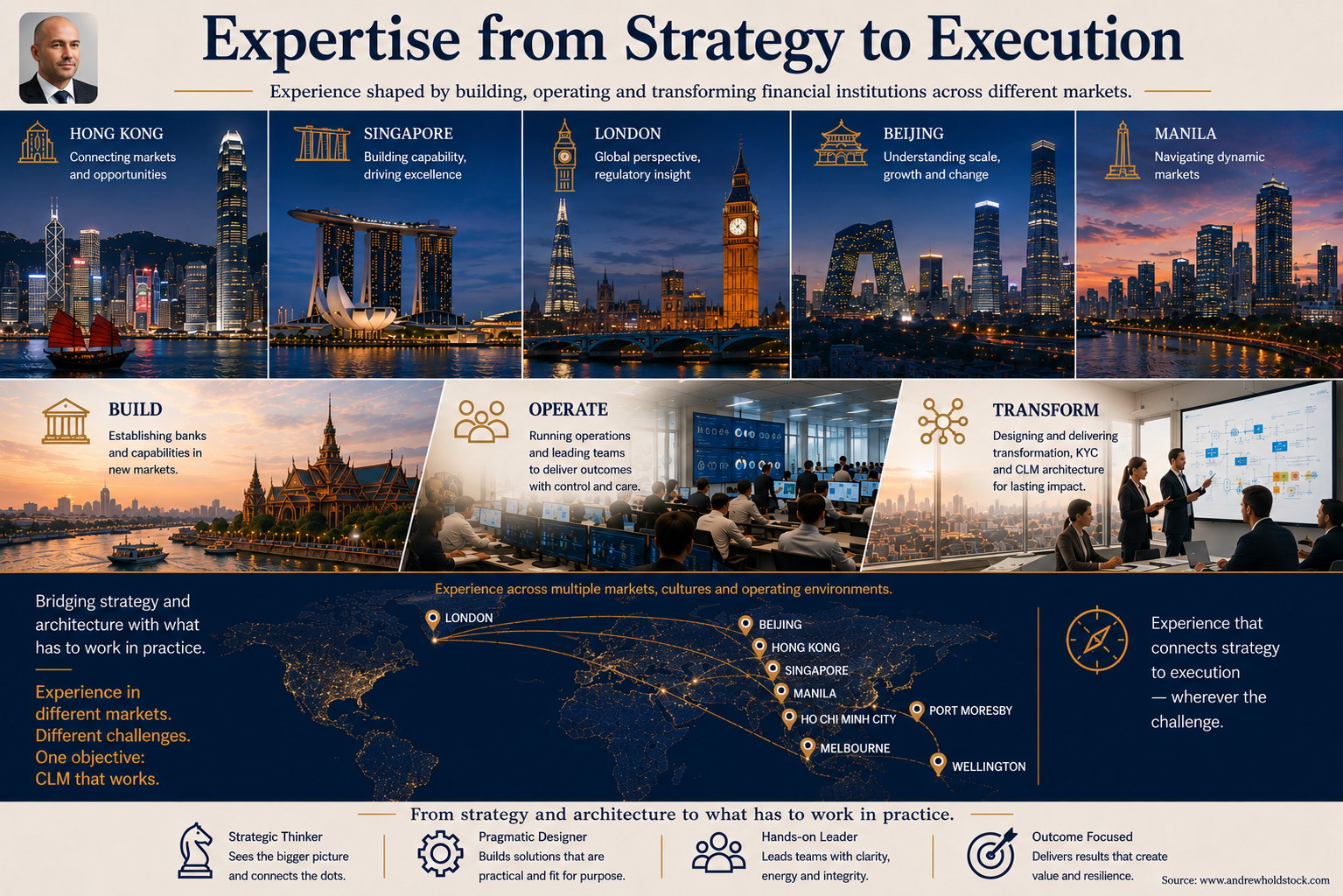
He has also had wider operations and transformation leadership roles across multiple countries globally.
That combination of strategy, design, execution and operational leadership provides a practical perspective on how operating models move from concept into reality — and what is required to make them work in practice.
How This Site Will Develop
This website will continue to evolve as new themes, questions and areas of CLM are explored in greater depth.
CLM is broad, organisation-specific and constantly changing. Some areas of the site will therefore be developed in more detail than others, and new material will be added as the thinking, evidence and practical experience develop.
The site will build out depth over time across topics such as operating models, data, architecture, technology, risk, performance, regulation and the wider economic and geopolitical environment.
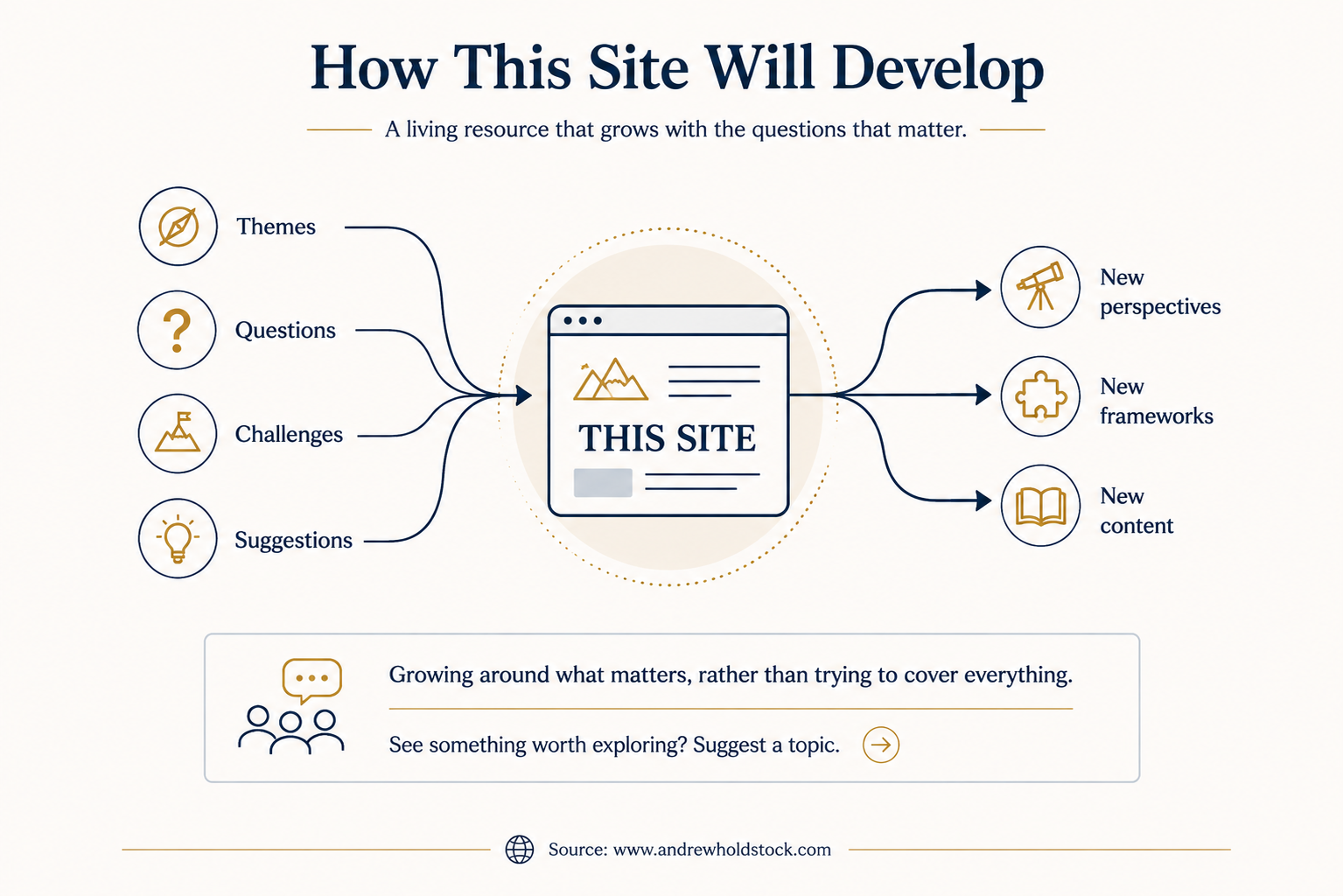
It may also develop around recurring problems seen across organisations, emerging questions, or ideas that challenge established ways of thinking about CLM.
The objective is not to create an encyclopaedia of CLM, but to develop a coherent body of material that helps banking leaders understand the capability, consider the issues that matter most, and make better decisions about how it should evolve.
Suggestions are welcome. If there is a CLM question, challenge or theme that would be useful to explore, please get in touch.
Designing What Comes Next
The future of CLM will not be created simply by digitising the current operating models.
CLM will need to do more in the interconnected, volatile and technologically advanced environment we are now in. AI, modern data, and new technology create opportunities to improve today’s capability, but also to reconsider its underlying assumptions.
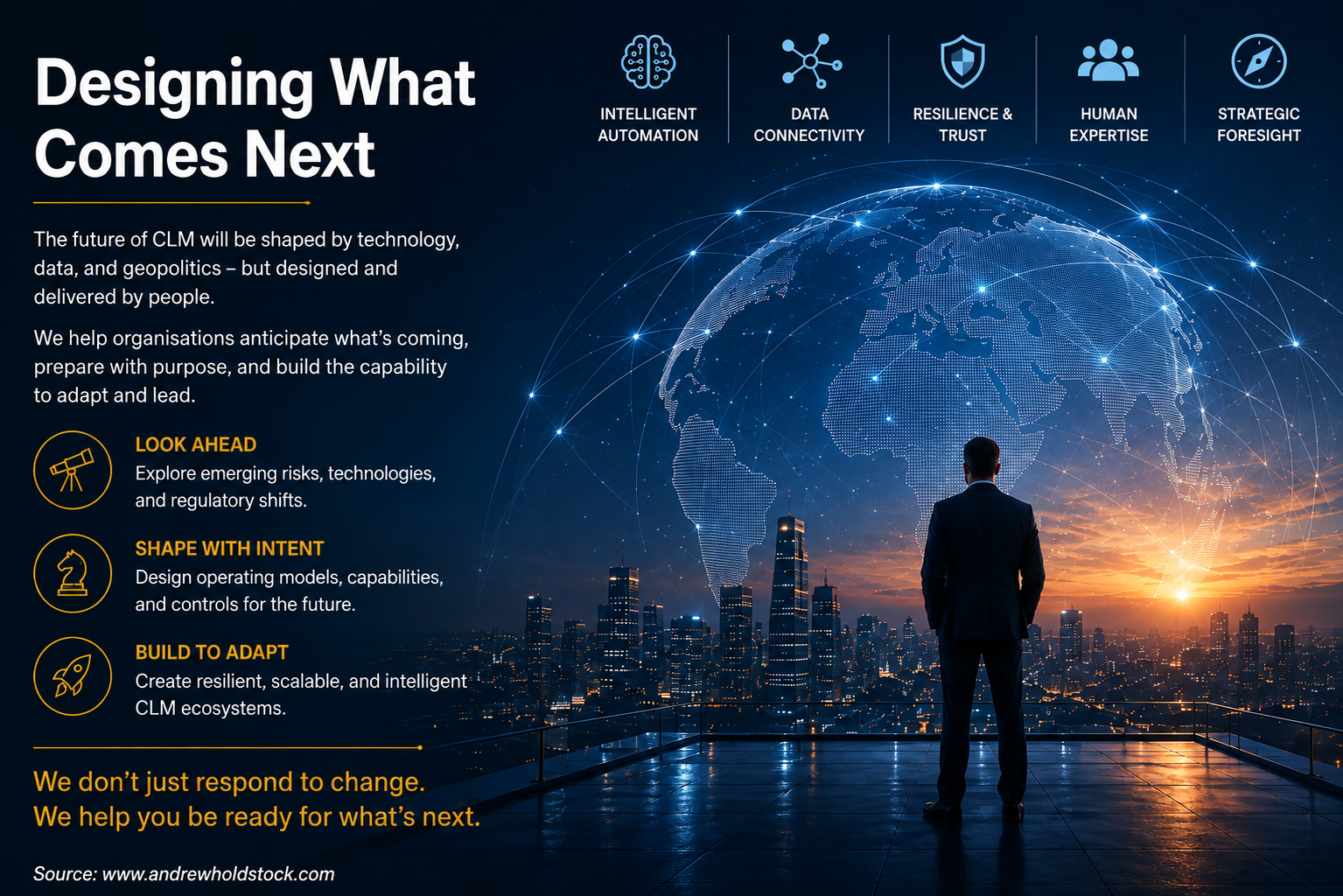
The greater opportunity is to understand what an organisation needs CLM to achieve, determine why the current operating model behaves as it does, and develop the business, control, data and technology capabilities required for what comes next.
The objective is not simply a better design. It is an operating model that works in design, in execution and in practice.