Understanding CLM
What CLM Does.
Client Lifecycle Management (CLM) brings together identity and relationship information, due diligence, risk assessment, decisions, permissions, controls, events and ongoing monitoring. It enables the organisation to know who it is doing business with, what business it has agreed to undertake, what risks it is accepting, and when it needs to act.
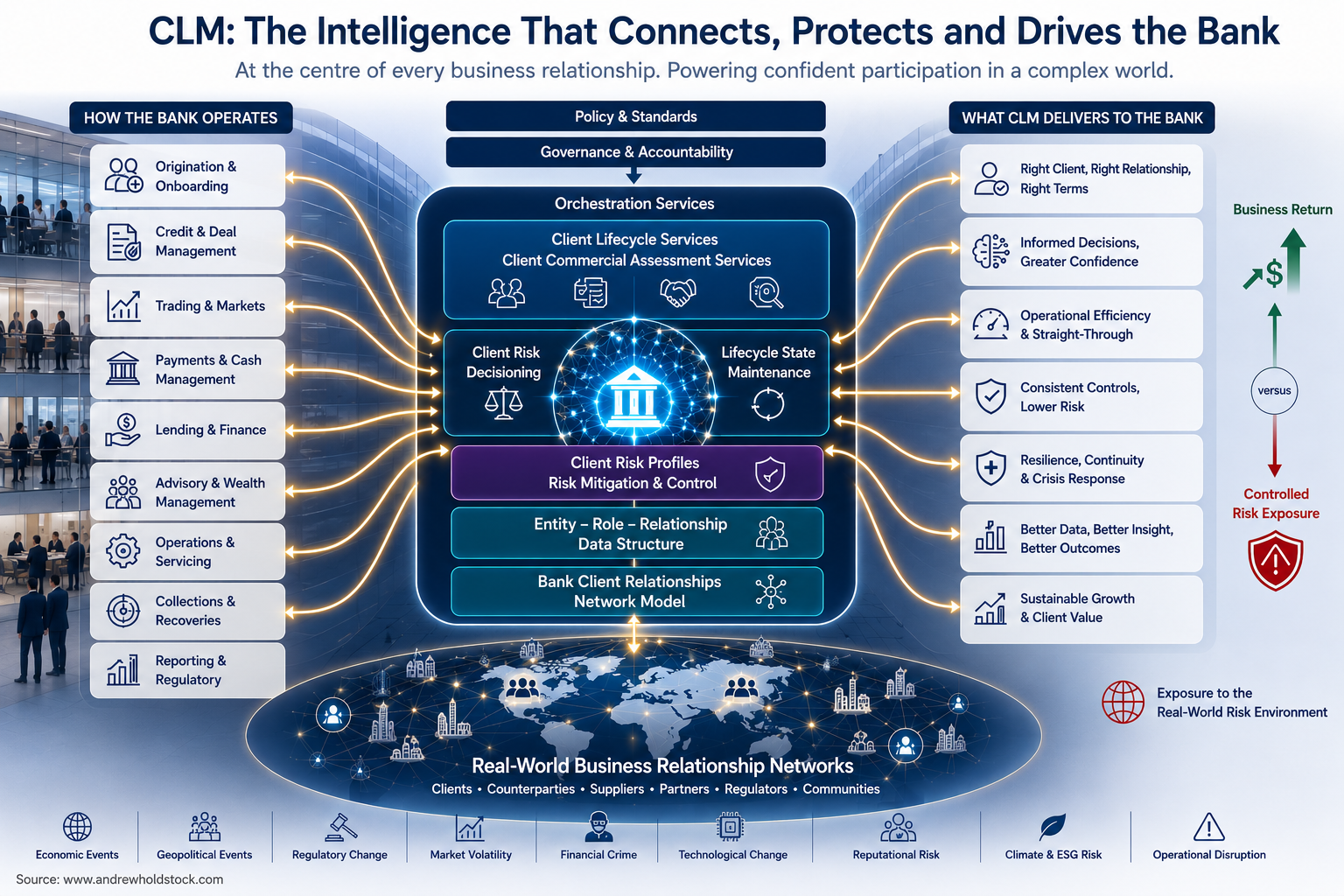
CLM creates the information and organisational knowledge of exposure to the business and financial world that leaders need to steer their organisation safely through its business activities. It does this by providing an understanding of its relationships with business and financial entities, providing the legal entity hierarchy through which exposures and obligations can be mapped, and enabling informed responses as clients, markets, regulation and the wider risk environment continually change.
Why CLM Matters
CLM enables safe client business.
Every client relationship creates business opportunity, but also creates obligations, dependencies and exposure. As business relationships extend across legal entities, products, booking locations and jurisdictions, the institution needs a reliable way to understand the whole relationship rather than seeing it through individual transactions, systems or processes.
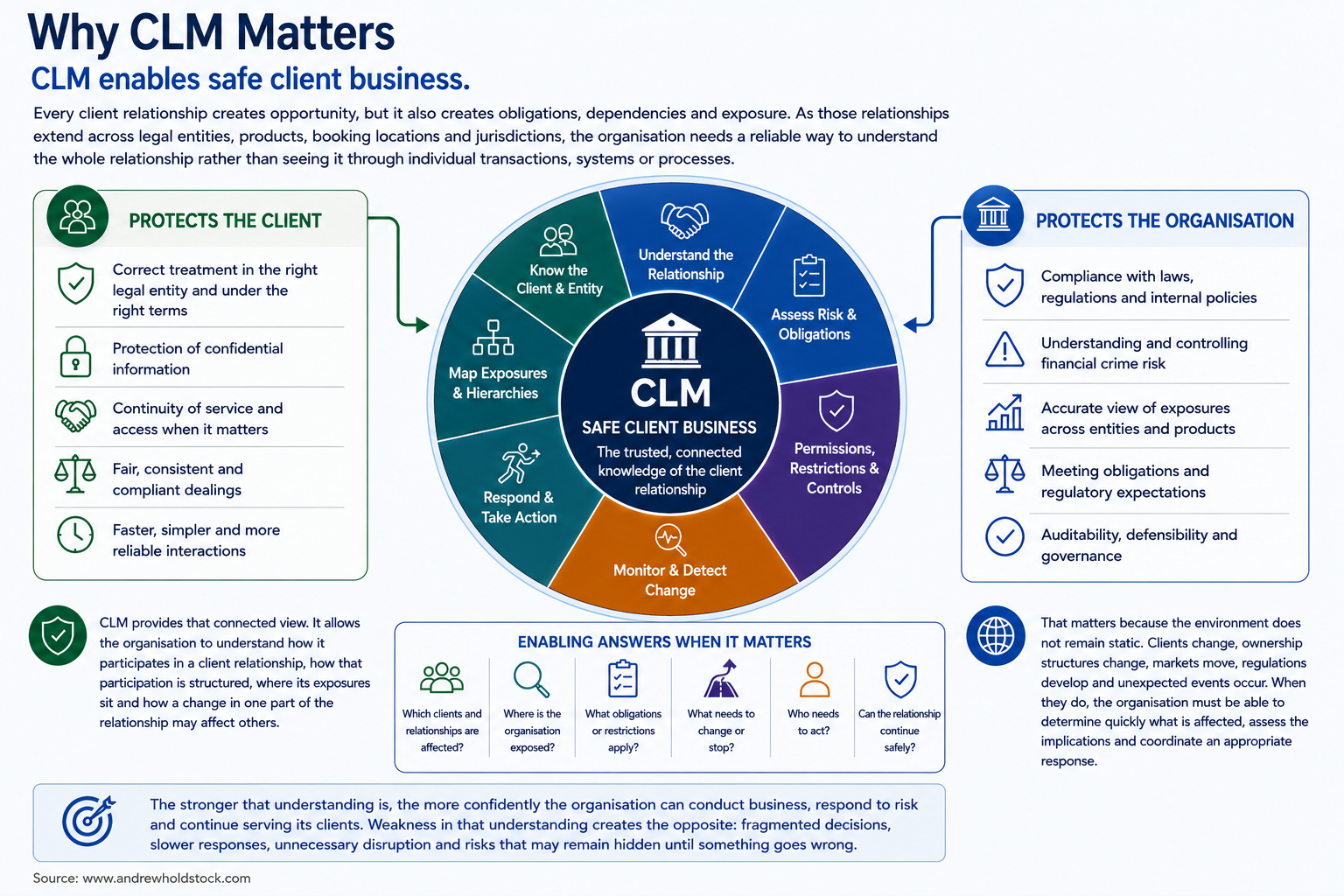
CLM provides the whole relationship view. It allows the organisation to understand how it participates in a client relationship, how that participation is structured, where its exposures sit and how a change in one part of the relationship may affect others.
That matters because the business and financial environment does not remain static. Clients change, ownership structures change, markets move, regulations develop and unexpected events occur. When they do, the organisation must be able to determine quickly what is affected, assess the implications and coordinate an appropriate response.
The stronger the client relationship understanding is, the more confidently the organisation can conduct business, respond to risk and continue serving its clients. Weakness in client relationship understanding creates the opposite: fragmented decisions, slower responses, unnecessary disruption and risks that may remain hidden until something goes wrong.
How CLM Works
CLM continuously converts business activity and change into an up-to-date understanding of the organisation's client relationships, obligations and exposures.
The client lifecycle provides the mechanism for understanding the client relationships. As relationships are established, maintained, reviewed, changed and eventually closed, CLM captures and validates the information, events and decisions generated along the way. The information does not belong to an individual case or process: it updates the organisation's view of the client and its business relationships.
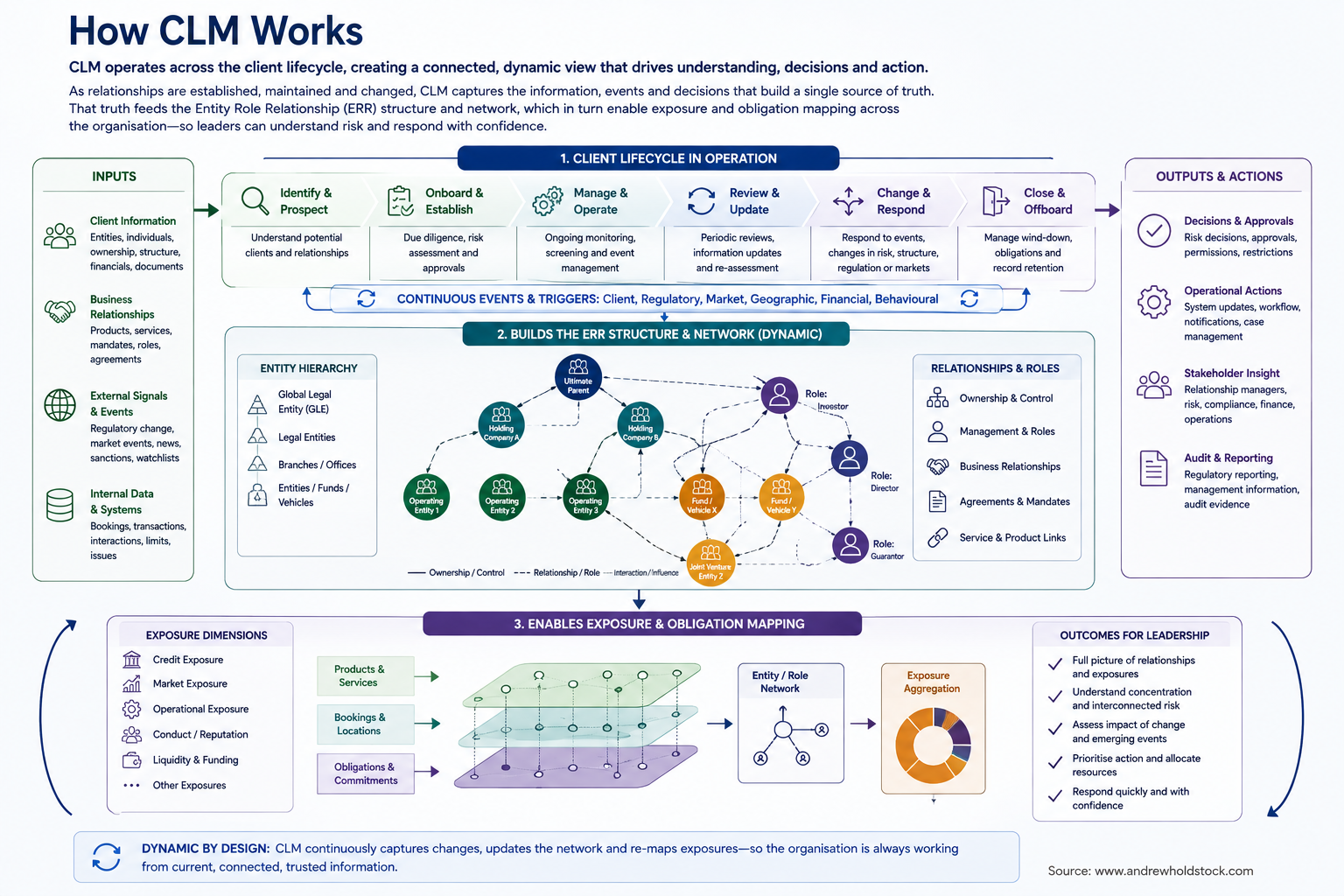
At the centre of that view is the Entity–Role–Relationship (ERR) structure. This is the connected representation of legal entities, people, ownership, roles, relationships and the business the organisation conducts with them. As changes occur in the client lifecycle, the ERR structure and the wider relationship network change with it.
Once relationships are structured in this way, products, booking locations, commitments, obligations and different forms of exposure can be mapped back to the entities and relationships that create them. A change in one part of the network can therefore be assessed for its effect elsewhere.
The client lifecycle is therefore not the end product of CLM. It is the mechanism through which the organisation's understanding of its business relationship network is continuously created, maintained and made usable for decisions and action.
The Client Relationship
A client relationship rarely maps neatly to a single legal entity.
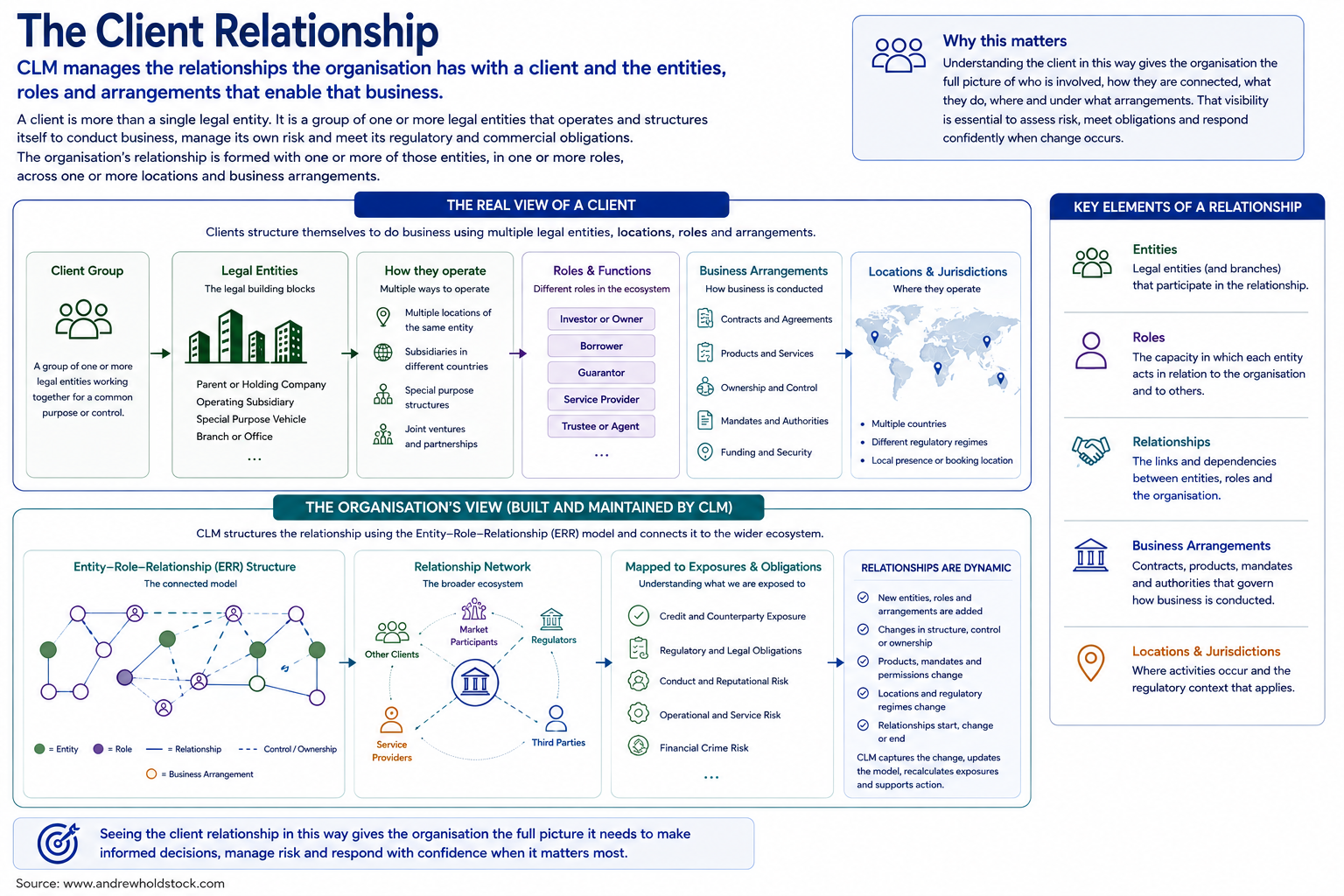
Clients structure themselves in the way that best enables them to conduct business and manage their own legal, regulatory, financial and risk requirements. That may mean operating through a single legal entity in several locations, through branches, through multiple subsidiaries, funds or special-purpose entities, or through a combination of these structures.
A financial institution may therefore conduct different parts of its business with different entities within the same client group, in different roles, through different products, booking locations and jurisdictions. Understanding the client means understanding both the individual legal entities with which the organisation has relationships and the wider structure that connects them.
CLM creates and maintains that connected client view. It links entities to their roles, relationships and business arrangements and places them within the wider ownership and relationship network. This gives the organisation a structure against which obligations, permissions, activity and exposure can be understood.
The legal entity remains the essential anchor, but the relationship is the context. Both are needed to understand the client properly.

KYC in CLM
KYC is an essential component of CLM, but is is not the whole of CLM.
Know Your Client establishes and maintains sufficient knowledge and assurance about the entities and people involved in a client relationship. It helps the organisation understand who it is dealing with, how those parties are owned and controlled, the purpose and nature of the relationship, and the risks that need to be assessed and managed.
That knowledge supports decisions about whether a relationship can be established or continued, the conditions under which business can be undertaken, and the level of ongoing review and monitoring required.
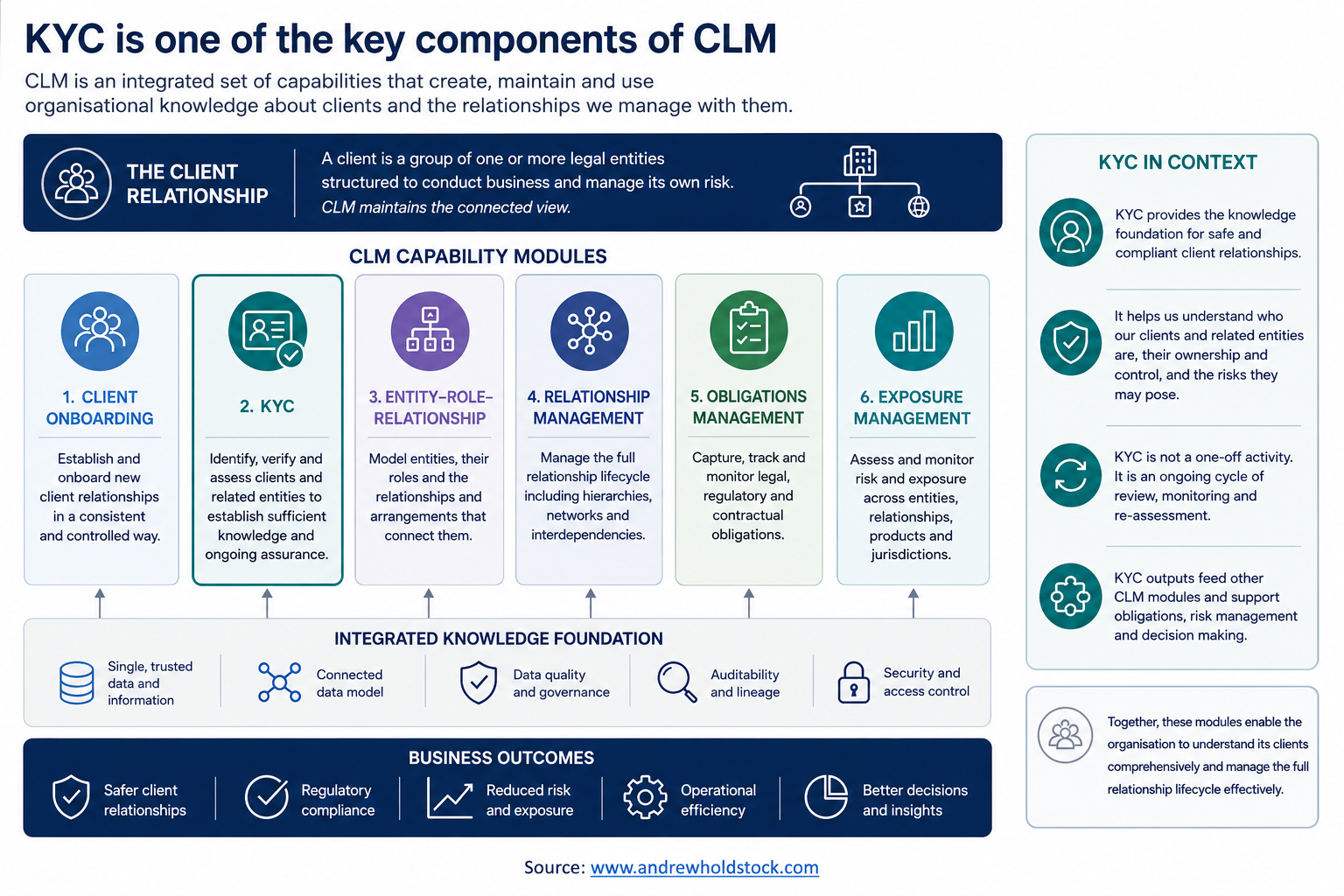
KYC does not operate independently. It relies on accurate entity and relationship information, policies and risk models, trusted evidence, screening, workflow and effective governance. Its outputs are then used by other CLM capabilities, including onboarding, permissions, monitoring, obligations management, exposure assessment, change management and offboarding.
This matters because weaknesses elsewhere in CLM cannot always be solved by improving the KYC process itself. Poor data, fragmented relationship structures, disconnected triggers or inconsistent permissions can undermine even a well-designed KYC control.
KYC provides knowledge and assurance about who the organisation is doing business with and the risks they present. CLM uses that knowledge, together with the other components of the capability, to manage the relationship safely throughout its lifecycle.
Customer Due Diligence
CDD is the due diligence activity that helps create the knowledge and assurance required for KYC.
Customer Due Diligence is the risk based process of obtaining, verifying and assessing information about a client and the parties connected to it. Its purpose is not simply to collect documents. It is to establish sufficient evidence and understanding to support an informed and defensible assessment of the relationship.
CDD typically establishes identity, ownership and control, the purpose and intended nature of the relationship, relevant activities and sources of funds or wealth where required. The depth of investigation should reflect the nature and level of risk, with enhanced due diligence applied where greater assurance is needed.
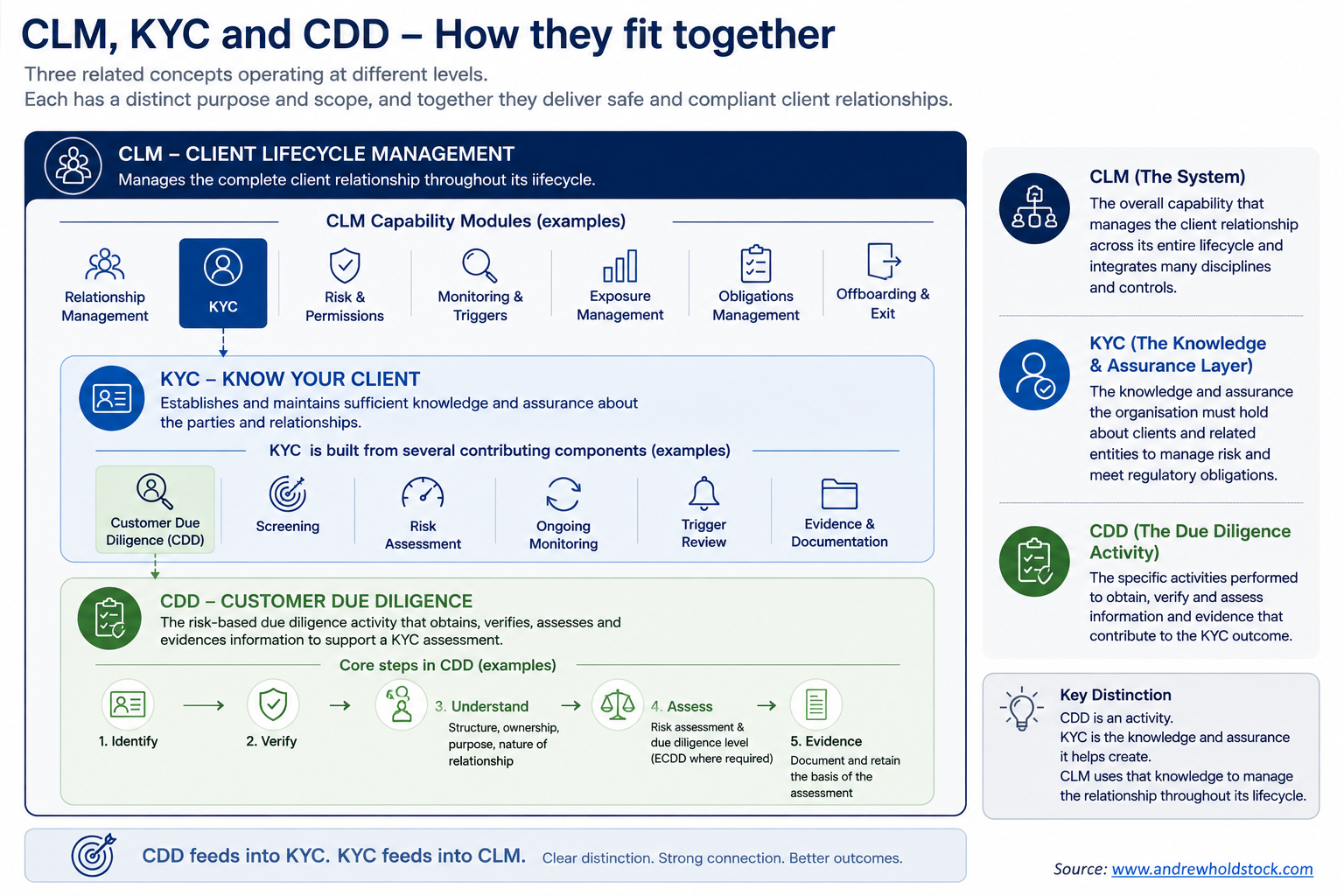
The distinction between CDD, KYC and CLM is important. CDD performs the investigation and assessment. KYC combines the resulting evidence and understanding with other information, controls and monitoring to maintain sufficient knowledge and assurance about the client. CLM then uses that knowledge alongside its other capabilities to establish, manage, change and ultimately close the relationship safely.
These boundaries are not always described consistently across organisations or regulatory frameworks. What matters operationally is that the activities, information, decisions and responsibilities are clearly understood and connected, rather than treating CDD, KYC and CLM as interchangeable terms.
CDD helps establish the evidence. KYC turns that evidence into continuing knowledge and assurance. CLM uses that knowledge to manage the client relationship throughout its lifecycle.
From Knowledge to Control
Knowing the client is only useful if the organisation can act on what it knows.
CLM turns knowledge of the client, its relationships and its risks into decisions about the business the organisation is prepared to undertake. Those decisions determine who the organisation will do business with, what products and services can be provided, where the business can take place, and what conditions or controls must apply.
This is where client knowledge becomes operational control. Risk appetite, regulatory requirements and internal policy are translated into permissions, limits, restrictions, monitoring requirements and other conditions that govern the relationship and the business conducted through it.
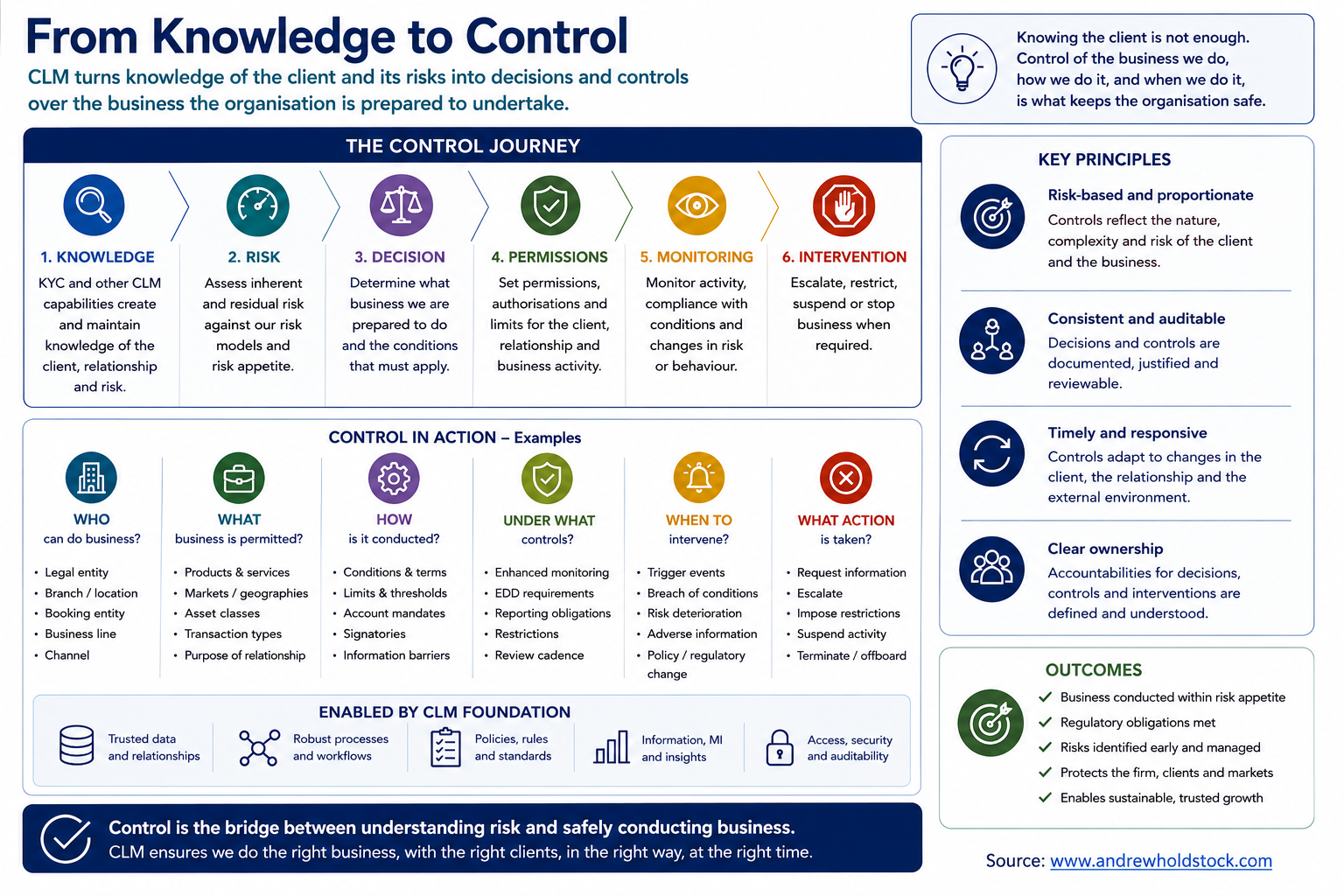
Control also has to be responsive. A relationship that is acceptable today may require different treatment tomorrow as ownership changes, new products are added, risks emerge, regulation develops or external events alter the environment. CLM provides the mechanisms to detect those changes, reassess their significance and adjust the organisation's response.
Effective control therefore depends on more than making the right decision once. The decision must be applied consistently across the relevant entities, products, systems and locations, remain visible and auditable, and change when circumstances require it.
CLM closes the gap between understanding risk and controlling business. It enables the organisation to do the right business, with the right clients, under the right conditions, and to intervene when those conditions are no longer met.
Bringing CLM Together
Every organisation already has a CLM capability, whether or not it recognises it as one.
The activities required to manage client relationships have to exist somewhere. Clients are onboarded, KYC is performed, data is maintained, risks are assessed, permissions are granted, obligations are tracked, changes are monitored and relationships are eventually restricted, suspended or closed.
The difference is how those activities are organised and connected. In some organisations they remain distributed across Operations, Compliance, Risk, Product, Finance and Technology, each with its own processes, systems and ownership. Others have created a CLM function, but use the term mainly for operational activities such as onboarding, KYC, periodic review and static data maintenance.
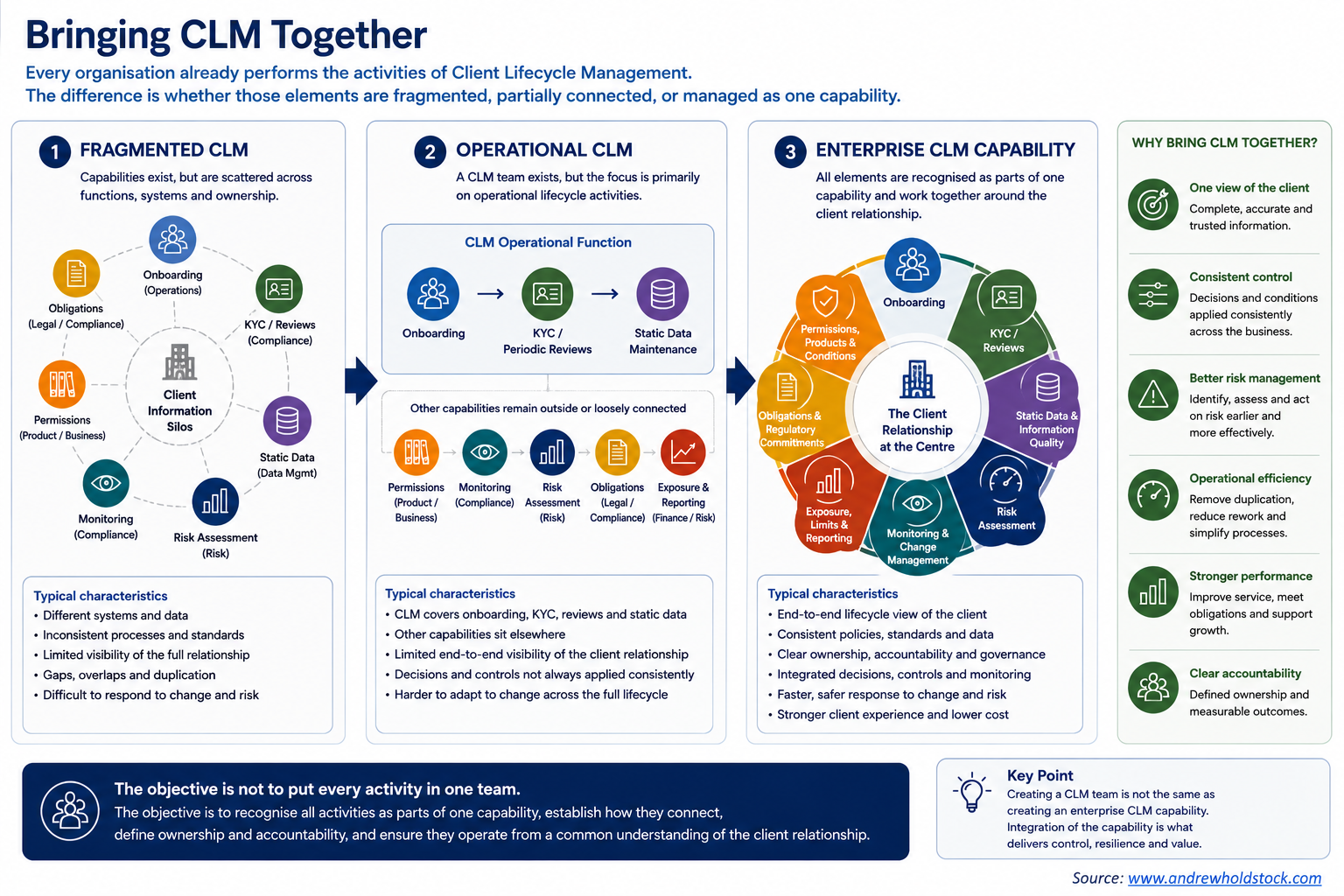
An enterprise CLM capability goes further. It recognises these activities as parts of one connected system for managing the client relationship. The objective is not necessarily to move every activity into one team, but to establish how the components fit together, who owns them, what information they share, how decisions and controls are applied, and how changes in one area are reflected across the wider relationship.
This matters because individual components can perform well while the overall capability remains weak. Fragmented ownership can create duplicated activity, inconsistent decisions, gaps between controls, disconnected information and limited visibility of the complete relationship. These weaknesses become most apparent when the organisation needs to respond quickly to change or risk.
Bringing CLM together means managing it as an enterprise capability rather than simply naming an operational function. The result is a common understanding of the client relationship, clearer accountability and a stronger basis for control, resilience and performance.
From CLM to Total Entity Exposure
CLM extends beyond the client lifecycle into the infrastructure that enables wider business participation, including the setup and maintenance of issuers, market counterparties and the identifiers needed for trading and investment activity.
A Bank or Financial Institution may interact with the same legal entity in more than one way. It may have a direct client relationship with that entity, while also trading its financial instruments, investing in securities it has issued, or holding other positions and obligations linked to it.
Those activities are often enabled through some of the same underlying capabilities used by CLM. Static data teams establish and maintain entity records and identifiers, identity is confirmed, legal entity hierarchies are created, and the resulting information is distributed to the systems that allow the organisation to transact.
This creates an important extension to the conventional client lifecycle view. Client relationships explain only part of the organisation’s exposure to an entity. Trading positions, investment holdings and other forms of participation may create additional exposures that need to be understood alongside the client relationship.
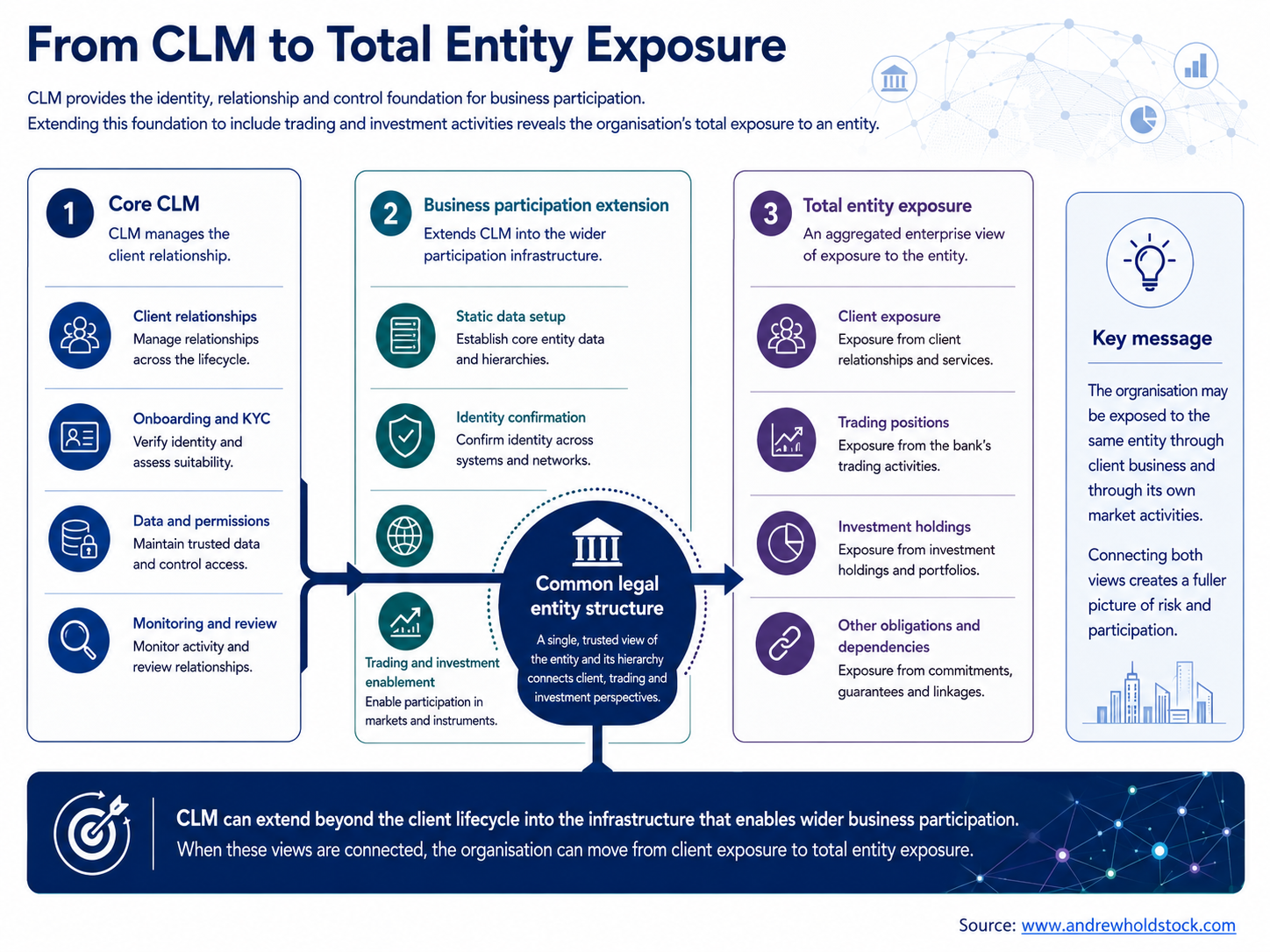
The legal entity provides the common anchor. When client, trading and investment activities resolve to the same trusted entity and hierarchy, the organisation can begin to aggregate exposures, obligations and dependencies that may otherwise remain separated across products, systems and business functions.
This becomes particularly important when circumstances change. Client distress, sanctions, market events or changes in ownership can affect more than the client relationship itself. A complete response depends on knowing all the ways in which the organisation participates with, through or in relation to the affected entity.
CLM provides much of the identity, relationship and control foundation for business participation. Connecting that foundation to the organisation’s wider activities creates the path from understanding client exposure to understanding total entity exposure.