Competitive Advantage


How banks build, defend and reshape their competitive position.
Banks do not stand still relative to one another. Over time, differences in performance, profitability and investment capacity can compound, strengthening some institutions, allowing others to catch up selectively, and causing others to focus or retreat to positions where they can compete more successfully.

The strategic question is therefore not simply how much a bank wants to grow. It is what competitive position the bank intends to occupy, where it expects to win, and whether its capabilities are strong enough to support that ambition.
Strong performance can create stronger returns. Stronger returns can increase the capacity to invest. Investment can improve technology, data, people, processes and other capabilities that strengthen future performance. Over time, this reinforcing cycle can widen the gap between institutions.
The implication is strategic. A bank needs to understand the position it wants to occupy, the performance required to compete there, and the capabilities it will need to build, sustain or strengthen to make that ambition achievable.
Choosing Where to Compete
Different positions can succeed if the bank is clear where it can win.
A bank does not need to be a global leader in every market to be successful. It does, however, need clarity about where it intends to compete, what role it wants to play, and where it can earn sustainable returns.
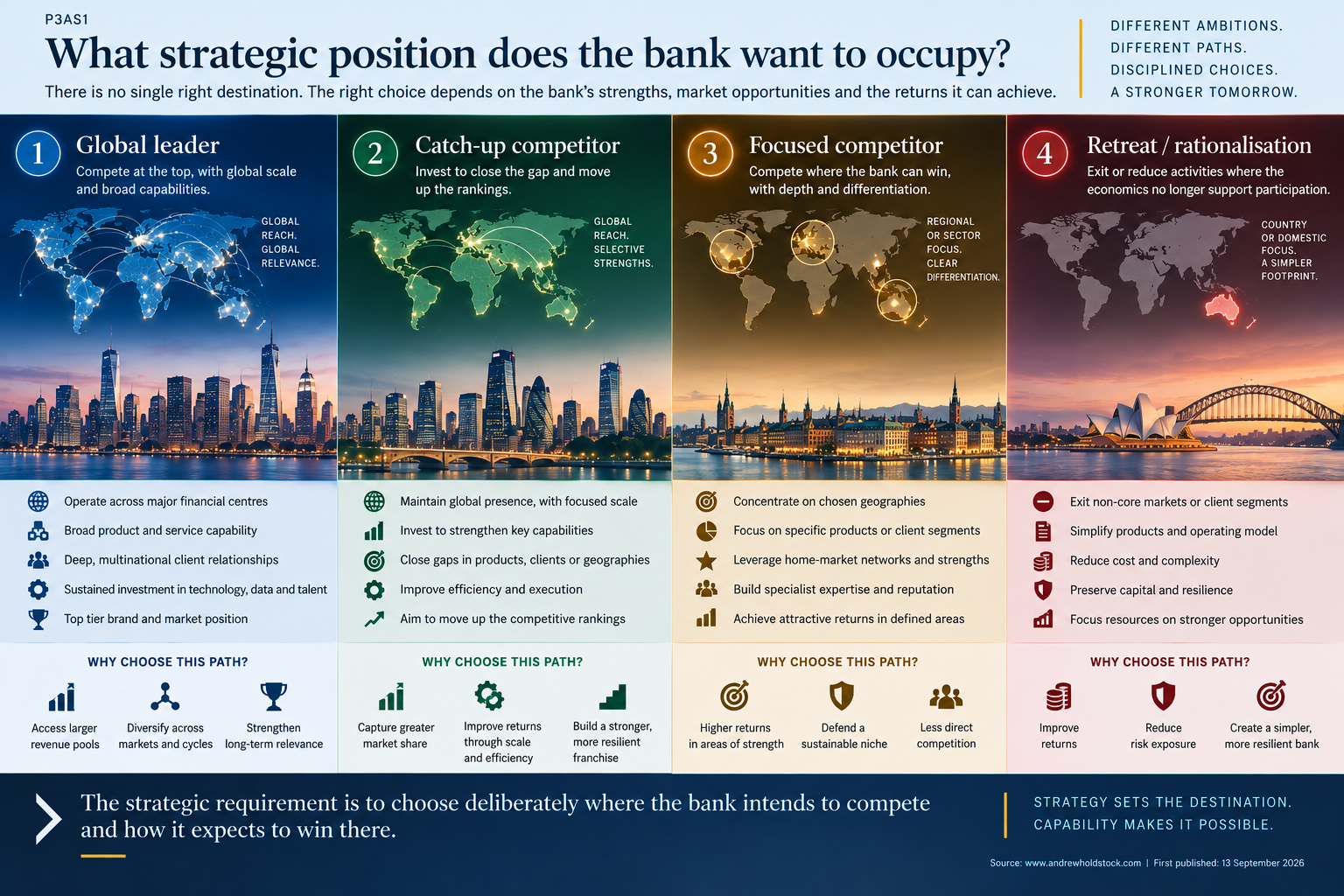
For some banks, the strategic ambition may be to build or defend a leading global position. Others may invest selectively to close gaps with stronger competitors. Some may choose to concentrate on particular regions, client segments, products or industries where they possess a structural advantage. Others may rationalise activities where scale, returns or competitive strength no longer justify continued investment.
These are different strategic choices, not simply different levels of success.
The appropriate position will depend on factors such as the strength of the existing franchise, client relationships, geographic reach, product capability, capital and investment capacity, cost base, risk appetite and the ability to differentiate.
The important question is therefore not whether every bank should move towards the same destination. It is whether the bank has deliberately chosen where it intends to compete, and understands why that position should be sustainable.
Strategy starts with choosing where to compete and how the bank expects to win.
Ambition requires the capabilities to deliver it.
Can the Bank Compete Where It Chooses?
Choosing where to compete is only the first step. The bank must also be capable of competing successfully in the position it has chosen.
A strategy to grow, defend market share, specialise or consolidate creates different demands on the organisation. A bank seeking greater global relevance may need stronger cross-border execution, data, technology, product breadth and operating resilience. A focused competitor may need exceptional depth and responsiveness in a narrower set of markets or client segments. A consolidating bank needs the information and discipline to identify where value is being created — and where resources should be redirected or withdrawn.
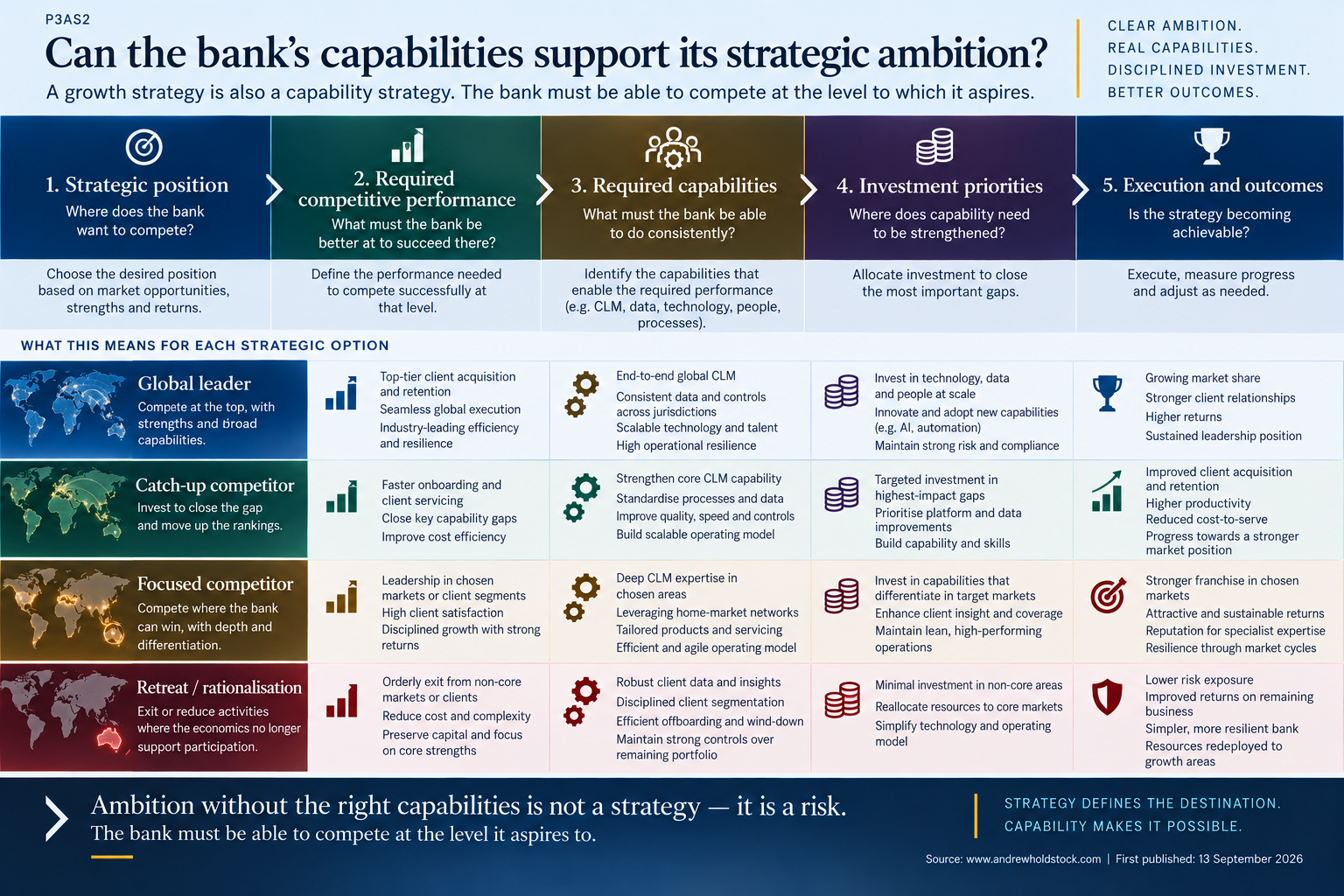
The required capabilities therefore follow from the strategic ambition.
This creates a direct chain:
Strategic position → required competitive performance → required capabilities → investment priorities → ability to execute
If critical capabilities are weaker than the strategy requires, the gap becomes a constraint on growth and competitiveness. If they are stronger, they can become a source of differentiation.
The practical question is therefore not simply whether a strategy is attractive. It is whether the bank has, or is prepared to build, the capabilities needed to make that strategy achievable.
Ambition without sufficient capability is not a strategy for advantage. It is a source of execution risk.
The Competitive Benchmark Keeps Moving
Competitors keep investing, raising the standard the bank must meet.
Reaching an attractive competitive position does not secure it.
Every position contains competition. Global leaders compete with other global leaders. Banks seeking to catch up are investing to close gaps. Focused competitors are trying to strengthen their advantage in the markets, products or client segments they have chosen. Even banks consolidating around a smaller franchise must remain competitive within that narrower position.
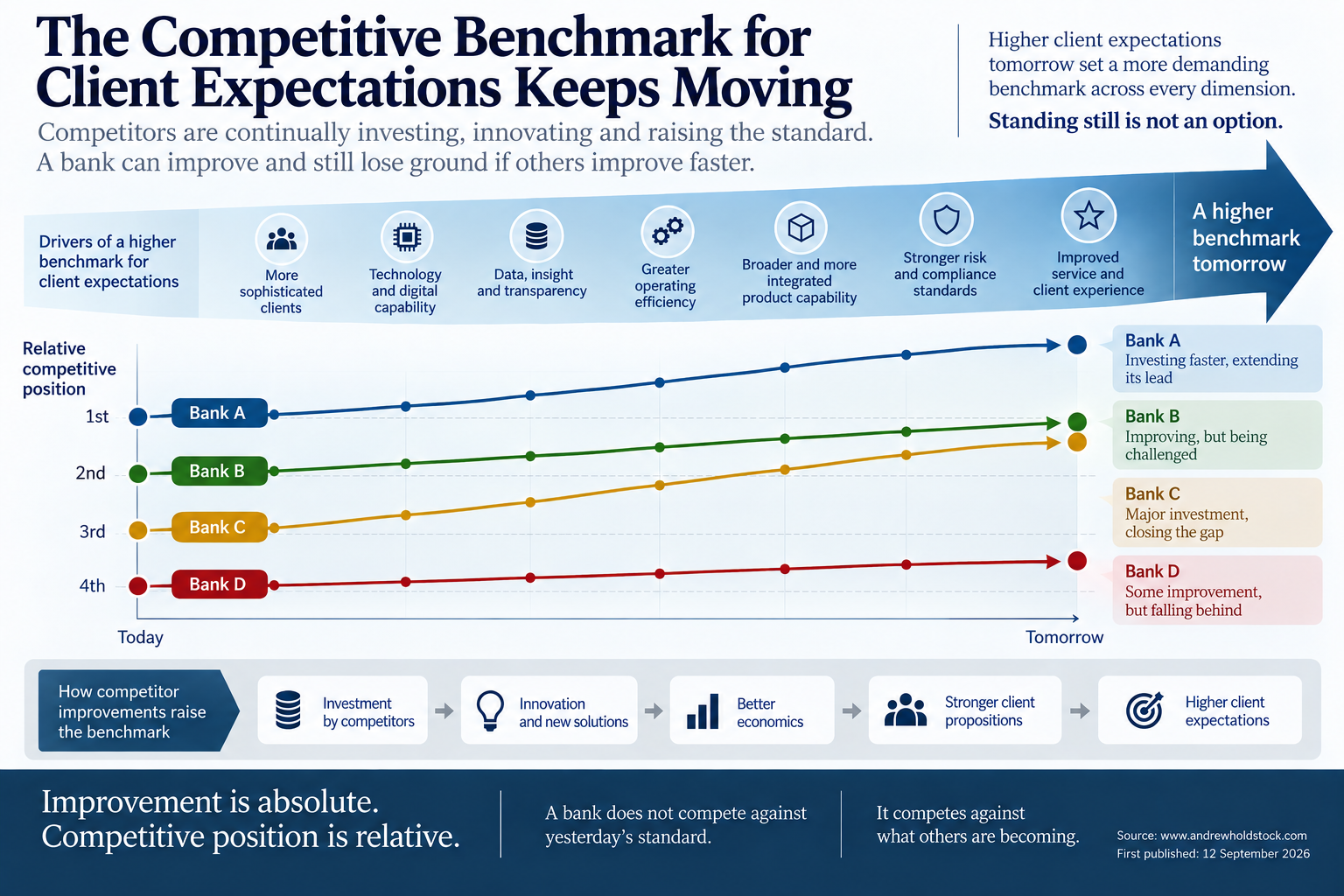
Competitors are also not standing still. They are improving technology, data, products, client experience, operating efficiency and the way work is performed. Some innovations may produce only incremental improvement. Others can change the economics of competing altogether.
This means competitive position is relative rather than absolute. A bank can improve and still fall behind if others improve faster.
Sustaining a chosen position therefore requires continuing attention to the capabilities that determine performance — identifying where advantage can be created, where competitors are pulling ahead and where further investment is justified.
The strategic question is not only whether the bank can compete today. It is whether it can continue to improve fast enough to remain competitive tomorrow.
How Competitive Advantage Is Created
Create a difference that clients value and deliver it consistently at sustainable economics.
Competitive advantage begins when a bank becomes meaningfully better than its competitors at something that matters to clients, and can sustain that difference economically.
The source of advantage will vary by business and market. It may come from better products or advice, greater geographic or product reach, stronger information and insight, faster and more reliable execution, a better client experience, lower cost-to-serve, or a reputation for consistently delivering when it matters.
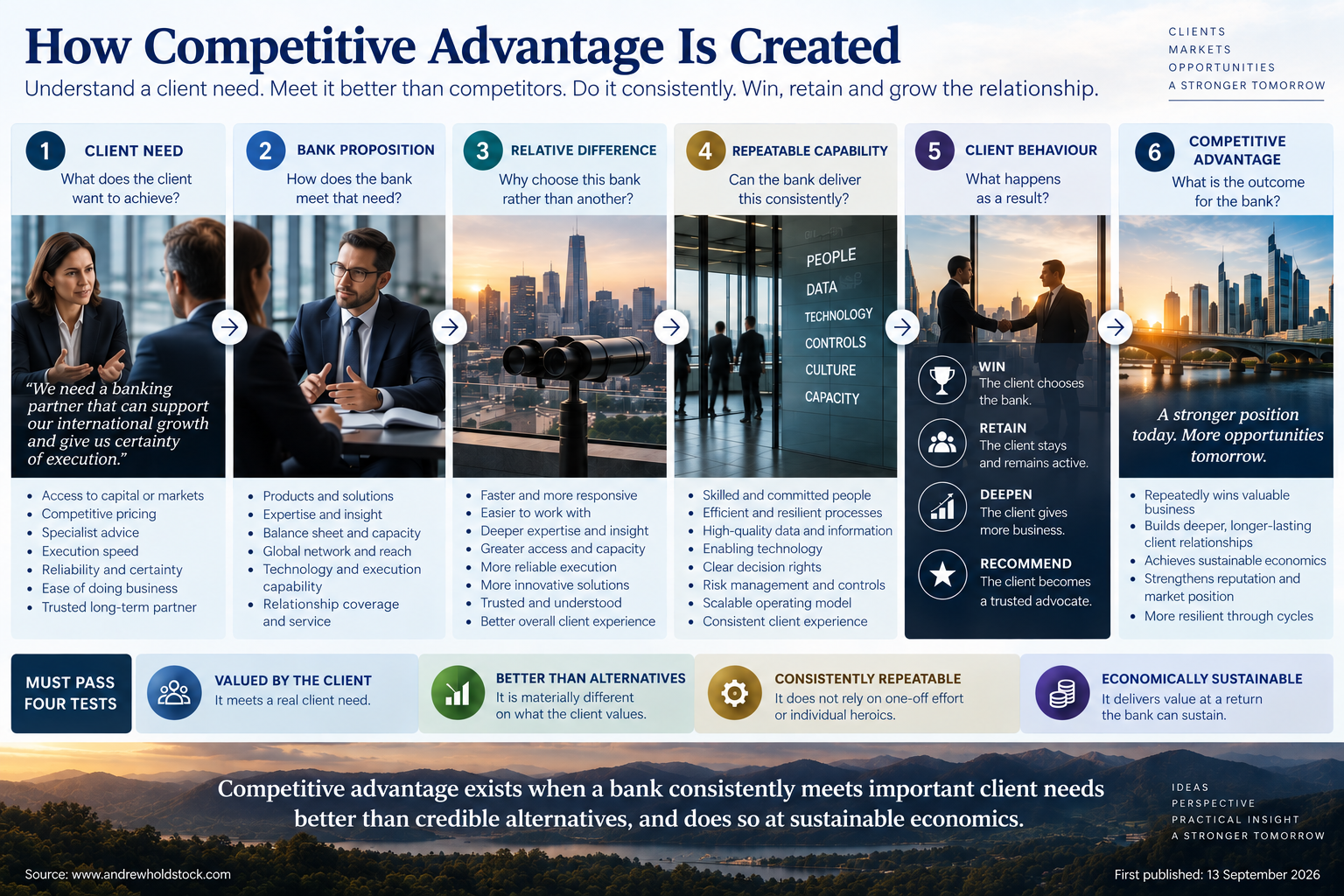
Innovation can create advantage by changing how these outcomes are achieved. Better technology, data, operating models or ways of working may allow the bank to deliver more quickly, with greater certainty or at lower cost. In other cases, advantage comes from concentrating resources and expertise on a particular market, client segment or product where the bank can become exceptionally strong.
The strongest advantages often combine several of these elements. Better information can enable faster decisions. Better execution can strengthen client confidence. Greater efficiency can allow the bank to offer a better service while maintaining attractive returns.
For an advantage to matter strategically, however, it must influence behaviour or economics. Clients must have a reason to choose the bank, place more business with it or remain with it, while the bank must be able to serve that business at an acceptable return.
Competitive advantage is created when distinctive capability produces an outcome that clients value and the bank can deliver sustainably better than its competitors.
How Competitive Advantage Compounds
Better performance strengthens economics and funds the next round of improvement.
Competitive advantage becomes more powerful when the benefits of better performance begin to reinforce one another.
A stronger client proposition can help the bank win more attractive business. Reliable execution can build confidence and deepen relationships. Deeper relationships can improve the bank’s knowledge of the client, creating opportunities to serve them more effectively and to reuse information rather than repeatedly starting again.
Better client economics can then create greater capacity to invest. That investment may strengthen technology, data, people, processes and service capability, improving performance further and making the next opportunity easier to win and execute.
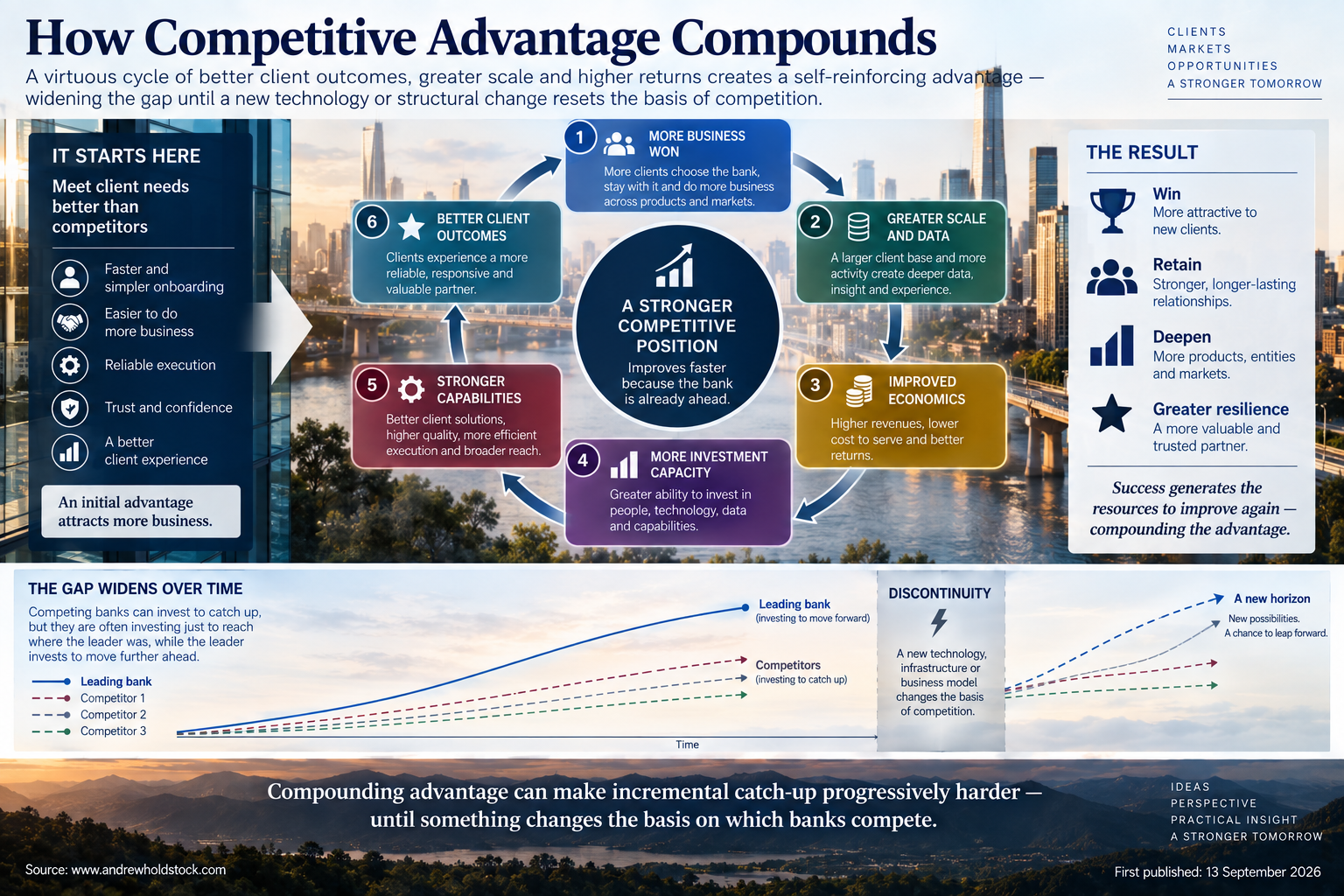
At the same time, better information about client profitability and cost-to-serve can support more disciplined portfolio choices. The bank can invest more in relationships where it has a credible advantage, simplify or exit those that consume disproportionate resources, and redirect capacity towards stronger opportunities.
Over time, these effects can become self-reinforcing:
Better capability → stronger client proposition → deeper and more profitable relationships → greater investment capacity → still better capability.
This is how relatively small differences in performance can grow into much larger differences in competitive position.
Competitive advantage compounds when better performance improves both the economics of the business and the bank’s ability to invest in the next round of improvement.
Where CLM Creates Competitive Value
CLM can make attractive business faster to execute, easier to expand and less costly to sustain.
CLM is not the only capability that can create competitive advantage. It can, however, influence several of the mechanisms through which advantage is built and sustained.
When well engineered, CLM can shorten the distance between a commercial opportunity and the bank being able to execute it. It can help the bank know what it already knows about a client, reuse information and prior due diligence where it remains valid, identify only what is genuinely new, and make the required risk and permissioning decisions more quickly.
That can reduce friction for both the client and the Front Office. It can also lower the incremental cost of expanding an existing relationship by making it easier to add products, entities, booking locations or other business without repeatedly rebuilding the client relationship from the beginning.
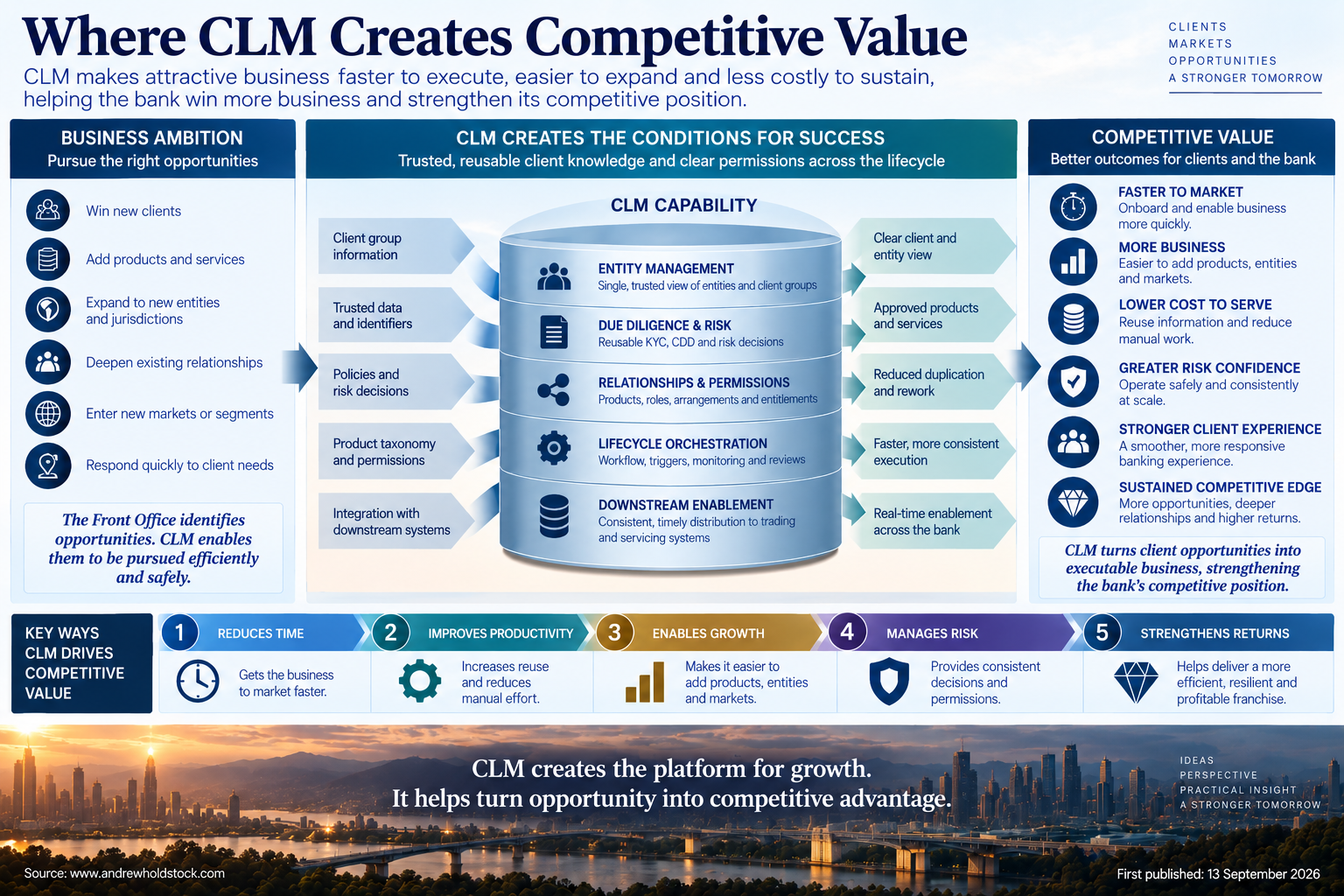
The same capability can support better portfolio decisions. By improving visibility of client complexity, servicing effort and relationship economics, CLM can help the bank distinguish between relationships to grow, maintain, simplify or exit.
Its competitive value therefore lies not simply in completing KYC or onboarding more quickly. It lies in making attractive business easier to execute, easier to expand and less costly to sustain.
CLM creates the capability. The Front Office realises the competitive advantage.
Turning Capability into Commercial Value
CLM creates potential; the Front Office converts it into growth, deeper relationships and better economics.
A well-engineered CLM capability can make the bank faster, more consistent and easier to do business with. It can improve reuse of information, reduce repeated work, shorten decision times and make it easier to expand an existing relationship.
But capability alone does not create commercial value.
That value is realised when the Front Office uses the capability to pursue attractive opportunities, deepen profitable relationships, introduce additional products or entities with less friction, and respond quickly when client needs change.

The Front Office also plays an important role in determining where further effort is justified. Better visibility of client complexity, servicing effort and relationship economics should support clearer decisions about which relationships to grow, maintain, simplify or exit.
When this works well, the benefits can reinforce one another. Reliable execution builds client confidence. Confidence can direct more business towards the bank. Deeper relationships create more knowledge that can be reused. Reuse can reduce the effort and cost required to execute the next opportunity.
The result is a stronger commercial cycle:
Better CLM capability → more effective Front Office action → better client experience and execution → deeper relationships → more reusable knowledge → stronger client economics → greater competitive advantage.
CLM creates potential advantage. The Front Office turns that potential into commercial advantage.
When Capability Becomes a Disadvantage
Weak execution creates friction, worsens economics and allows competitors to pull ahead.
The absence of competitive advantage is not necessarily neutral. If important capabilities fall behind those of competitors, disadvantage can also become self-reinforcing.
Poor information, fragmented processes and repeated work can increase the time and effort required to establish, maintain and expand client relationships. Clients may experience repeated requests, uncertain timelines and difficulty executing new business. The Front Office may spend more time navigating internal processes and less time developing the relationship.
The economic effects can accumulate. Higher servicing costs reduce relationship profitability. Limited visibility of client economics can allow complex or low-return relationships to continue consuming scarce capacity, while attractive opportunities compete for the same resources.
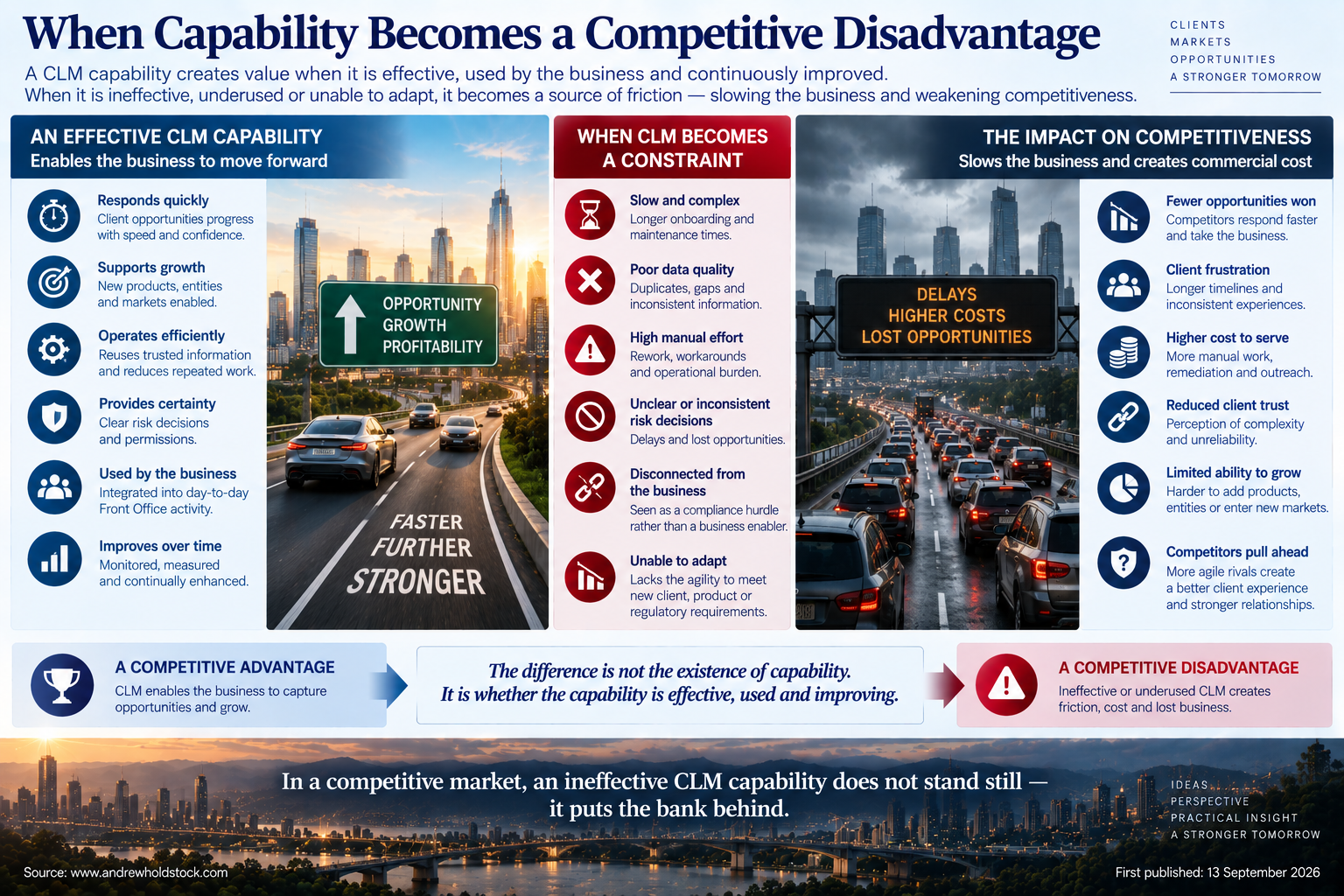
Repeated execution problems can also affect reputation. If clients experience another bank as easier, faster or more reliable to do business with, future opportunities may increasingly be directed elsewhere. The stronger competitor gains more business, deeper relationships and more client knowledge — further strengthening its position.
Lower returns can then constrain the ability or willingness to invest in the capabilities needed to close the gap. Meanwhile, competitors continue to improve and the benchmark moves again.
The resulting cycle can become difficult to reverse:
Weaker capability → greater friction and cost → poorer client experience and economics → lost or constrained business → reduced investment capacity → widening capability gap.
Competitive disadvantage therefore does not necessarily appear as a single failure. It can emerge gradually as the cumulative effect of being harder, slower or more expensive to do business with than the alternatives.
In a moving competitive market, failing to build advantage can eventually become a disadvantage in itself.