Business Arrangements


Every Financial Business Arrangement Has a Purpose and Carries Risk
Financial arrangements do not exist for their own sake. They arise because individuals, businesses, financial institutions and governments want to achieve something. They may need to finance an investment, acquire goods, raise capital, manage liquidity, facilitate trade, protect against uncertainty or generate a financial return.
Achieving these objectives brings participants together, each performing particular roles within arrangements that establish rights, responsibilities, commitments and obligations. A single economic objective may involve several interconnected arrangements, each serving a different purpose and involving different participants.

Every arrangement also carries risk. The pursuit of an economic objective introduces exposures and dependencies between participants. Financial arrangements can retain, share, transfer, mitigate or concentrate those risks, but transferring a risk does not necessarily eliminate it. Ultimately, someone remains exposed to the consequences when an obligation cannot be fulfilled or an expected outcome does not materialise.
The financial system is therefore more than a collection of institutions, markets and products. It is an interconnected network of business arrangements through which economic activity is enabled, financial obligations are established, and risks are distributed across participants.
To understand the financial system, we must understand the arrangements that make it work.
From Economic Purpose to Financial Arrangement
Financial products are not the starting point. The economic objective is.
Individuals, businesses, governments and financial institutions enter financial arrangements to achieve an outcome: obtain funding, make payments, invest, manage liquidity or protect against financial uncertainty.
Consider a manufacturer purchasing machinery from an overseas supplier. The underlying commercial arrangement creates obligations to deliver and pay. Supporting that transaction may require financing, international payments, guarantees and foreign exchange hedging.

Each financial arrangement has its own purpose, participants, obligations and risks. Although separate, these arrangements are economically connected through the manufacturer's underlying objective.
This principle applies throughout the financial system. Financial products provide the means to achieve economic objectives, while the arrangements establish how participants engage, what obligations arise and how risks are allocated.
Understanding the underlying purpose is essential to understanding the arrangement, its dependencies and the risks it carries.
One Financial System. Many Arrangements.
Different purposes, participants and obligations connected through the movement of money, assets and risk.
Financial arrangements extend across almost every aspect of economic activity. They enable borrowing and lending, payments, investment, international trade, risk management, asset ownership, and participation in financial markets.
Some arrangements are relatively simple, involving two participants with clearly defined obligations. Others bring together borrowers, investors, intermediaries, agents, custodians, clearing houses and other participants, each performing different roles.

Arrangements are also interconnected. A securities issuance, for example, may involve underwriting, distribution, investment, custody, clearing and settlement arrangements. Each serves a distinct purpose, yet all contribute to the wider economic activity.
Across this diversity, money, assets, obligations and risks move between participants. The failure of one arrangement can affect others, sometimes transmitting consequences far beyond the original transaction.
Understanding the financial system therefore requires understanding not only individual arrangements, but also how they connect, depend upon one another and distribute risk.
One Project. Hundreds of Participants. Interconnected Arrangements.
The Channel Tunnel demonstrates how a single economic objective can create a complex network of financial and commercial obligations.
The Channel Tunnel began with a straightforward economic objective: establish a permanent transport link between Britain and continental Europe, enabling the movement of passengers, vehicles and freight.
Achieving that objective required an extraordinary network of arrangements involving two governments, concessionaires, shareholders, nearly 200 lending banks, construction companies, railway operators and other participants.

Each arrangement served a particular purpose. Government concessions established operating rights, investors provided capital, syndicated loans funded construction, contractors undertook delivery, and railway agreements provided access to the infrastructure. Each introduced distinct rights, obligations, dependencies and risks.
When construction costs escalated and revenues fell short of expectations, financial pressures spread through the interconnected arrangements. The resulting debt burden ultimately required major financial restructuring, demonstrating how the consequences of an underlying economic activity can extend across a network of participants.
The Channel Tunnel illustrates a fundamental characteristic of the financial system: one economic objective can generate many arrangements, each carrying its own risks, yet dependent upon the performance of others.
The Anatomy of a Business Arrangement
Different arrangements, common foundations: purpose, participants, roles, obligations and risk.
Whether a simple loan, a securities transaction or a complex infrastructure financing, every business arrangement has an underlying structure that explains how it works.
An arrangement brings participants together to achieve an objective. Each participant acts in one or more roles, establishing relationships through which rights, responsibilities, obligations and exposures arise. Terms and conditions govern how the arrangement operates, while contracts and other authoritative instruments establish its legal framework.
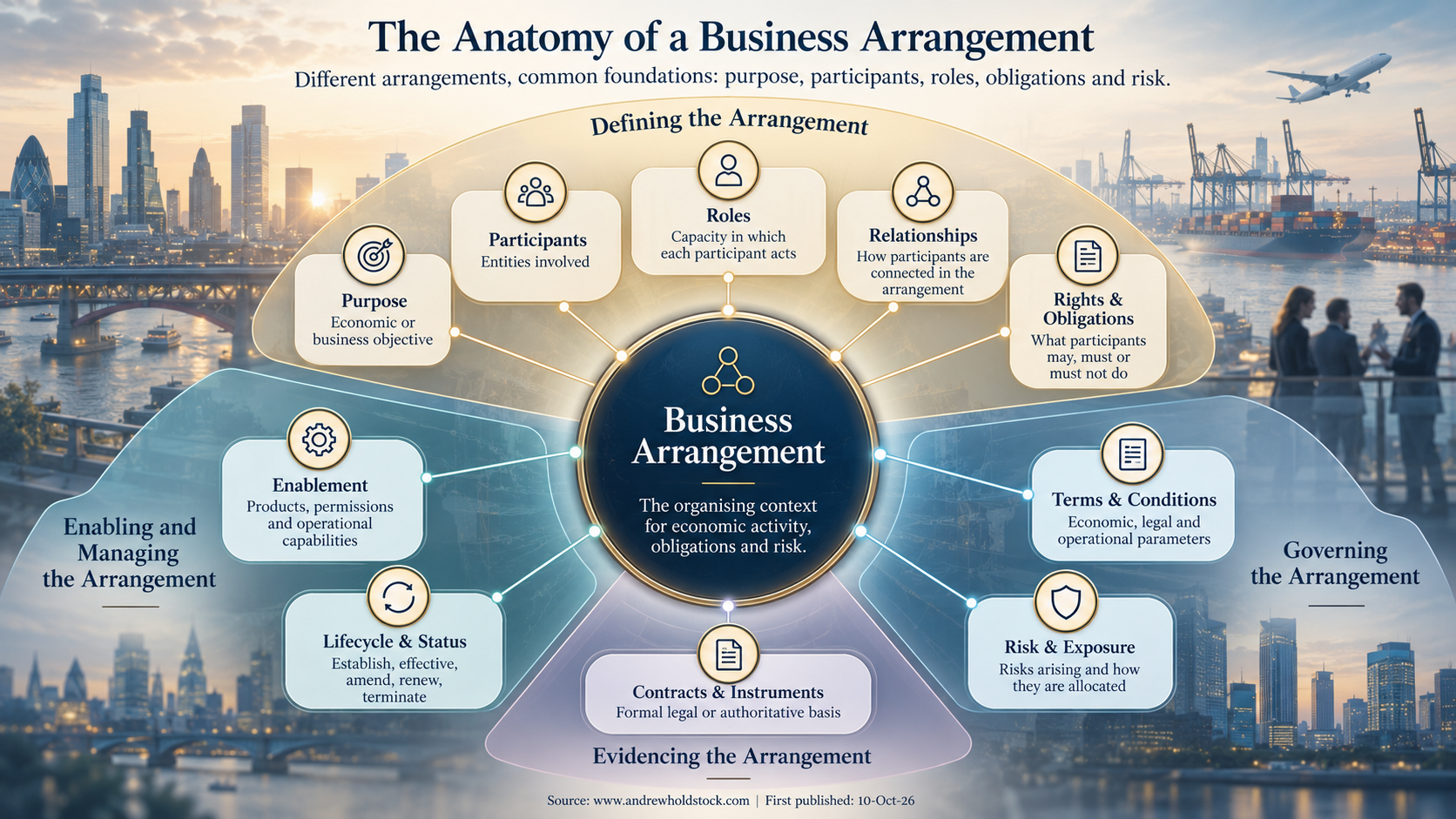
Arrangements also have a lifecycle. They are established, become effective, may be amended or renewed, and eventually expire or terminate. Throughout that lifecycle, participants, obligations, permissions and risks may change.
Understanding an arrangement means knowing who is involved, why they are involved, what they are entitled or obliged to do, and how the associated risks are allocated and controlled.
Interconnected Arrangements
Financial arrangements can form hierarchies, create dependencies and transmit obligations and risks beyond their immediate participants.
Financial arrangements do not always exist independently. Some form part of larger arrangements, while others are separate but connected through contractual, operational or financial dependencies.
A syndicated loan, for example, may involve an overarching facility supported by individual lender commitments, guarantees, security and agency arrangements. Each serves a distinct purpose, but their operation and effectiveness are interconnected.

These connections are not always hierarchical. A derivatives transaction, for example, may depend upon separate clearing, margin and collateral arrangements involving different participants. Although legally distinct, the arrangements remain economically and operationally connected.
Changes to one arrangement can therefore affect others. An amendment, default, suspension or termination may alter obligations, exposures or the ability of participants to continue operating.
Interconnected arrangements may involve the same entities performing different roles, or the same role across multiple arrangements. A bank may act as a lender, agent or guarantor in different transactions, while a custodian may service hundreds of investment funds. Equally, several entities may perform the same role within one arrangement.
Understanding these connections requires recognising not only the entities involved, but the roles they perform and the arrangements in which they act. These connections determine how rights, obligations, dependencies and risks extend across the financial system.
The entity establishes who is involved, the role establishes the capacity in which it acts, and the arrangement establishes the business context in which those responsibilities and exposures arise.
How Financial Arrangements Create and Distribute Risk
Financial arrangements enable economic activity, but the obligations and dependencies they establish also determine who is exposed when things go wrong.
Every financial arrangement carries risks arising from its underlying economic purpose. A borrower may default, a supplier may fail to deliver, an investment may lose value, or market conditions may change unexpectedly.
Arrangements establish how these risks are allocated between participants. Through lending, guarantees, collateral, derivatives and insurance, risks may be retained, shared, transferred, mitigated or concentrated. Transferring risk, however, does not necessarily eliminate it.
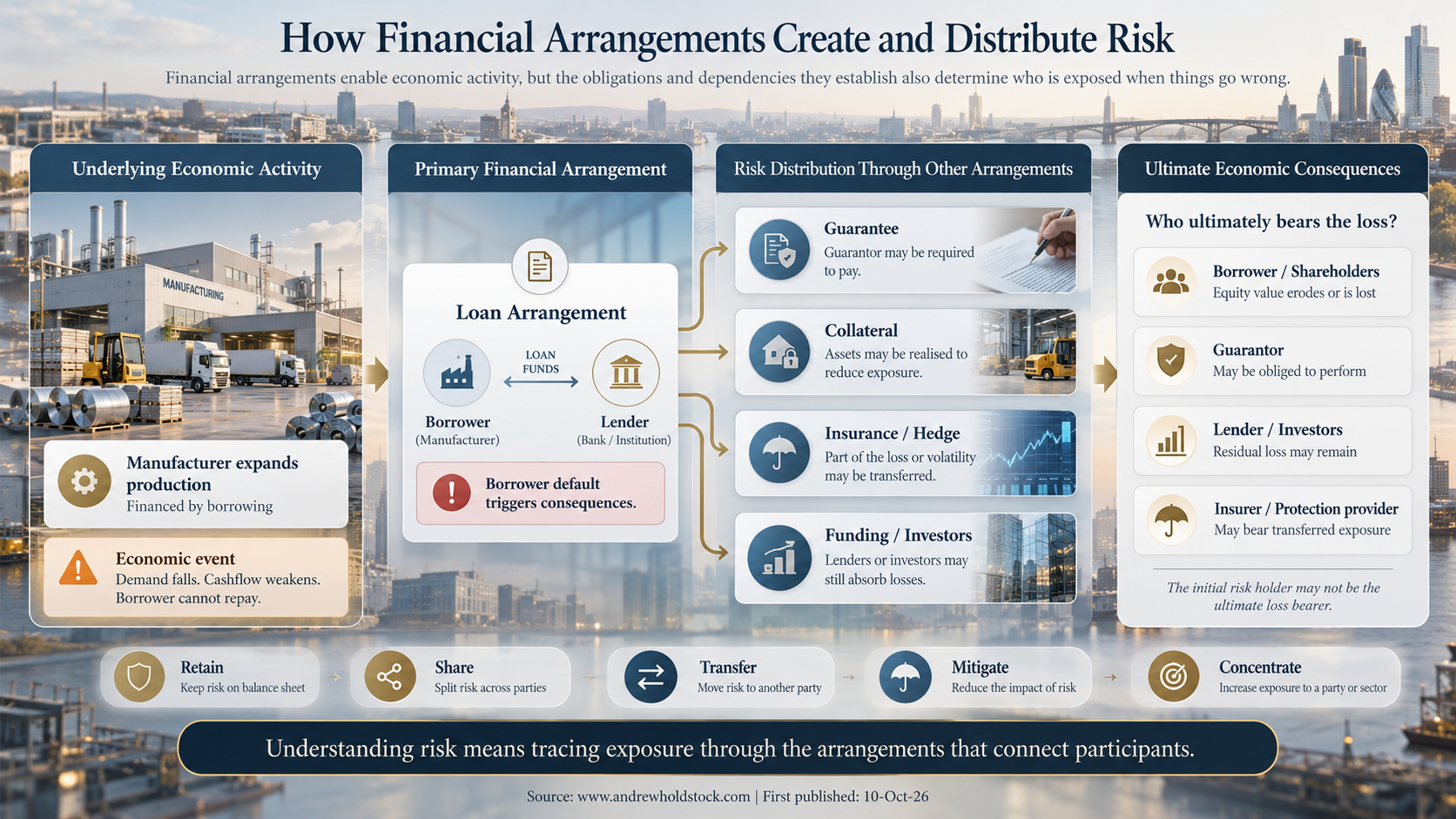
When risks materialise, the consequences follow the roles, rights and obligations established across the arrangements. A borrower's default may trigger a guarantee, the realisation of collateral or losses for lenders and investors. Where arrangements are interconnected, the consequences can extend well beyond the original participants.
Importantly, the participant initially exposed to a risk may not be the one that ultimately bears the loss. Understanding where losses fall requires tracing the underlying economic exposure through the arrangements and obligations connecting participants.
Understanding financial risk therefore requires knowing not only what could go wrong, but who is exposed, how the risk is distributed, and who ultimately bears the consequences.
From Financial Arrangements to Banking Products
Financial products are the means through which banks support the objectives, obligations and activities established by business arrangements.
Banks organise their businesses around products and services such as lending, payments, trade finance, custody, securities and derivatives. But these products exist to meet the requirements arising from financial arrangements.
A single arrangement may require several products. An international trade transaction, for example, might involve financing, payments, guarantees and foreign exchange hedging. Equally, the same banking product may support many different arrangements, participants and economic purposes.
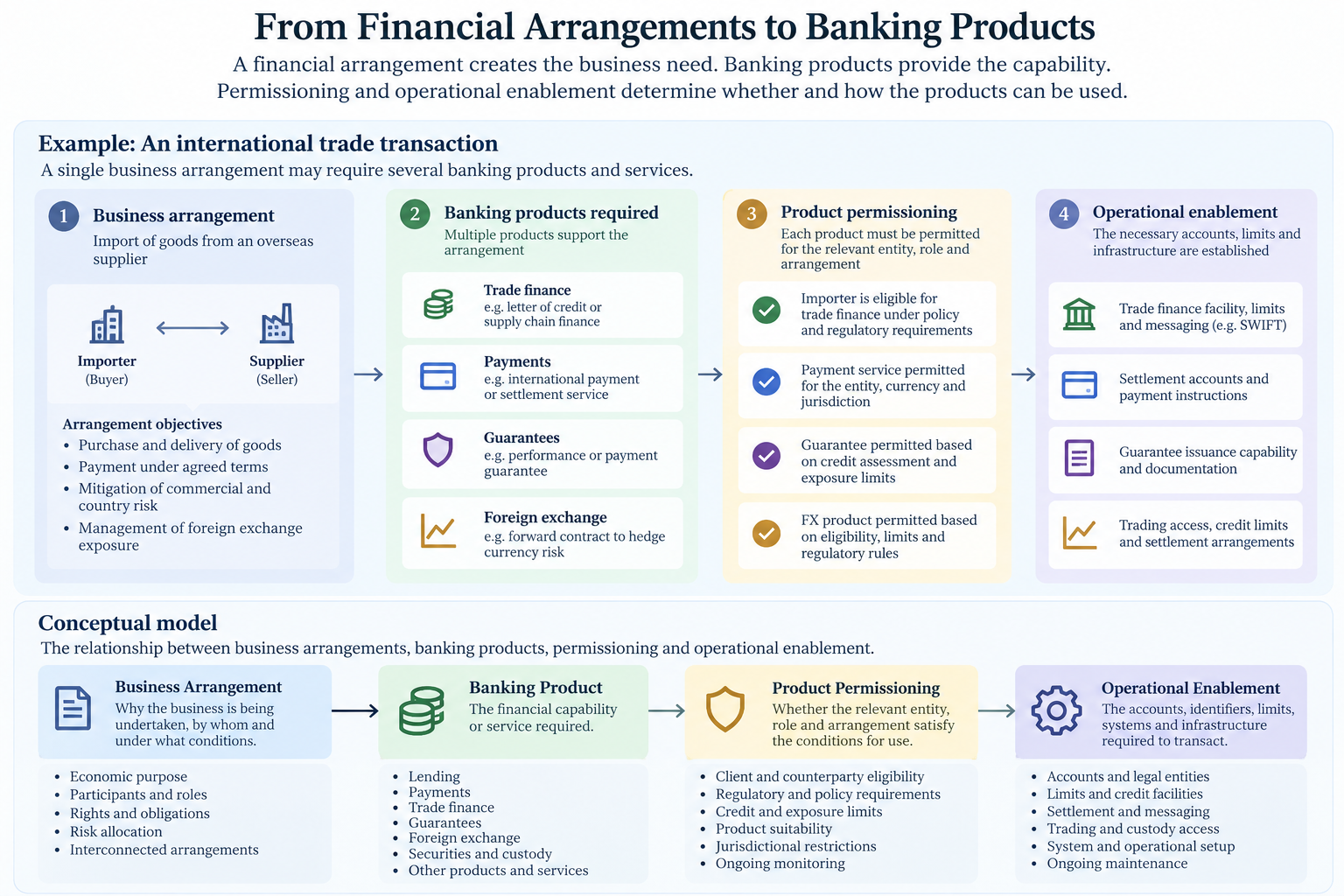
Providing a product therefore requires more than identifying the customer and selecting a product from a catalogue. The bank must understand the arrangement, the entities involved, the roles they perform, the applicable contractual and regulatory requirements, and the conditions under which the product may be provided.
The product may then require operational enablement through accounts, limits, settlement instructions, trading access or other downstream capabilities.
The arrangement establishes the business context. The banking product provides the capability. Permissioning and operational enablement determine whether and how that capability can be used.
Why Banks Must Understand Their Business Arrangements
There is no client relationship without an underlying business relationship, or the prospect of one.
A client relationship exists because the bank intends to undertake, is undertaking, or has undertaken business with a client. Business arrangements give that relationship substance, establishing its purpose, participating entities, roles, rights, obligations and associated risks.
Understanding these arrangements enables the bank to determine what business it can undertake, with whom, in what capacity and under what conditions. It provides the context for contractual commitments, regulatory eligibility, product permissions and operational enablement.
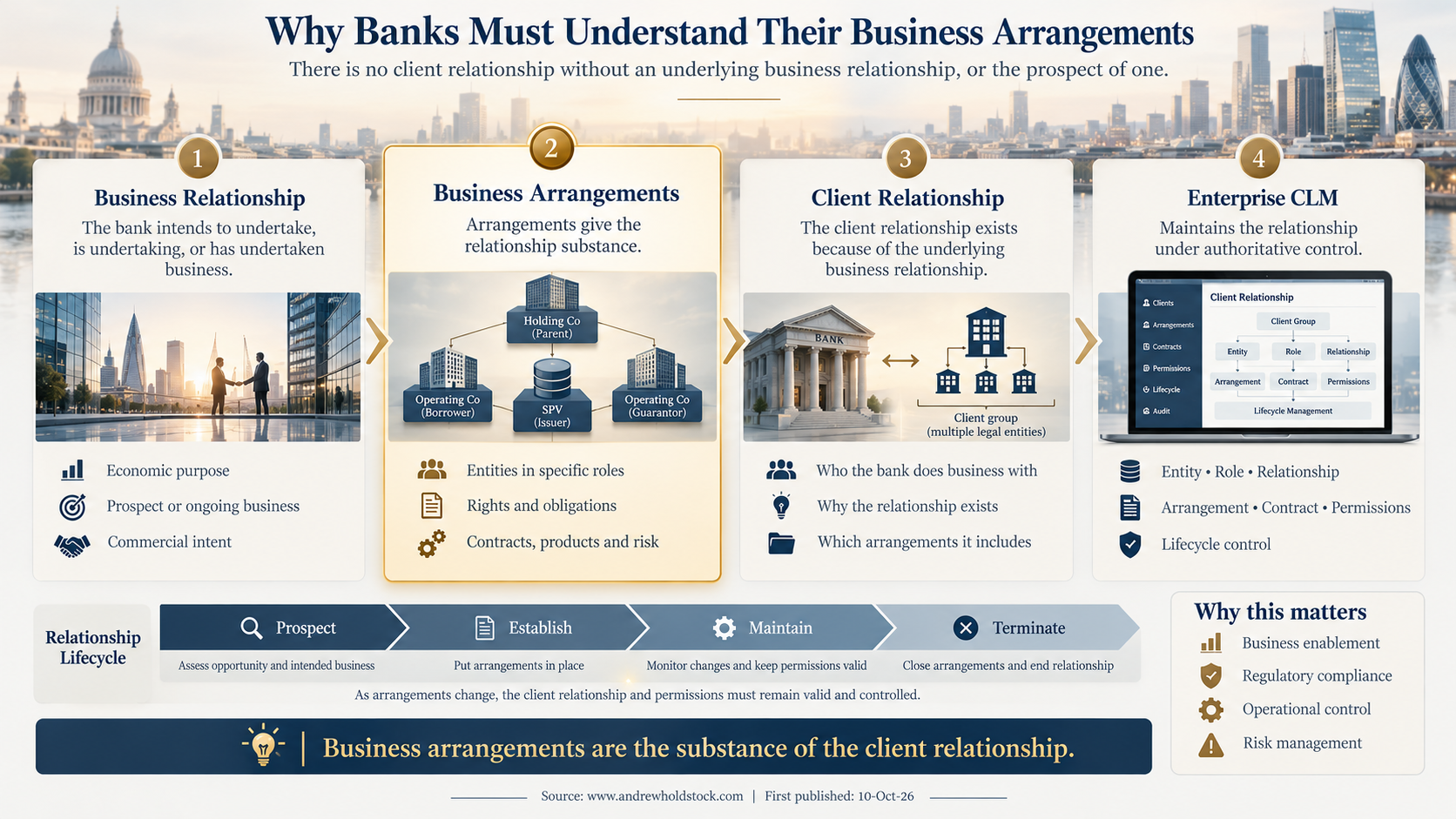
As arrangements are established, amended, fulfilled or terminated, the wider client relationship may change. The bank must maintain an authoritative understanding of these changes, including their implications for other arrangements, continuing obligations and risk exposures.
Managing client relationships therefore requires more than maintaining entity records, completing KYC or enabling banking products. It requires understanding the business arrangements that justify and define the relationship.
Business arrangements are the substance of the client relationship. Enterprise Client Lifecycle Management ensures that relationship remains valid, appropriately permissioned and under control throughout its lifecycle.