Contracts

When Business Becomes Binding
Business arrangements describe what parties intend to do. Contracts define what they are legally committed to do.
Banks do business through arrangements: lending, trading, investing, paying, safeguarding, advising and providing access to markets. But those arrangements often need a legal framework before the parties can rely upon them.
A contract identifies the parties and establishes enforceable rights, obligations, conditions and remedies. It may define what can be done, by whom, under what circumstances, for how long, and what happens when something goes wrong.
But the contract is not the business relationship itself.
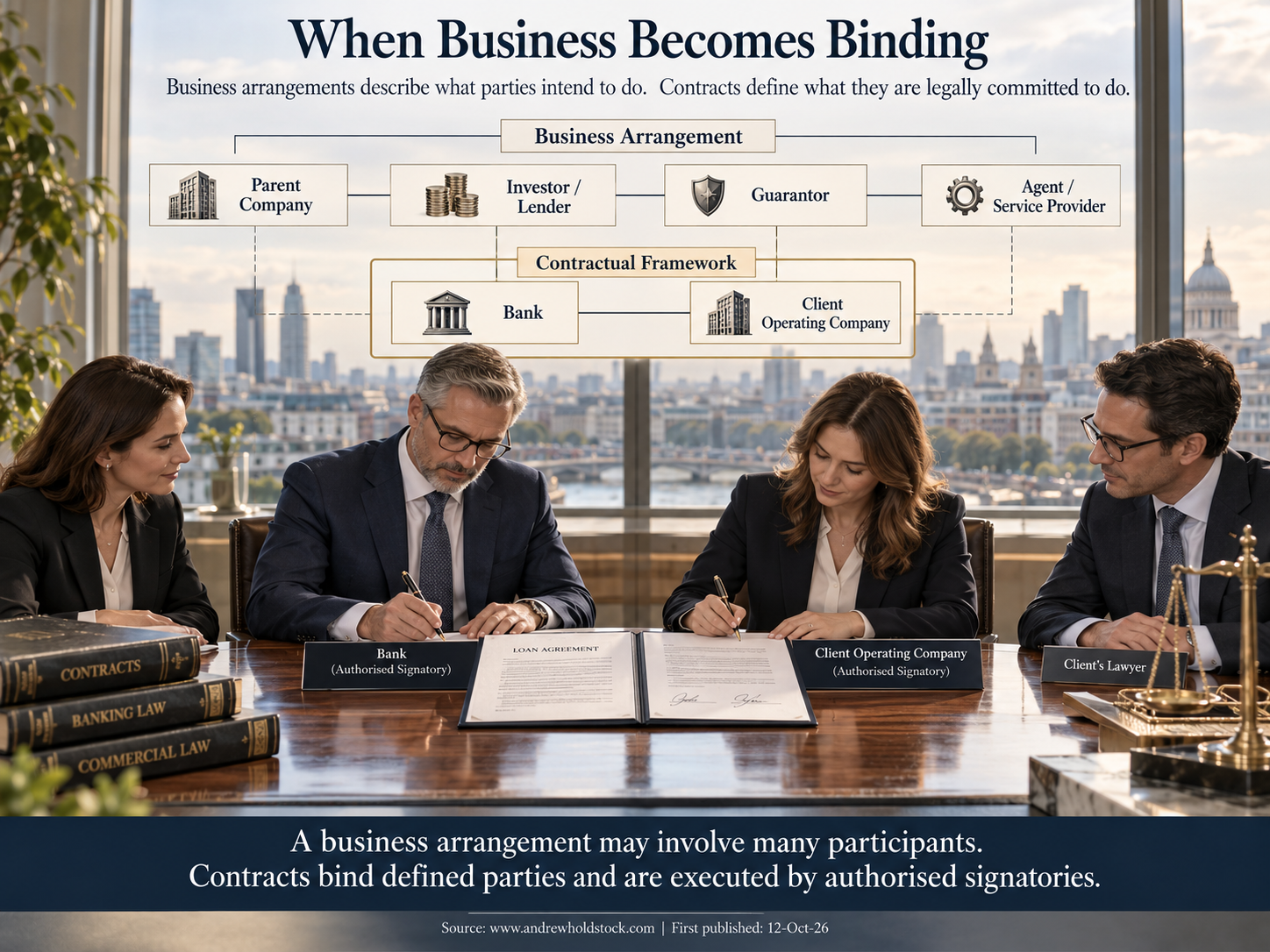
A client relationship may contain many business arrangements. An arrangement may depend upon several contracts. A contract may govern many products or transactions. And some participants important to the arrangement may not themselves be parties to the contract.
Understanding those distinctions matters because the bank must know not only that a contract exists, but what it governs, who it binds, and whether it remains capable of supporting the business being undertaken.
What Is a Contract?
A contract is the legally enforceable framework through which parties define what they have agreed to do.
At its simplest, a contract identifies the parties and establishes rights, obligations, conditions, scope and consequences.
It can determine who must perform, what must be delivered, when performance is required, what conditions must first be satisfied, what happens if something goes wrong, and how the arrangement can be changed or brought to an end.
But a contract should not be confused with the business relationship itself.
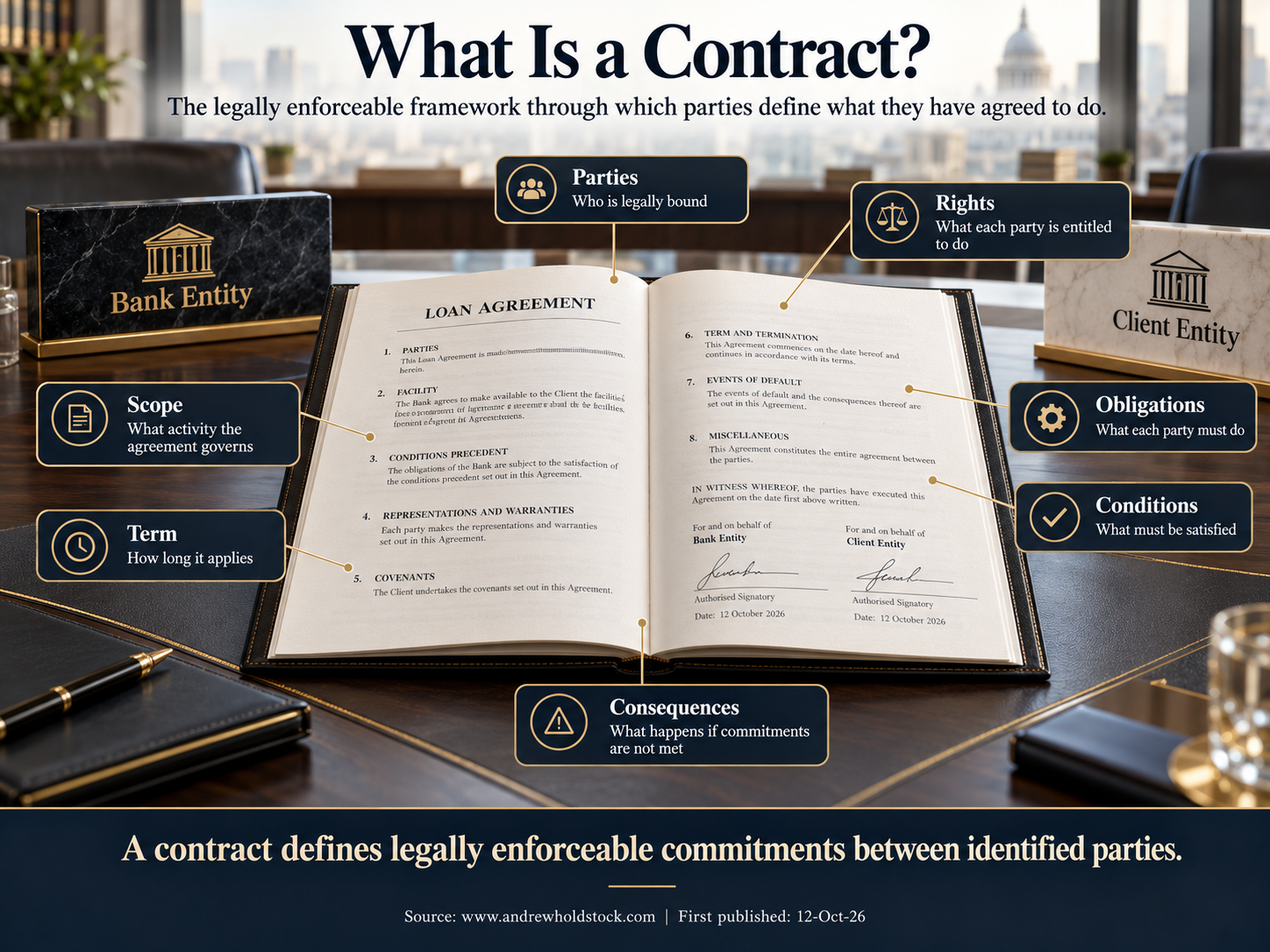
The relationship may be much broader. The arrangement may involve several participants. The contract may govern only part of what the parties are doing together.
In banking, this distinction matters because contracts sit within a wider structure of entities, roles, relationships and business arrangements.
A bank therefore needs to understand not simply that a contract exists, but what it governs, which legal entities it binds, and how it relates to the activity the bank is permitting.
Participants, Parties and Signatories
The entities involved in a business arrangement, the parties bound by its contracts, and the people who sign those contracts are not necessarily the same.
A business arrangement can involve many participants. Some may provide funding, security, guarantees, agency services, investment management, settlement support or other functions that make the arrangement work.
But contractual rights and obligations attach only to the legal persons that are party to the relevant contract.
And the person who signs that contract may simply be acting on behalf of one of those legal persons.
That distinction matters.
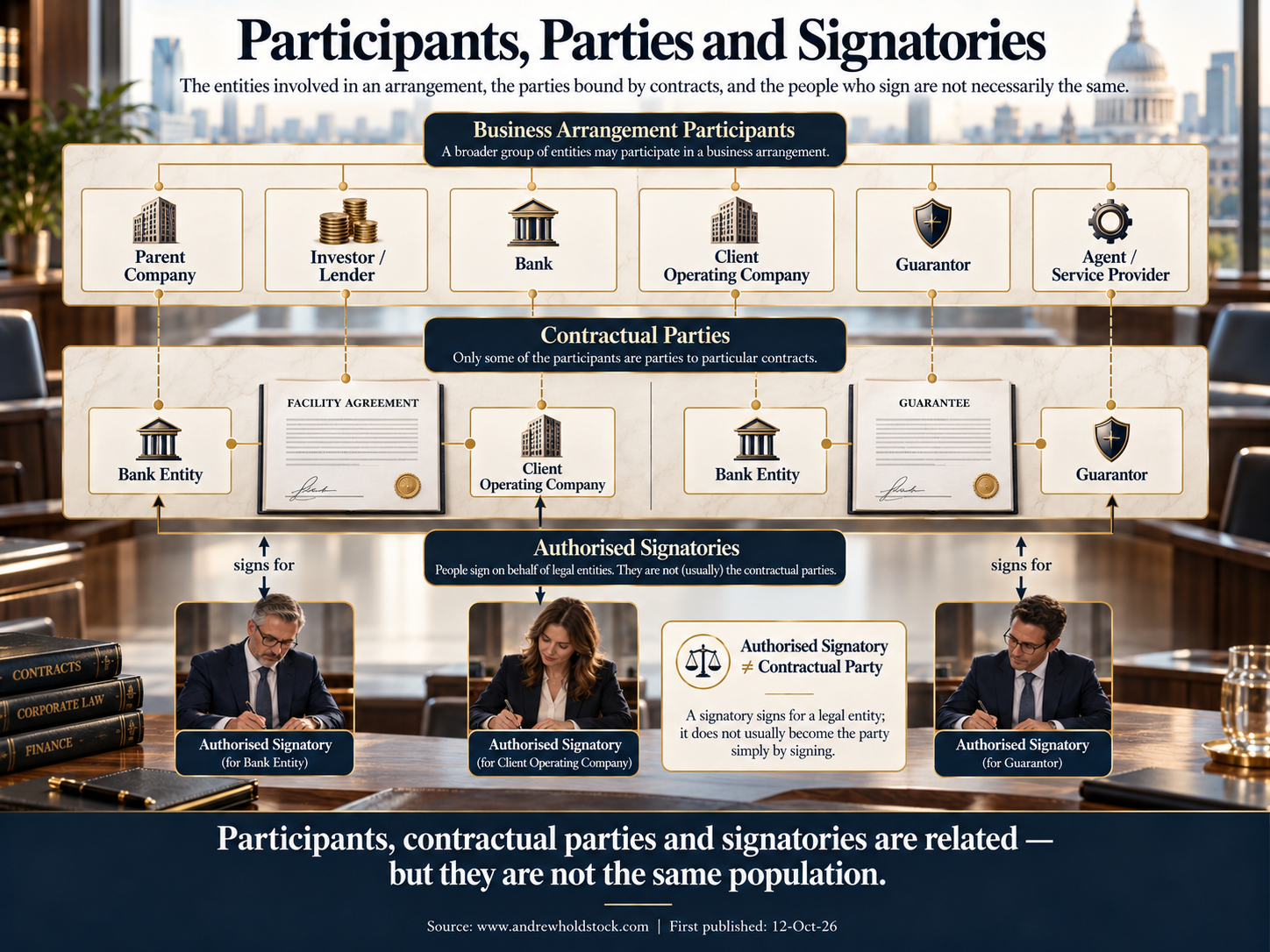
An entity may participate in the wider arrangement without being party to a particular contract. A contractual party may be involved only for one part of the arrangement. Several contracts may bind different combinations of entities. And an authorised signatory does not usually become a party merely by signing.
The bank therefore cannot determine the complete business relationship simply by reading a signature page.
It must understand separately:
who participates in the arrangement, what role each entity performs, which contracts each entity is party to, and who is authorised to act for them.
This has an important architectural consequence.
The Business Relationship should reflect the substantive business context between the bank and the entities involved. Contracts then provide the legal framework governing particular parts of that relationship.
In other words, contract membership is evidence of a relationship, but it is not a complete definition of one.
One Arrangement, Many Contracts
A business arrangement is often governed not by one contract, but by a network of related contracts.
A lending arrangement may include a facility agreement, guarantees, security documents, intercreditor arrangements and agency agreements. A trading relationship may rely on a master agreement, schedules, product annexes and individual confirmations. Other arrangements may involve account terms, collateral agreements, service agreements or separate contracts with third parties.
These documents do not necessarily bind the same parties or perform the same function.
One contract may establish the principal commercial terms. Another may provide security. Another may appoint an agent. Another may govern a particular product or transaction. Together, they form the contractual framework supporting the business arrangement.
This means the bank needs to understand more than individual contracts in isolation.
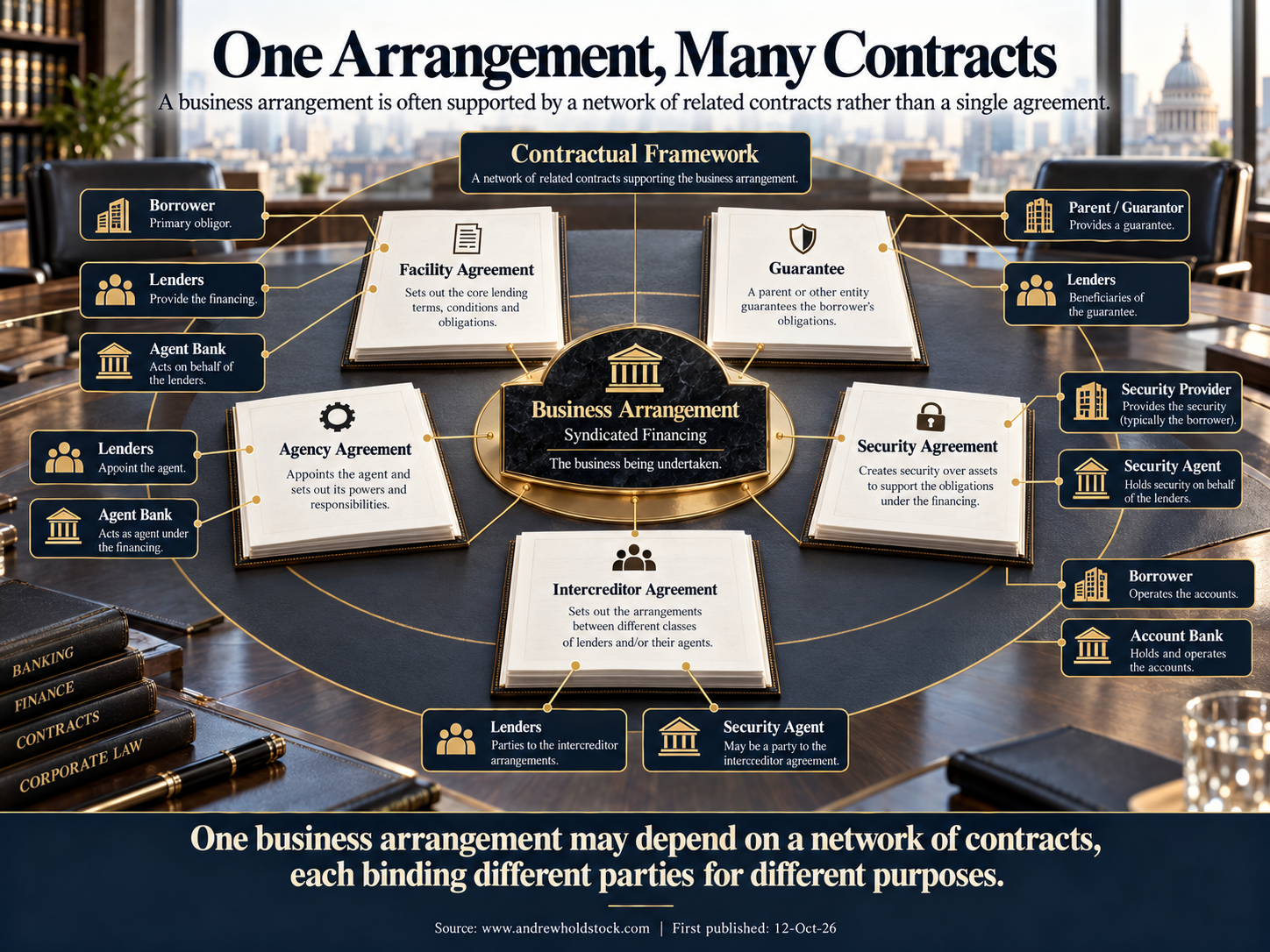
It needs to know which arrangement each contract supports, how the contracts relate to one another, which entities are party to each, and what part of the business each one governs.
That structure also matters when something changes.
A contract may expire while the wider arrangement continues. A new agreement may replace only part of the existing framework. A guarantee may be released while the facility remains outstanding. A master agreement may survive while individual transactions are opened and closed beneath it.
The important unit of understanding is therefore not simply the contract.
It is the contractual framework within the business arrangement.
Contracts Have a Lifecycle
A contract is not simply signed and stored. It has a lifecycle of its own.
Contracts are created, negotiated, executed, amended, renewed, assigned, novated, extended, replaced and eventually terminated or allowed to expire.
Managing that lifecycle is the role of Contract Management.
Contract Management keeps track of the contractual framework itself: the parties, terms, obligations, effective dates, amendments, renewal points, expiry, termination rights and the documents that evidence them.
But those contractual events can have consequences beyond the contract.
A change of party may require new due diligence. A novation may move business to a different legal entity. An amendment may change product scope or exposure. A guarantee may be released. A facility may be extended. An agreement may expire while transactions remain outstanding.
This is where Contract Management and Client Lifecycle Management intersect.
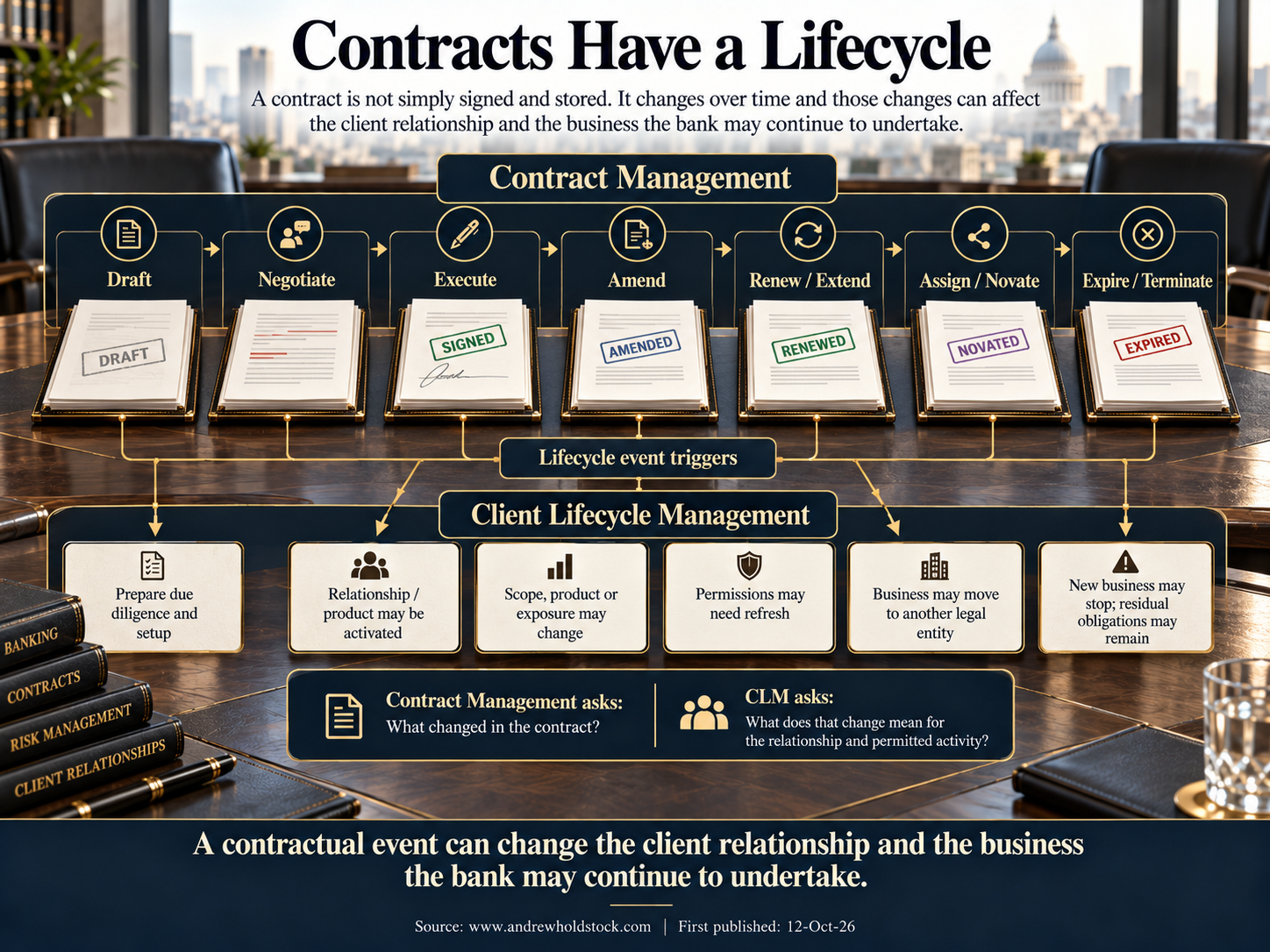
Contract Management asks what has changed in the contract.
CLM asks what that change means for the client relationship and the business the bank may continue to undertake.
The two capabilities therefore need to be connected.
A contractual event that changes an entity, role, relationship, arrangement or permission should be capable of triggering the appropriate lifecycle response.
Without that connection, the bank may know that the contract has changed while continuing to operate the relationship as though nothing has.
Contracts Define Rights and Obligations
Contracts turn a business arrangement into a defined set of enforceable rights and obligations.
They establish what each party is entitled to do, what each party must do, what conditions must be met, and what happens if those commitments are not fulfilled.
In banking, those rights and obligations can cover many things: providing funding, making payments, delivering securities, maintaining collateral, supplying information, observing covenants, meeting reporting requirements, or exercising termination and enforcement rights.
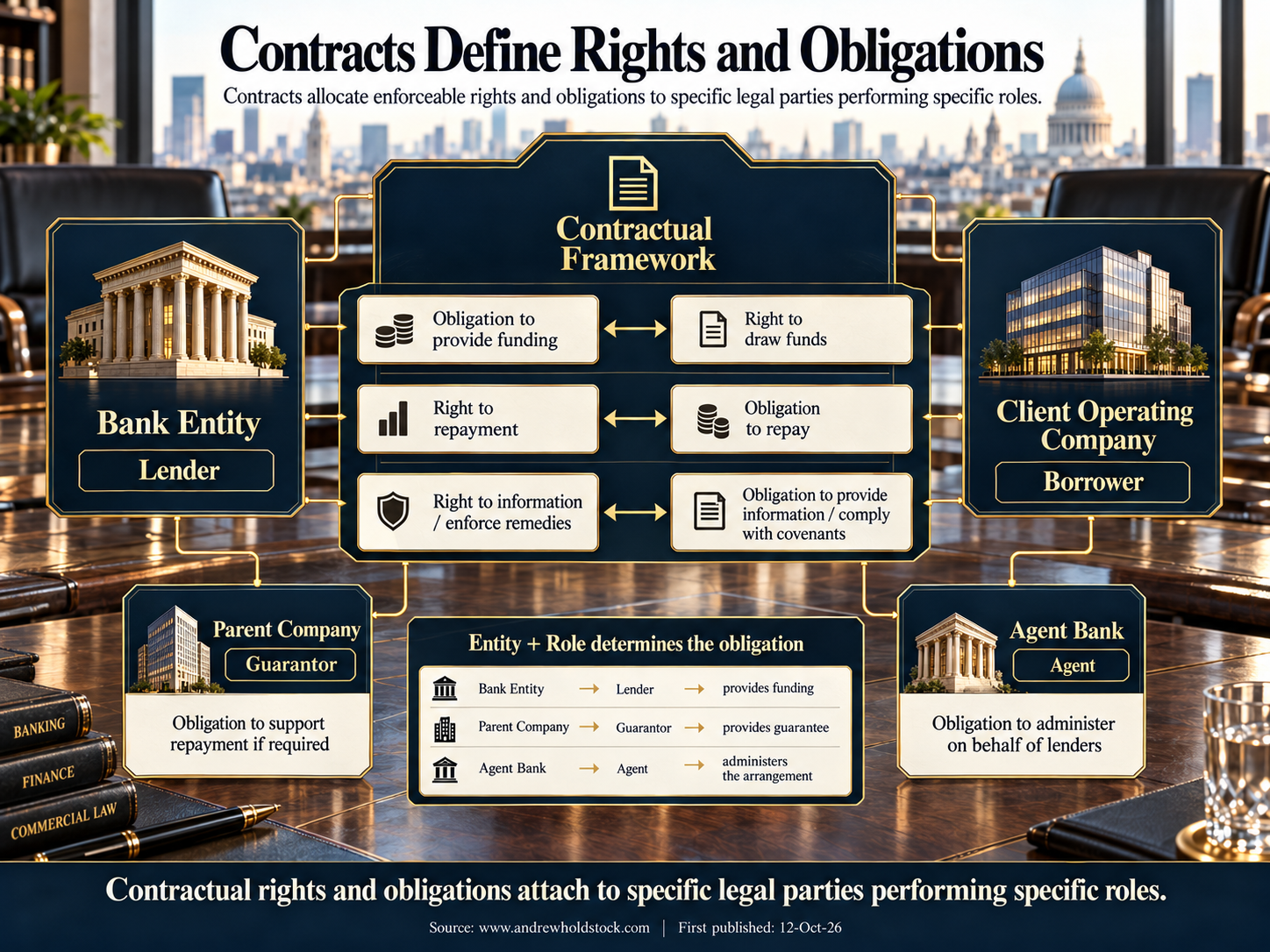
The important point is that these obligations attach to specific legal parties performing specific roles.
A parent company may guarantee. A borrower may repay. An agent may administer. A security provider may grant collateral. A bank entity may provide a facility or execute transactions.
Those obligations are therefore another important connection between Entity, Role, Relationship, Business Arrangement and Contract.
They also change over time.
Some obligations arise immediately. Others depend on future events or conditions. Some continue after a transaction closes. Some survive termination of the contract itself.
For the bank, understanding contractual rights and obligations is therefore not only a legal matter.
It helps determine what must happen next, who is responsible, and whether the business arrangement can continue as intended.
Contracts Have Conditions
A signed contract does not always mean that business can begin.
Contracts often become effective, usable or fully operative only when certain conditions have been satisfied.
These may include credit approval, completion of KYC, delivery of legal opinions, provision of collateral, confirmation of authority, satisfaction of conditions precedent, establishment of accounts, operational readiness, or other regulatory and internal requirements.
That distinction matters because contractual existence and business permission are not the same thing.
A facility agreement may have been executed, but drawdown may still be prohibited. A trading agreement may be in place, but a particular product may not yet be approved. An account may have been opened contractually, but activity may remain restricted until required controls are complete.
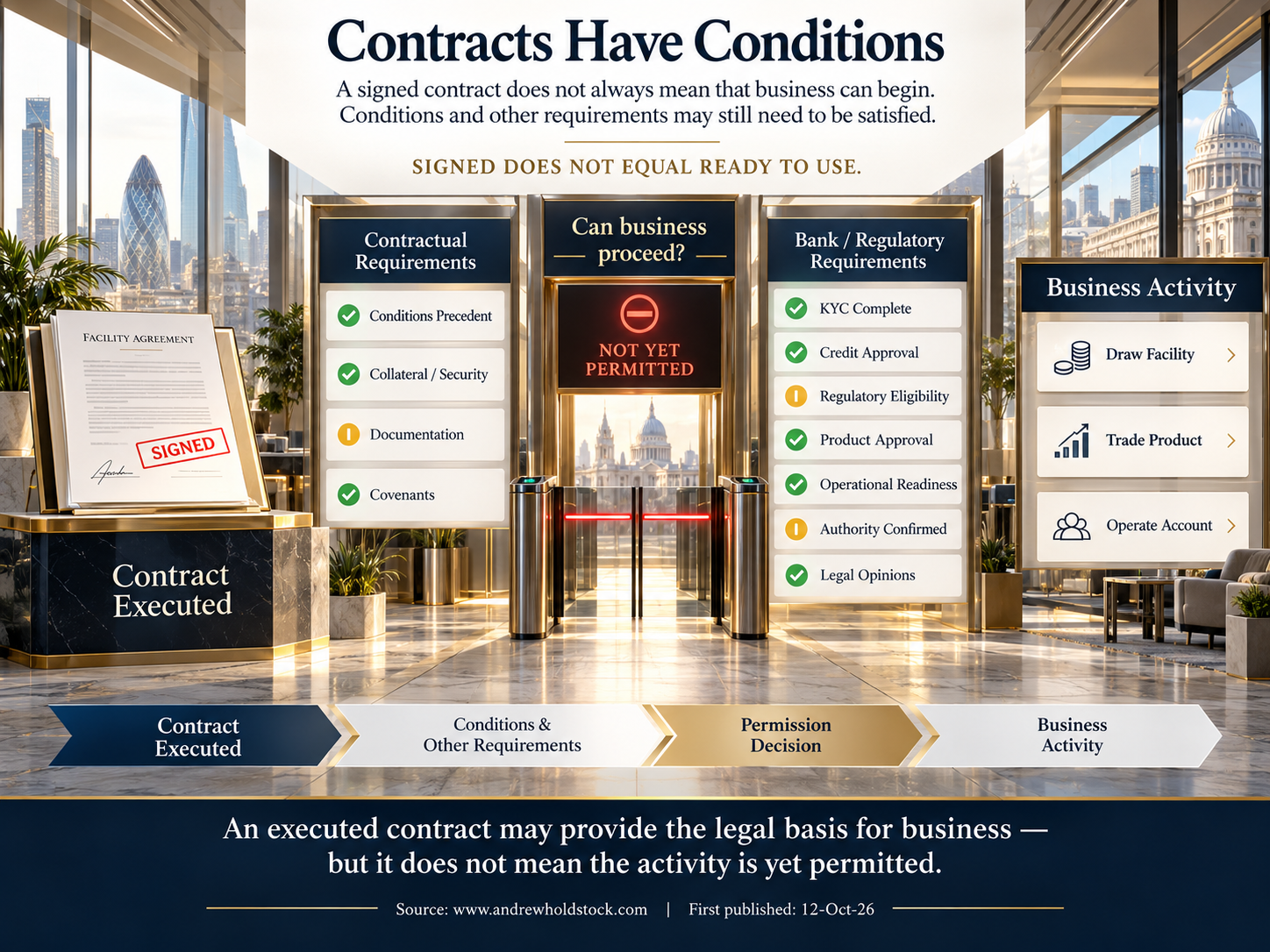
The bank therefore needs to understand both whether the contract exists, and whether the conditions required to use it have been met.
Those conditions may also change over time.
A covenant may be breached. Collateral may fall below requirements. An approval may lapse. A regulatory restriction may arise. A party may cease to satisfy an eligibility condition.
Contract status must therefore connect to the wider permissioning framework.
The important question is not “Do we have a contract?” It is: “Is this contract currently capable of supporting the activity the bank intends to perform?”
Contract Does Not Equal Product
A contract and the business activity it supports are not the same thing.
A contract and the business activity it supports are not the same thing.
One contract may govern several products, facilities or transactions. Equally, one product or arrangement may depend on several different contracts.
A master trading agreement can support many individual transactions. A facility agreement can support multiple drawdowns. An account may operate under broader terms and conditions. A particular product may also depend on guarantees, collateral agreements, agency arrangements or other supporting documents.
This creates a many-to-many relationship between contracts and business activity.
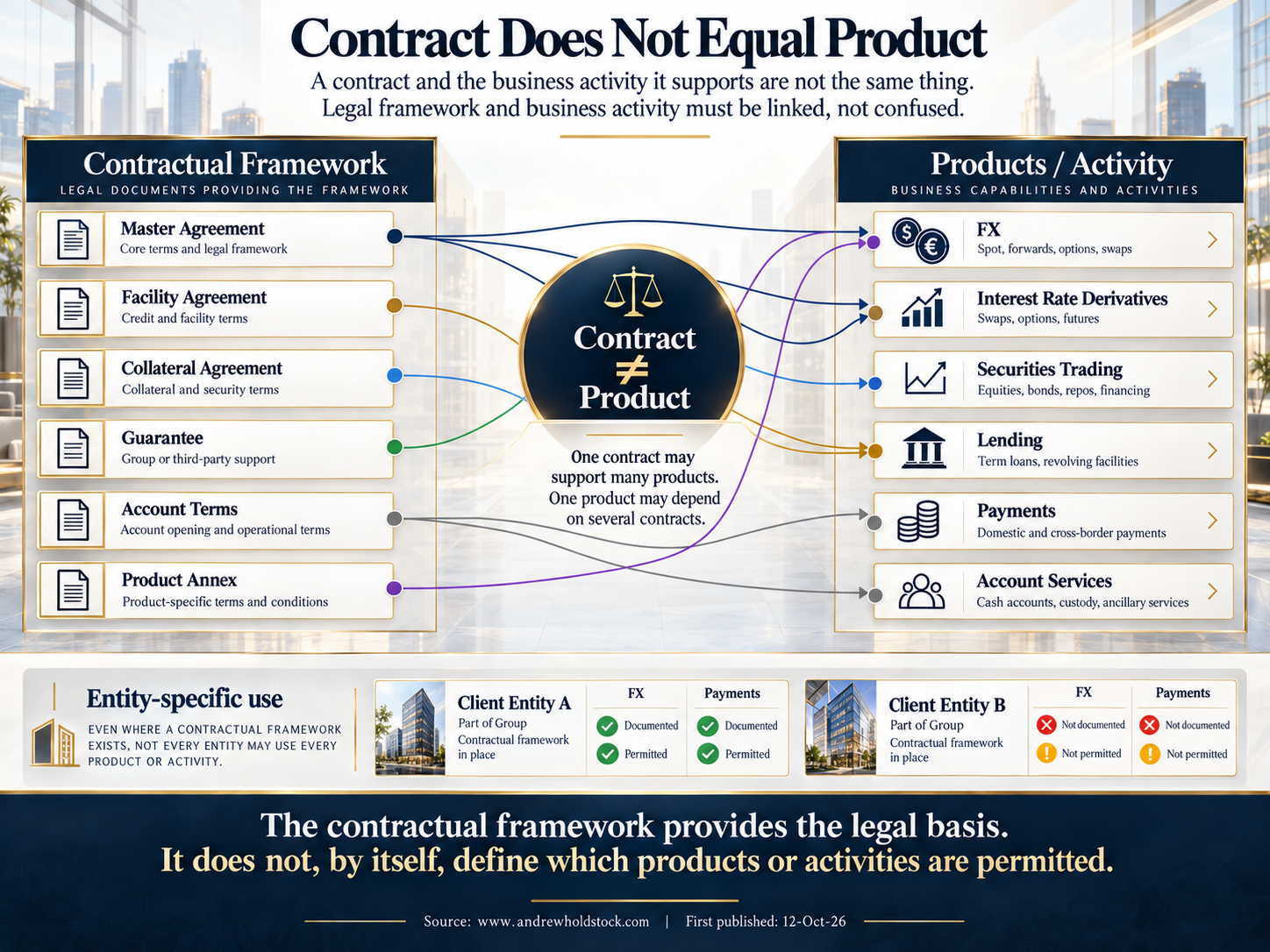
That distinction matters because contractual validity alone does not tell the bank what activity is permitted.
The bank must also understand:
which products or activities the contract supports, which entities may use them, in what roles, and subject to what conditions or limitations.
Those permissions may differ even where the same contractual framework applies.
A client may be documented for one product but not another. A particular legal entity may be permitted to trade under an agreement while another entity in the same group is not. A master agreement may remain valid even though individual transactions have matured or particular products are no longer available.
The contractual framework therefore needs to connect to, rather than replace, product and activity permissioning.
The contract provides the legal basis. Permissioning determines what business may actually be done under it.
From Contract to Permission
A contract can create the legal conditions for business to proceed, but it does not by itself grant permission to undertake that business.
Contracts can establish obligations and conditions that must be satisfied before particular products, facilities or transactions become available.
A facility may require conditions precedent before funds can be drawn. A trading relationship may require additional documentation before certain products can be used. A guarantee or security arrangement may need to be in place before credit is made available. Collateral requirements may need to be maintained for activity to continue.
These contractual requirements then sit alongside other forms of permissioning.
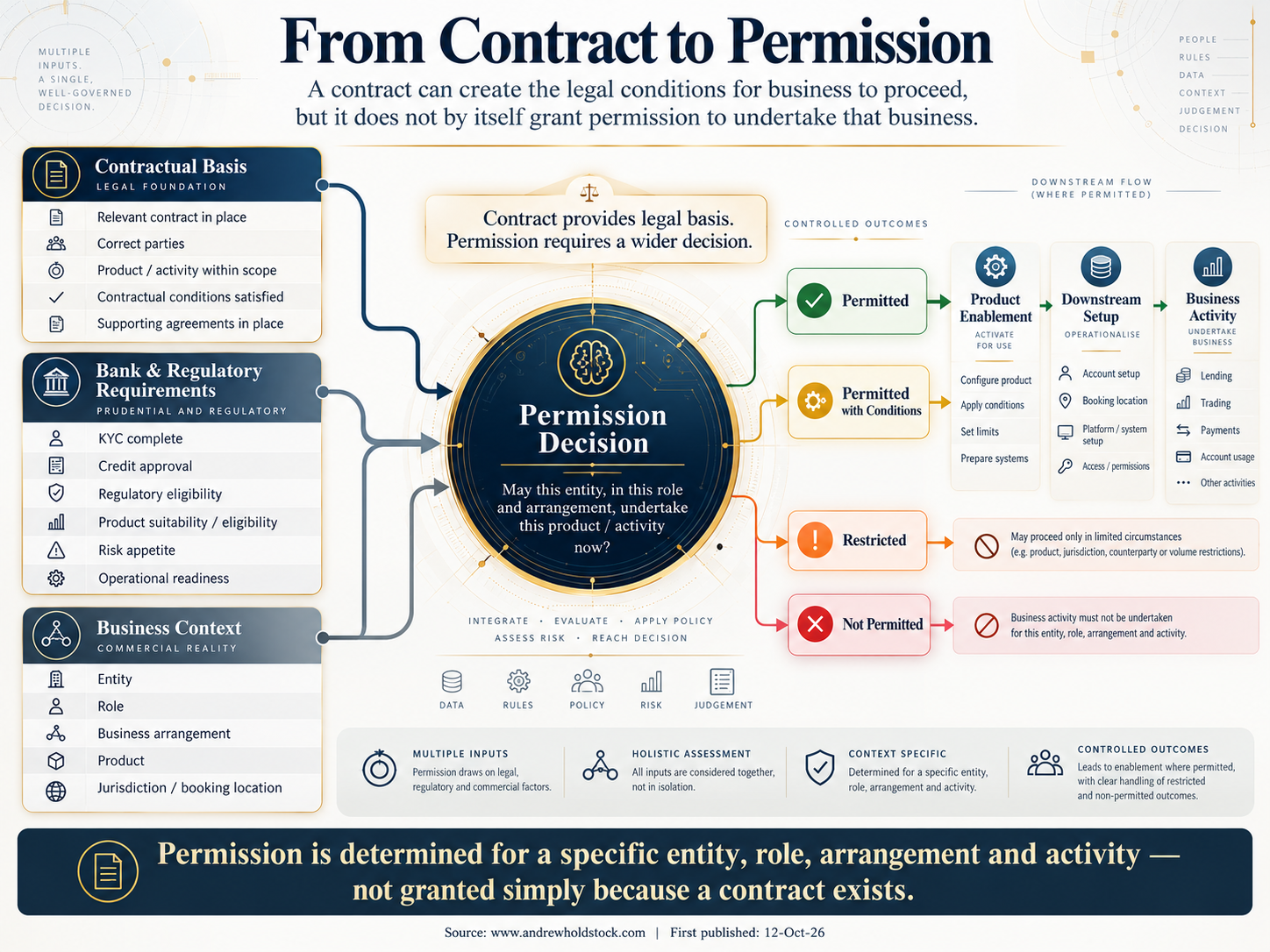
The bank may also need to consider KYC status, credit approval, product eligibility, regulatory restrictions, jurisdiction, operational readiness and internal risk appetite.
The result is a sequence rather than a single decision:
Contract → Obligations and Conditions → Product Eligibility → Permissioned Activity
Not every contractual obligation affects permissioning. Some concern payment, reporting, confidentiality, dispute resolution or other matters.
But where contractual requirements determine whether business may begin or continue, they need to be connected to the bank’s permissioning framework.
This distinction is important.
The contract provides the legal basis for activity. Permissioning determines whether the bank is currently prepared and authorised to undertake it.
Contract Status Affects Permissioning
Whether business may proceed can depend on the current status of the contractual framework.
A contract may be drafted, under negotiation, executed, effective, suspended, amended, expired or terminated.
Those states are not merely administrative. They can affect whether particular activity is permitted.
A product may require an executed agreement. A facility may not be drawable until specified conditions are satisfied. A trading relationship may need particular documentation before certain transactions can be booked. An expired or terminated agreement may prevent new business while leaving existing obligations in place.
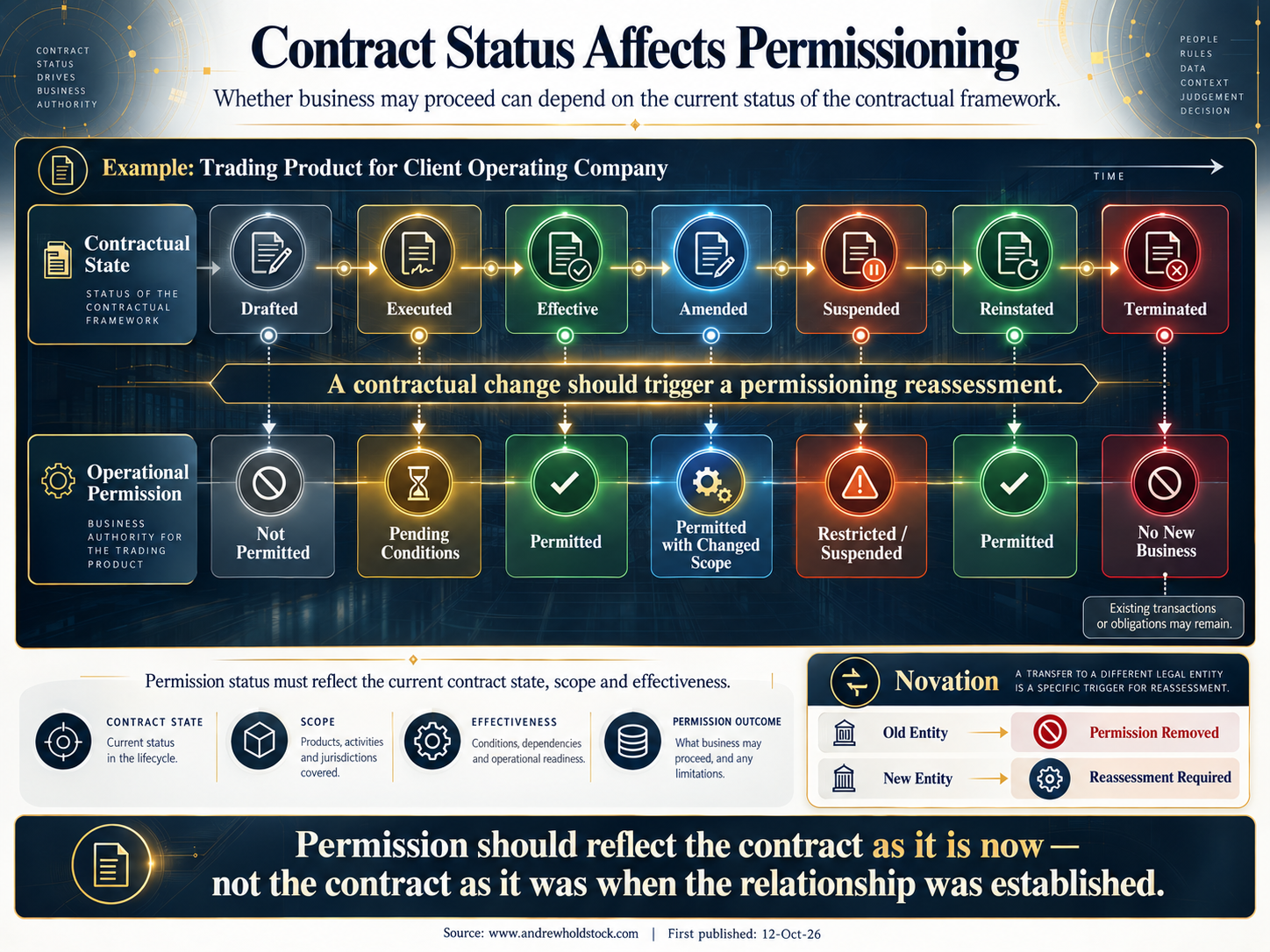
Permissioning therefore needs to take account of more than the existence of a contract.
It may need to understand which contract applies, which parties it covers, what activity falls within its scope, whether required conditions have been met, and whether the contract remains effective for that purpose.
This creates an important connection between Contract Management and the wider client lifecycle.
A contractual event can change the set of activities available to the client. An amendment may expand or restrict scope. A termination may stop new business. A novation may transfer permission to another entity. An expiry may require renewal before activity can continue.
The bank therefore needs a clear path from:
Contract status → Business arrangement → Product or activity → Permission
Without that connection, contractual changes can occur without the operational permissions of the bank changing with them.
Permission should reflect the contract as it is now, not the contract as it was when the relationship was first established.
Section 9 title
The end of a contract does not always mean the end of the business relationship.
A contract may expire, be terminated, replaced, novated, discharged or cease to support new activity.
But obligations can remain.
Outstanding transactions may still need to settle. Payments may remain due. Collateral may need to be released. Records may need to be retained. Confidentiality, indemnities, representations or other provisions may survive termination.
The wider arrangement may also continue under a different contractual framework.
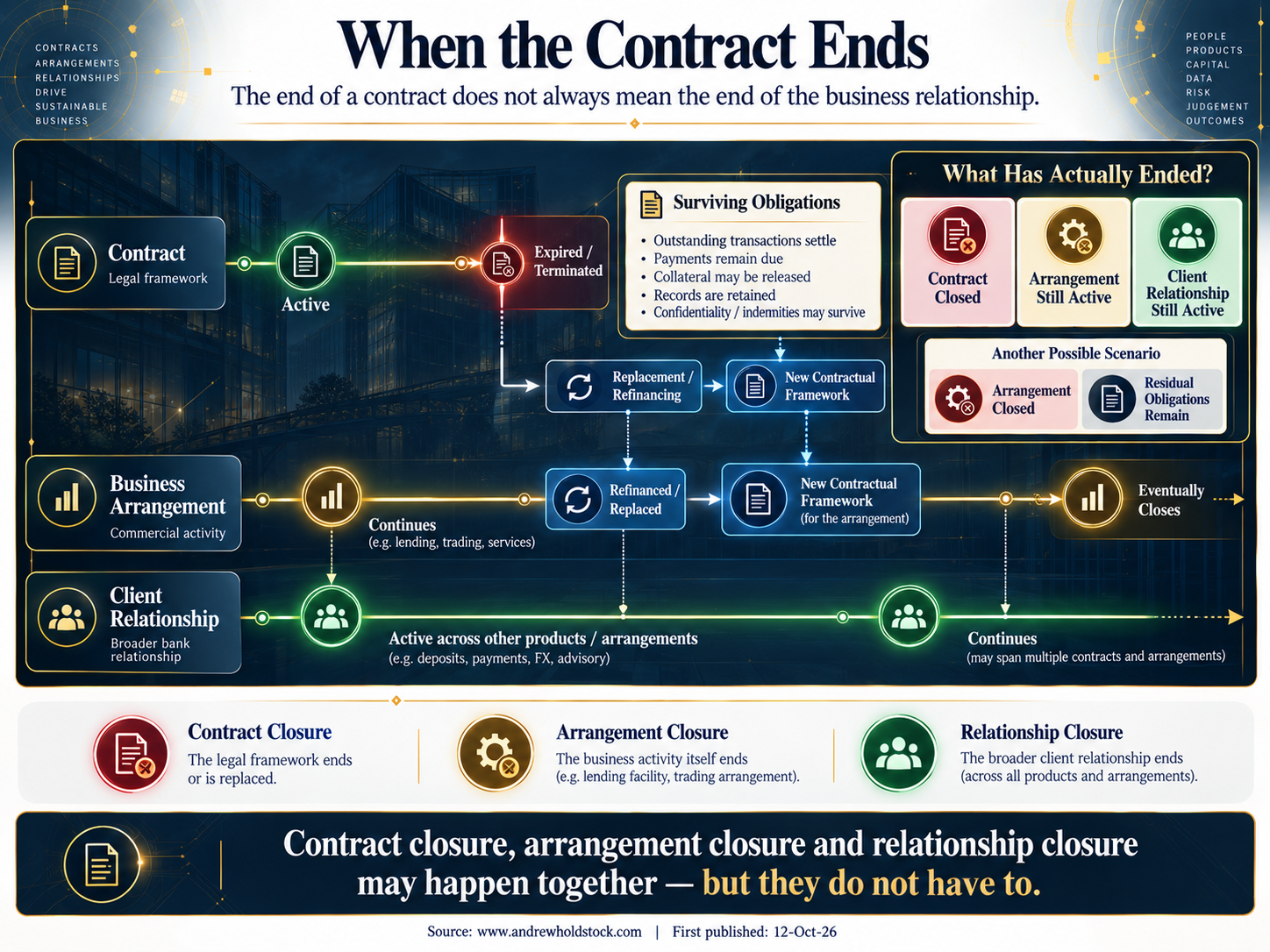
A facility may be refinanced. A master agreement may be replaced. Business may move to another legal entity. One contract may terminate while others supporting the same arrangement remain in force.
This means the bank should not treat contract termination as a simple binary event.
It needs to understand:
what has ended, what remains in force, what obligations survive, whether new activity is still permitted, and whether the wider business arrangement continues.
The same distinction applies to the client relationship.
A client relationship may remain active even though one contract has ended. Equally, the bank may decide to end the broader relationship while residual contractual obligations continue for some time.
The lifecycle therefore needs to distinguish between:
contract closure, arrangement closure and relationship closure.
They may happen together.
But they do not have to.
Contracts in Context
Contracts are essential to banking, but they are only one part of the structure that allows business to take place safely and lawfully.
They provide the legal framework for defined rights, obligations, conditions and remedies.
But they do not, by themselves, define the client, the wider business relationship, the complete set of participants, or every activity the bank is permitted to undertake.
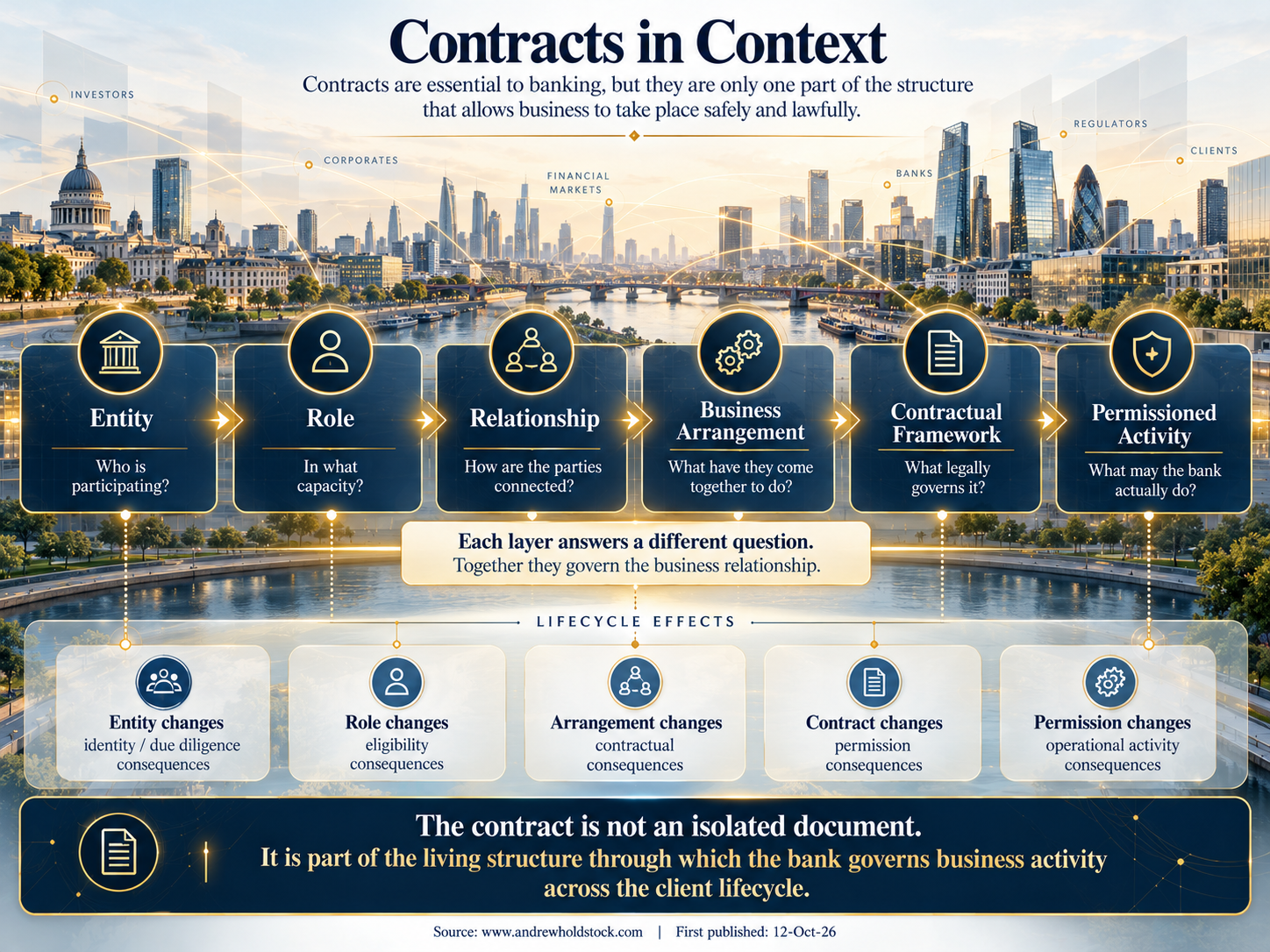
Those questions sit across a broader chain:
Entity → Role → Relationship → Business Arrangement → Contractual Framework → Permissioned Activity
Each layer answers something different.
Who is the party?
In what capacity are they acting?
How are the parties connected?
What have they come together to do?
What legally governs that activity?
And what may the bank actually do now?
The strength of the operating model depends on keeping those distinctions clear while connecting them properly.
That is especially important as contracts change, parties move, obligations survive, permissions evolve and business arrangements continue over time.
The contract therefore should not be treated as an isolated document.
It should be understood as part of the living structure through which the bank governs business activity across the client lifecycle.