Front Office Deep-Dives


Using CLM Capacity to Protect Profitability
CLM capacity is a scarce commercial resource. It should be used not only to win and grow business, but also to protect the value of relationships already on the books.
Client profitability does not necessarily remain stable after onboarding. Revenue can flatten or decline while servicing effort, complexity, periodic review, exceptions, additional entities, products and booking arrangements continue to add cost. A relationship that was attractive when established can therefore become progressively less economic over time.
That makes capacity allocation a continuing commercial decision. Business Lines need to decide where further investment is justified, where complexity should be challenged, where relationships should be simplified or repriced, and where capacity should be released altogether.
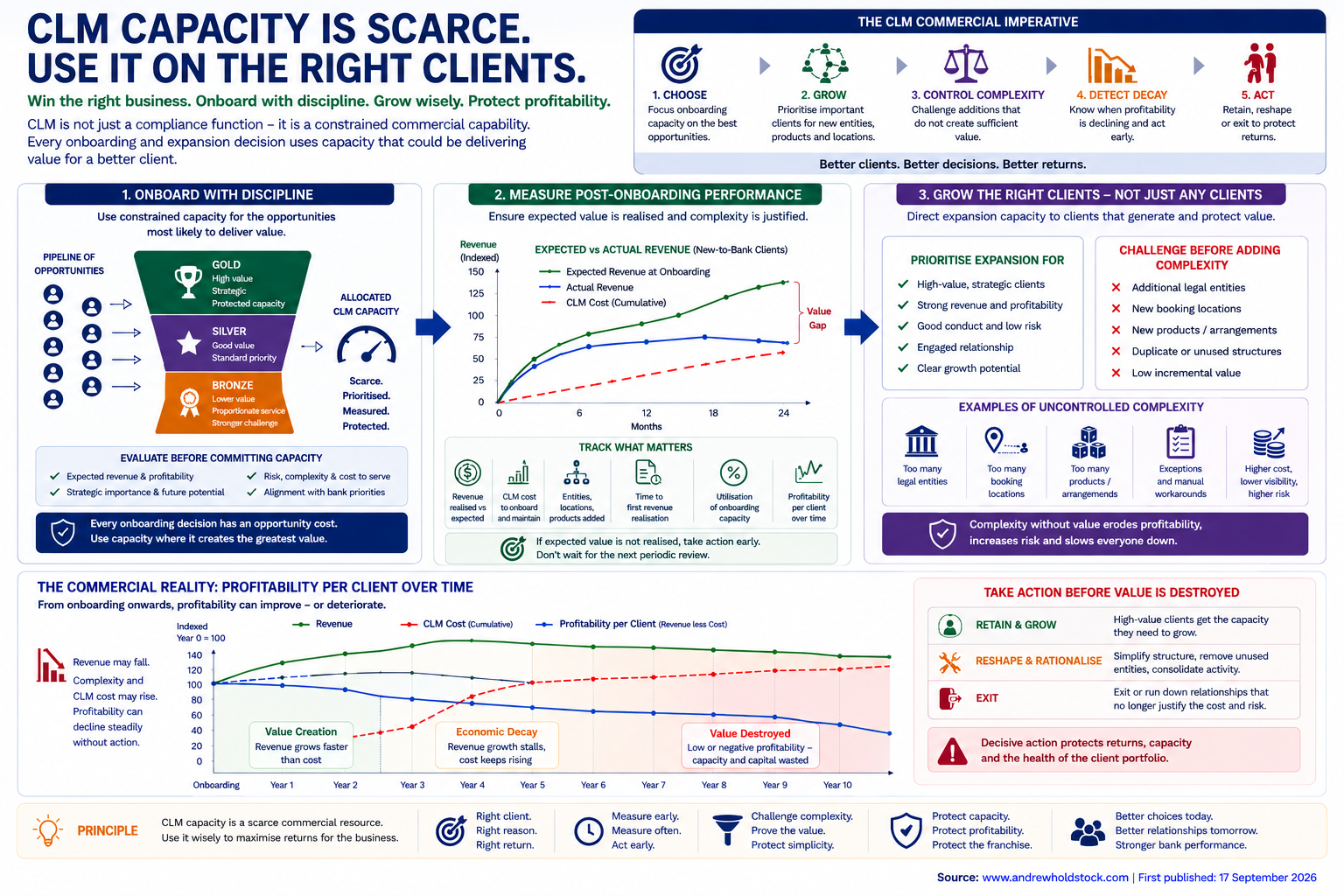
The objective is not simply to use CLM capacity to create growth. It is to use it deliberately across the lifecycle to preserve profitability, protect scarce capacity and sustain the value of the client franchise.

Front Office Lifecycle Stewardship
The Relationship Manager is closest to the commercial reality of the client relationship. That creates a responsibility to understand who the client is, how the bank is engaged, what value the relationship creates, where opportunities exist and how the relationship is changing.
That responsibility continues after onboarding. New entities, products, markets, ownership changes, client strategy and changes in performance can all alter both the value and the risk of the relationship. The RM therefore acts as a lifecycle steward: keeping the commercial picture current, recognising change and initiating action when the relationship should grow, be reshaped or be exited.
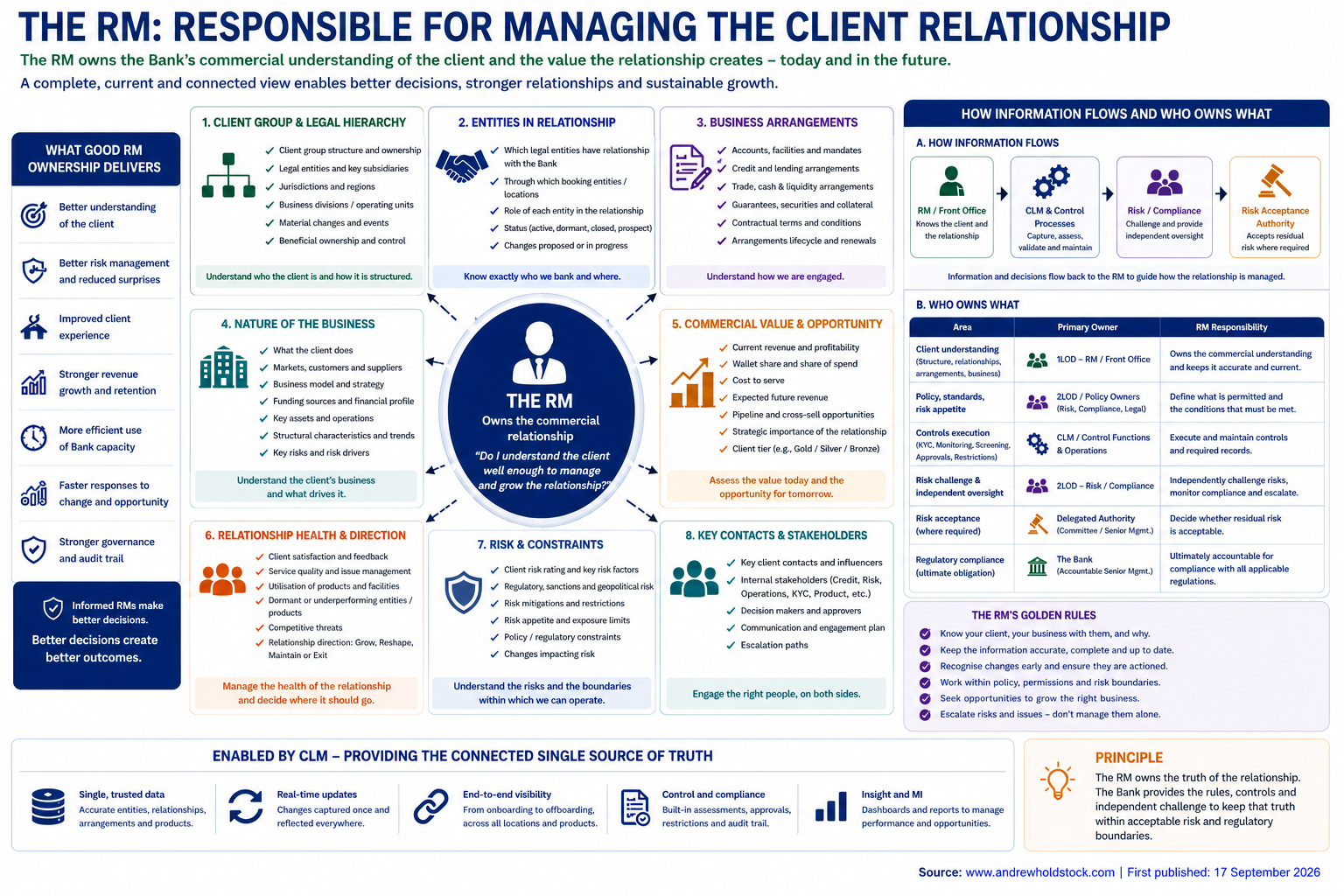
CLM enables that stewardship by providing the connected institutional record, lifecycle controls, permissions, workflow and management information needed to turn Front Office knowledge into coordinated action across the bank. Risk and Compliance retain their independent roles in setting requirements, challenging decisions and overseeing the control environment.
The RM owns the commercial truth of the relationship. CLM helps the bank preserve it, act on it and keep it within acceptable risk boundaries.
RM as Lifecycle Steward
The RM is not responsible for performing every control in the client lifecycle. The RM is responsible for ensuring that material changes in the client relationship are recognised, understood and brought into the bank’s control framework.
That matters because client relationships do not stand still. Ownership changes, restructures, new entities, new jurisdictions, product changes, changes in activity and emerging risk can all alter both the commercial value and the risk profile of the relationship.
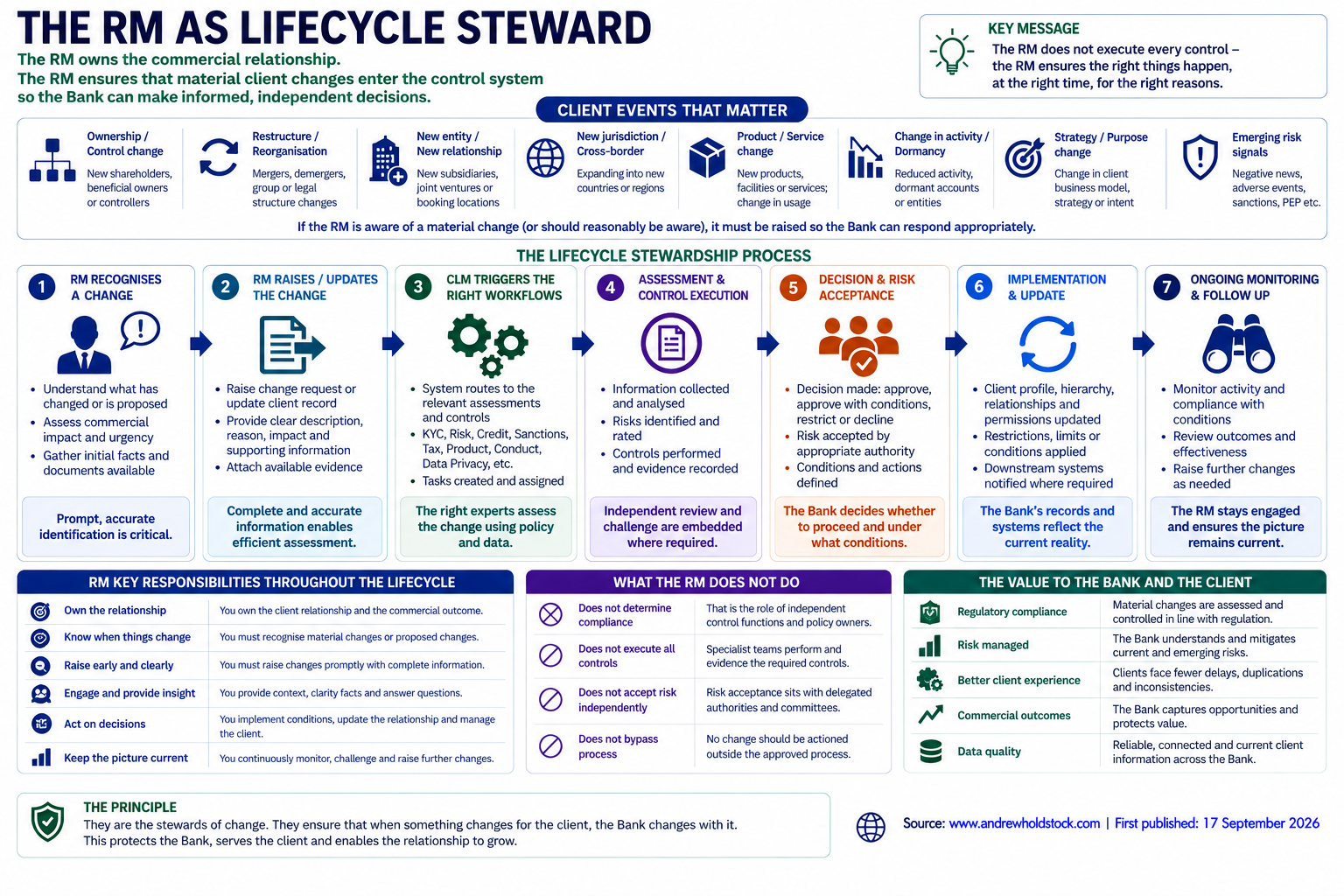
The RM is often the first person to see those changes because of their proximity to the client. Good stewardship means raising them early, providing the commercial context and ensuring the right parts of the bank can assess and act.
CLM then provides the structure around that stewardship: routing changes to the right functions, applying controls, recording decisions, updating permissions and ensuring downstream systems reflect the current relationship.
The RM does not execute every control. The RM ensures that when the client changes, the bank changes with it.
RM Accountability, Incentives & Continuity
Strong client relationships depend on more than individual judgement. They also depend on clear ownership, balanced incentives and continuity of knowledge.
The RM is accountable for the commercial quality of the relationship: understanding the client, maintaining an accurate picture, stewarding change, challenging unnecessary complexity, managing the economics of the relationship and supporting rationalisation or exit where required. But the behaviours the bank gets will reflect the measures and incentives it sets.
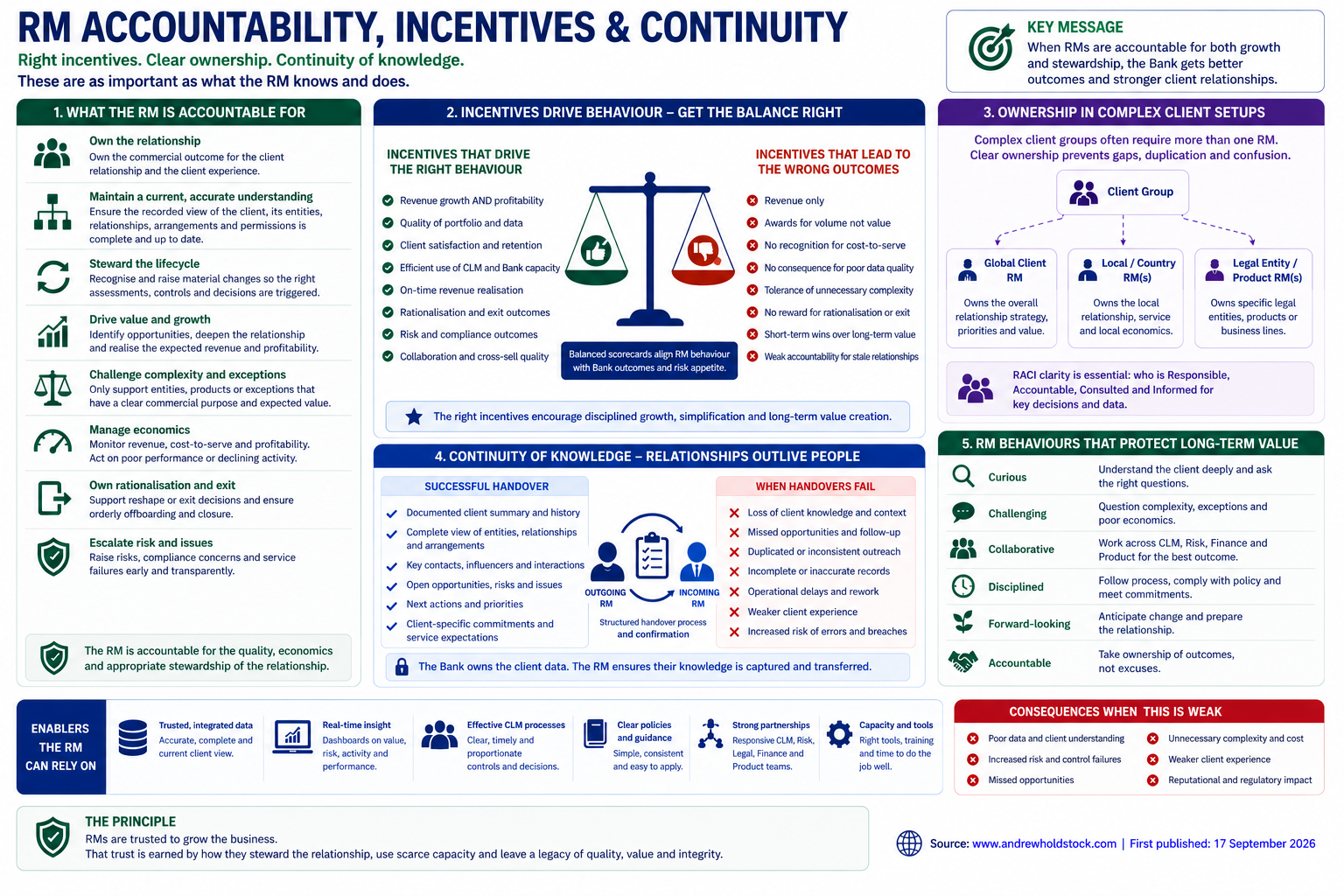
If performance is judged mainly on revenue or new business, the result can be predictable: too much emphasis on acquisition, too little attention to cost-to-serve, stale relationships, unnecessary complexity and weak data quality. Balanced measures encourage a different outcome, growth where it creates value, disciplined use of capacity, better client experience and stronger long-term economics.
Continuity matters just as much. Client relationships often outlive individual RMs. Knowledge of the client, commitments, risks, opportunities and history therefore needs to belong to the bank rather than remain in personal memory, emails or local files.
The strongest Front Office model aligns accountability, incentives and institutional knowledge so that good stewardship continues even when people change.
Client Complexity Has a Cost
Growth in a client relationship does not automatically mean growth in value. Over time, additional entities, booking locations, products, exceptions and servicing requirements can accumulate faster than the revenue they support.
That creates a commercial problem as much as an operational one. Revenue may plateau or decline while the cost of maintaining the relationship remains sticky. Complexity can also make the relationship harder to understand, increase risk and consume capacity that could be used elsewhere.
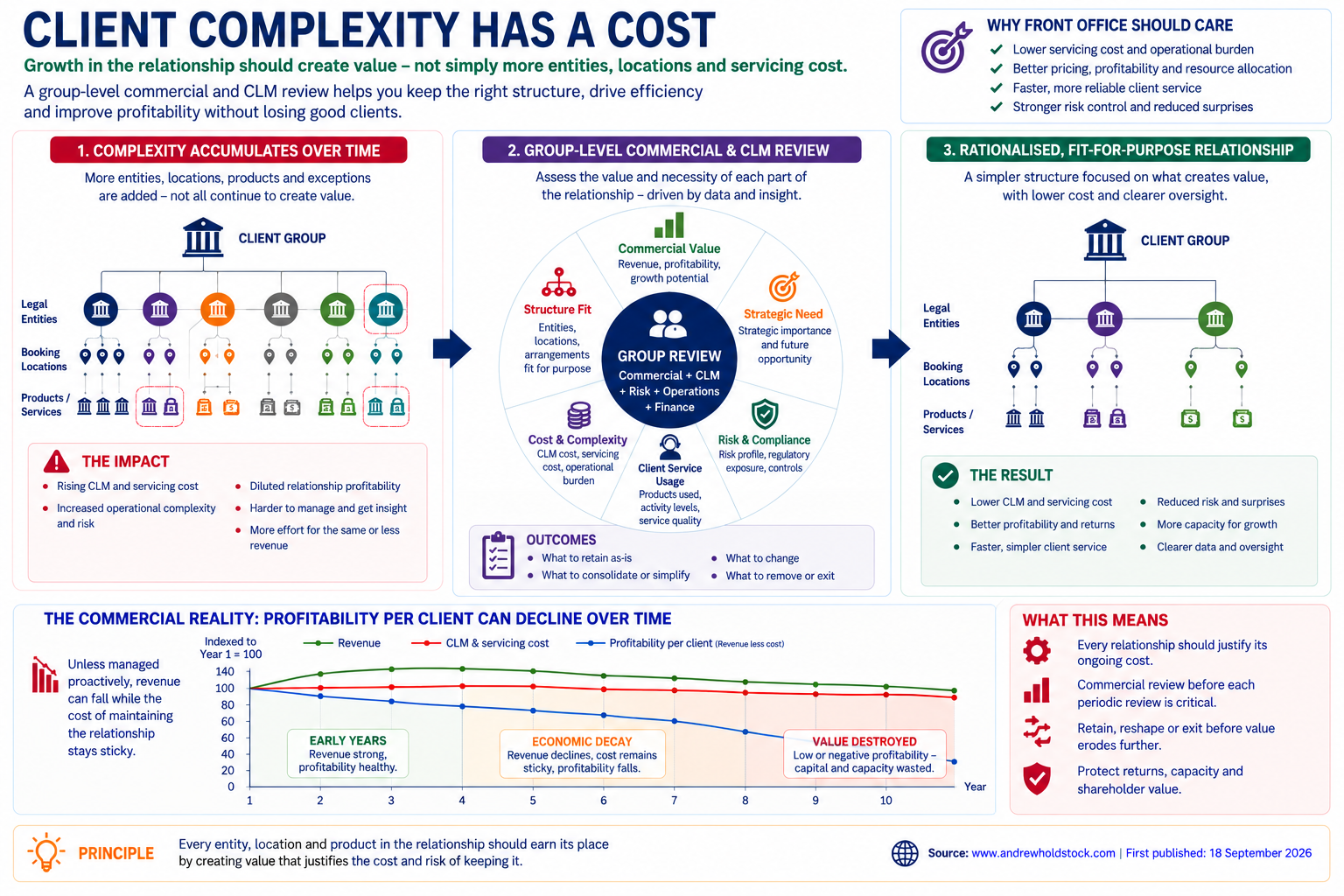
A periodic group-level review should therefore look beyond headline revenue and ask whether each part of the relationship still has a clear commercial purpose. That means considering commercial value, strategic importance, client usage, cost-to-serve, structure, risk and regulatory requirements together.
The objective is not simply to reduce complexity. It is to retain the parts of the relationship that create value, simplify or reshape those that do not, and release capacity before profitability is eroded further.
Every entity, booking location and product should continue to justify the cost, complexity and risk of keeping it.
Commercial Economic Decay
Client relationships can become less profitable over time even when nothing appears obviously wrong.
Revenue may fall as transactions reduce, mandates end or products are rationalised, while many of the costs of maintaining the relationship remain. KYC, periodic review, screening, data maintenance, controls, servicing and operational support can continue even when the commercial value has weakened.
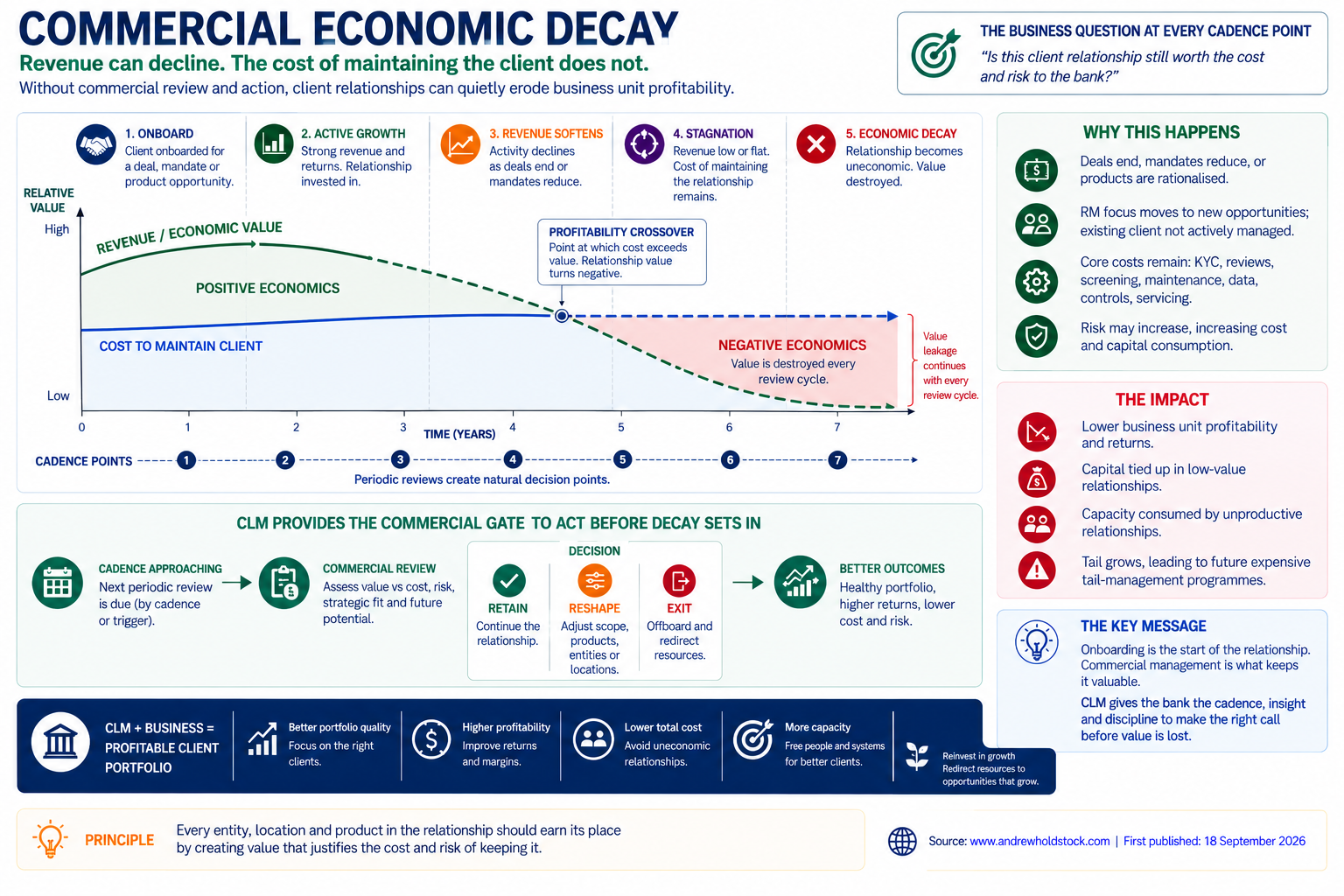
That creates a point at which the economics of the relationship can cross from positive to negative. If no one is looking for it, the relationship can continue consuming capital and capacity long after it has stopped creating sufficient value.
Periodic review therefore creates more than a compliance checkpoint. It can also provide a natural commercial decision point: retain the relationship, reshape it, simplify it or exit before value deteriorates further.
Onboarding starts the relationship. Active commercial management is what keeps it economically worthwhile.
CLM Supporting Bank Profitability
CLM contributes to profitability by creating regular decision points throughout the client lifecycle, not just at onboarding.
As a relationship develops, the bank continues to spend money maintaining it through reviews, servicing, controls, data, monitoring and operational support. At the same time, the commercial value of that relationship can strengthen, weaken or change direction.
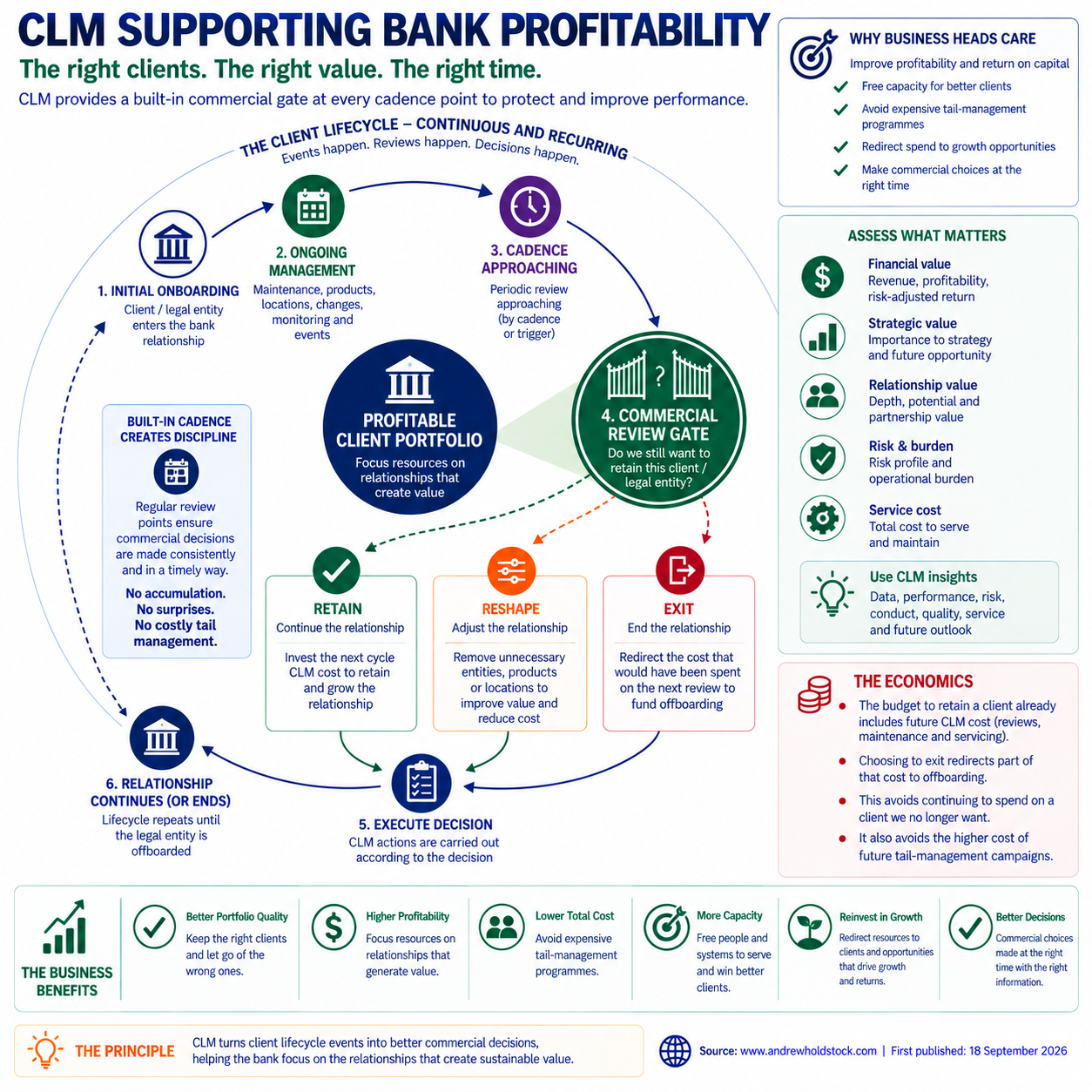
That makes periodic lifecycle events useful commercial checkpoints. They provide an opportunity to ask whether the relationship still justifies the cost, risk and capacity it consumes, and whether the right decision is to retain it, reshape it or exit.
Used this way, CLM helps Business Heads improve portfolio quality, release capacity from uneconomic relationships, redirect resources toward stronger opportunities and avoid the cost of allowing a weak client tail to accumulate.
The commercial value of CLM is not only in enabling business. It is also in helping the bank decide, repeatedly and with discipline, which relationships remain worth supporting.
The Economics of Knowing the Client Already
The deeper a client relationship becomes, the less often the bank should need to start again.
Much of the information needed to support new business may already exist: legal entities, controllers and other persons, ownership structures, risk assessments, documents, product permissions, booking arrangements, identifiers and knowledge held elsewhere in the client group or another Business Line.
An entity-based CLM model makes that knowledge reusable. If an entity or person has already been identified, remains current and is still within the applicable risk acceptance period, the bank should be able to link to that existing record rather than recreate it simply because a new case or relationship has arisen.
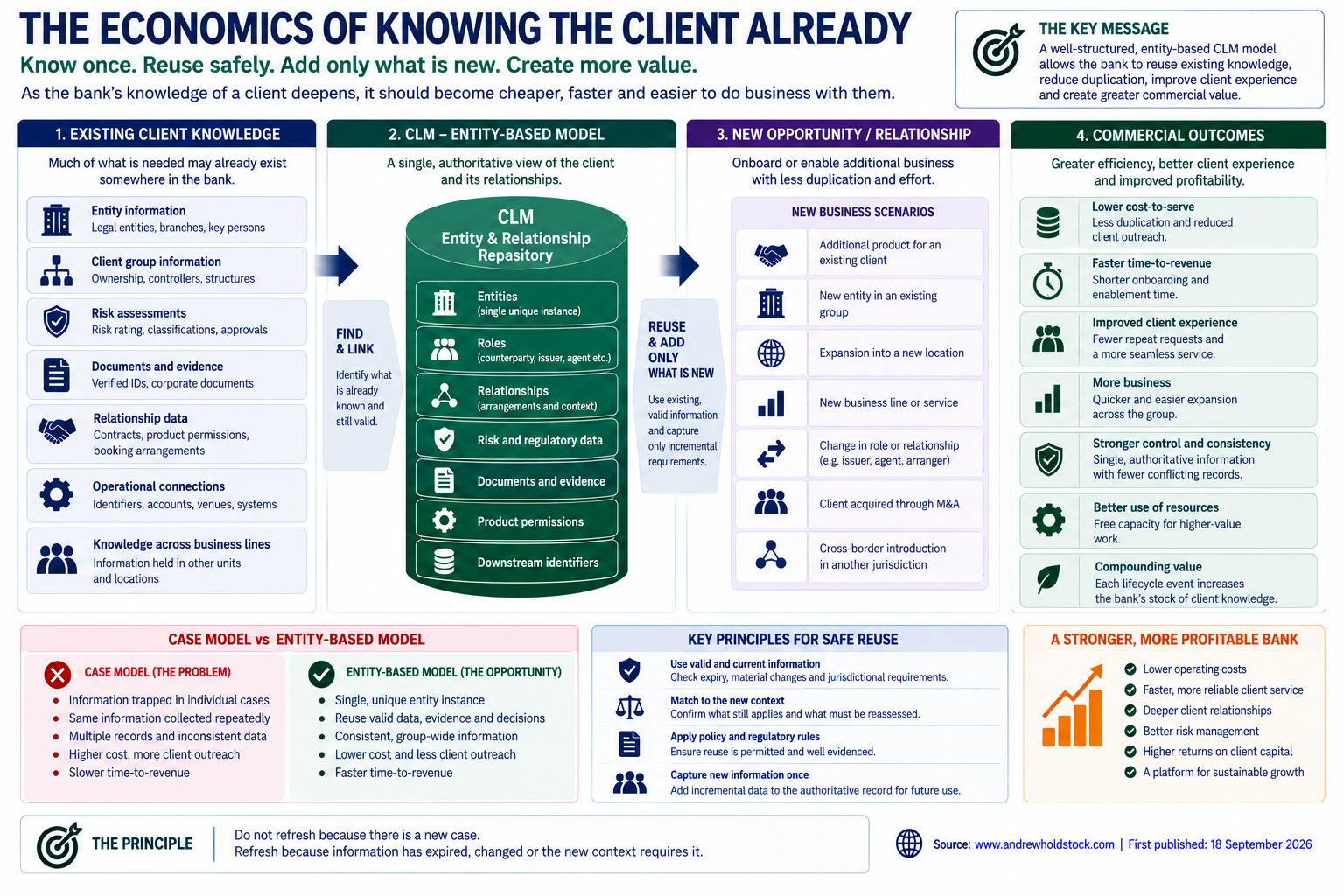
The same principle applies more broadly. Existing documents, decisions, relationships and operational connections should be reused where they remain valid, while new work focuses on what has genuinely changed or what the new context requires.
This reduces duplication, client outreach and operating cost. It can also shorten time-to-revenue, improve consistency and make it easier to expand into new products, entities, locations or Business Lines.
The commercial value of knowing the client is realised when the bank can safely reuse what it already knows and add only what is new.
Do not refresh because there is a new case. Refresh because information has expired, changed or the new context requires it.
From Opportunity to Executable Business
Identifying a commercial opportunity is only the beginning. The bank still has to turn that intent into a state in which the intended business can actually be executed.
That starts by defining precisely what the client wants to do: which entity, role, product, arrangement, booking location, jurisdiction and timing are involved. CLM can then determine what the bank already knows, what remains valid and what genuinely needs to be added or changed.
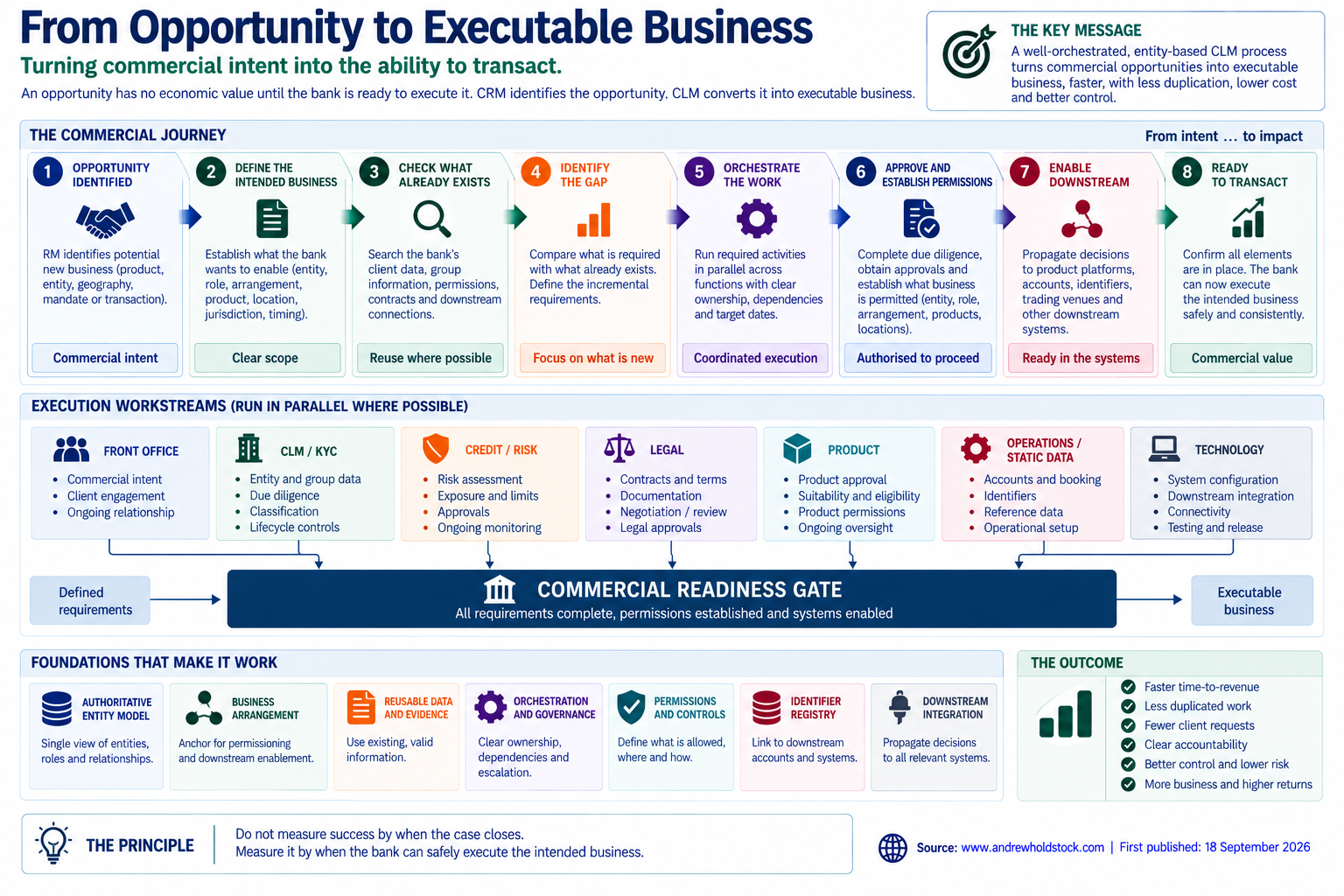
The remaining requirements should be treated as an integrated set of workstreams rather than disconnected hand-offs. Front Office, CLM, Risk, Legal, Product, Operations and Technology may all have actions to complete, but wherever possible those activities should run in parallel against a common target date and a single view of readiness.
The critical point is that approval alone is not enough. Permissions, identifiers, accounts, booking arrangements and other decisions must reach the downstream systems through which the business will actually be conducted.
Only when those elements come together is the opportunity commercially executable.
Success isn’t measured by when the onboarding case closes, it is measured by when the bank can safely execute the intended business e.g., “ready to trade”.
CLM Can Widen the Commercial Jaws
CLM can improve profitability from both sides of the equation.
On the revenue side, better client knowledge, faster readiness and easier expansion can help the bank do more business with the right clients. Existing relationships can support additional products, entities, geographies and services without repeatedly starting from scratch.
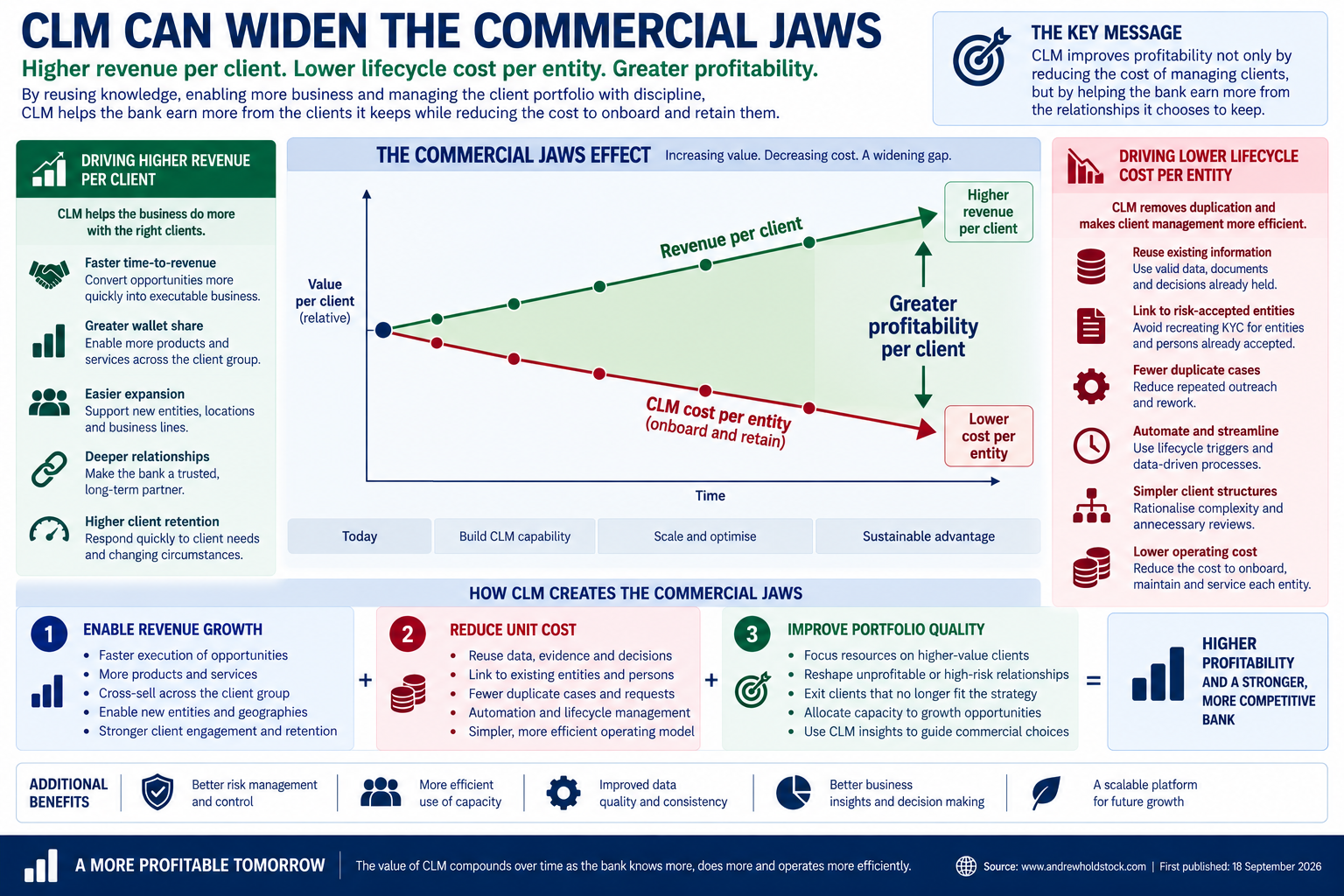
At the same time, the cost of onboarding and maintaining each entity can fall as the bank reuses valid information, links to existing risk-accepted entities and persons, reduces duplicate cases and client outreach, simplifies structures and automates lifecycle activity.
The result is a widening gap between revenue per client and lifecycle cost per entity. That gap represents stronger profitability.
The effect should also compound over time. As CLM capability matures, the bank knows more about its clients, can reuse more of what it already holds and can direct scarce capacity toward relationships with stronger economic value.
The commercial value of CLM is greatest when it helps the bank earn more from the relationships it keeps while reducing the unit cost of supporting them.