Operational Systems Engineering

Designing for Predictable Outcomes
Banks need confidence that investments in their operations will deliver the intended results, without creating additional cost, risk or complexity.
Banks invest in new platforms, operating models, automation and organisational change to improve efficiency, strengthen controls, support growth and meet regulatory obligations. Yet these investments can introduce unexpected costs, operational weaknesses, delays and further remediation.
Before committing to a design, decision-makers need to understand whether it will deliver the required capacity, quality, reliability, cost and resilience under expected operating conditions.
OSE introduces an engineering approach to answering these questions through modelling and prediction, rather than relying principally on discovering operational behaviour after implementation.
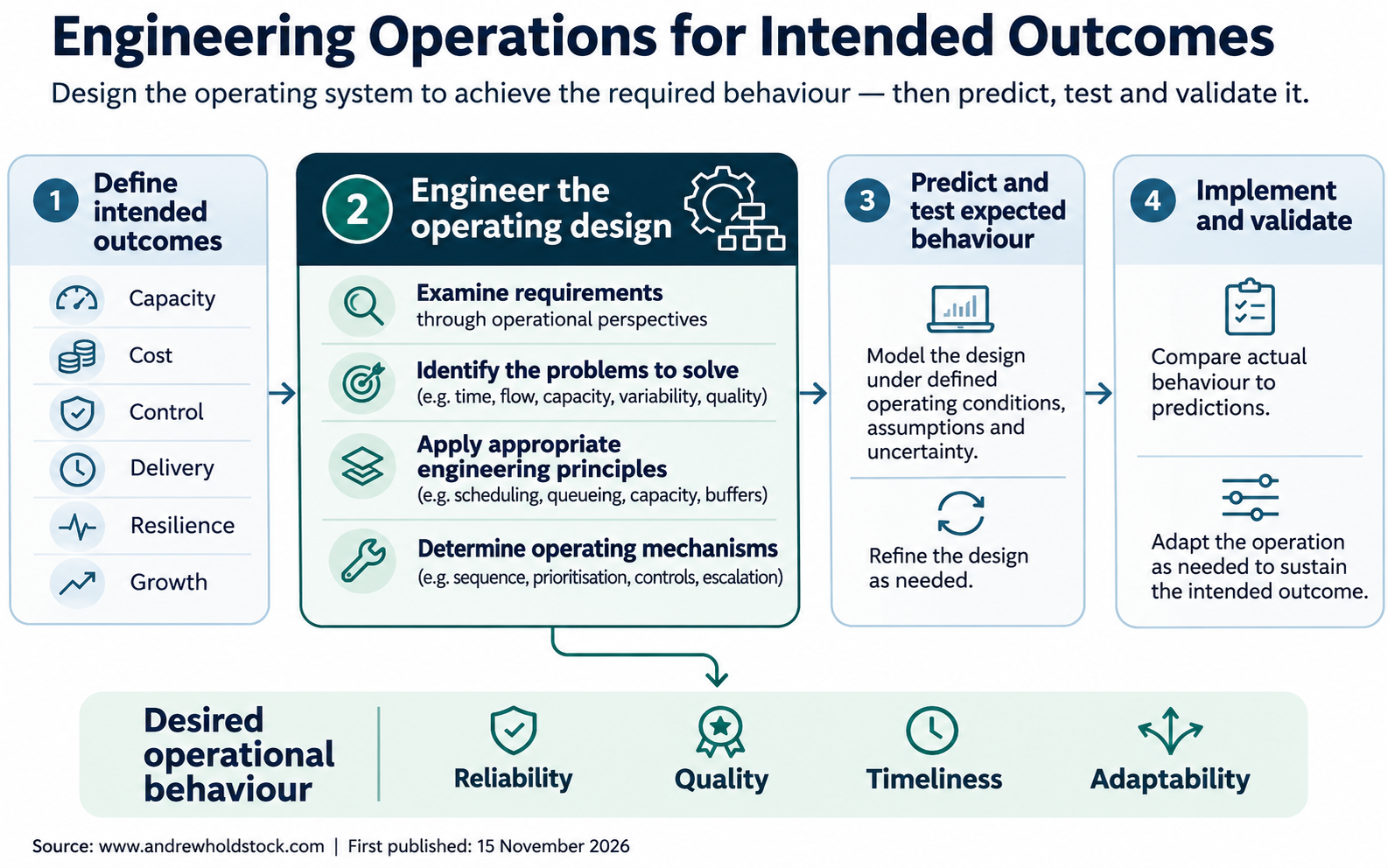
Predictive engineering allows organisations to examine alternative operating designs, test assumptions and identify potential weaknesses before implementation.
It cannot remove uncertainty, but it can make the expected behaviour and limitations of a proposed operation more visible. This provides a stronger basis for investment decisions, operational readiness and subsequent validation against actual results.
Understanding the Operational Problem
Examining requirements from multiple perspectives reveals the operational challenges that must be solved before a reliable design can be developed.
Business requirements describe what an operation must achieve, but do not necessarily reveal the problems involved in achieving it.
OSE examines requirements through multiple operational perspectives, including time, flow, capacity, variability, quality, controls and human factors. Each perspective helps identify characteristics that will influence how the operation must be designed.
The resulting understanding provides the foundation for selecting appropriate scientific and engineering principles, rather than beginning with a preferred process, technology or organisational solution.
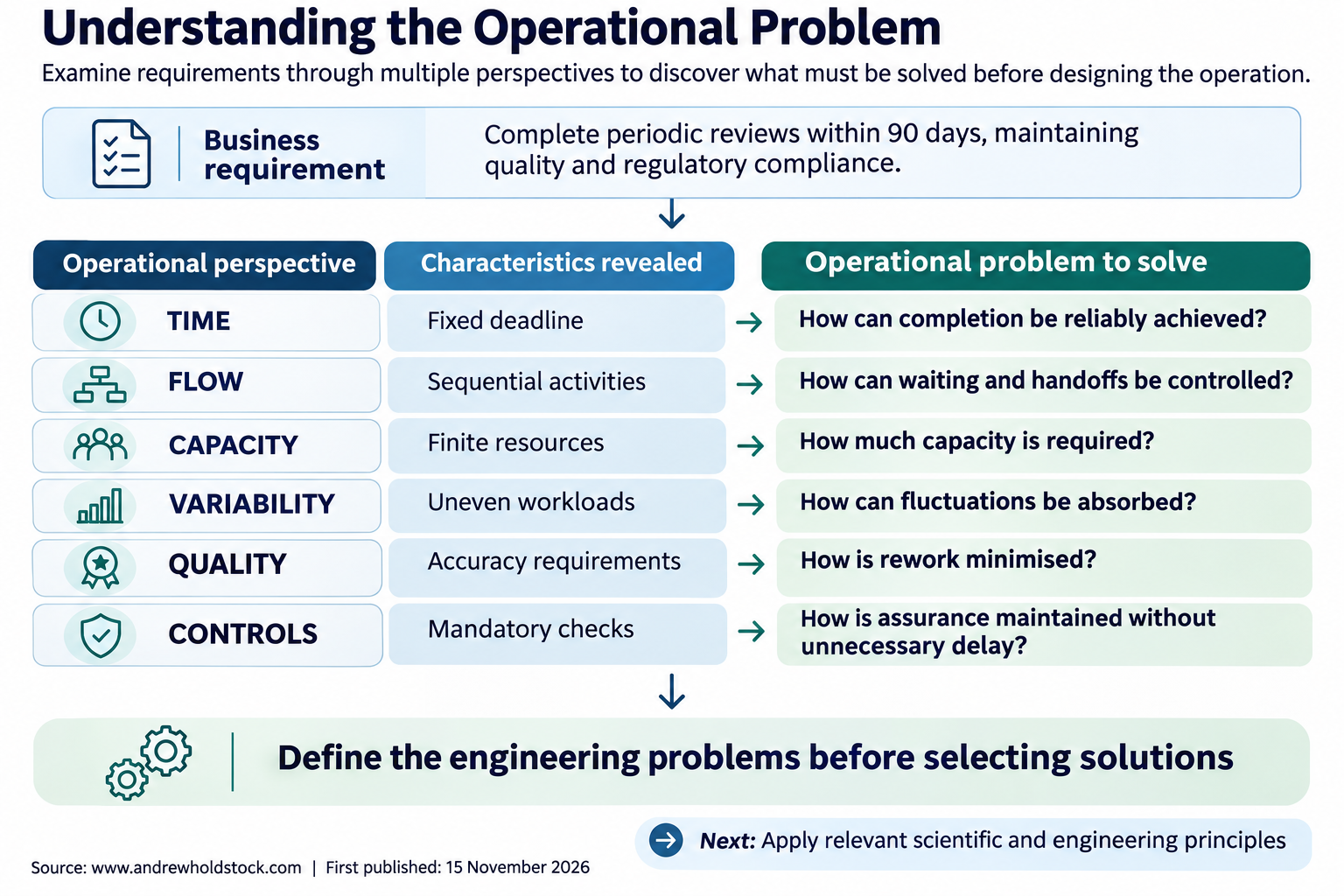
Different operating requirements reveal different engineering problems. A fixed deadline may require scheduling and buffer management. Variable workloads may require capacity and queueing analysis. Complex decisions may require attention to human factors and decision design.
The perspectives do not prescribe solutions. They provide a systematic way to discover what needs to be solved, allowing the operating design to follow from the nature of the requirement.
Applying Engineering Principles
Different operational problems require different engineering approaches. Understanding the problem enables the appropriate science to guide the design.
Once the operational problems have been identified, OSE draws on established scientific and engineering disciplines to determine how they can be solved.
The appropriate approach depends on the nature of each problem. Flow and waiting may require queueing theory; fixed deadlines may require scheduling and buffer management; variable workloads may require statistical analysis and capacity modelling.
Rather than beginning with a preferred process, technology or organisational solution, OSE uses the characteristics of the operational problem to guide the selection of engineering principles.
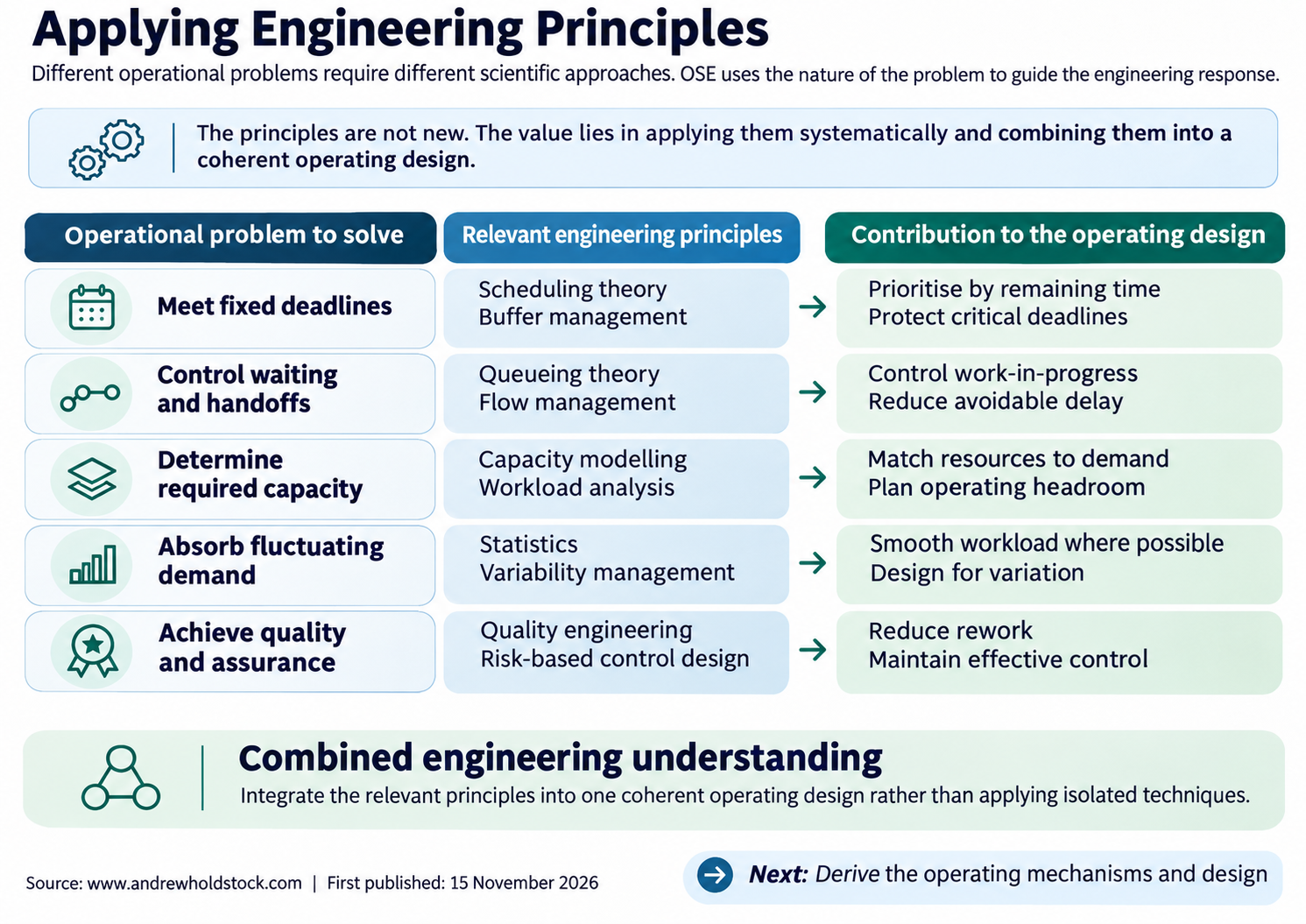
Engineering principles help establish the mechanisms an operation needs to achieve its intended behaviour. These may include controlling work-in-progress, protecting critical deadlines, balancing capacity and demand, or reducing the effects of variability.
The principles are not new. OSE seeks to make their application systematic, practical and accessible, creating a foundation for operating designs that can subsequently be modelled and tested.
Engineering the Operating Design
Scientific principles guide the design of operating mechanisms that work together to produce the required operational behaviour.
Understanding the relevant engineering principles is only the beginning. They must be translated into practical arrangements governing how work is organised, decisions are made, resources are deployed and controls are applied.
OSE combines these mechanisms into a coherent operating design, encompassing responsibilities, processes, information, technology, capacity and governance. Each element must contribute to achieving the intended outcome.
The objective is not simply to assemble functional components, but to engineer an operation whose collective behaviour meets its requirements.
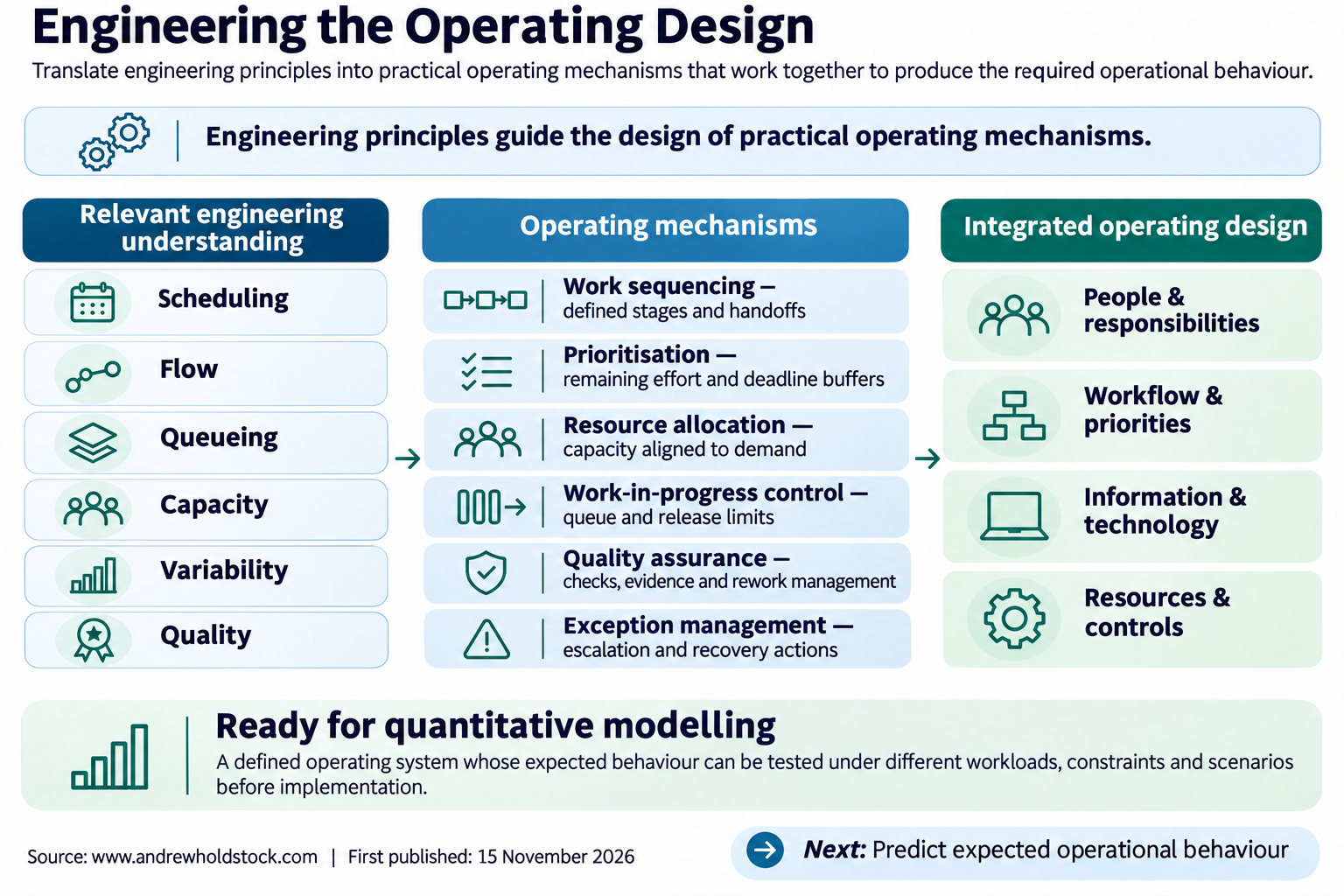
The resulting design establishes how the operation is expected to function, including its workflow, priorities, resource arrangements, decision authority, controls and responses to changing conditions.
These arrangements create the basis for quantitative modelling. Their expected behaviour can then be tested under different workloads, constraints and scenarios before implementation.

Predicting Operational Behaviour
Quantitative modelling allows operating designs to be tested against expected demands, constraints and uncertainties before implementation.
An engineered operating design establishes how an operation should function. The next step is to determine whether it can produce the required outcomes under realistic operating conditions.
OSE introduces numerical assumptions and operational data into models representing workloads, processing times, resources, dependencies, variability and controls. These models allow alternative designs to be tested against business requirements before implementation.
The objective is to predict operational behaviour with sufficient confidence to inform design and investment decisions.
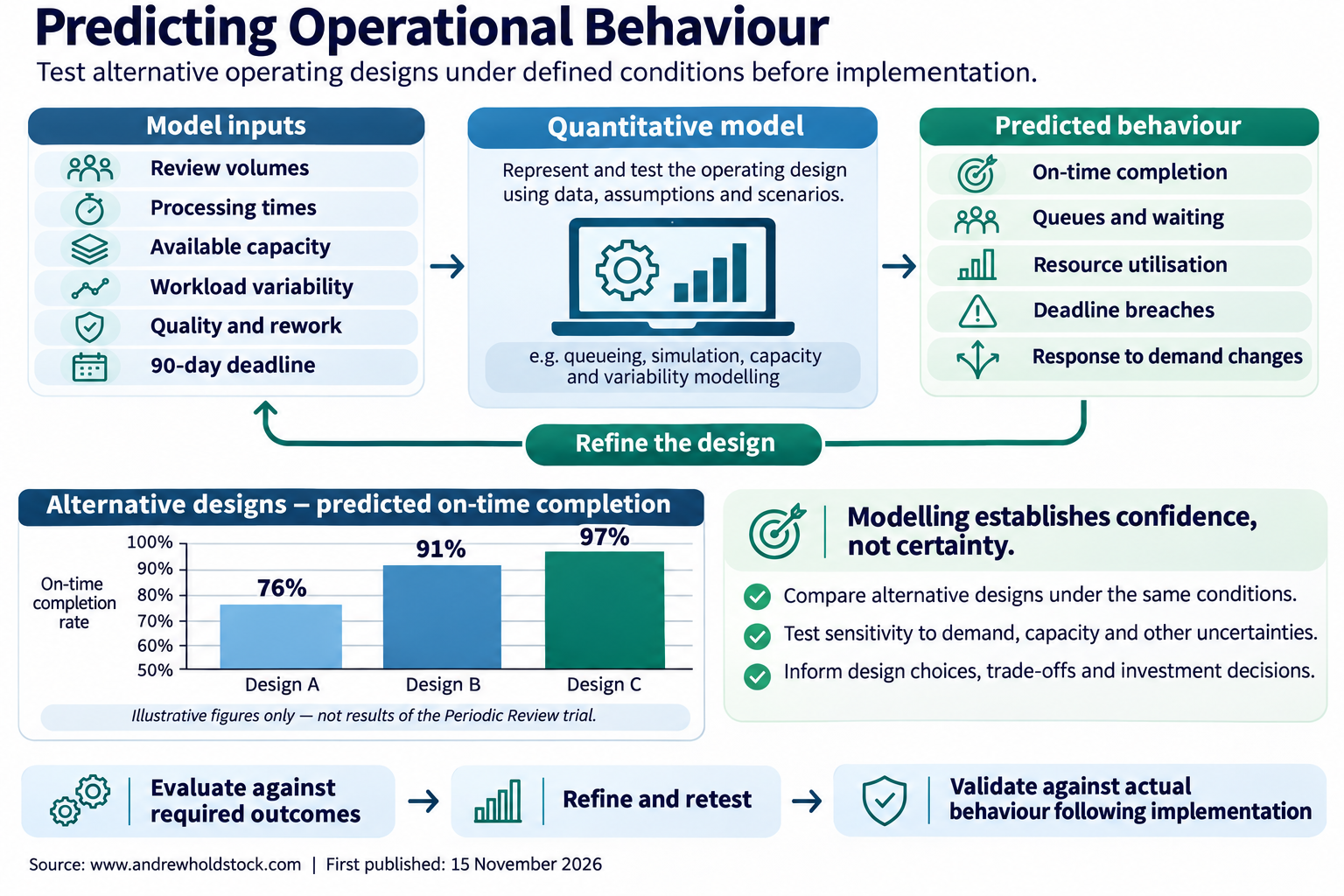
Modelling can reveal whether proposed arrangements are likely to achieve required outcomes, where constraints may arise and how the operation could respond when conditions change.
Predictions are not guarantees. Their reliability depends on the quality of the model, its assumptions and the evidence supporting them. Following implementation, actual behaviour must be compared with predictions to validate and refine both the operating design and the model.
OSE in Practice
Applying engineering principles to design a reliable Periodic Review operation.
Periodic Reviews provide a practical example of OSE. Banks must complete reviews within defined timeframes while maintaining regulatory compliance, information quality and effective controls.
Examining this requirement through multiple operational perspectives reveals challenges involving deadlines, workflow, capacity, variability and quality. These characteristics determine the engineering principles needed to design the operation.
The resulting design combines scheduling, flow management, capacity planning, prioritisation and control mechanisms to achieve the required operational behaviour.
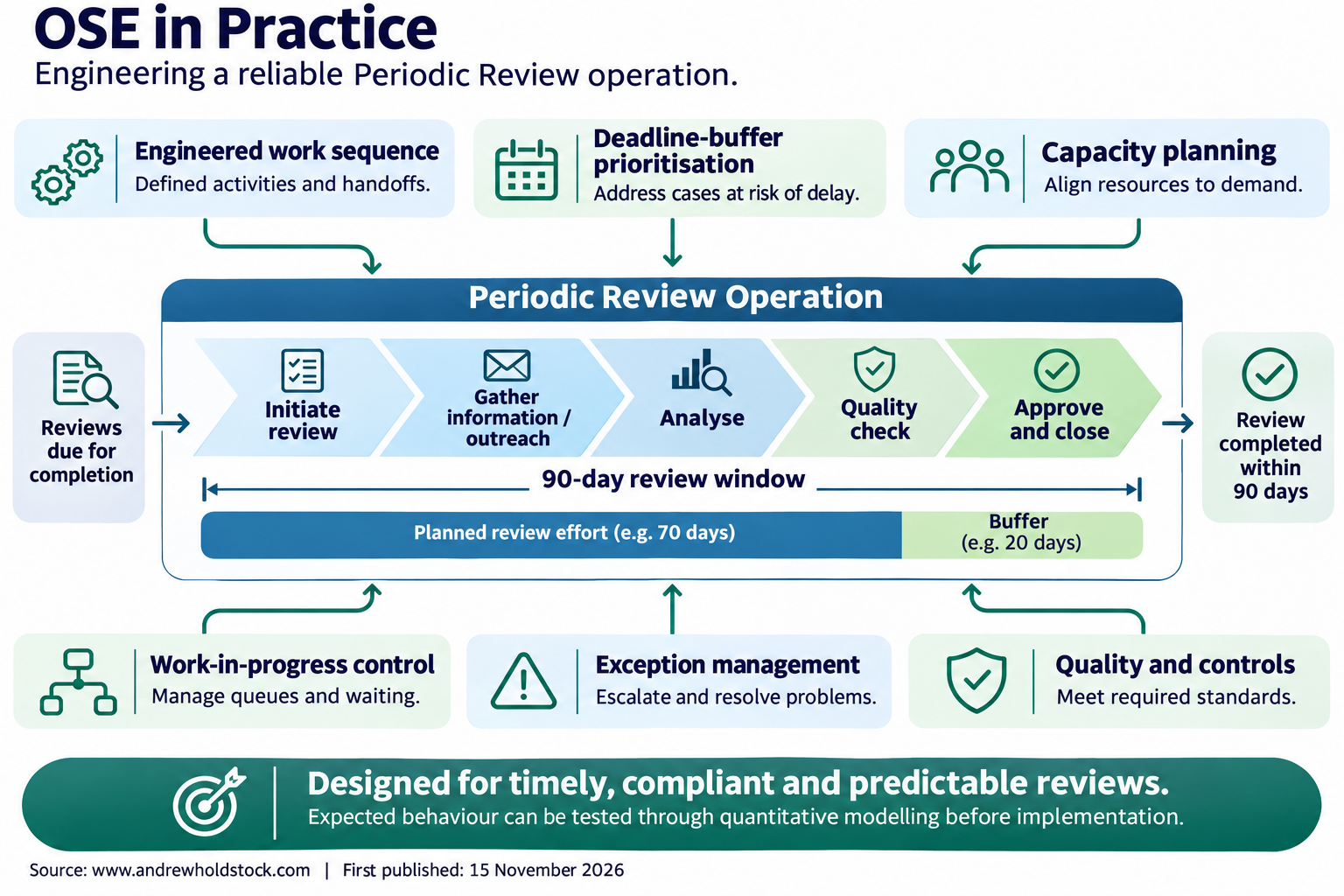
The operating design can be represented in a quantitative model to test its expected behaviour under different workloads, resource constraints and operating conditions.
This allows alternative arrangements to be evaluated and refined before implementation, establishing a stronger basis for achieving timely, compliant and predictable Periodic Reviews.
Engineering for Outcomes, Not Trial and Error
OSE makes established engineering principles practical, systematic and accessible, enabling organisations to design operations whose behaviour can be predicted with confidence before implementation and validated in practice.
First Published: 15-Nov-2026