Roles


Markets Run on Roles
Financial markets require roles to be performed properly to manage risk
Financial markets do not operate through legal entities alone. They operate through participants performing specialised roles within transactions, relationships and business arrangements.
Those roles carry expectations. An arranger must structure. A custodian must safeguard. A trustee must protect defined interests. A risk function must challenge. An investment manager must exercise judgment. Each role depends on the capability, authority, expertise and independence required to perform it properly.

As transactions become more sophisticated, dependence on specialist roles increases. The strength of a financial market therefore rests not only on the participants within it, but on the quality with which those participants perform the roles entrusted to them.
When a critical role is poorly performed, the consequences can extend beyond the role holder. Risk can propagate through the arrangement — and, at scale, through the market.
Roles matter.
When Roles Fail
The 2007–09 Global Financial Crisis showed how much financial markets depend on roles being performed properly.
The crisis was not caused by one failed product, one institution or one bad decision. It developed through a chain of weaknesses across the financial system.
Mortgage originators were expected to assess creditworthiness. Arrangers structured and distributed securities. Rating agencies assessed risk. Investors were expected to understand what they were buying. Risk functions were expected to challenge exposures. Senior management was expected to understand the risks being taken. Regulators and supervisors provided another layer of oversight.
Failures occurred across many of these roles. Weak underwriting entered the system. Complex products were built on increasingly poor assets. Ratings created confidence that later proved misplaced. Investors did not always challenge the assumptions sufficiently. Risk concentrations, liquidity dependencies and model limitations were not always understood or acted upon.
No single role explains the crisis. But the system depended on many roles being performed effectively, and weaknesses in one part of the chain amplified weaknesses elsewhere.
This is the deeper importance of Role.

A role is not simply a label describing what an entity does. It identifies a position of responsibility and relied-upon performance within a financial arrangement.
When that performance fails, risk can propagate through the relationships connecting the participants.
The more interconnected the arrangement, the more consequential role failure can become.
What is a Role?
An entity is who the participant is. A role is what that participant is relied upon to do.
A role describes the function an entity performs within a relationship or business arrangement.
The same entity can perform different roles in different contexts. A bank may act as lender in one arrangement, arranger in another, custodian in another, and counterparty elsewhere. The legal entity has not changed, but the role it performs — and therefore the responsibilities, risks and expectations attached to it — has.
A role is therefore more than a label. It carries an expectation of performance. Depending on the role, that may require particular expertise, authority, capability, independence, eligibility or market standing.

A role is therefore more than a label. It carries an expectation of performance. Depending on the role, that may require particular expertise, authority, capability, independence, eligibility or market standing.
Roles also exist in context. An entity may be capable of performing a role generally, but only be appointed to perform it for a particular relationship or arrangement.
For CLM, this distinction is fundamental. Knowing the identity of the entity is not enough. The bank must also understand what role the entity is performing, where it is performing it, and what is expected of it in that role.
One Entity, Many Roles
A single entity can participate in the financial system in many different ways.
Banks often organise information around legal entities, but a legal entity does not have only one business meaning.
The same entity may borrow from the bank, issue securities, guarantee another entity's obligations, act as an investment manager, trade as a counterparty, provide custody services or act as an agent.
Those roles may exist at the same time and across different products, businesses and jurisdictions.
This matters because the bank's obligations and exposures are not determined by identity alone. They depend on the capacity in which the entity is participating.
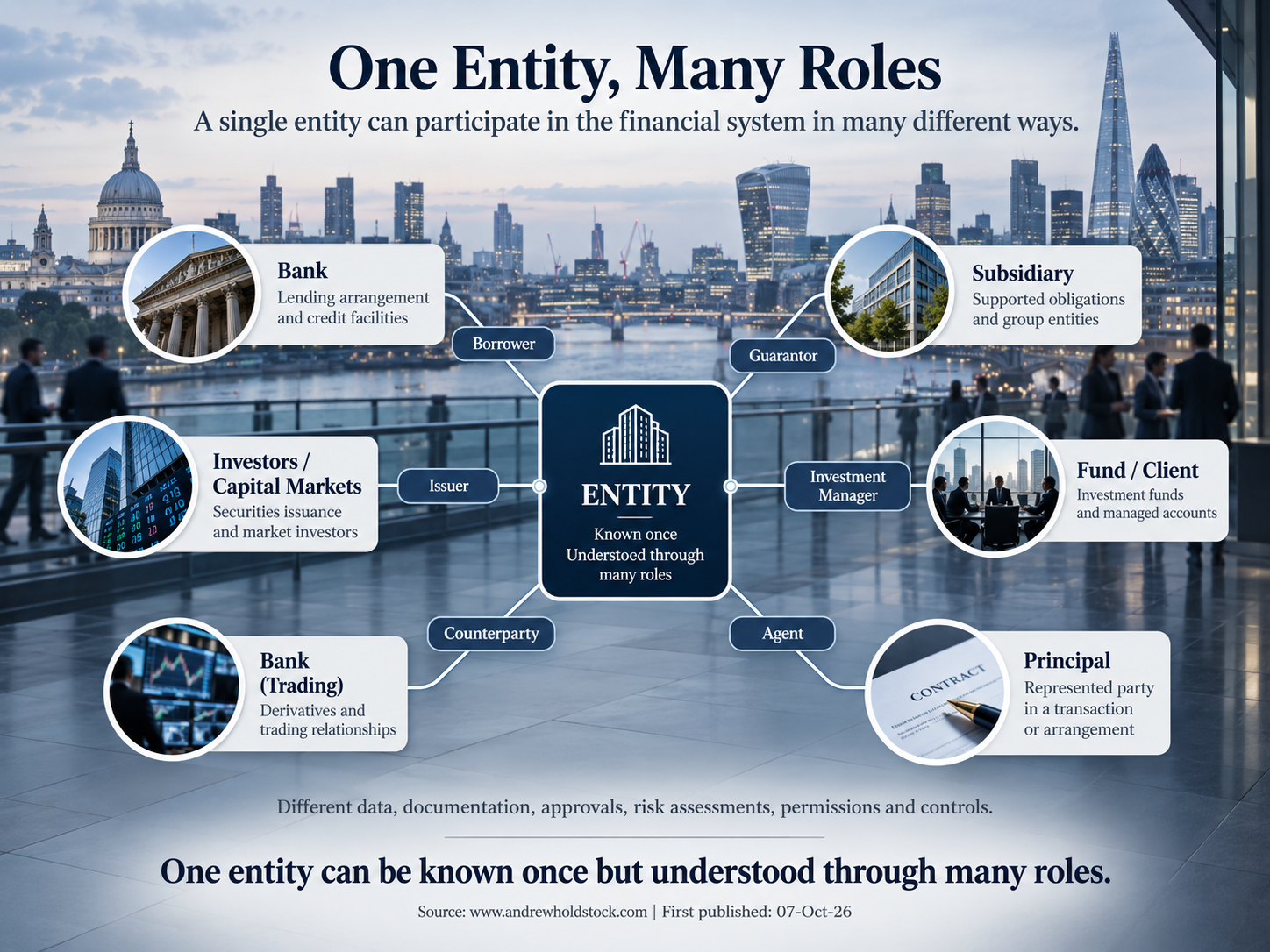
For example, the same legal entity might be:
a borrower for a lending facility;
a guarantor for a subsidiary;
an issuer of securities held or traded by the bank;
an investment manager acting for a fund;
a counterparty under a derivatives agreement;
an agent acting on behalf of another party.
Each role may require different data, documentation, approvals, risk assessments, permissions and controls.
If the bank collapses all of this into a single undifferentiated entity record, important distinctions can disappear. Exposure may be misunderstood, permissions applied too broadly, obligations missed, or relationships represented incorrectly.
One entity can be known once but understood through many roles.
Same Entity. Different Role. Different Risk.
A single entity can participate in the financial system in many different ways.
A bank does not deal with entities in the abstract. It deals with them in particular capacities as borrowers, issuers, guarantors, counterparties, investment managers, agents, custodians, trustees and many other roles.
The same entity can perform several of these roles at the same time. Each role can create different relationships, obligations, permissions, exposures and risks.
That means identity is only the starting point.
The bank must also understand what role the entity is performing, in which context, and what that role means for the relationship.
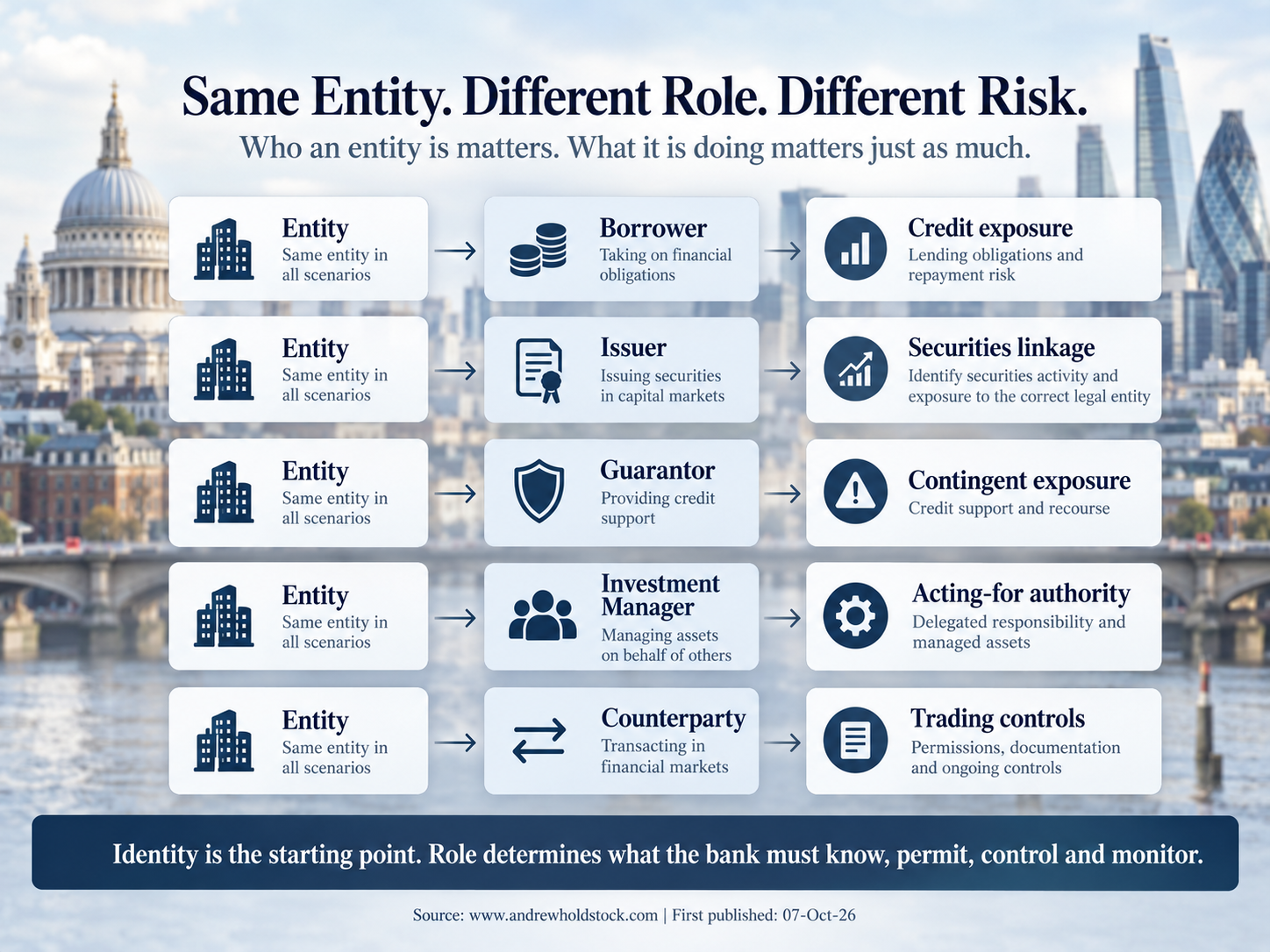
A borrower may create credit exposure. An issuer may need to be identified so the bank can link securities activity, exposure and risk to the correct legal entity, even where the issuer is not itself an AML client. A guarantor may introduce contingent exposure. An investment manager may act on behalf of other entities. A counterparty may require trading permissions, documentation and ongoing controls.
The entity has not changed but is role has, and that can change what the bank needs to know, permit, control and monitor.
Roles Create Relationships
A relationship becomes meaningful when the roles of the participants are understood.
Knowing that two entities are connected is not enough. The bank also needs to understand how they are connected and the capacity in which each participant is acting.
A lender is related to a borrower. A guarantor supports an obligor. An investment manager acts for a fund. An agent acts for a principal. A custodian holds assets for another party.
The roles make the relationship interpretable: they determine the rights, obligations, exposures, permissions and controls that arise from it.
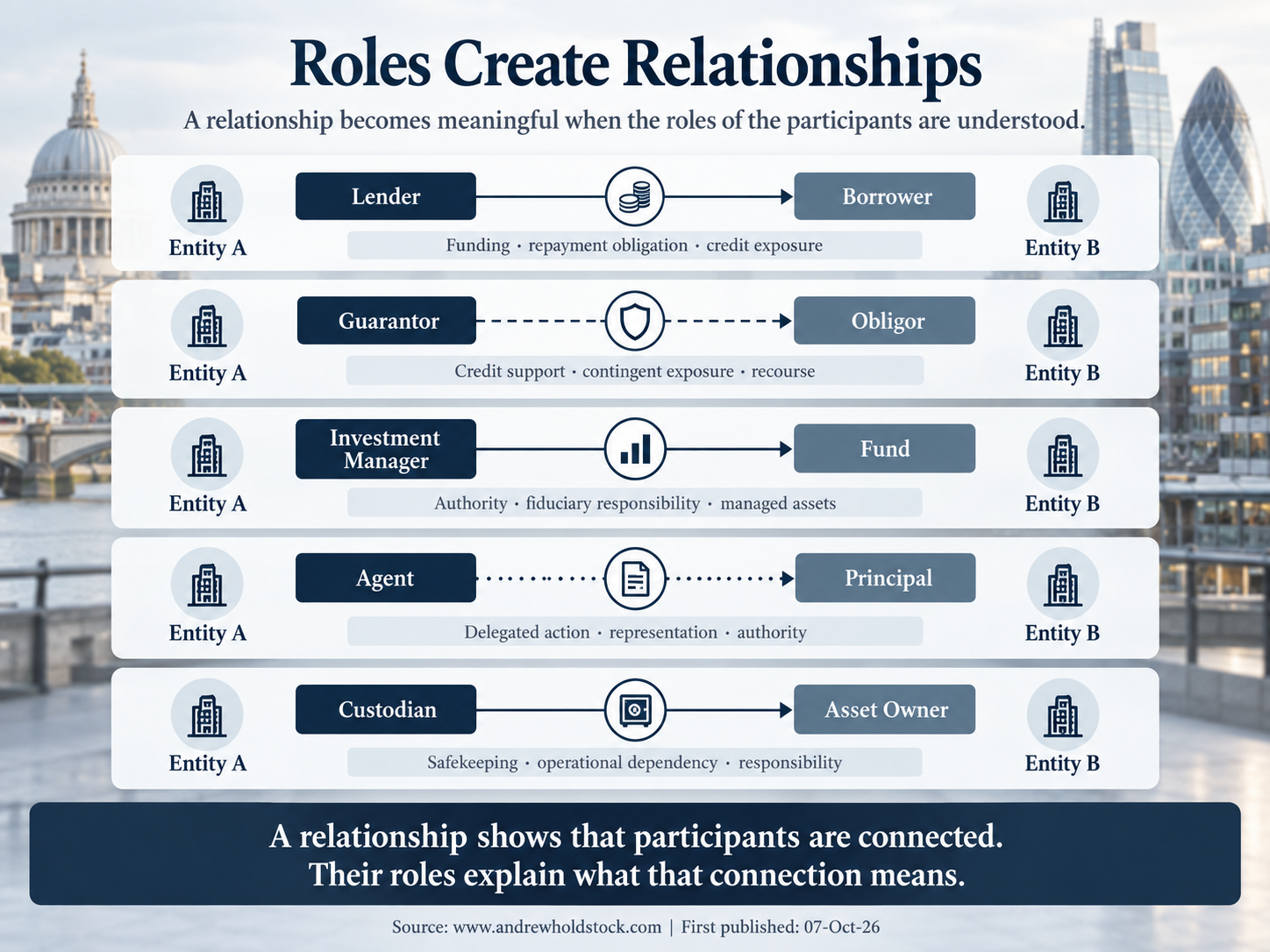
This is important because the same two entities can have more than one relationship at the same time. One entity might lend to another, guarantee one of its obligations, provide services to it, or act on its behalf in a different arrangement.
The participants have not changed, but the role each performs changes the nature of the relationship between them.
That relationship can determine what the bank needs to understand about authority, exposure, dependency, control, ownership, responsibility and risk.
Roles therefore help turn a network of connected entities into something the bank can interpret.
A relationship shows that participants are connected. Their roles explain what that connection means.
Roles Within Arrangements
A role only has meaning in the context in which it is performed.
An entity may perform many roles, but those roles do not exist in isolation. They arise because the entity is participating in a particular business arrangement.
A borrower is a borrower under a lending arrangement. A guarantor provides support for an obligation. An issuer issues a particular security. An investment manager acts under a mandate. A counterparty participates in a trading arrangement.
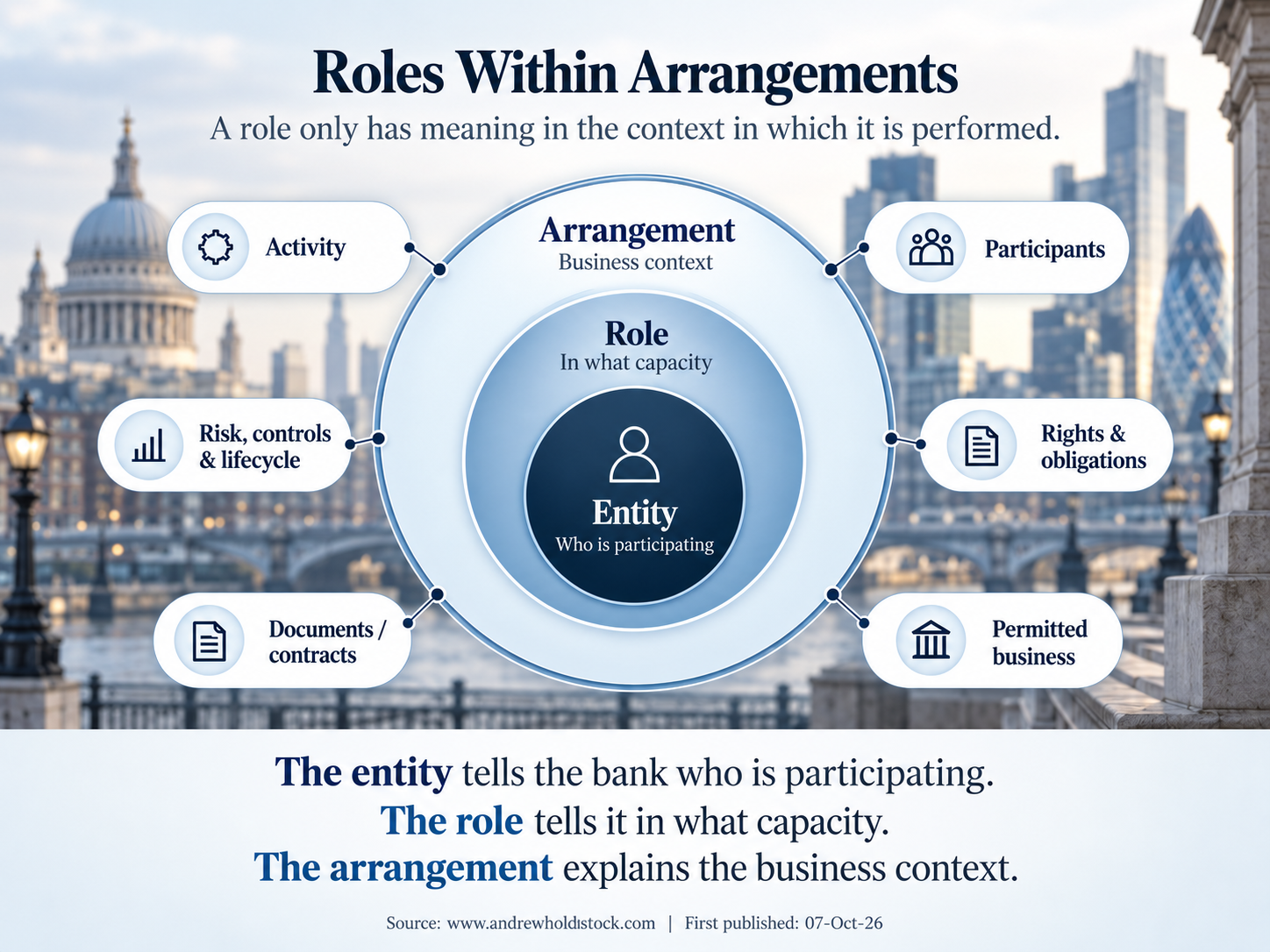
The arrangement provides the context that gives the role its scope.
It helps answer questions such as:
What activity is the entity participating in?
Which other participants are involved?
What rights and obligations arise?
What products, services or transactions are permitted?
What documents or contracts govern the arrangement?
What risks and controls apply?
When does the role begin, change or end?
The same entity may therefore perform the same role in several different arrangements, with different terms, permissions, exposures and obligations in each.
This is why role should not simply be stored as a permanent attribute of the entity. The role must be understood in relation to the arrangement in which it is being performed.
The entity tells the bank who is participating. The role tells it in what capacity. The arrangement explains the business context in which that participation takes place.
Roles and Contracts
Contracts formalise participation, but they do not define the whole relationship.
Many roles are expressed through contracts, agreements, mandates or other legal documentation.
A borrower may enter into a facility agreement. A guarantor may sign a guarantee. An investment manager may act under an investment management agreement. A counterparty may trade under a master agreement. An agent may be appointed under specific contractual terms.
These documents help define the rights, obligations, authorities and limitations associated with the role.
But the contract is not the role itself.
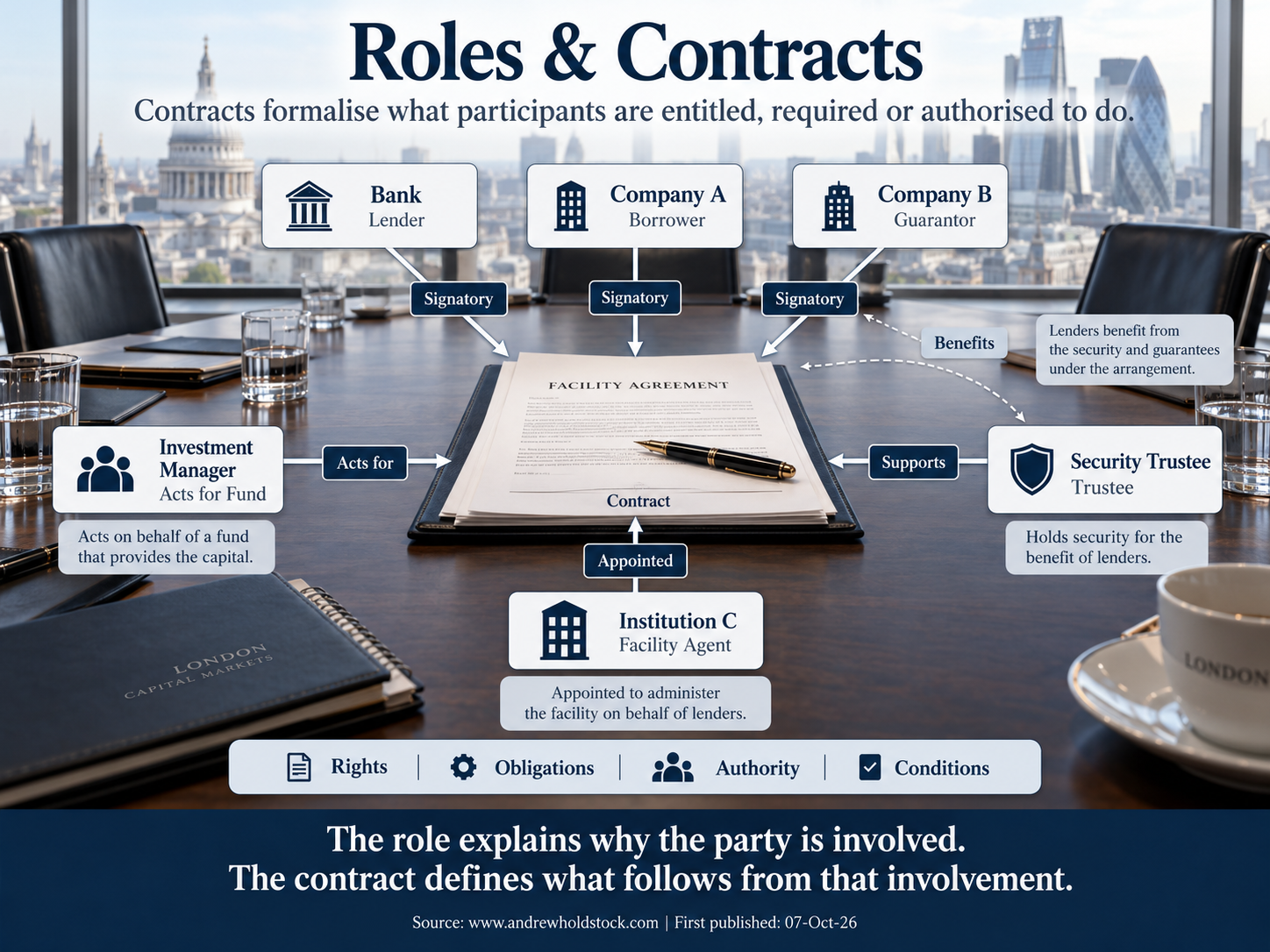
The role describes the capacity in which the entity participates. The contract records some or all of the legal terms under which that participation takes place.
There may also be more than one contract supporting the same arrangement, and some important aspects of participation may arise from regulation, market rules, delegated authority or operating practice rather than from a single document.
This distinction matters because a bank should not have to reconstruct business meaning solely from contracts.
It should be able to understand:
who the participants are;
what roles they perform;
how they are related;
which arrangement those roles belong to; and
which contracts or documents govern that participation.
Contracts document the terms. Roles explain who is doing what within the arrangement.
Understanding a Role
The bank needs to understand the role, the arrangement in which it is performed, and the entity expected to perform it.
Knowing that an entity performs a role is only the starting point. The bank also needs to understand what the role requires, the business context in which it is being performed, and whether the entity performing it is suitable to do so.
The role defines the function being performed, the responsibilities attached to it and the authority or permissions that may come with it.
The arrangement provides the context. It establishes why the role exists, who the other participants are, what activity is taking place, what contracts or mandates apply, and when the role begins, changes or ends.
The performer matters as well. The bank may need to understand whether the entity is eligible and authorised to perform the role, has the necessary expertise and capability, is sufficiently independent where required, and remains acceptable to the relevant parties.
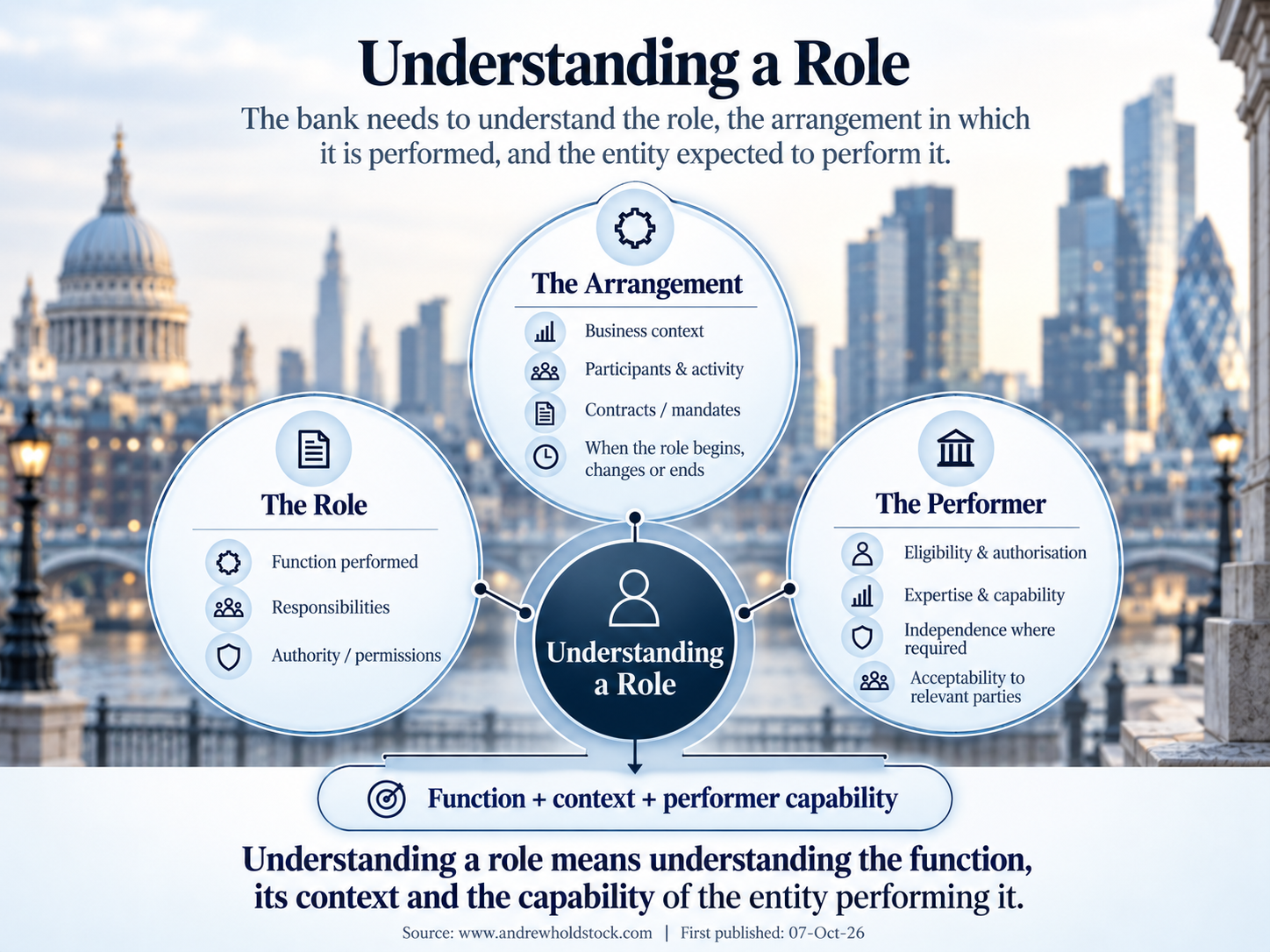
These dimensions cannot be considered separately. A capable entity may not be authorised for a particular arrangement. An eligible entity may not be acceptable to the parties. A role may remain valid in one arrangement but cease in another.
Understanding a role therefore means understanding the function, its context and the capability of the entity performing it.
That understanding gives the bank the basis for deciding what information, approvals, permissions, controls and monitoring are required.
Roles Drive Bank Activity
Once the role is understood, the bank can determine what needs to happen.
A role is not just descriptive. It can drive the bank's actions, decisions and controls.
The capacity in which an entity participates may determine what information is required, which approvals are needed, what documentation must be in place, what risks need to be assessed, what permissions can be granted and what activity must be monitored.
A borrower may trigger credit assessment, facility documentation and exposure monitoring. A guarantor may require legal enforceability checks and contingent exposure recognition. An investment manager may require authority to be verified before instructions can be accepted. A counterparty may require trading documentation, product permissions and ongoing controls.
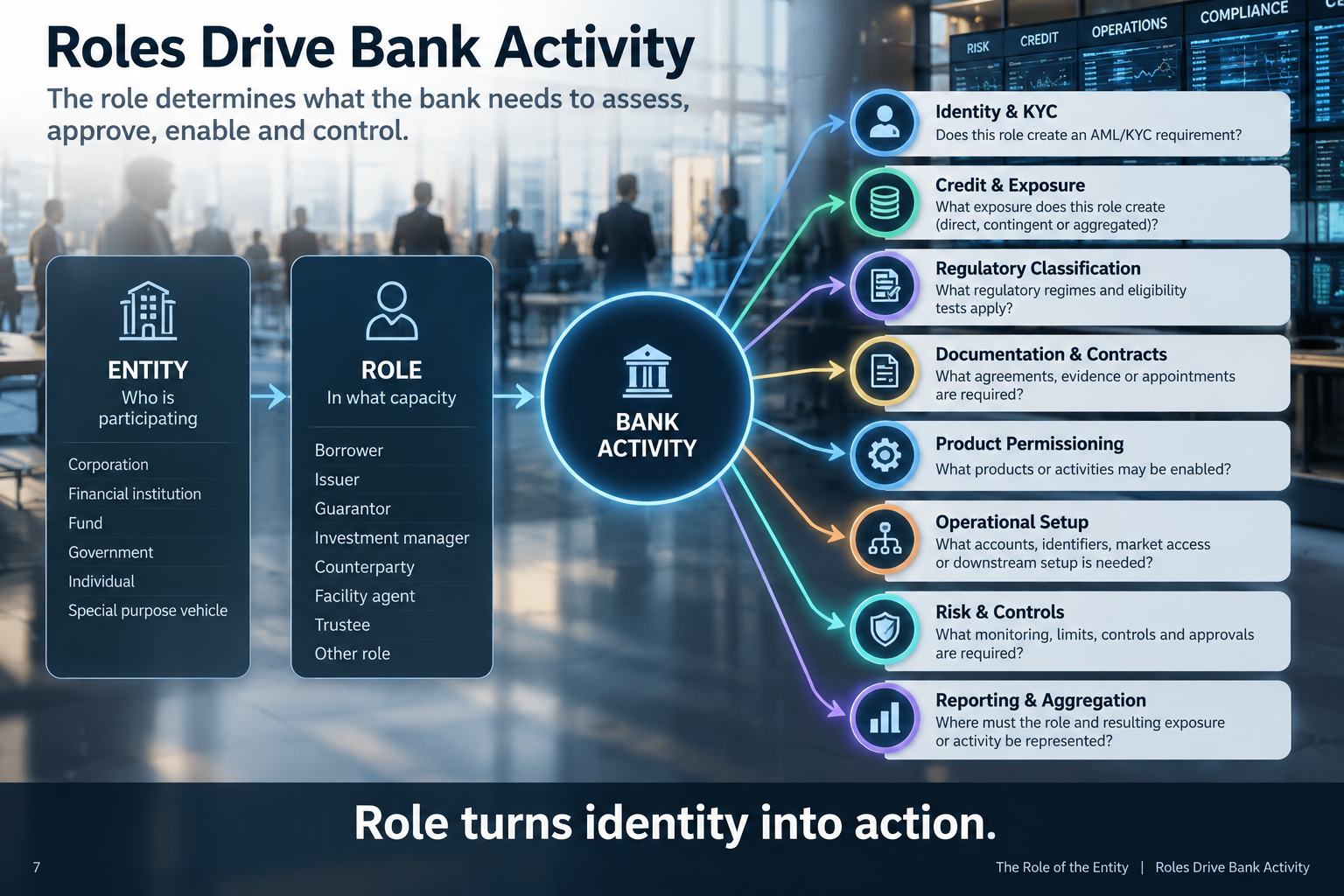
The role can also affect how information is distributed across the bank.
It may determine which systems need to recognise the entity, which identifiers are required, how exposure is aggregated, which products can be used and which teams are responsible for managing the relationship.
This is why role modelling should not sit only in reference data or documentation.
It should connect directly to the bank's operating model, control framework and platforms.
The role tells the bank not only what the entity is doing, but what the bank must do in response.
Role Eligibility
An entity may exist, but that does not mean it can perform every role.
Before the bank accepts an entity in a particular capacity, it may need to determine whether that entity is eligible to perform the role.
Eligibility can depend on many things: legal capacity, regulatory permissions, licences, jurisdiction, constitutional powers, mandate, credit standing, product rules, market membership or the terms of the underlying arrangement.
An entity may therefore be perfectly valid and correctly identified, but still be unable to perform a particular role.
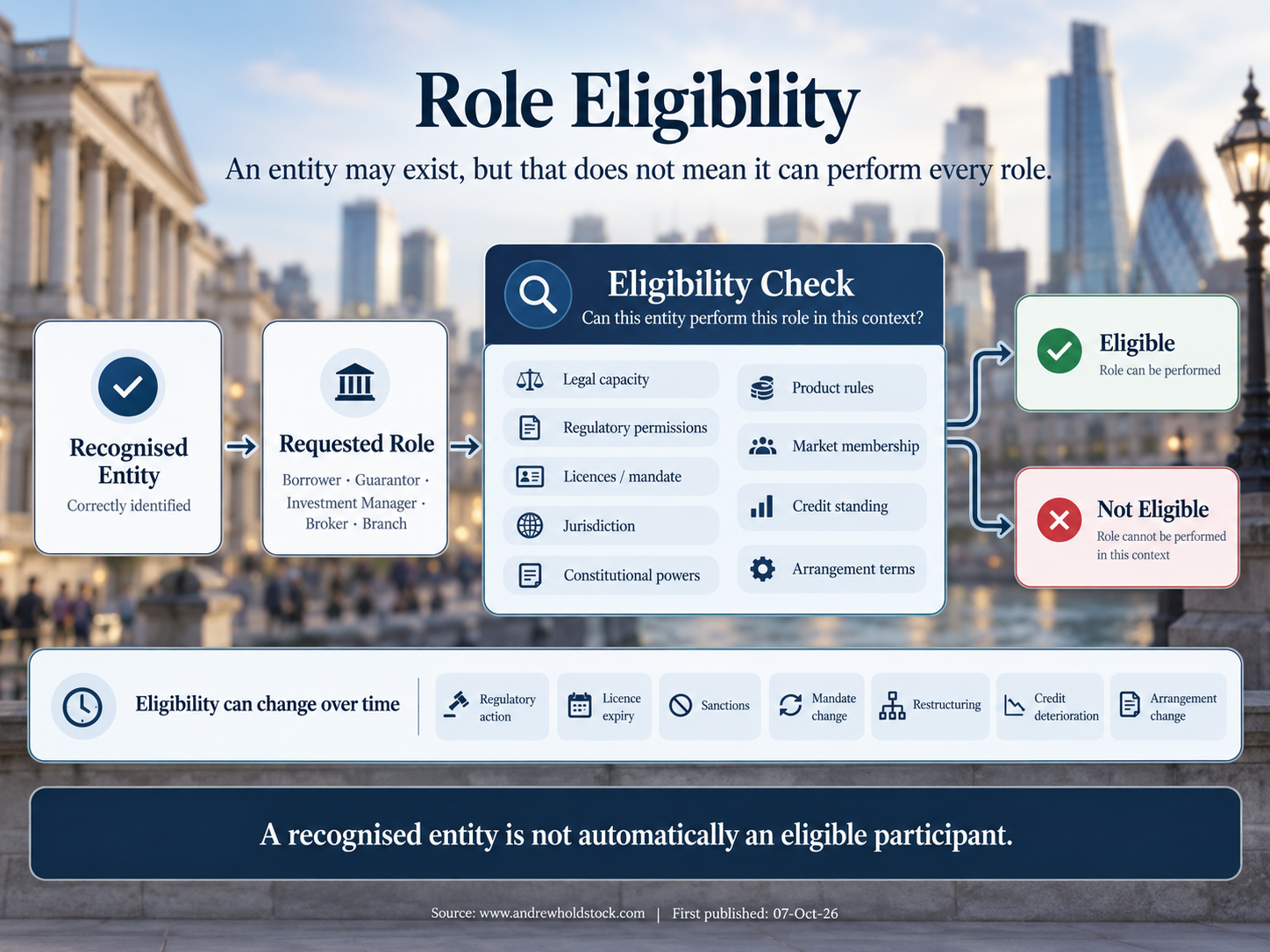
A fund may not be permitted to borrow beyond defined limits. An investment manager may only act within the scope of its mandate. A broker may need specific regulatory permissions. A branch may have restrictions on the activities it can undertake. A guarantor may lack the legal capacity or authority to provide the intended support.
This distinction is important because identity and eligibility answer different questions.
Identity asks: is this the correct entity?
Eligibility asks: can this entity legitimately perform this role in this context?
Eligibility is also not necessarily permanent. It can change because of regulatory action, licence expiry, sanctions, mandate changes, restructuring, credit deterioration or changes to the arrangement itself.
The bank therefore needs to understand not only who the participant is and what role it performs, but whether that role remains valid over time.
A recognised entity is not automatically an eligible participant.
Roles Change
A role can change or end even when the entity itself remains unchanged.
Entities often persist for years, but the roles they perform can begin, change, expire or cease altogether.
A borrower may repay a facility. A guarantor may be released. An investment manager may lose or relinquish its mandate. A broker may lose a regulatory permission. An agent may be replaced. A counterparty may no longer be permitted to trade a particular product.
In each case, the entity still exists.
What has changed is the capacity in which it participates.
That change can have consequences across the bank. Permissions may need to be removed. Exposure may need to be recalculated. Documentation may need to be closed or replaced. Systems may need to stop accepting activity. Downstream platforms may need to be updated. Other participants in the arrangement may also be affected.
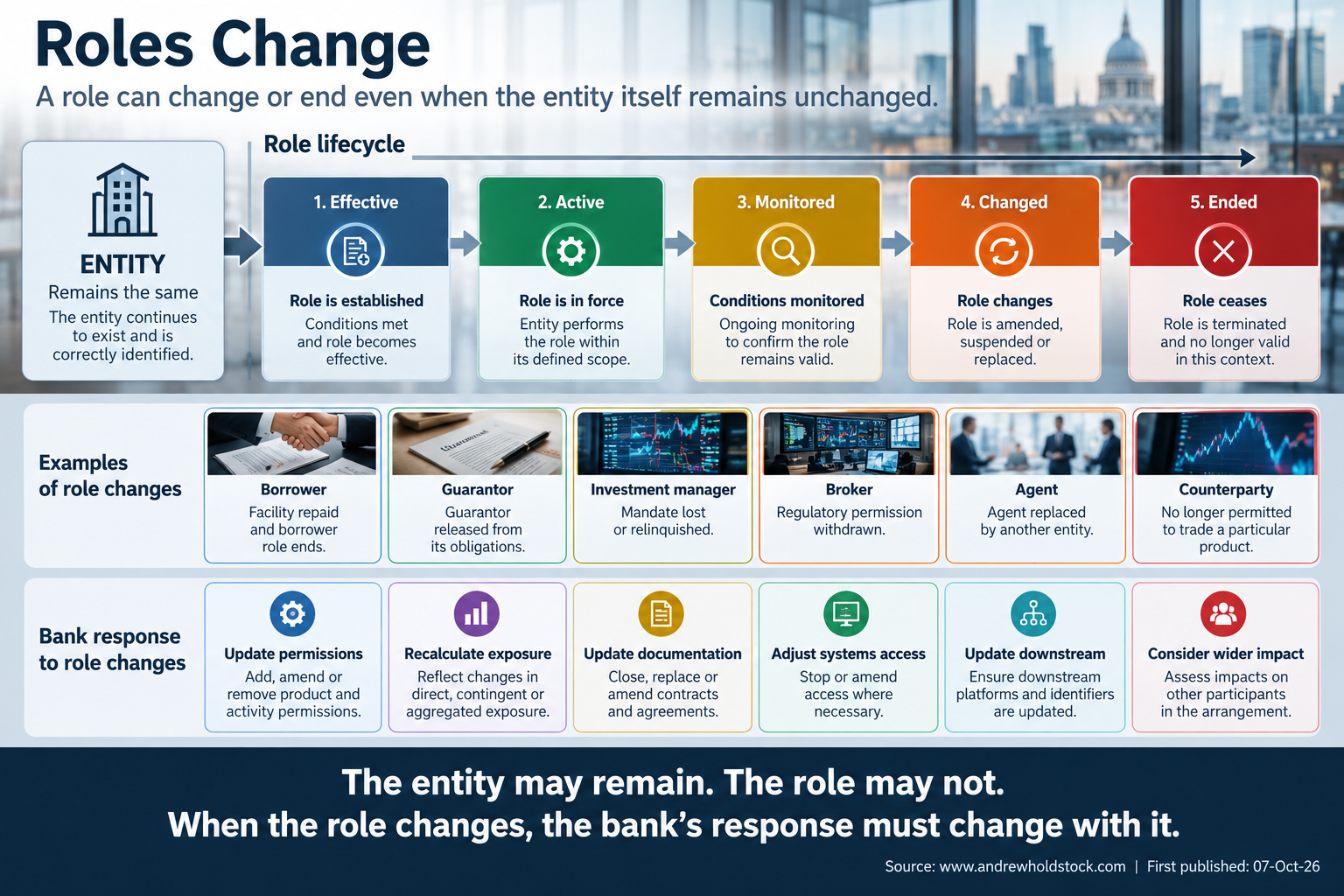
Role changes therefore need to be treated as lifecycle events in their own right.
The bank should be able to understand:
when a role became effective;
what conditions make it valid;
whether those conditions still hold;
what happens when the role changes; and
what must be withdrawn, updated or retained when the role ends.
This is particularly important where a role gives an entity authority, access or permission to act.
The entity may remain. The role may not. And when the role changes, the bank's response must change with it.
From Identity to Action
Knowing who the entity is does not tell the bank enough.
Banks need to understand not only the identity of a participant, but the capacity in which that participant is acting.
Role determines how the bank interprets the relationship, what obligations arise, what permissions may be granted, what risks need to be managed and what actions must follow.
Without a clear role model, the bank can end up treating very different forms of participation as though they were the same.
That can lead to incorrect permissions, missed exposures, unclear accountability, weak controls, duplicated data and poor understanding of the relationships that actually matter.
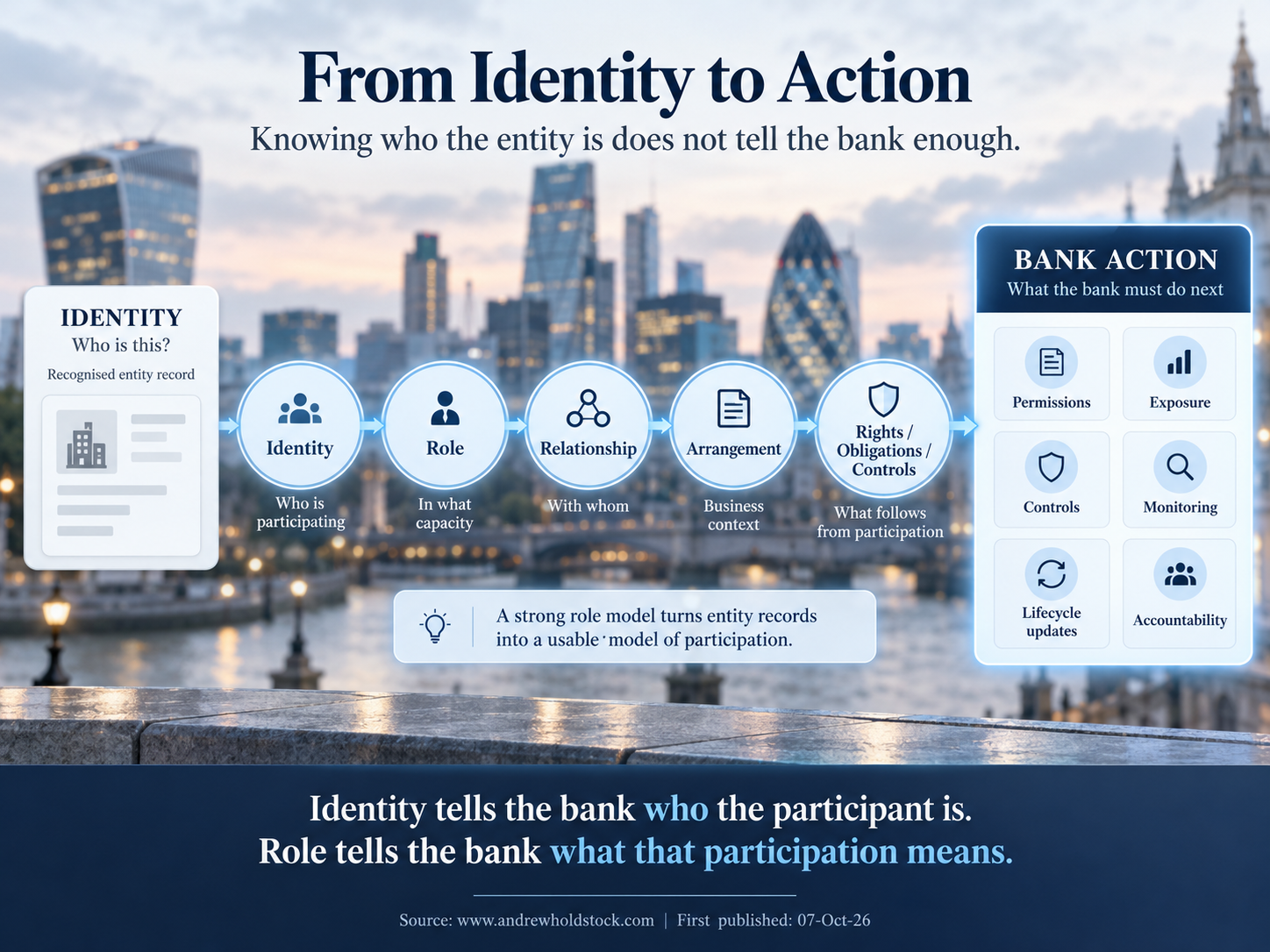
A strong role model allows the bank to connect identity to business context.
It helps the bank understand:
who is participating;
in what capacity;
with whom;
under which arrangement;
subject to which rights, obligations and controls; and
what changes when that role starts, changes or ends.
This is what turns a collection of entity records into a usable model of participation.
Identity tells the bank who the participant is. Role tells the bank what that participation means.