Engineering the AI-Enabled Bank

Imagining Tomorrow’s Bank
What could banks discover, achieve and become as AI transforms the possibilities for financial services?
Much of today's AI investment in banking focuses on automating activities, improving productivity and reducing costs. Yet the greater opportunity may be to rethink what banks could become.
AI could enable discoveries about financial relationships, new approaches to managing systemic risk, and services that are difficult to imagine today. If we were designing a bank for 2036, unconstrained by today's organisational structures, products and technology, what might we create—and what would we need to begin changing now?
The Bank of 2036 is a thought experiment, not a prediction. It explores how AI might change the nature of banking, what new knowledge and enterprise abilities could become possible, and what institutions would need to realise them.
The enquiry also considers a central hypothesis: that the transformative value of AI depends not only on the technology itself, but on the quality of the questions asked, the information available and the ability to turn discoveries into dependable operations.
Beyond Automation
AI offers opportunities to discover new knowledge, anticipate financial risks and fundamentally rethink what banks can achieve.
Much of the initial application of AI in banking has focused on automating tasks, increasing productivity and reducing operating costs. These are valuable improvements, but they largely preserve the business models and operating arrangements banks already possess.
The greater opportunity may lie in using AI to explore what banks do not yet know, discover new financial relationships, anticipate systemic risks and develop entirely different services. Rather than asking how AI can improve today's bank, we should ask what an AI-enabled bank could become.
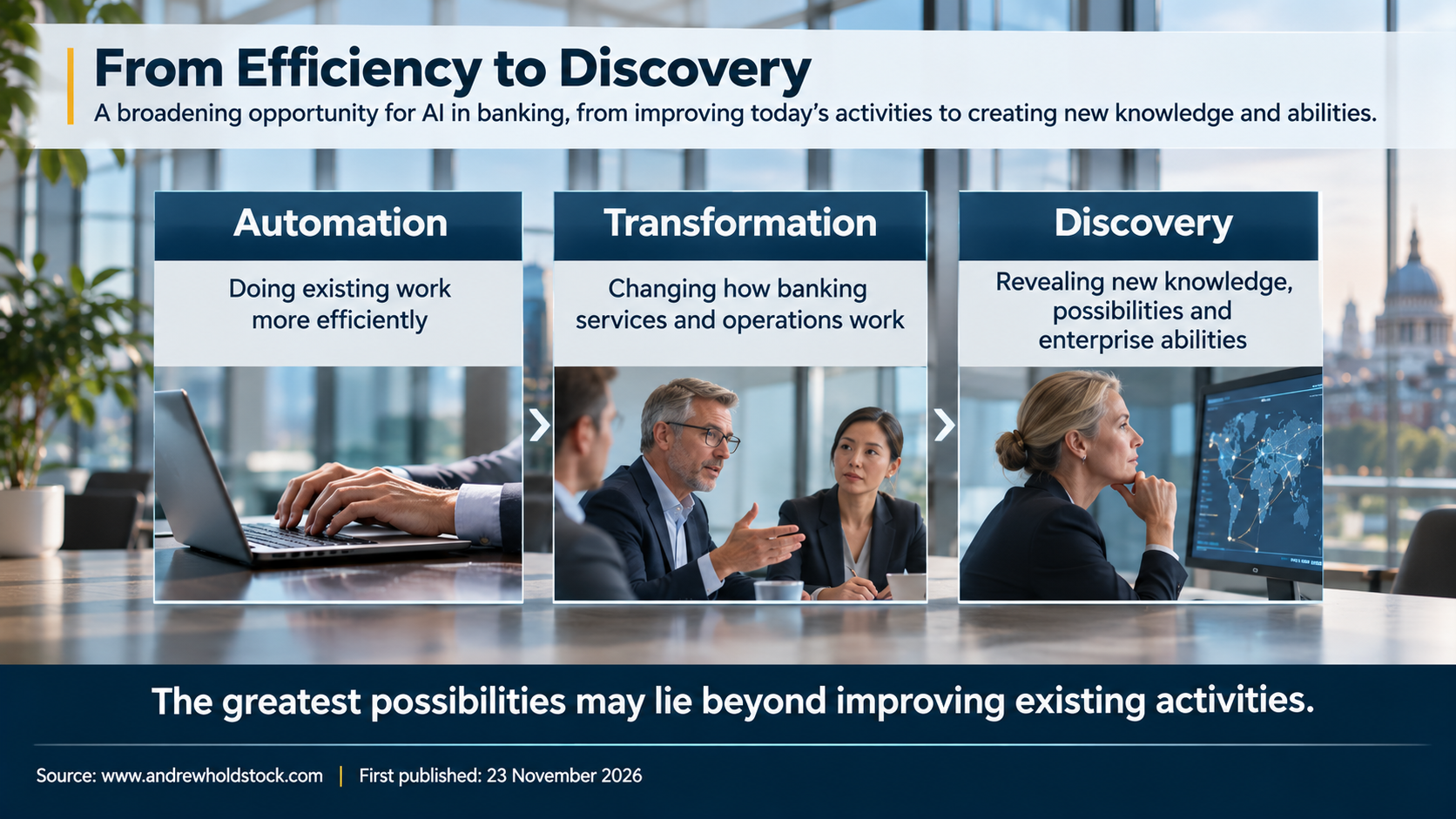
Consider systemic financial risk. AI might do far more than accelerate stress-testing reports. It could help discover previously unrecognised dependencies, explore how crises propagate through financial networks and evaluate how a bank might position itself against multiple possible futures.
The difference could be substantial. Banks may gain competitive advantage not simply by processing information faster, but by developing knowledge and strategic foresight their competitors lack. This raises a more fundamental question: how do we discover which opportunities are worth pursuing?
The Power of Enquiry
AI can expand what bankers are capable of investigating, but the quality of the enquiry shapes what they discover.
AI gives banking professionals access to knowledge, analytical methods and scientific disciplines that previously required specialist expertise. Yet access to these capabilities does not automatically produce valuable insights.
The questions we ask determine what we investigate, the assumptions we carry forward and the possibilities we may overlook. A well-written prompt can still address the wrong problem. Unlocking AI's transformative potential requires disciplined enquiry: exploring alternatives, challenging assumptions, examining evidence and discovering questions we might not otherwise have considered.
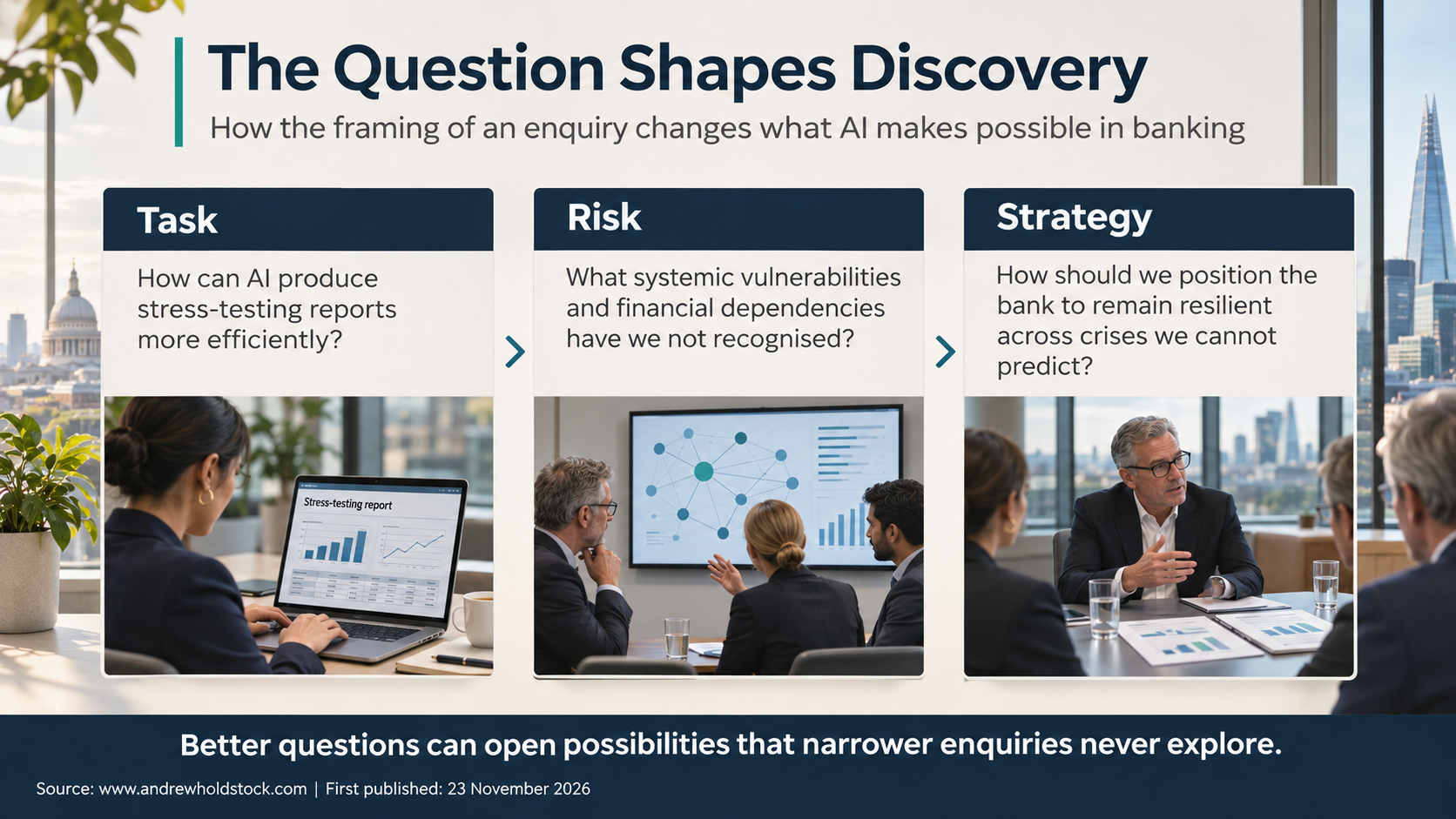
The difference is not simply better prompting. It is the ability to structure an investigation around the underlying business objective, identify relevant scientific principles, test hypotheses and challenge conclusions.
This may become an important new professional ability. AI could enable bankers to undertake sophisticated investigations without becoming specialists in every discipline involved. However, the quality of the results must still be established through reliable information, appropriate methods and independent validation.
The next question is whether banks possess the information needed to support such enquiries.
Intelligence Needs Information
AI could transform financial intelligence, but its conclusions depend on the quality, completeness and connectedness of underlying information.
AI may be capable of exploring thousands of financial scenarios, identifying emerging risks and discovering relationships that conventional analysis overlooks. But its intelligence is constrained by what it can reliably know.
Banks hold enormous quantities of information, often distributed across businesses, regions and platforms. Inconsistent identities, disconnected relationships and incomplete financial data can prevent a coherent understanding of exposures and dependencies. Transformative AI therefore requires more than access to data. It requires information that is connected, meaningful, trustworthy and sufficiently current to support the decisions being made.
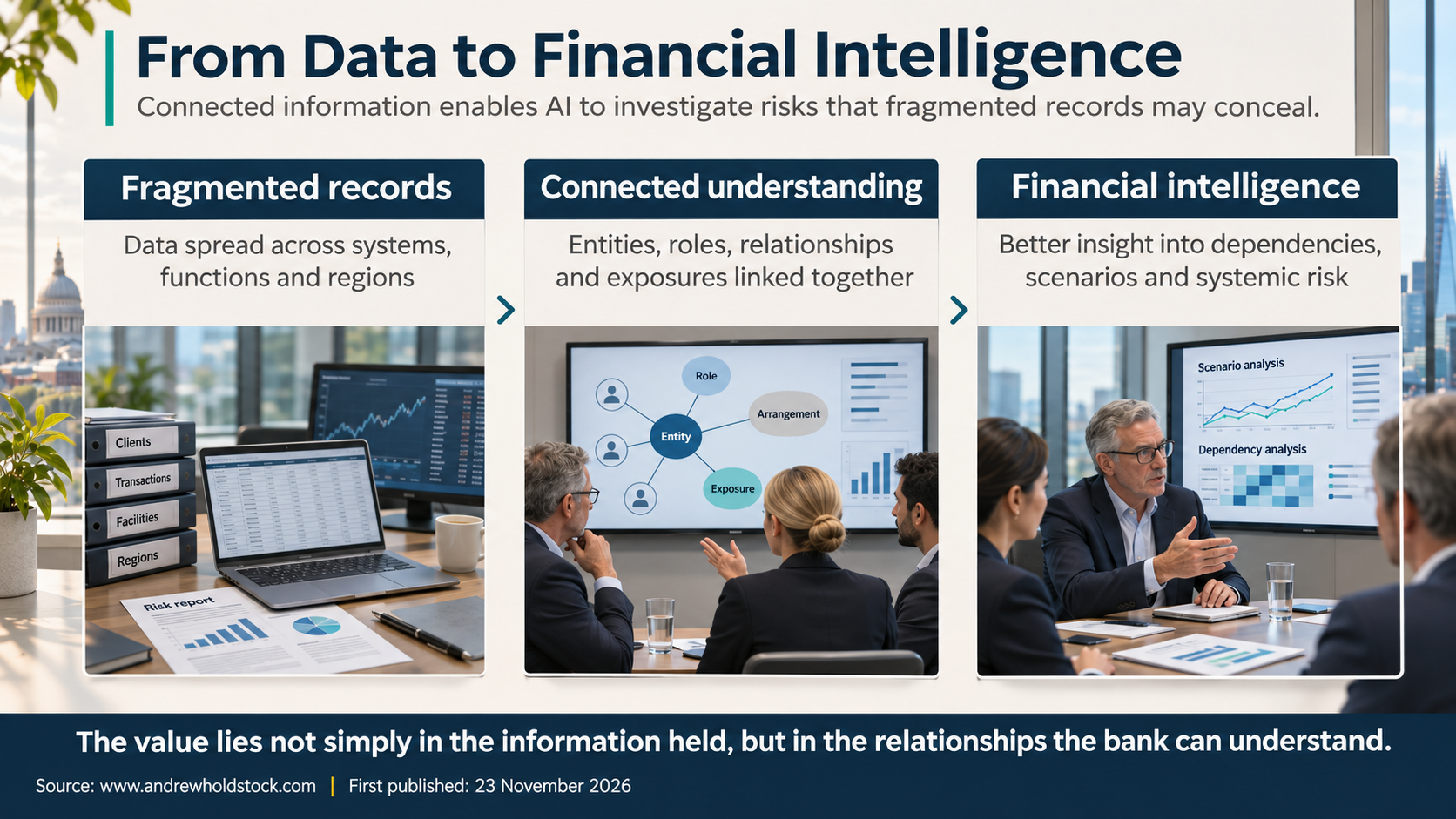
Consider a financial crisis spreading through seemingly unrelated companies and institutions. Understanding the consequences requires knowing not only who the parties are, but the roles they play, the arrangements connecting them and the obligations and exposures involved.
An Entity–Role–Relationship (ERR) architecture may provide an important foundation for this connected understanding. It is not the complete information solution, but it could help establish the structure through which financial information becomes meaningful across the enterprise. The challenge then becomes creating and sustaining the abilities needed to exploit it.
Engineering the Enterprise
AI discoveries create possibilities, but banks must establish the enterprise abilities needed to turn them into dependable outcomes.
AI may identify previously unrecognised risks, reveal new financial opportunities or suggest fundamentally different ways of serving customers. But discovering what might be possible does not mean a bank is capable of achieving it.
Realising these opportunities requires coordinated changes across the enterprise. Information, technology, responsibilities, decision authority, processes and controls must work together to deliver the intended outcome. Without this integration, even a valuable discovery may become another isolated initiative, adding complexity rather than creating lasting value.
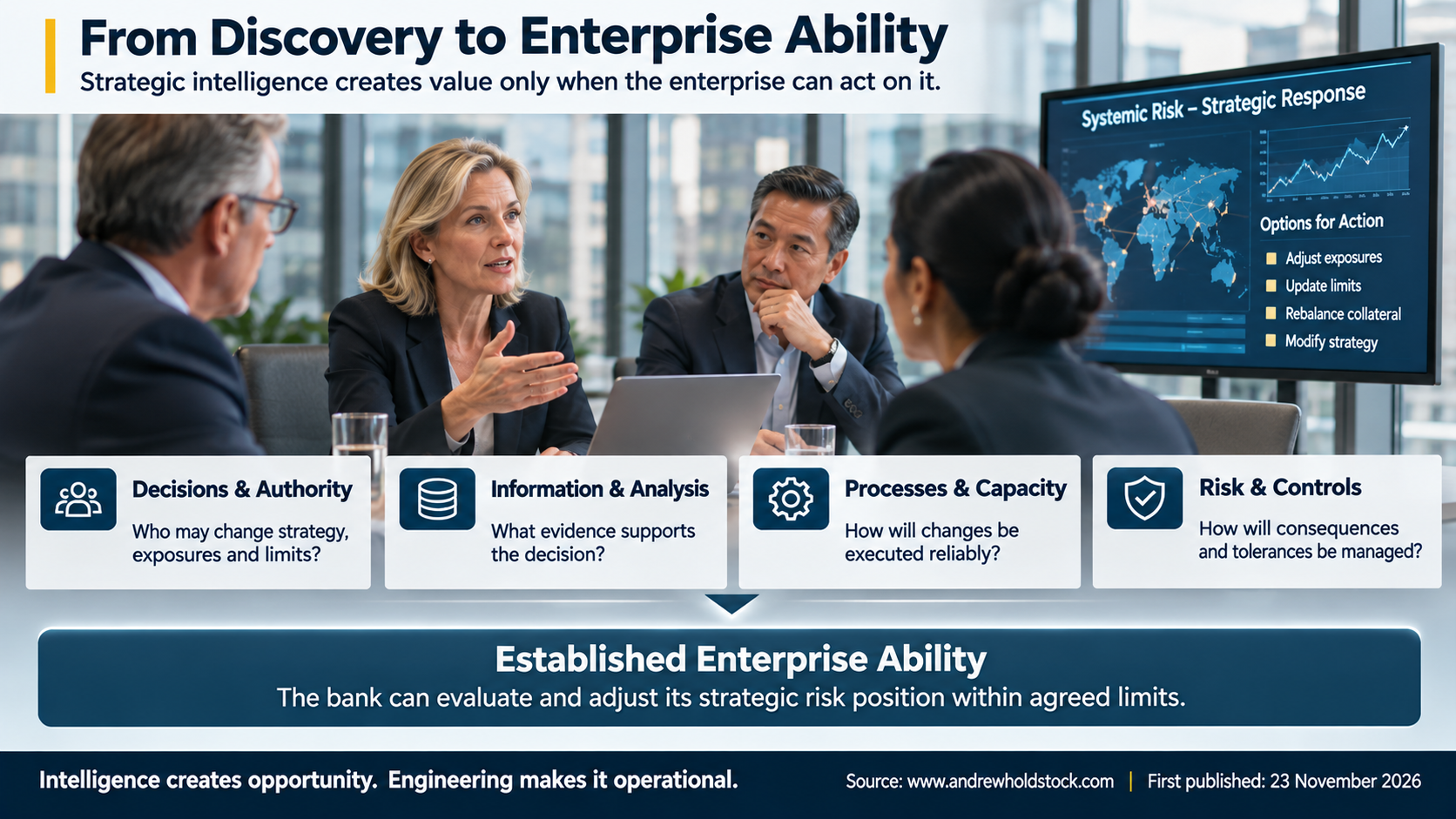
Consider a bank whose AI analysis reveals an emerging concentration of systemic risk. Understanding the vulnerability is valuable, but acting effectively may require coordinated changes to lending, treasury, collateral, counterparty limits and business strategy.
The bank must establish who can decide, how decisions are executed, which controls apply and how outcomes are monitored. These arrangements must operate reliably under changing conditions.
The challenge is therefore not simply adopting AI. It is engineering enterprise abilities capable of converting new intelligence into sustained business value.
Engineering Methods for an AI Future
EAA and OSE may provide the disciplines needed to investigate AI opportunities and engineer dependable enterprise outcomes.
AI makes sophisticated knowledge and analytical methods increasingly accessible to banking professionals. Yet the quality of the outcomes depends on how questions are framed, alternatives explored, evidence evaluated and proposed solutions tested.
Enterprise Ability Architecture (EAA) and Operational Systems Engineering (OSE) are developing approaches that may help bring discipline to this process. EAA investigates what the enterprise needs to be able to achieve and how those abilities should be architected. OSE applies scientific and engineering principles to design operations capable of delivering predictable outcomes.
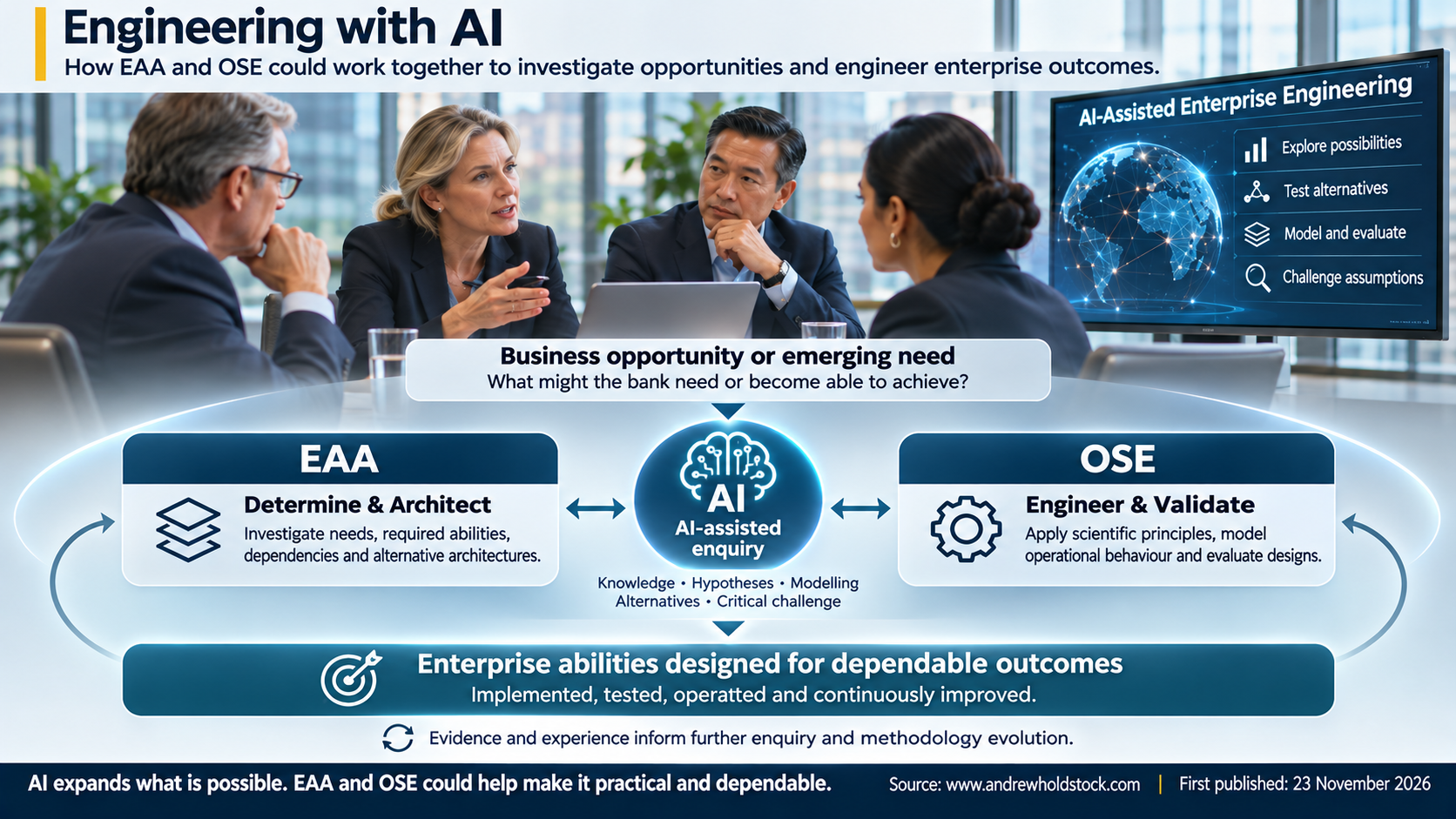
AI may also change the methodologies themselves. Continuous discovery, autonomous agents, rapidly evolving capabilities and new forms of simulation could require different approaches to enterprise architecture and operational engineering.
EAA and OSE should therefore be treated as evolving methods, tested through practical applications rather than assumed to be complete. Their potential contribution is to make sophisticated enquiry and engineering more accessible, systematic and evidence-led.
The objective is not to fit AI into existing methods, but to develop methods capable of exploiting what AI makes possible.
The Future of Banking
The banks of 2036 may be defined by what they can discover, understand and achieve—not simply automate.
The Bank of 2036 may be fundamentally different from today's digital institutions. AI could enable banks to discover new financial knowledge, anticipate emerging risks, develop unfamiliar services and adapt continuously to changing circumstances.
The competitive consequences could be considerable. In a global financial crisis, banks with superior intelligence and the ability to act on it may emerge stronger than those relying on conventional approaches. The advantage may come not from possessing the most powerful AI, but from how effectively the institution can exploit its possibilities.
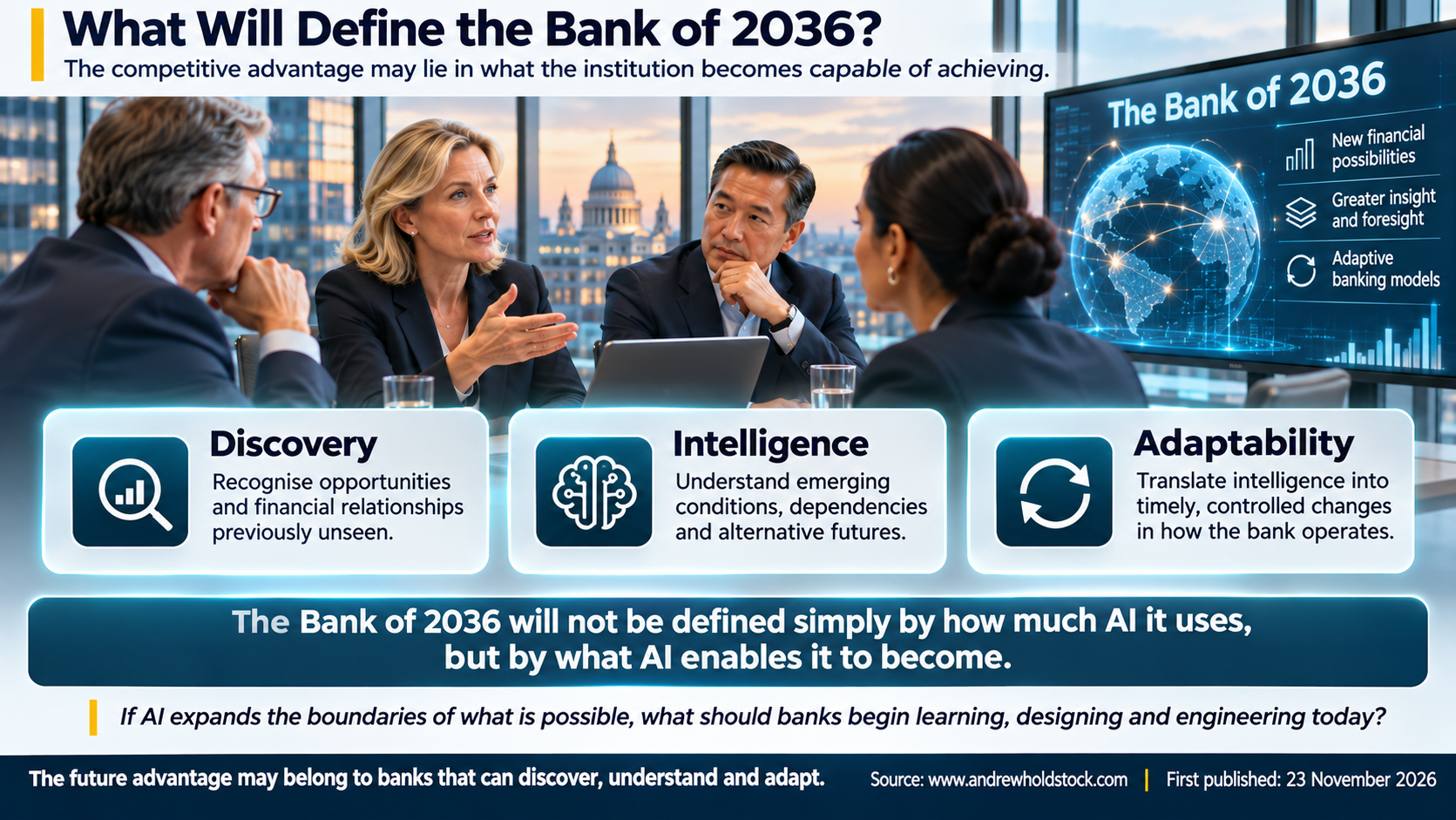
The Bank of 2036 is not a forecast or a proposed blueprint. It is an invitation to reconsider the boundaries of banking and investigate what AI might make possible.
The challenge for today's leaders is to look beyond individual use cases and ask what new enterprise abilities could create lasting value. That requires disciplined enquiry, trustworthy information, effective engineering and the willingness to challenge established assumptions.
EAA and OSE may contribute to this journey, while evolving as new possibilities emerge.
First Published: 23-Nov-2026