The EAA Framework

Engineering the Abilities Banks Need
A systematic, business-led approach to defining precisely what banks must be able to achieve before determining how.
Banks identify business needs through strategy, horizon planning, regulatory developments and operational experience. Yet moving directly from these needs to proposed solutions risks addressing individual requirements without resolving the underlying business problem.
Enterprise Ability Architecture (EAA) takes a different approach. It defines precisely what the enterprise must be able to achieve to accomplish the identified Job to Be Done and deliver the intended business outcome, independently of existing organisational structures, processes or technology.
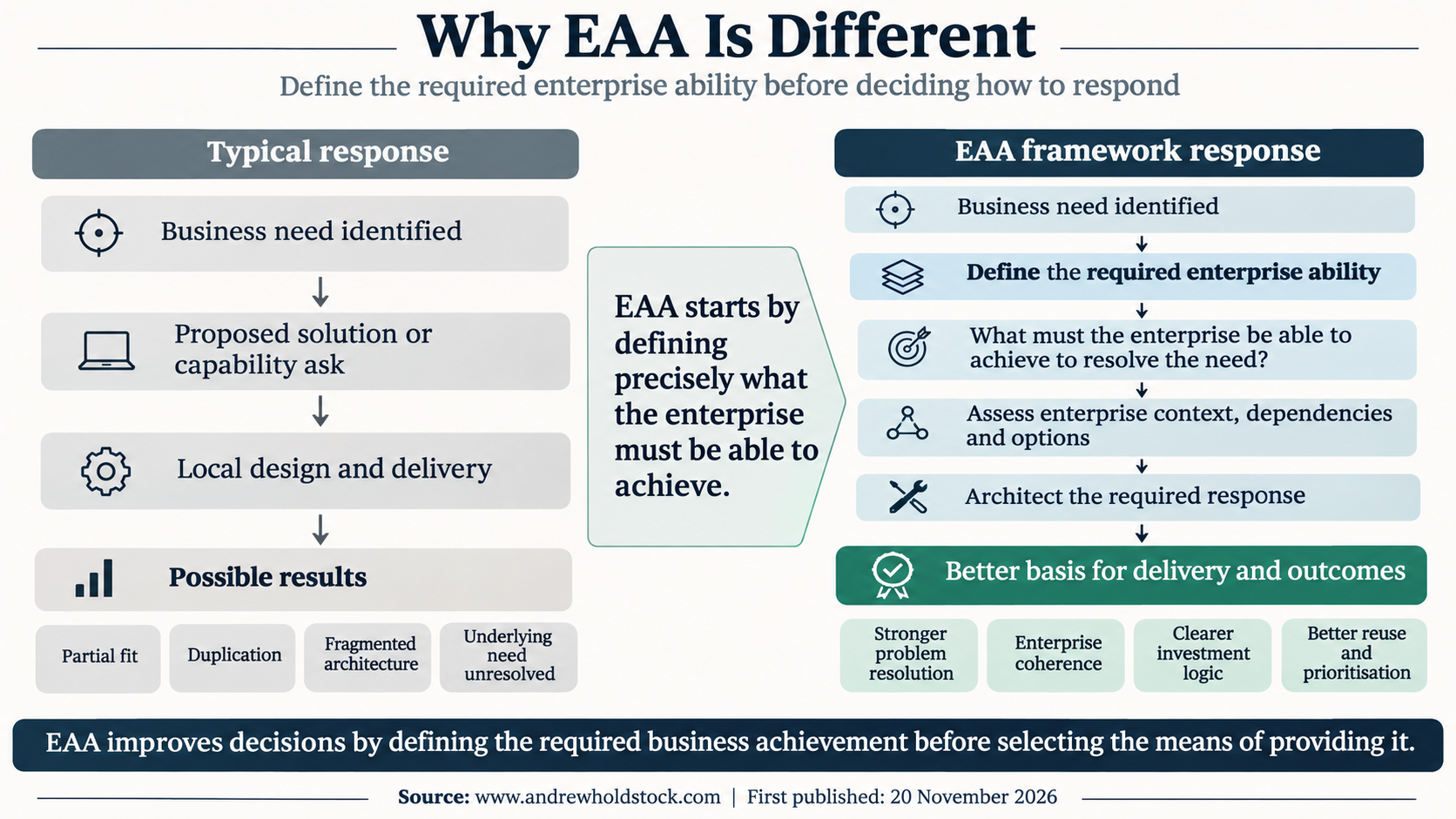
With the required ability clearly defined, EAA examines the enterprise as a whole to identify existing capabilities, shared requirements, dependencies and architectural choices.
This provides a stronger basis for deciding what should be reused, adapted or created, and where investment will deliver the greatest value.
By designing around the required business achievement rather than an assumed solution, banks can reduce the risk of fragmented capabilities, unnecessary complexity and investments that fail to address the original need.
Key takeaway
Define what the enterprise must achieve to fulfil the business need, then engineer how to make it possible.
From Business Need to Required Ability
EAA translates an identified business need into a precise definition of what the enterprise must be able to achieve.
A bank may identify a need to improve client onboarding because delays, rework and inconsistent practices are affecting its business. The immediate response might be to replace a platform, automate processes or reorganise operations.
EAA first establishes the underlying Job to Be Done: enabling the bank to establish client relationships and make them ready for business, while satisfying applicable obligations.
It then defines precisely what the enterprise must be able to achieve to fulfil that job, before considering how the ability should be provided.
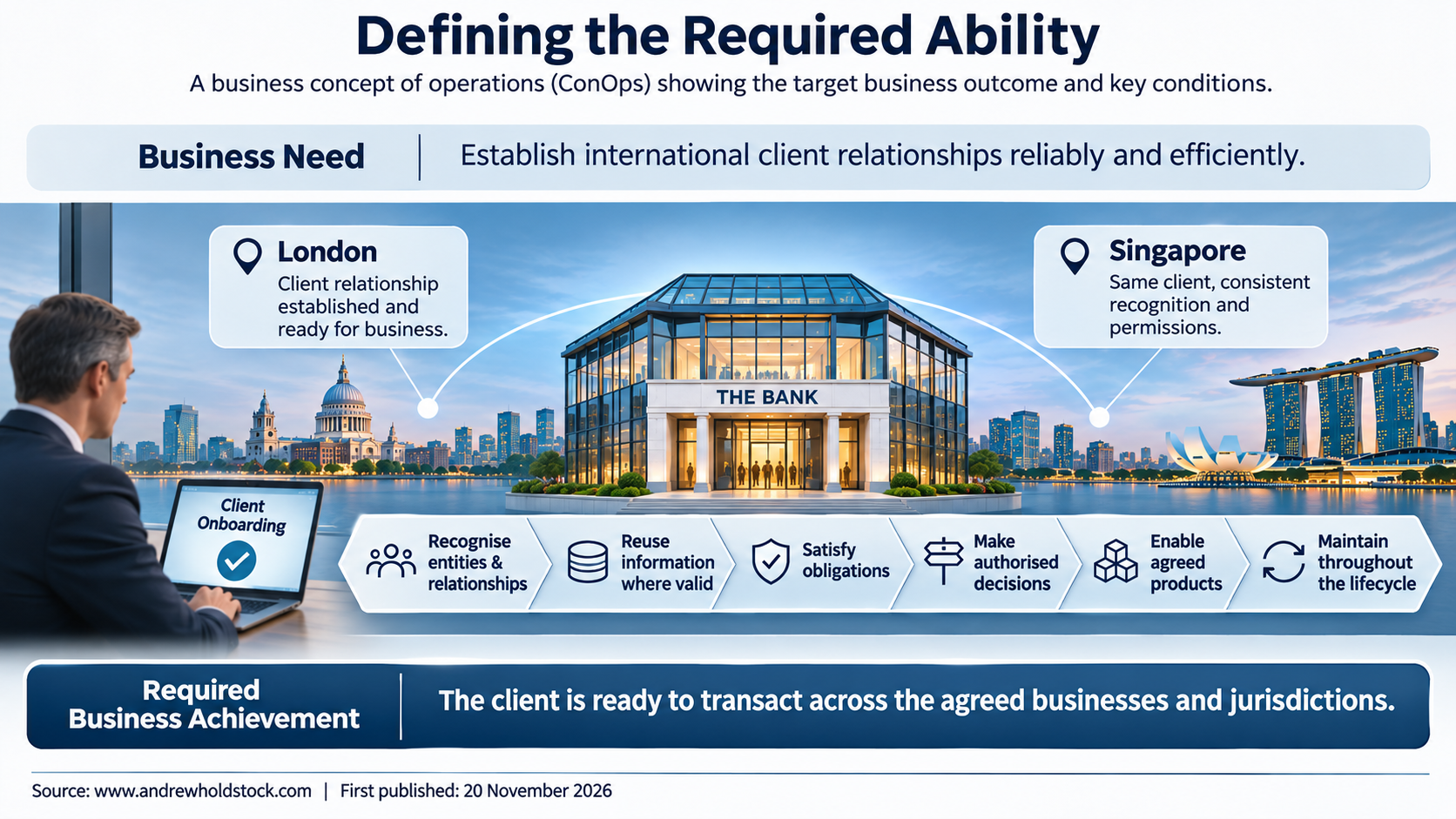
The resulting specification describes the required business achievement and the conditions under which it must be possible, independently of existing capabilities, organisational structures or technology.
This distinction matters. An onboarding platform may support several activities, but its implementation does not necessarily establish the complete enterprise ability.
By defining the ability first, EAA creates a consistent reference for investigating existing capabilities, identifying enterprise-wide dependencies and evaluating alternative ways of fulfilling the business need.
Key takeaway
Define the business achievement and its conditions of success before determining the capabilities needed to deliver it.
Examine how existing capabilities, information, responsibilities and systems could support the required ability, and identify what is missing.
Understanding the Existing Enterprise
Banks rarely start from nothing. They already possess extensive capabilities, information, processes and technology developed to meet different business needs, often independently across functions, products and jurisdictions.
EAA examines these existing arrangements against the precisely defined enterprise ability. It identifies what can be reused, where capabilities are fragmented, and which dependencies or gaps prevent the enterprise from achieving the required outcome.
The objective is not simply to catalogue what exists, but to understand how the enterprise's existing components could contribute to the required ability.
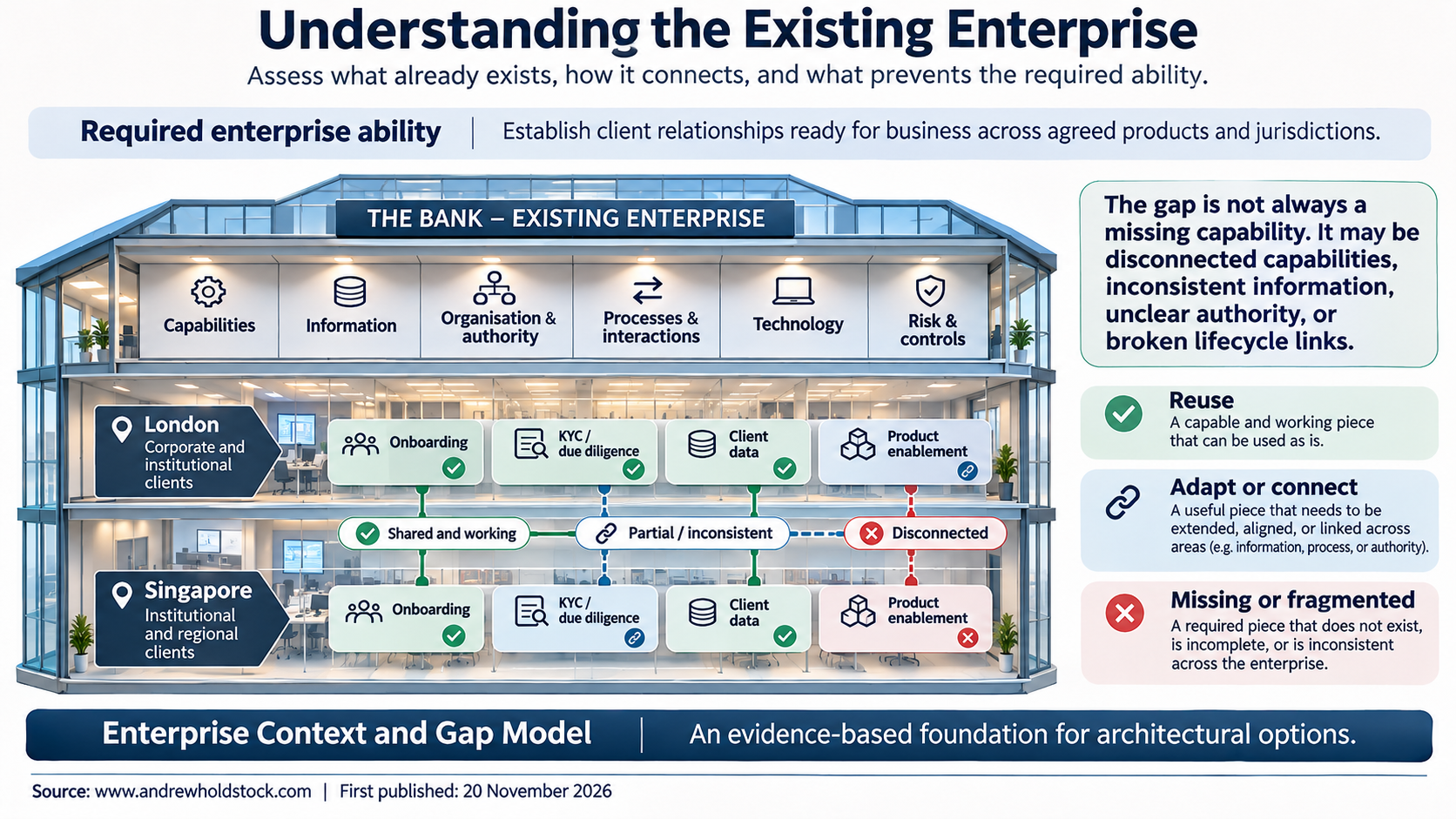
This analysis may reveal that the required ability can be established by connecting or extending existing capabilities rather than creating entirely new ones.
It also exposes architectural weaknesses that individual projects may overlook, such as inconsistent information, unclear authority, duplicated functions or disconnected lifecycle arrangements.
The resulting Enterprise Context and Gap Model provides an evidence-based foundation for developing architectural options, helping the bank avoid unnecessary investment and solutions that optimise individual functions at the expense of the enterprise.
Key takeaway
Understand what the enterprise already possesses, how it fits together and what prevents it from delivering the required ability.
Architecting the Required Ability
Develop and compare coherent architectural arrangements that enable the enterprise to achieve its defined business outcomes.
Once the required ability and existing enterprise context are understood, EAA explores alternative ways of making that ability possible.
The objective is not simply to fill capability gaps. It is to determine how existing and new capabilities, information, responsibilities and business relationships should be arranged to work together.
Options may involve reusing existing capabilities, connecting fragmented arrangements, extending shared services or introducing new structures. Each must be assessed against the required enterprise ability rather than the preferences of individual functions or technology platforms.
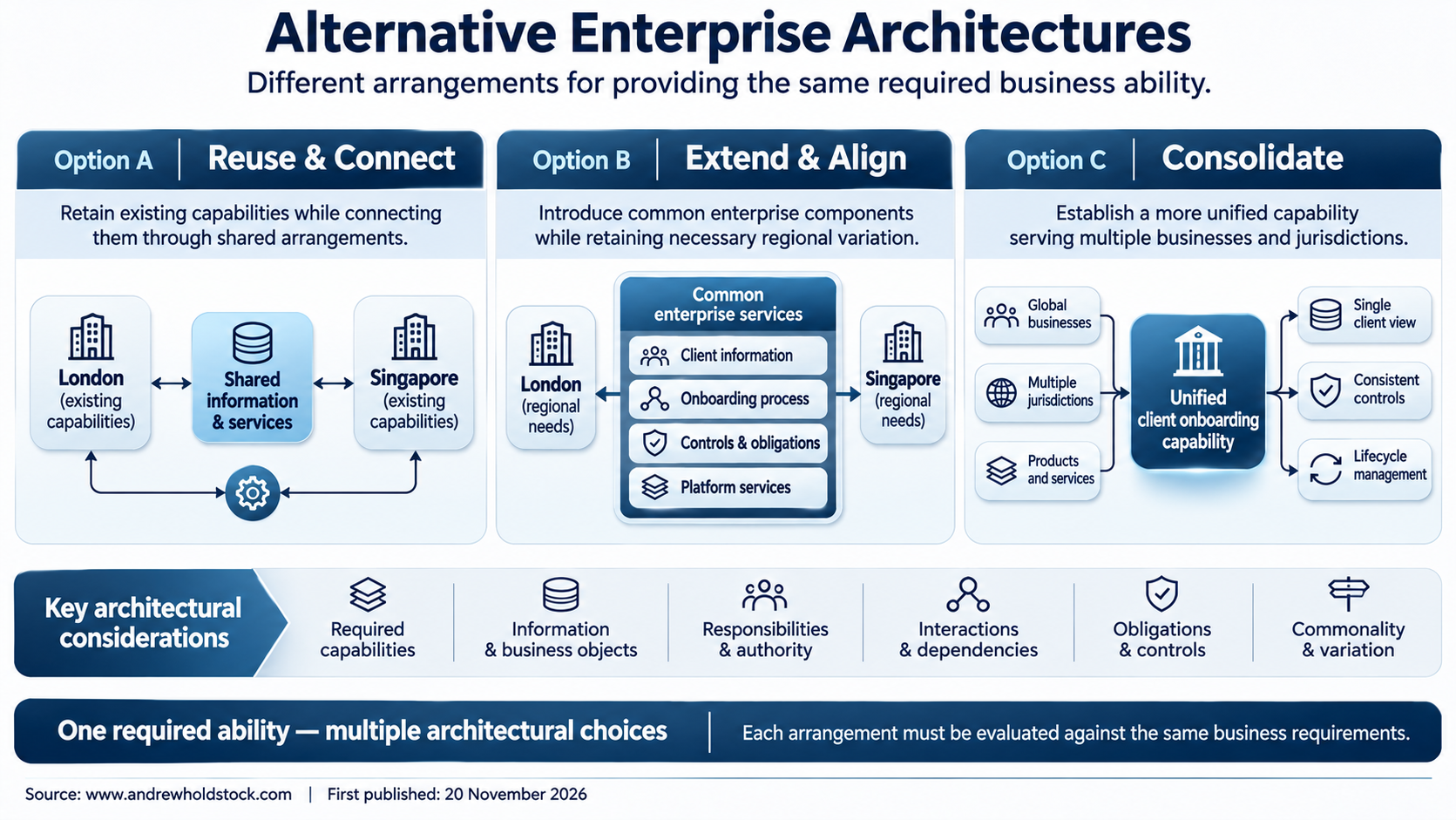
A credible architectural option explains how its components fit together, which responsibilities and information are shared, and where local variation remains necessary.
EAA examines the implications of each arrangement for enterprise coherence, reuse, obligations, adaptability and investment.
This creates a basis for comparing materially different approaches, rather than selecting the most familiar solution. The resulting options can then be evaluated against the intended business outcomes, costs, risks and practical constraints before a preferred architecture is selected.
Key takeaway
Architect the enterprise as an integrated whole, not as a collection of independently developed capabilities.
Selecting the Right Architecture
Evaluate alternative arrangements against the required enterprise ability, business outcomes, investment implications and long-term adaptability.
Different architectural arrangements may provide the same enterprise ability, but with different consequences for cost, risk, complexity, resilience and future change.
EAA evaluates each option against the original business need and the precise conditions established in the Enterprise Ability Specification. It considers how effectively the arrangement brings together capabilities, information, responsibilities and dependencies across the enterprise.
The objective is to identify the most appropriate architecture, supported by transparent evidence, explicit trade-offs and a clear business rationale rather than organisational or technological preference.
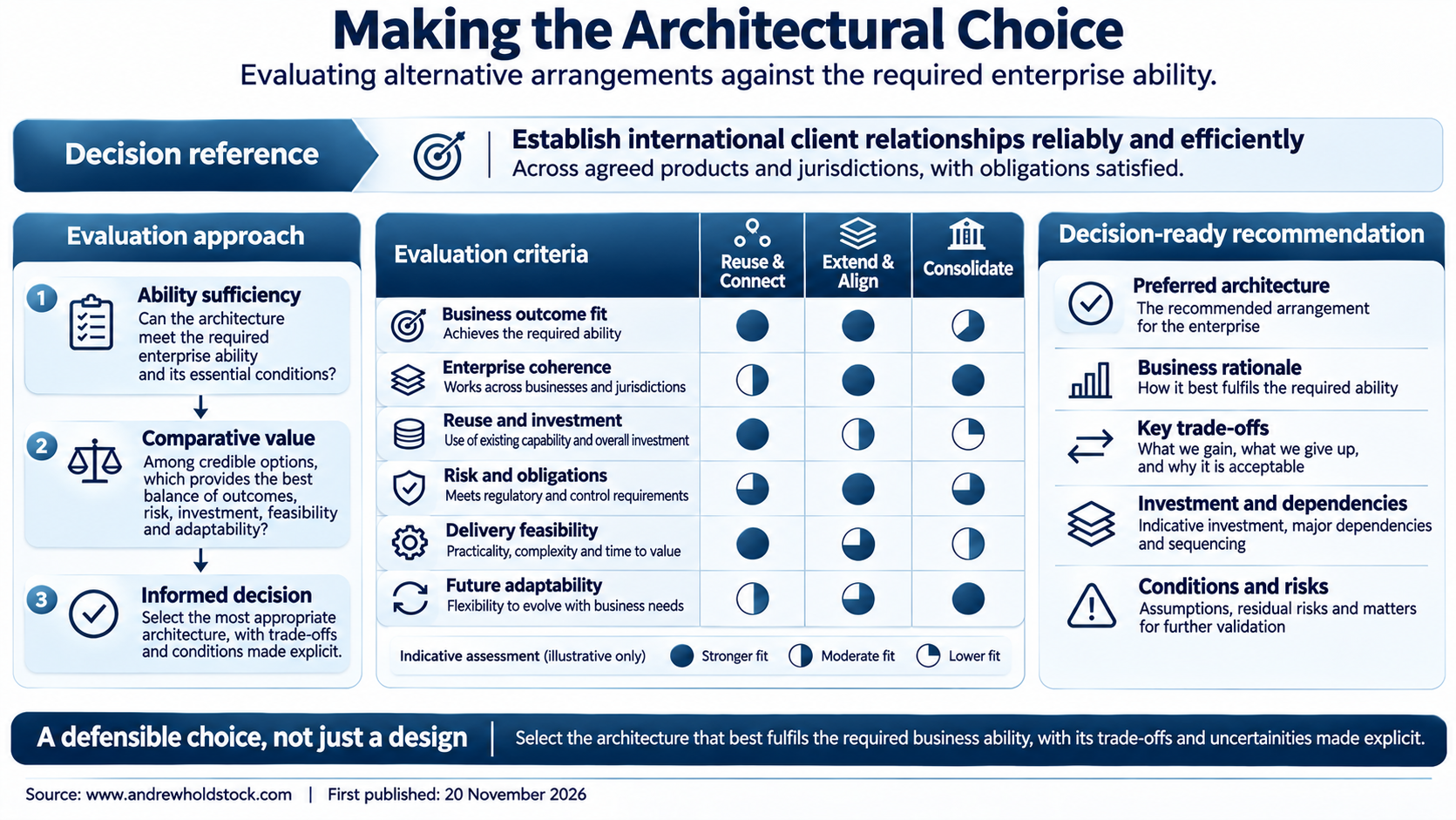
A decision-ready architecture explains what will be established, how its components fit together, and why the chosen arrangement is preferable to credible alternatives.
The recommendation also identifies investment implications, implementation dependencies, unresolved assumptions and conditions requiring further validation.
The business sponsor should be able to understand and challenge the proposed architecture without specialist architectural knowledge. This provides a sound basis for approving the direction of change while recognising that detailed operational behaviour must still be engineered and validated.
Key takeaway
Choose the architecture that best fulfils the required business ability, with its trade-offs and uncertainties made explicit.
Sustaining Enterprise Abilities Through Change
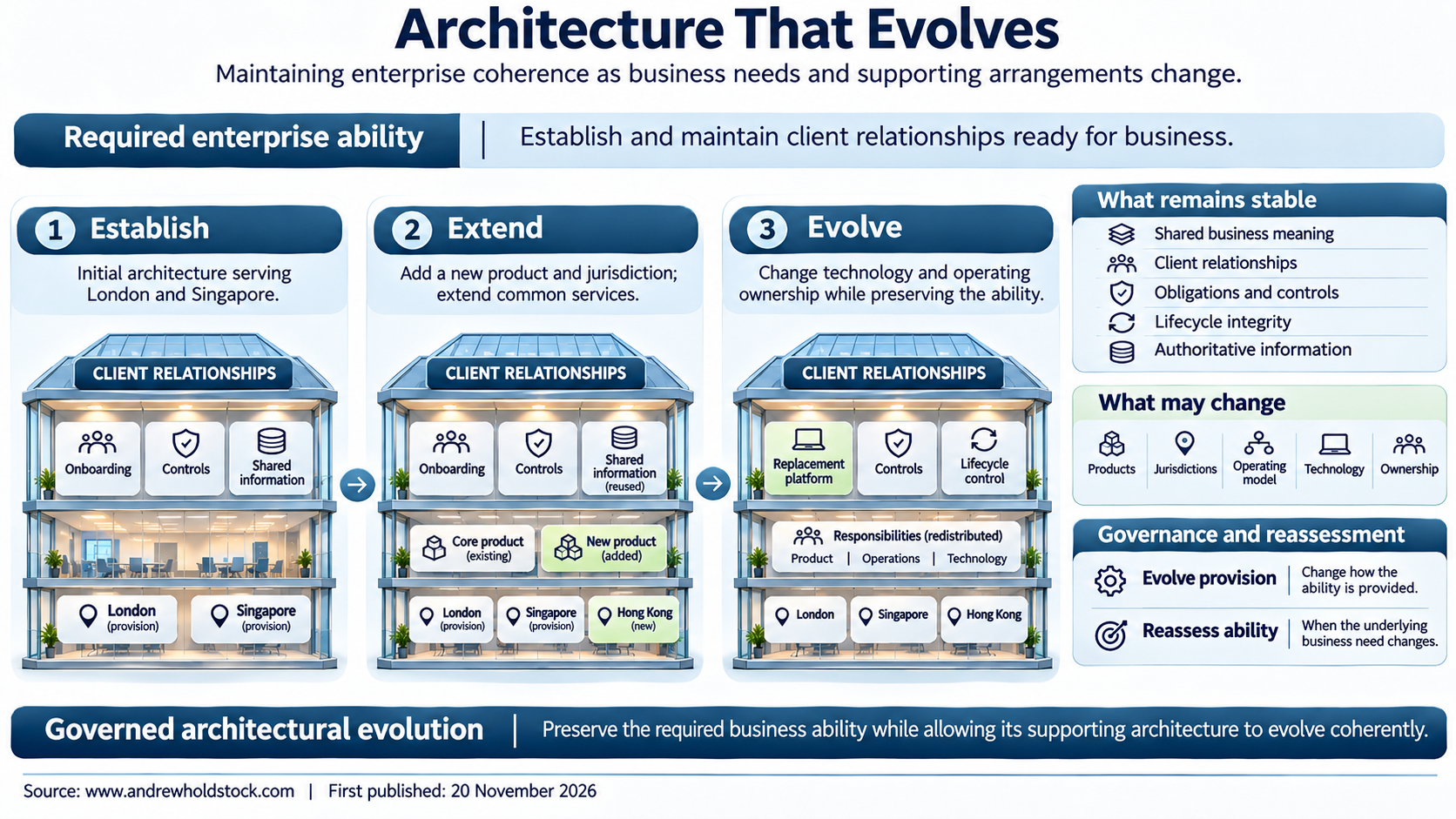
Establish how enterprise abilities and their supporting architecture should evolve as business needs, obligations and operating conditions change.
Selecting an architecture is not the end of EAA. Banks continually introduce products, enter markets, change organisational arrangements and replace technology, potentially affecting capabilities shared across the enterprise.
EAA establishes the principles, responsibilities and decision rules needed to manage these changes coherently. It identifies which architectural relationships must remain consistent, where variation is appropriate and what developments should trigger reassessment.
The objective is to preserve the enterprise's ability to achieve its intended business outcomes without unnecessarily constraining future change.
The required enterprise ability provides a continuing reference point for evaluating changes to supporting capabilities and architecture.
Some changes can be accommodated within existing arrangements. Others may require architectural adaptation, additional capabilities or reconsideration of the underlying ability itself.
EAA therefore connects architectural governance with emerging business needs and evidence from implementation and operations. This helps prevent incremental changes from creating fragmented structures, inconsistent information or dependencies that undermine the enterprise's ability to perform.
Key takeaway
Preserve the required business ability while allowing its supporting architecture to evolve coherently.
From Architecture to Operation
A coherent enterprise architecture establishes what must work together; operational engineering determines how it will perform in practice.
EAA produces a decision-ready architecture describing the capabilities, information, responsibilities and relationships required to provide the defined enterprise ability.
However, selecting an architecture does not establish that the bank can operate it reliably. Processes, resources, decisions, controls and interactions must be engineered to achieve the required outcomes under real operating conditions.
This is where Operational Systems Engineering (OSE) becomes relevant. It develops and tests the operating arrangements through which the chosen architecture is expected to deliver the intended business results.
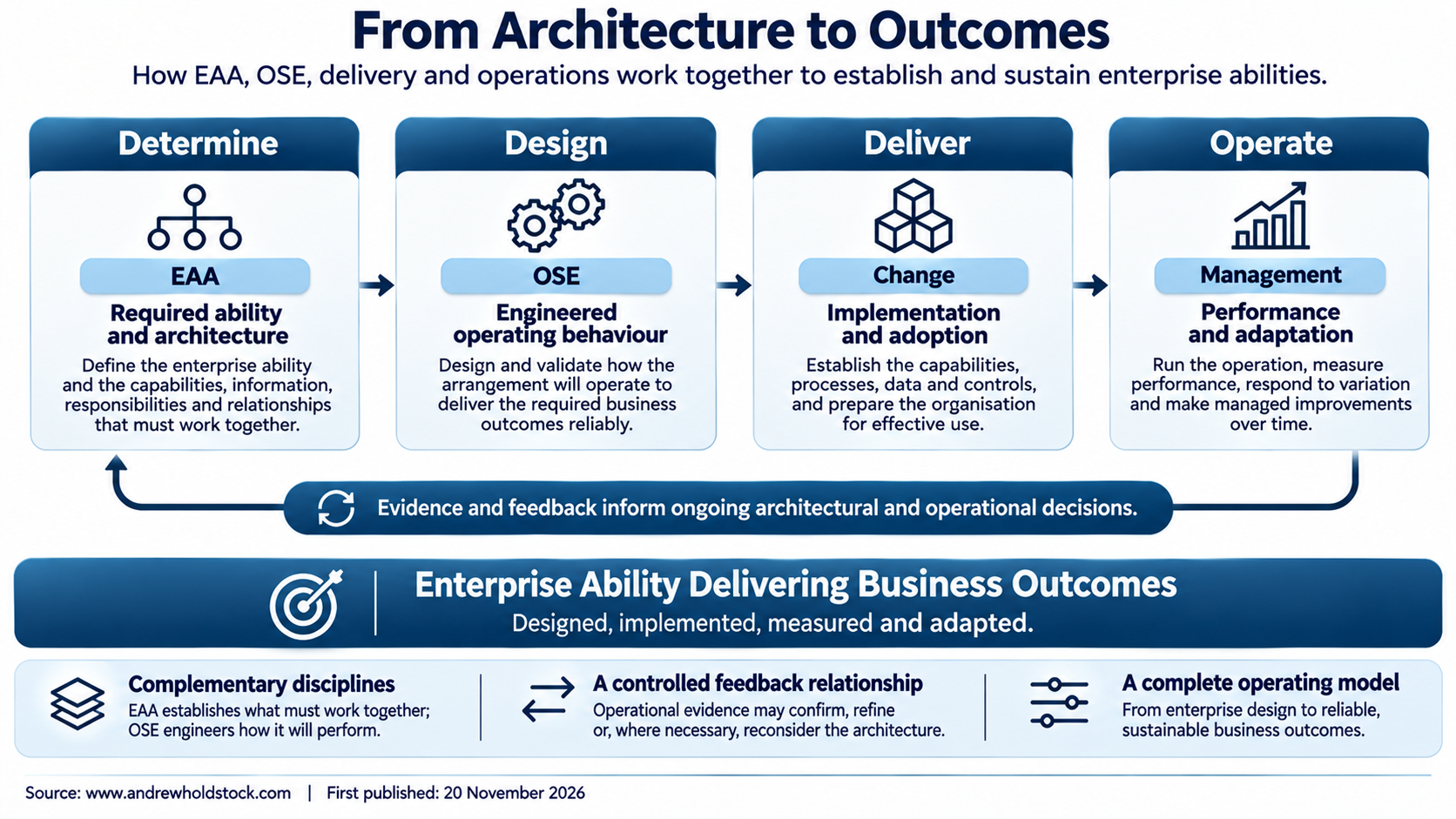
EAA and OSE are complementary disciplines. EAA determines which enterprise capabilities and architectural arrangements are required; OSE engineers how those arrangements must behave to deliver predictable operational outcomes.
Implementation then establishes the designed capabilities, while operating management measures performance, responds to variation and sustains results.
Evidence from engineering, implementation and operations may reveal that earlier architectural assumptions were incorrect. Such findings must return to EAA for reassessment rather than being accommodated through uncontrolled changes.
Key takeaway
A sound architecture makes the required ability possible; operational engineering, delivery and management make its outcomes achievable and sustainable.
A repeatable, business-led method for defining required enterprise abilities and developing coherent, decision-ready architectural arrangements.
The EAA Methodology
The EAA Methodology brings together six connected stages, beginning with the business need and progressing through ability definition, enterprise investigation, architectural options, selection and ongoing evolution.
Each stage has a defined purpose, principal output and completion criteria, providing a disciplined approach that can be applied proportionately to different business needs.
The methodology retains traceability between the original Job to Be Done, the required enterprise ability and the resulting architectural decisions.
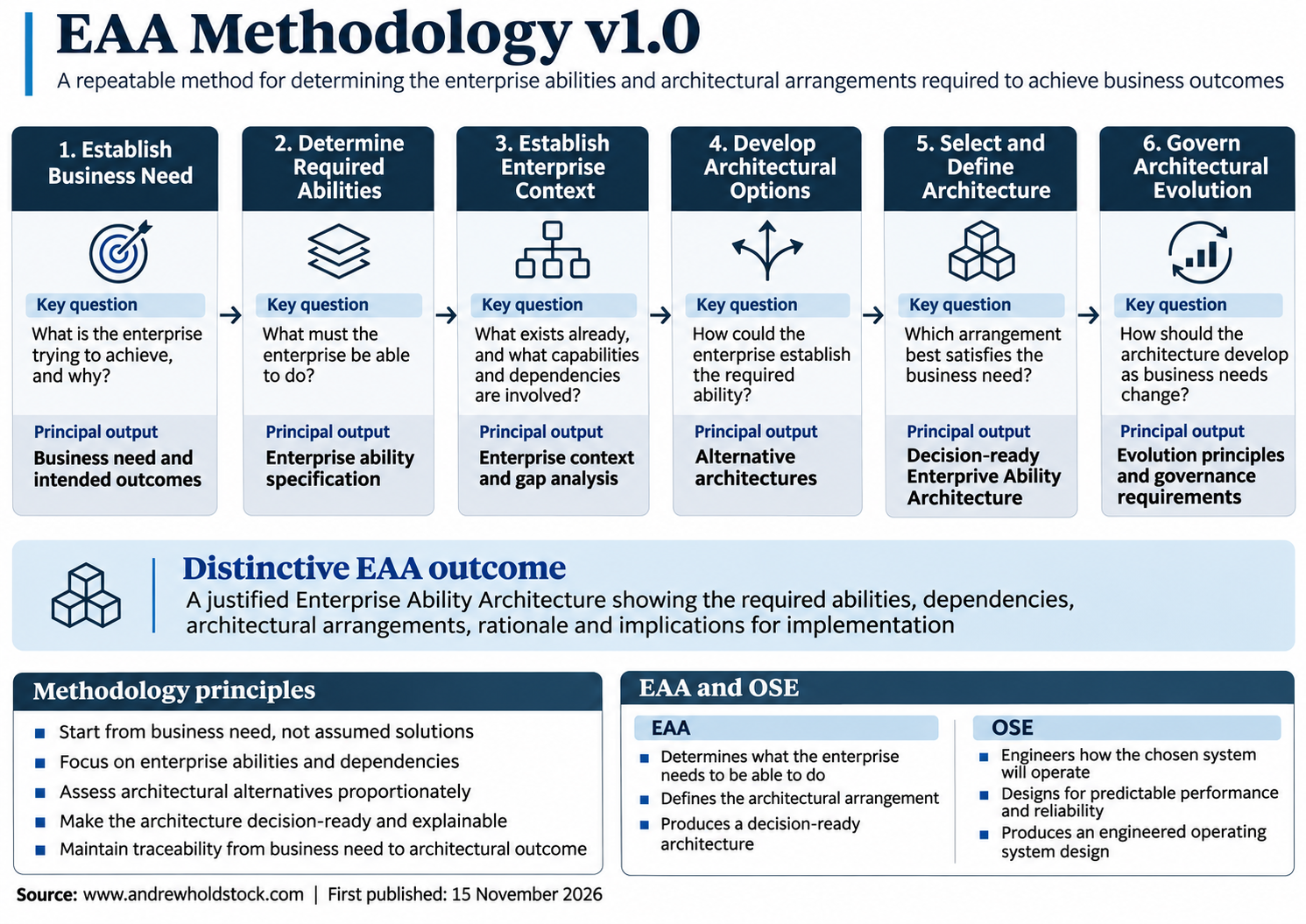
The methodology is supported by practical guidance, analytical questions, evidence requirements, decision records and reusable templates. These help business leaders and architects apply EAA consistently while adapting the depth of investigation to the nature and significance of the need.
Worked applications provide opportunities to test the method against actual banking problems, assess its limitations and refine its application.
The framework is therefore intended as a developing, evidence-led discipline rather than a fixed collection of architectural techniques.
Key takeaway
A repeatable method that connects business needs to precisely defined enterprise abilities and justified architectural decisions.
First Published: 20-Nov-2026