EAA in Practice

From a Question to an Opportunity
Applying Enterprise Ability Architecture to a real banking challenge reveals opportunities beyond the original investment proposition.
A bank is considering the future of operational identifiers that have supported its business for decades. As it develops its future technology architecture, it needs to determine whether to retain, replace or rethink the arrangements through which these identifiers are managed and used.
Rather than starting with the existing functionality and determining how to replicate it, we apply Enterprise Ability Architecture (EAA) to understand what the bank needs to be able to do, how that ability is currently realised and what opportunities might emerge.
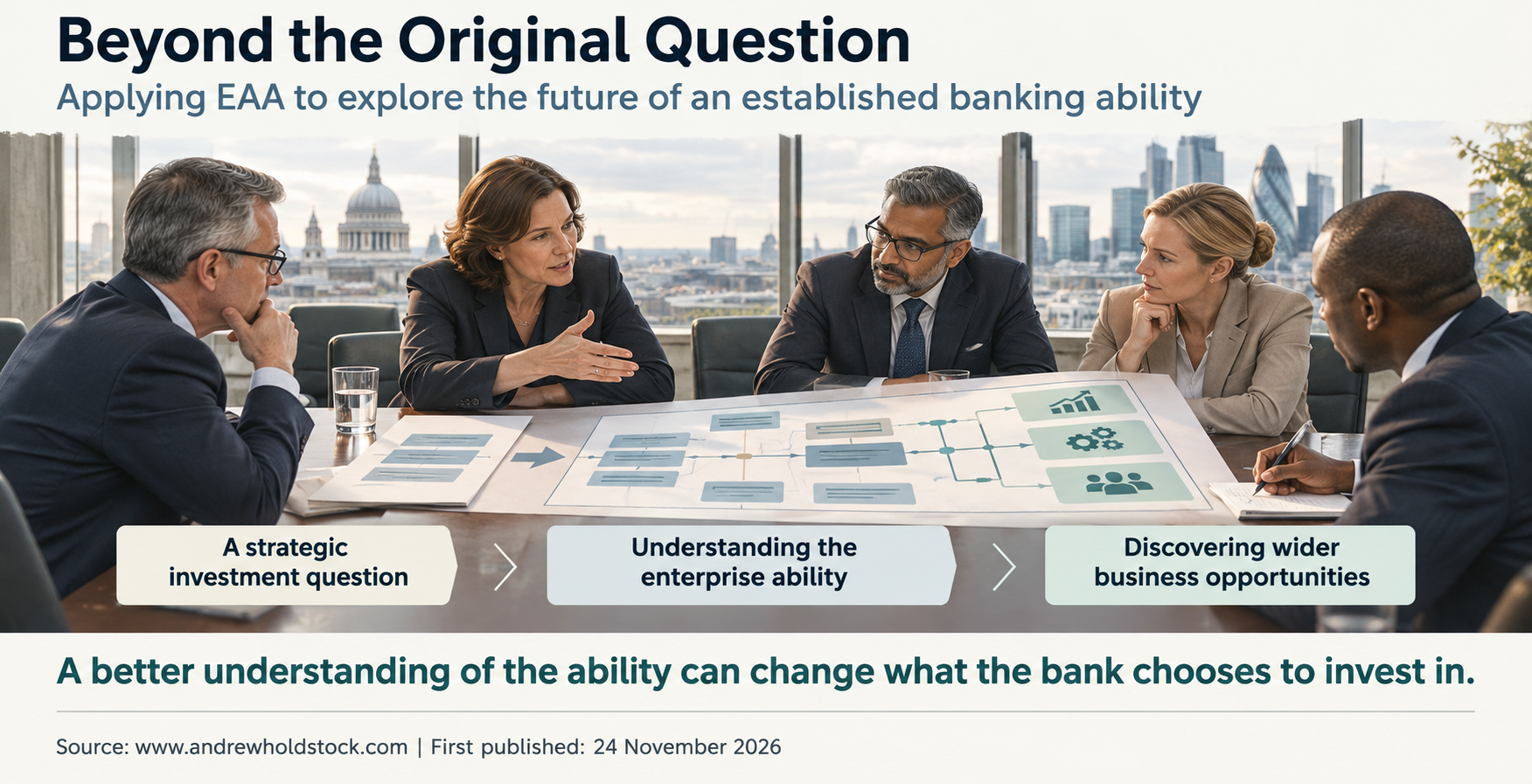
This case study follows the application of EAA to a real banking challenge. It explores how understanding an established enterprise ability, examining its architectural foundations and considering future business needs can reveal opportunities to improve operational efficiency, strengthen business control and increase business agility.
The question is no longer simply what to do with an inherited architectural solution, but what the bank could achieve through rethinking the ability it supports.
Discovering the Original Ability
Looking beyond an inherited architectural solution to discover the enterprise ability it was established to provide.
When considering the future of an established architectural solution, it is natural to begin by examining its existing functionality and uses. EAA takes a different starting point: what did the enterprise need to be able to do that led to the solution coming into existence?
Returning to the banking environment of the 1980s, we explore how the need to connect different aspects of a business arrangement across independent computer systems gave rise to shared operational identifiers.
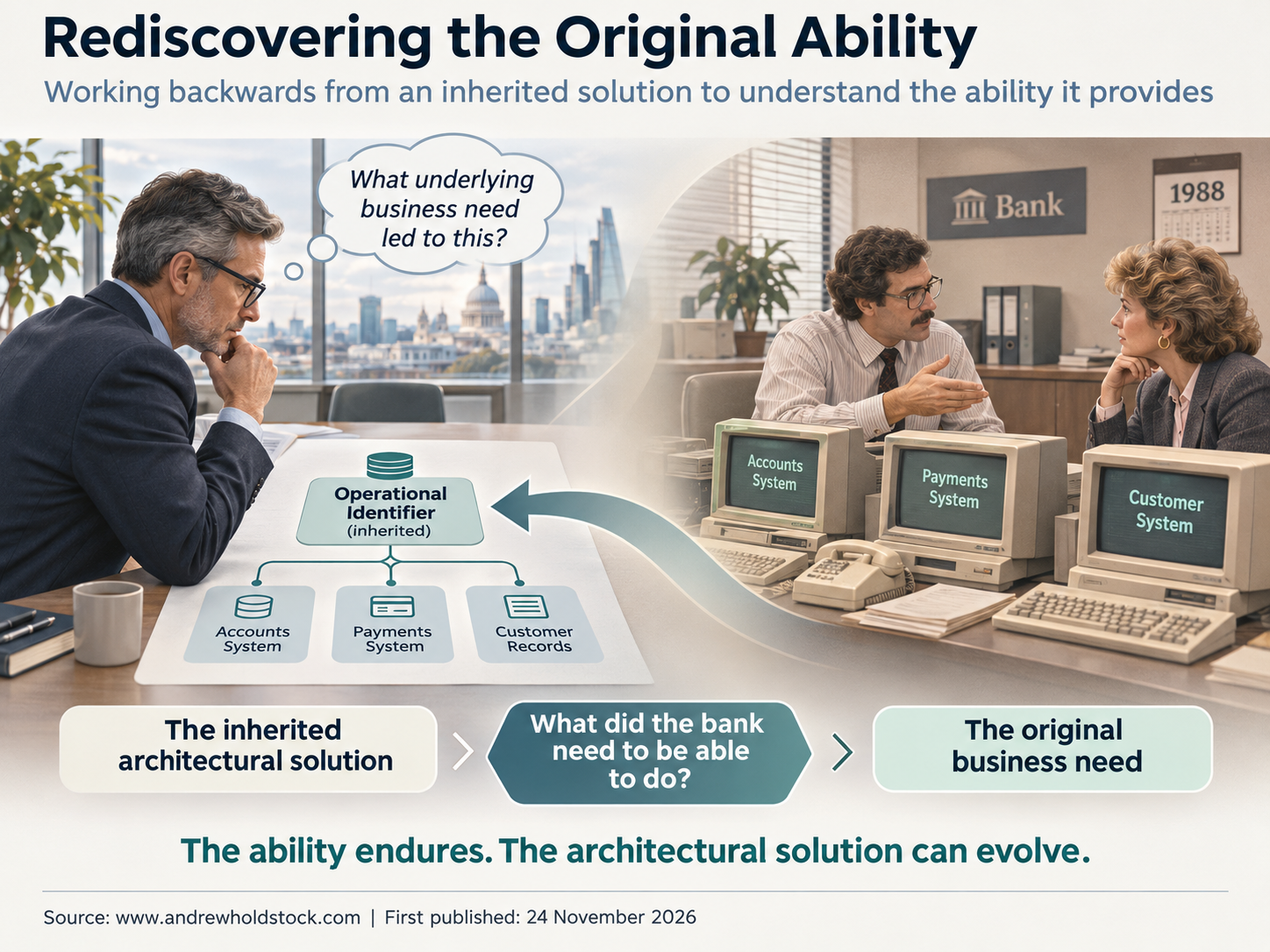
We can now begin to articulate the original enterprise ability independently of the architectural solution that emerged to provide it.
The identifier becomes one means of realising that ability, rather than the defining feature of the ability itself. This provides a different foundation for examining how business needs have evolved and determining what the future architecture should achieve.
Examining how changing business needs have extended the use of an established architectural solution.
Understanding How the Ability Has Evolved
As banking became more complex, the flexibility of Business Enablement Identifiers (BEIs) allowed banks to accommodate an increasingly diverse range of business requirements. Downstream platforms could recognise particular identifiers and apply the associated booking, processing, financial, risk, control or reporting treatments.
Over time, these identifiers also came to represent different aspects of the business itself, including organisational units, roles and business arrangements.
Applying EAA requires us to distinguish between the evolution of the enterprise ability and the adaptation of the architectural solution.
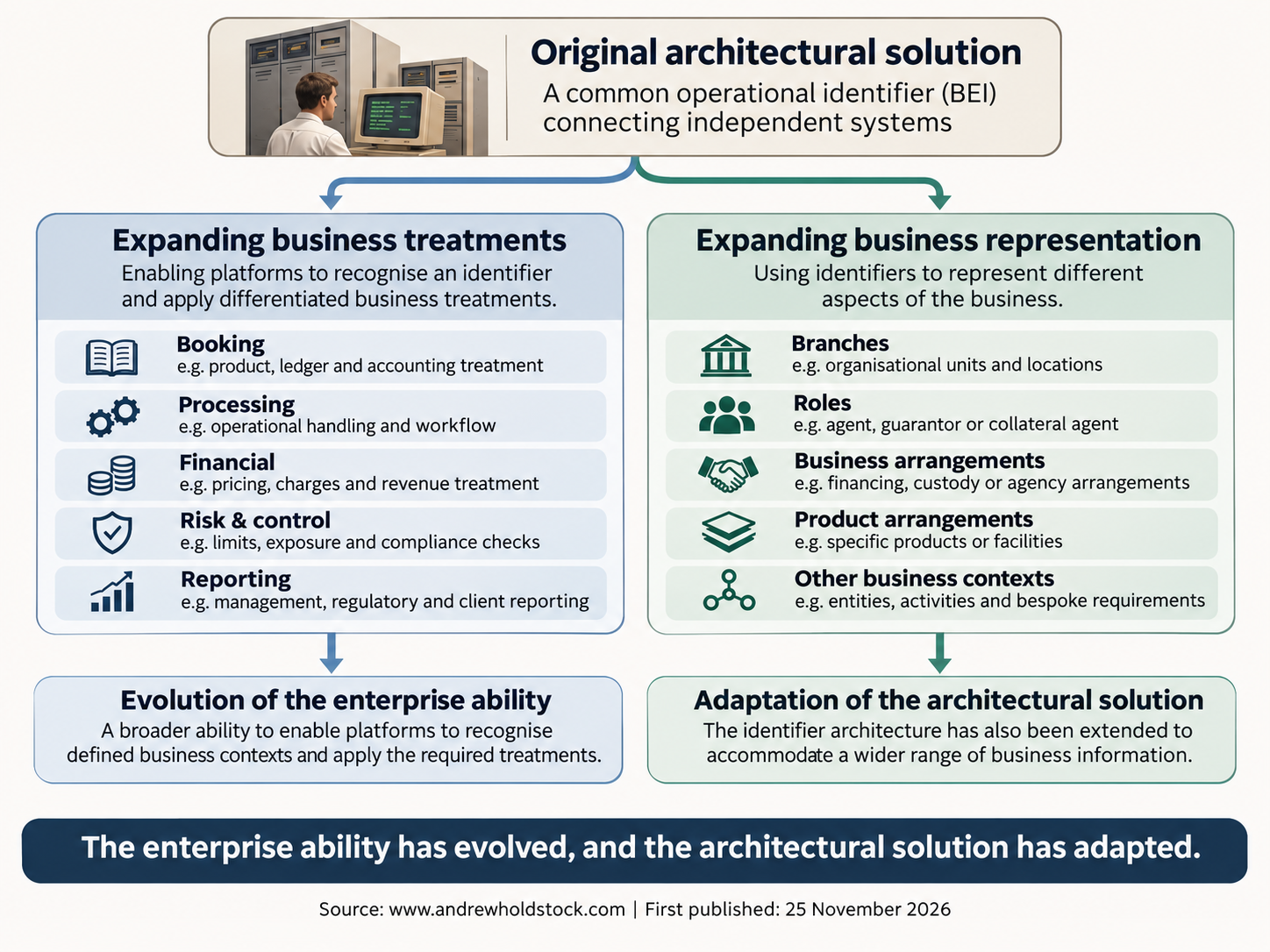
The original ability to connect aspects of a business arrangement across independent systems has developed into a broader ability to enable platforms to recognise defined business contexts and apply the required treatments.
However, our enquiry also reveals that the architectural solution has taken on responsibilities beyond its original purpose. Understanding this distinction is important when determining which aspects of the existing architecture should be preserved, rearchitected or replaced.
Defining the Required Ability
Establishing what the bank needs to be able to do, independently of its existing architectural arrangements.
Understanding how the business has evolved allows us to reconsider the enterprise ability the bank requires today. The requirement extends beyond connecting information across independent systems.
The bank needs its platforms to recognise a diverse range of business contexts, apply the appropriate treatments and respond to changes in the circumstances under which business is conducted.
Applying EAA allows us to articulate these requirements without being constrained by the existing identifier architecture.
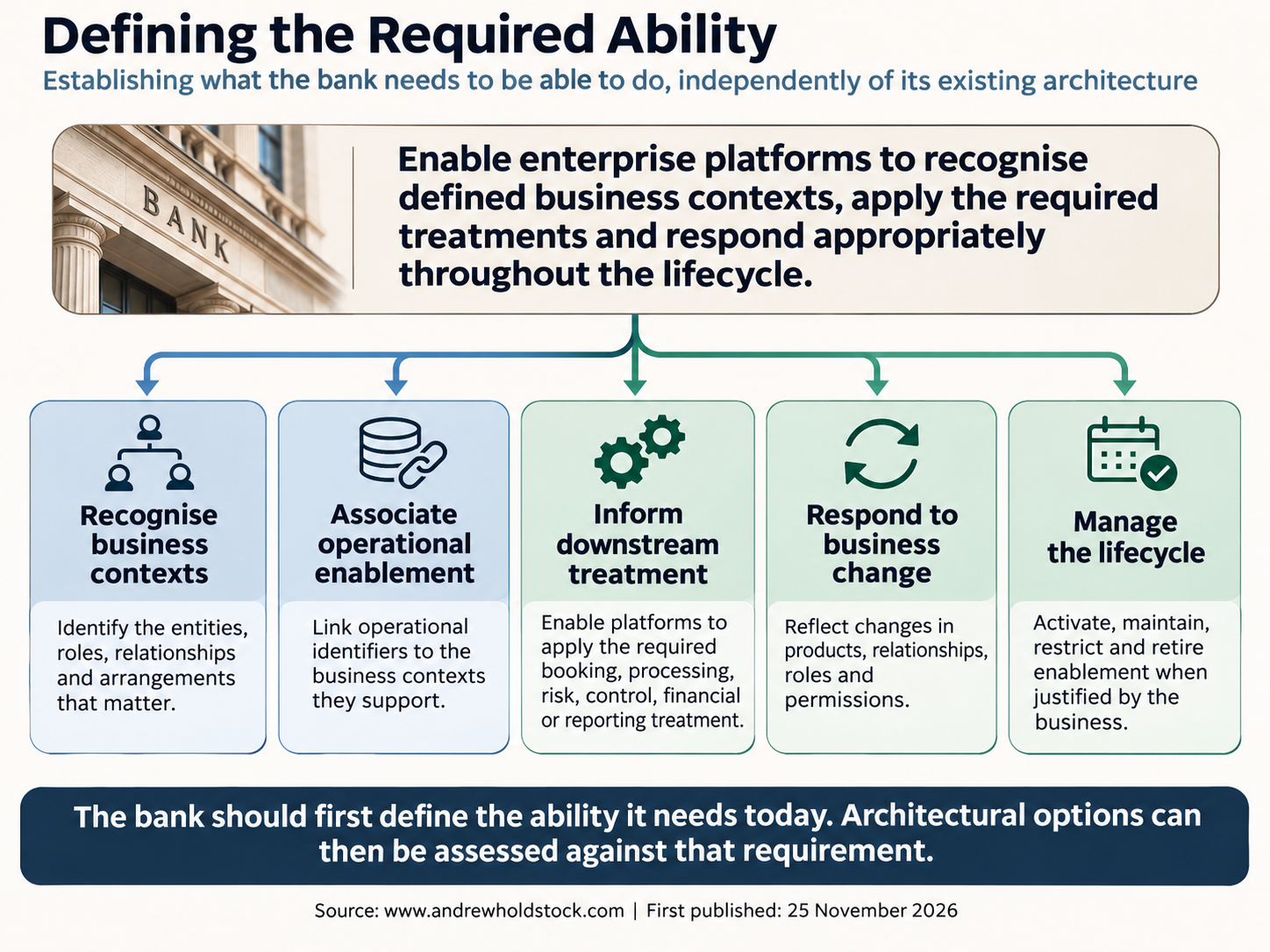
By establishing the required enterprise ability independently of its implementation, the bank creates a basis for assessing alternative architectural arrangements.
The objective is not simply to preserve existing functionality, but to establish an architecture capable of supporting the business throughout its lifecycle and responding to changing business needs.
Architecting for Greater Business Value
Assessing architectural alternatives against the required enterprise ability reveals opportunities to achieve better business outcomes.
Having established the required enterprise ability, the bank can assess alternative architectural arrangements. Replicating the existing identifier repository is one option, but a different approach is to explicitly represent the entities, roles and business relationships that give the identifiers their purpose.
An Entity-Role-Relationship (ERR) architecture offers such an alternative, providing a foundation for managing business enablement in response to the business itself.
This reveals opportunities that may not have been apparent when the bank first considered replacing its existing identifier functionality.
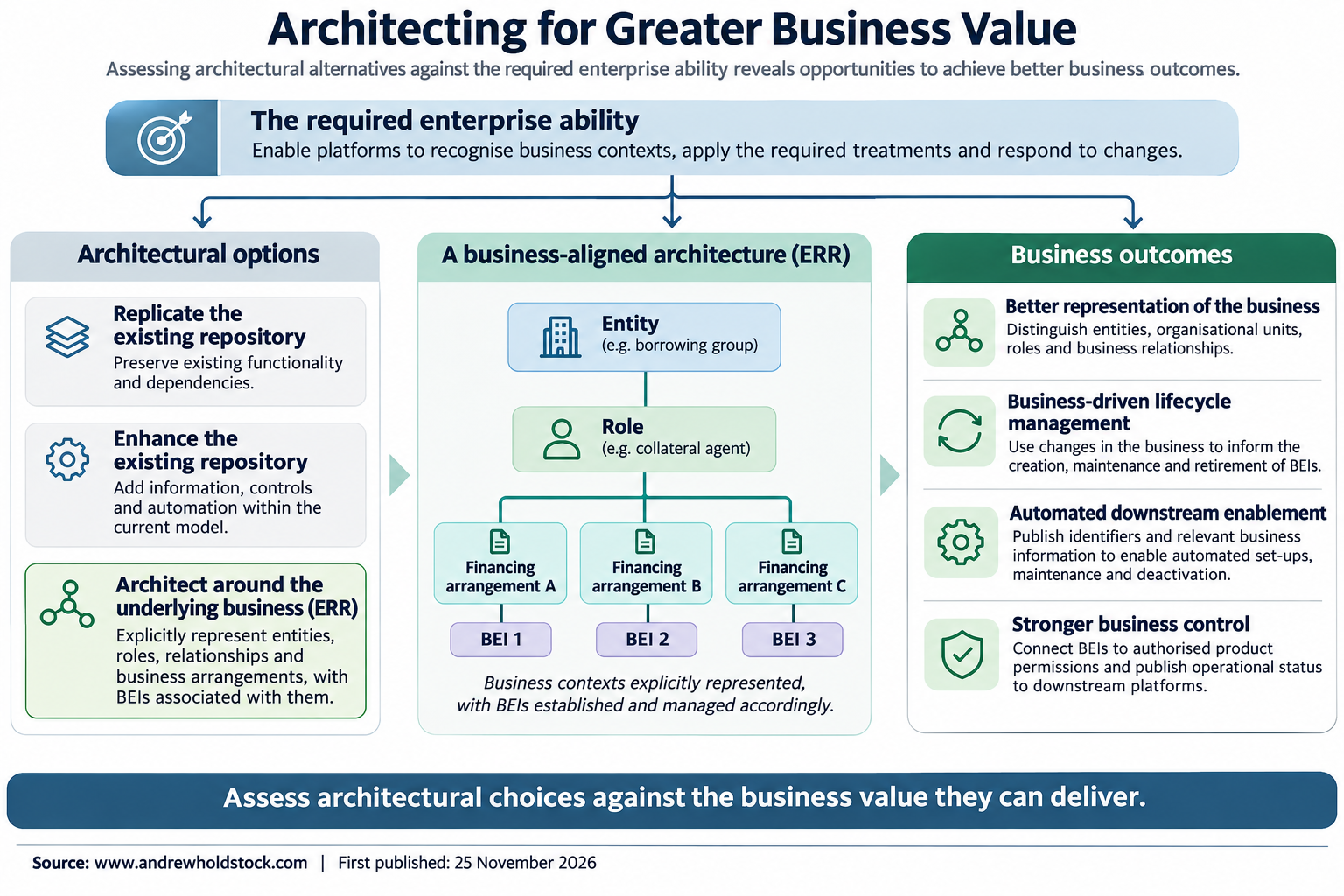
A more coherent architecture could enable the bank to reduce manual maintenance, automate downstream set-ups, accelerate business readiness and exercise greater control over authorised business activity.
These opportunities can inform the assessment of architectural alternatives and the investment proposition. The bank can now consider not only the cost of establishing the required ability, but also the additional business value that different architectural arrangements could deliver
Architecting for Future Business Needs
Considering tomorrow's business requirements can influence the architectural and investment decisions a bank makes today.
Banks continually develop new products, enter new markets, establish differentiated business arrangements and respond to changing regulatory requirements. These developments may require multiple transaction-processing platforms to recognise and apply specific business treatments.
Rather than asking what additional uses could be found for existing operational identifiers, EAA encourages us to work backwards from anticipated business needs and consider the architectural arrangements that would enable them.
This introduces a forward-looking dimension to the architectural assessment.
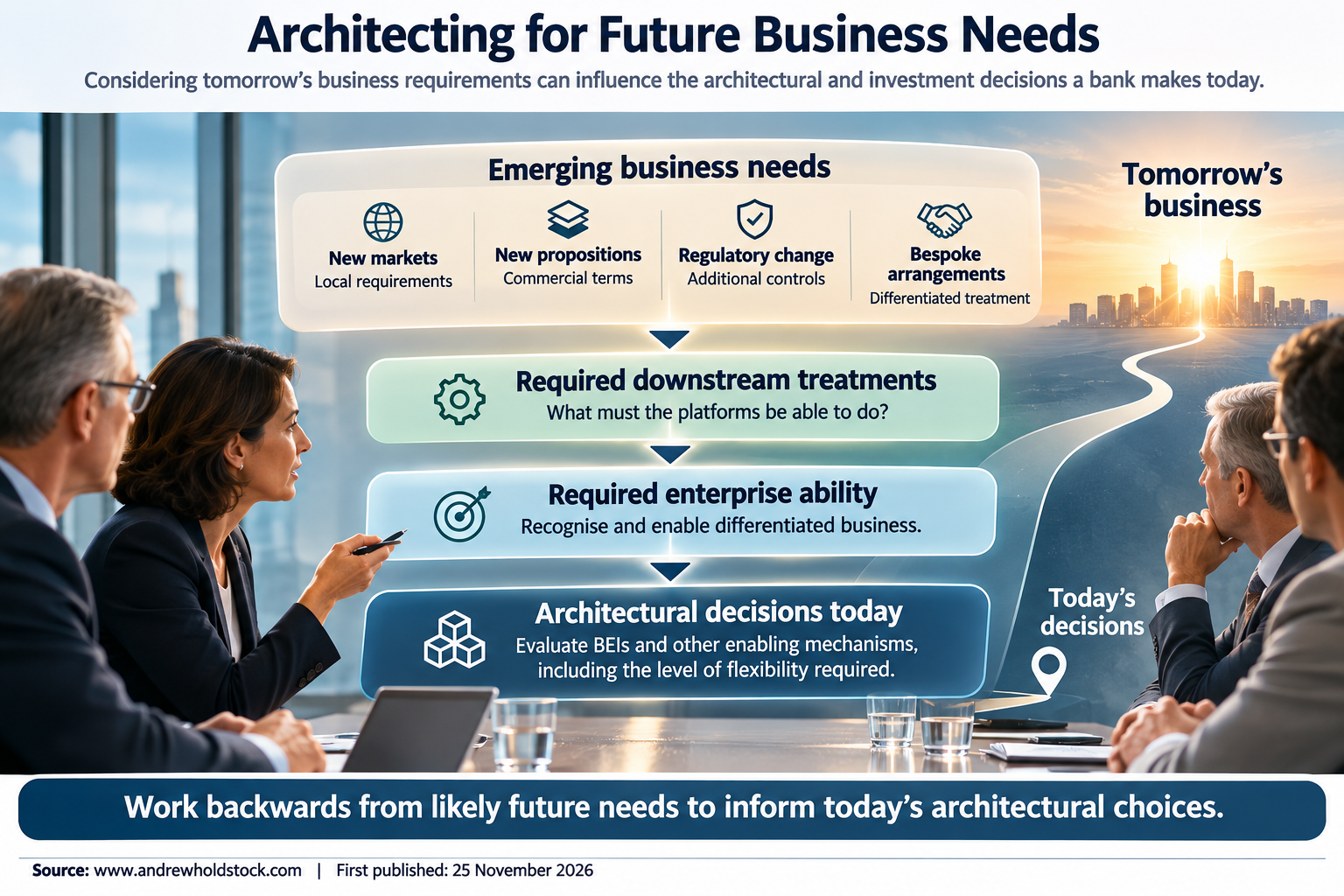
By considering the nature of future business requirements, the bank can assess whether its proposed architecture would allow new treatments to be introduced without disproportionate technology investment, operational effort or additional complexity.
The objective is not to anticipate every future requirement, but to establish an enterprise ability that can accommodate changing business needs in a controlled and economically sustainable way.
Making Better Investment Decisions
Applying EAA can change both the scope of an investment and the business value it is expected to deliver.
The bank began by considering the future of an established operational identifier. Applying Enterprise Ability Architecture has broadened the scope of that assessment.
By understanding the required enterprise ability, examining alternative architectural arrangements and considering future business needs, the bank has identified opportunities to improve operational efficiency, accelerate business enablement, strengthen control and increase business agility.
These opportunities provide a broader basis for evaluating architectural choices and determining investment priorities.
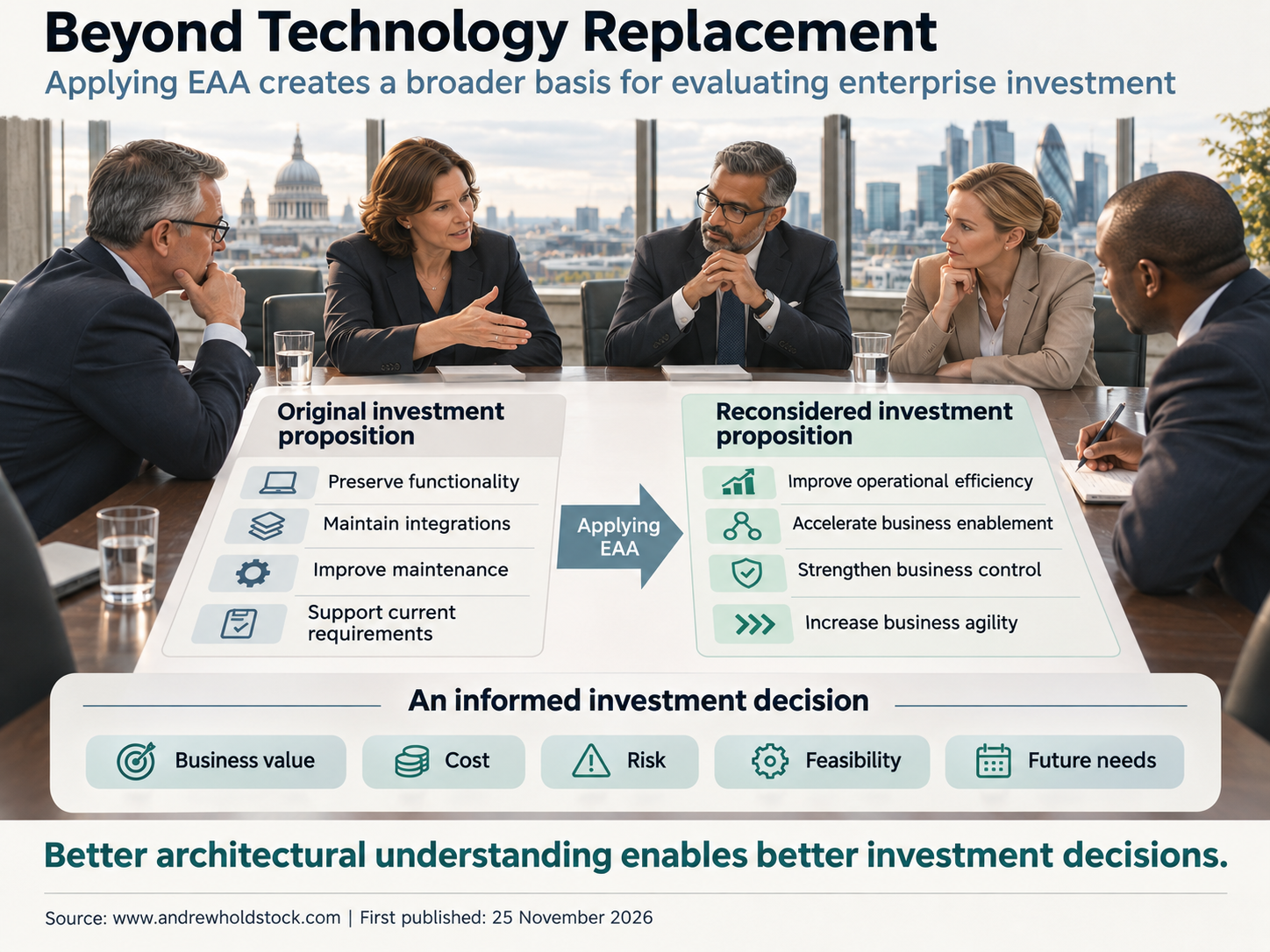
The bank can now assess whether the additional business value justifies a different architectural approach and the investment required to establish it.
Once the architectural direction has been determined, Operational Systems Engineering can help design and validate the operating arrangements needed to achieve the intended outcomes.
The objective is not simply to deliver a better technology solution, but to establish an enterprise ability that creates lasting business value.
First Published: 25-Nov-2026