OSE in Practice

Could We Have Predicted the Problems?
The value of engineering before implementation
Banks have invested considerable resources in conducting KYC Periodic Reviews, yet overdue reviews, backlogs, resource pressures and remediation remain familiar challenges.
But were these difficulties foreseeable? Could an engineering assessment of the proposed operating model have revealed its inherent challenges before banks committed to its implementation?
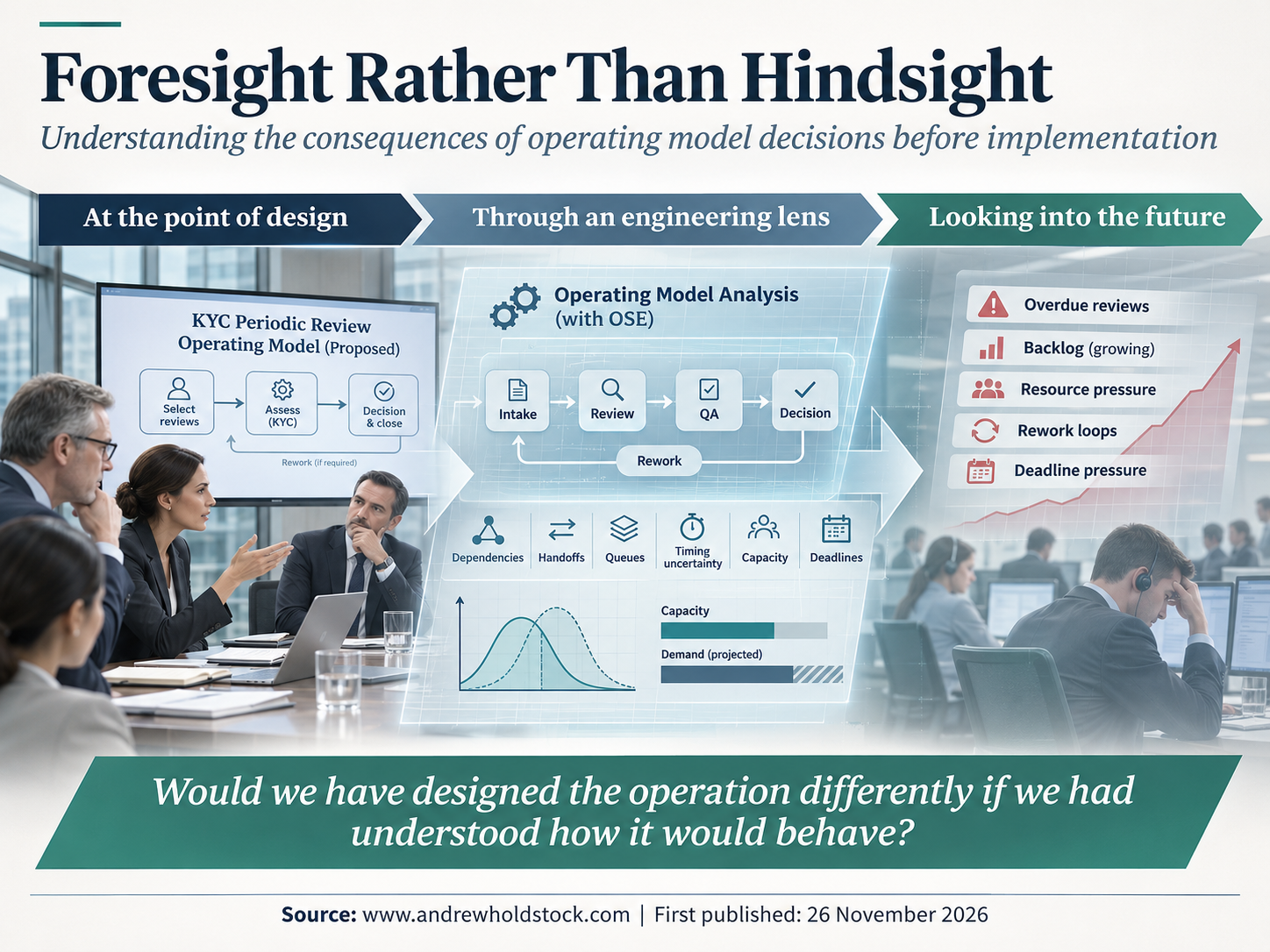
This example takes us back to the point at which the conventional KYC Periodic Review was conceived.
By applying Operational Systems Engineering (OSE), we explore what we might have predicted about its operational behaviour and whether that understanding would have led us to design a different way of achieving the underlying business objective.
Establishing the Objective
Defining what the bank needs to achieve
When a bank establishes a client relationship, it assesses the financial crime risk associated with that relationship. However, the circumstances on which that assessment is based may change over time.
The bank needs an enduring ability to maintain a sufficiently accurate and current understanding of its clients and their associated risks, so that decisions to continue business relationships remain appropriately informed.
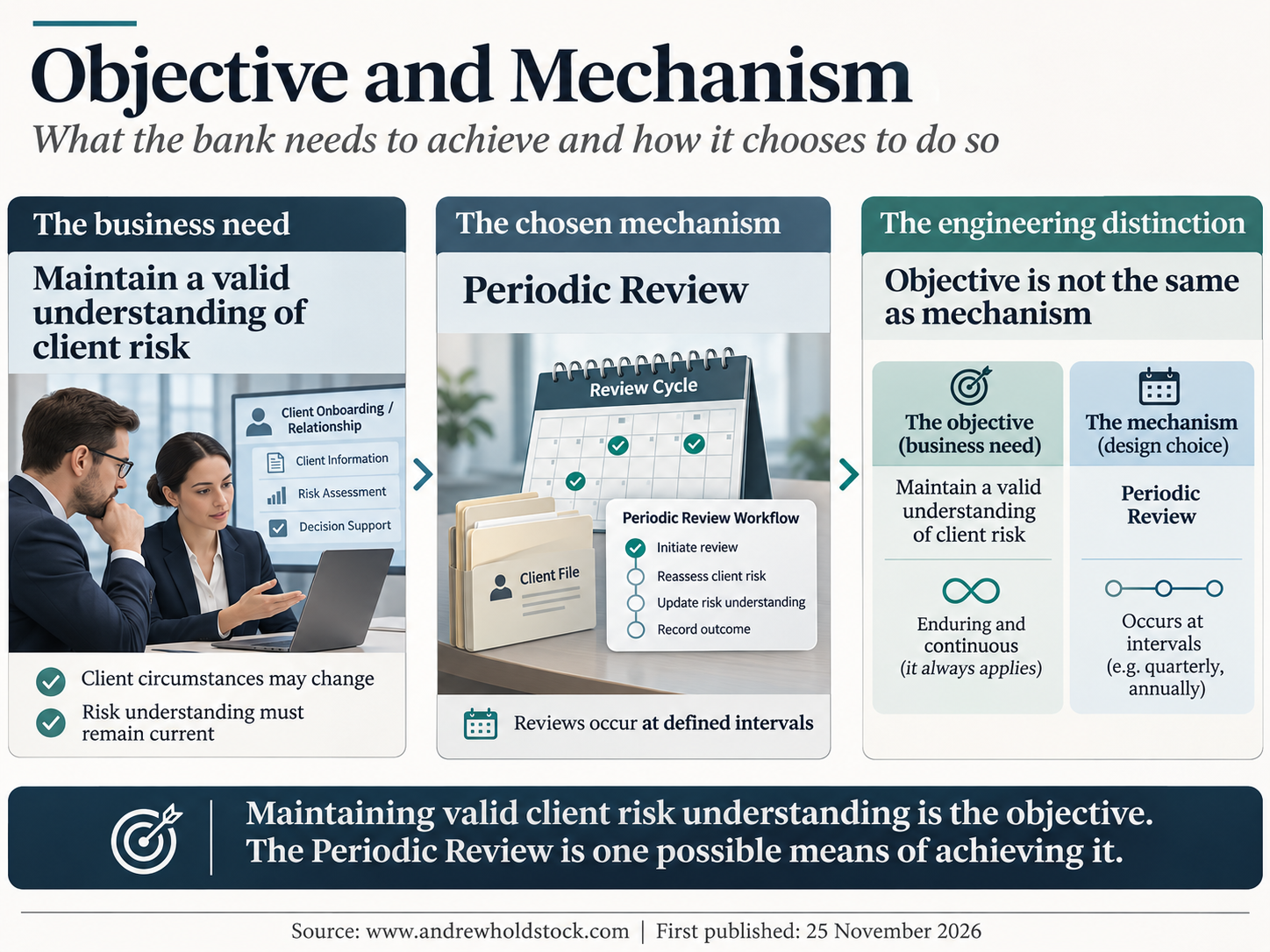
One possible way of achieving this objective is to reassess each client at predetermined intervals through a Periodic Review.
However, the completion of a Periodic Review is not itself the business objective.
By making this distinction at the outset, OSE enables us to examine the proposed mechanism against the outcomes the bank needs to achieve, without assuming that it is the only viable approach.
Defining the Operating System
Understanding the full extent of the proposed operation
Suppose the bank proposes to maintain the validity of its client risk assessments by conducting Periodic Reviews at intervals determined by client risk.
Reviews would need to be scheduled, client information obtained and verified, risk assessments reconsidered, decisions made and records updated.
Achieving the required outcome would involve multiple participants, information sources, technologies and decision-making authorities, both within and outside the bank.
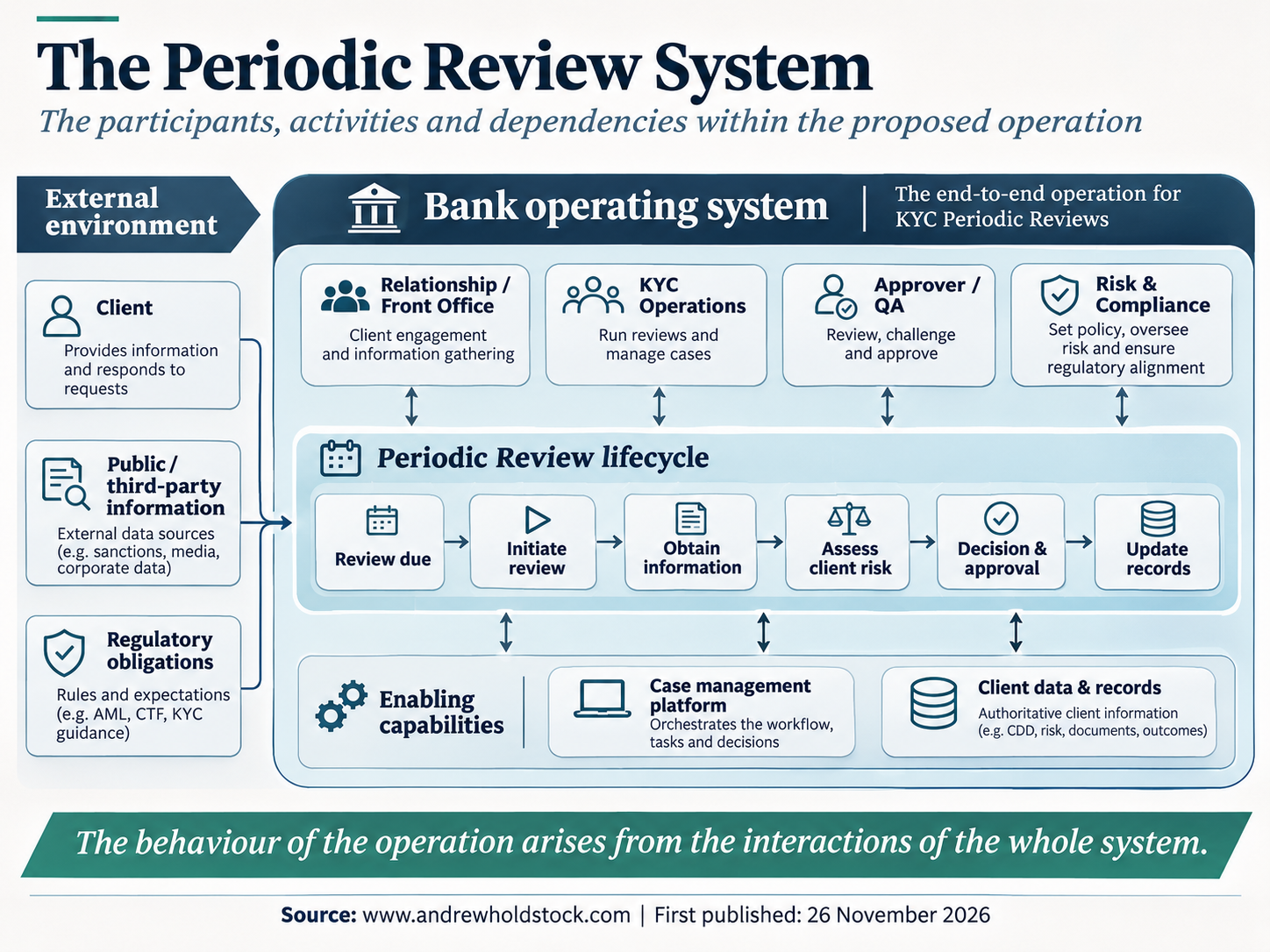
The operating system extends beyond the organisational boundaries of KYC Operations. It encompasses all the participants, activities, resources and dependencies required to achieve the intended outcome.
Establishing these boundaries is an important step in OSE. It ensures that the subsequent engineering analysis considers the behaviour of the whole operating system, rather than that of an individual team or process.
Establishing the Required Behaviour
What must the operation reliably achieve?
Before designing the operation, we need to establish how it must behave to achieve the required business objective.
Reviews must produce valid risk assessments, be completed within prescribed timescales and provide sufficient assurance to support decisions on continuing client relationships.
The operation must also accommodate differences in client complexity, fluctuations in demand and changing circumstances, whilst making sustainable use of the bank's resources.
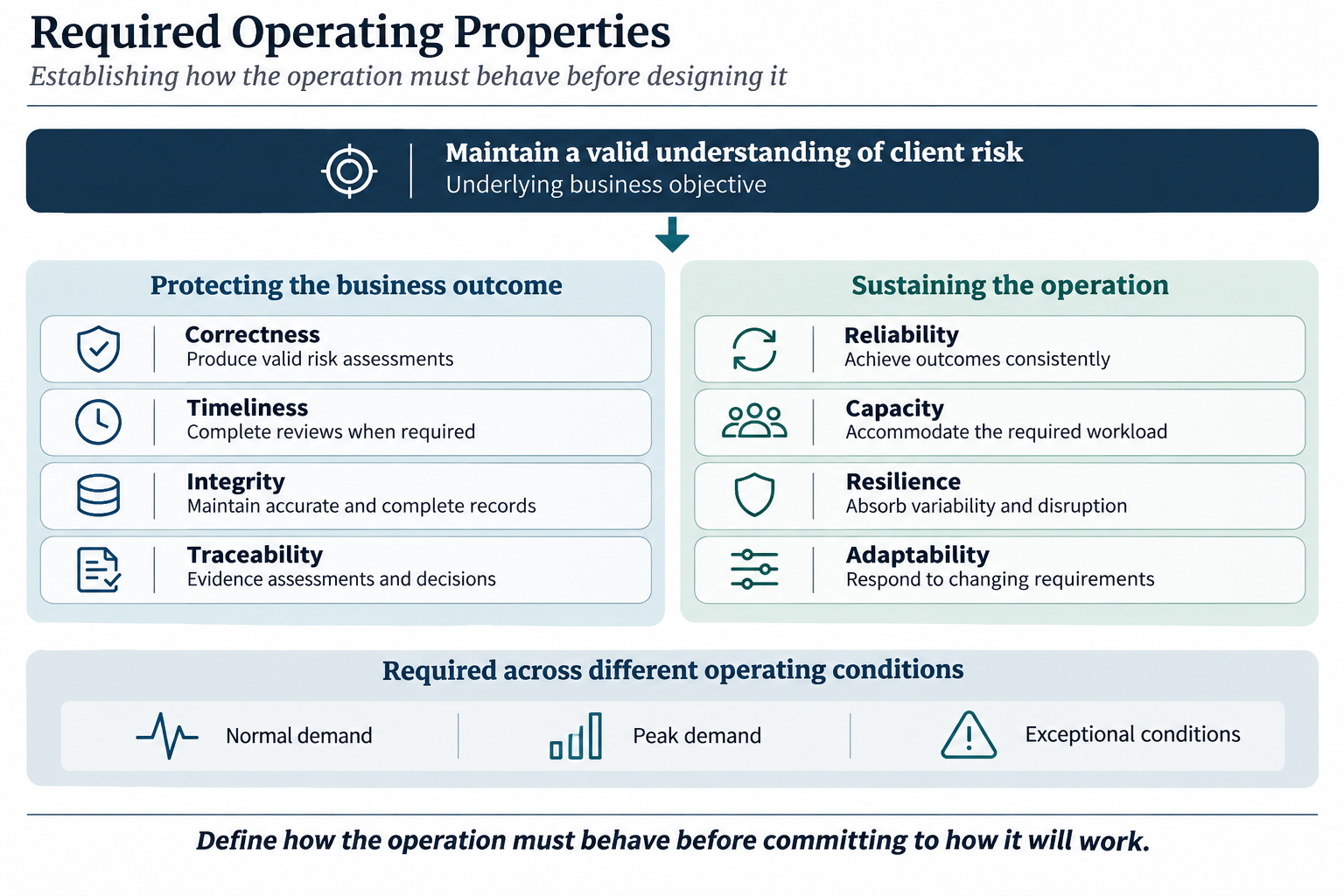
These required operating properties provide the criteria against which the proposed operating model can be assessed.
OSE requires us to consider not only whether the operation could achieve the intended outcomes under normal conditions, but also whether it could do so reliably under the range of conditions it would reasonably be expected to encounter.
Discovering the Engineering Challenge
Examining the characteristics of the proposed operation
Applying the 20 OSE perspectives to the proposed Periodic Review operation reveals a number of characteristics that would influence its behaviour.
The operation would need to complete work of varying complexity within prescribed timescales, using finite resources. Activities would have dependencies, information would need to be obtained from multiple sources, and some participants would operate outside the bank's direct control.
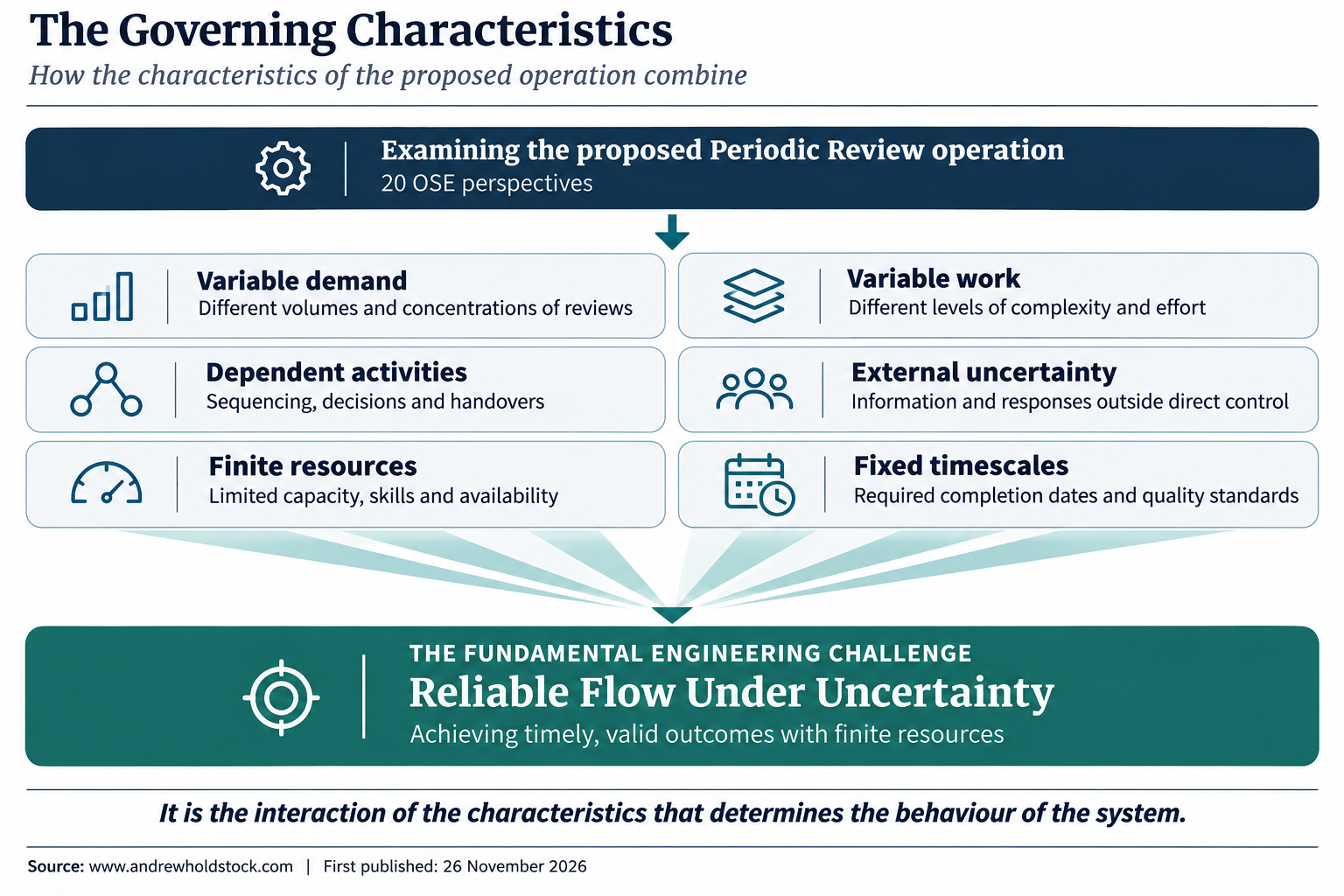
Considered individually, these characteristics are familiar features of banking operations. However, their interaction creates a more demanding engineering problem.
The bank would need to achieve the reliable flow of work of uncertain duration, through a network of dependent activities, within fixed timescales, whilst maintaining quality and making sustainable use of resources.
Predicting Operational Behaviour
What could we have anticipated before implementation?
Established scientific and engineering principles enable us to examine how the governing characteristics of the proposed operation would interact.
Queueing theory explains how variability and high resource utilisation increase waiting times. Critical path analysis reveals how dependencies and uncertainty threaten completion dates. Systems science explains how feedback mechanisms can amplify operational difficulties.
Together, these principles provide a basis for anticipating how the operation might behave.
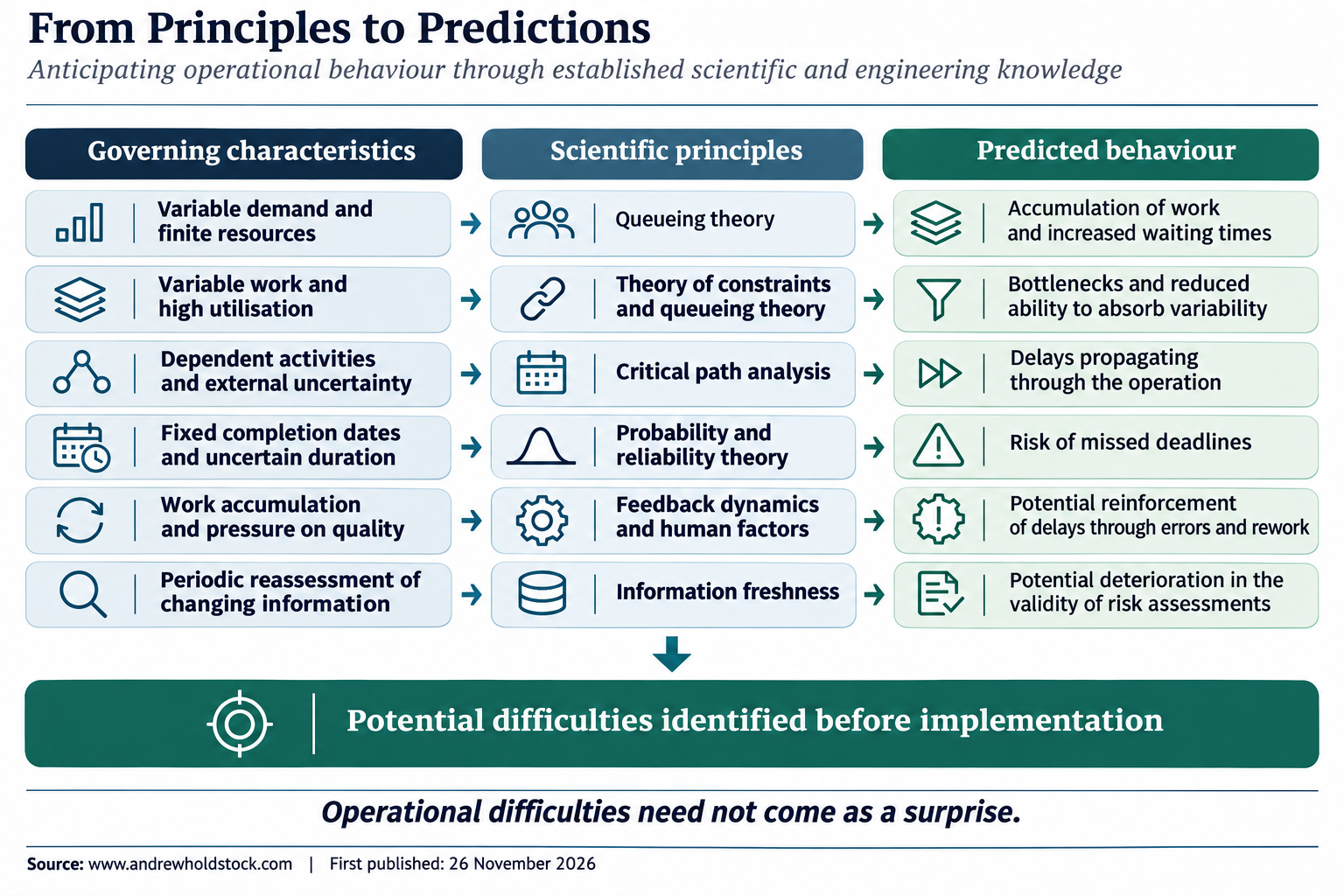
We could have anticipated that, without appropriate engineering mechanisms, the operation would be vulnerable to accumulating work, missed completion dates, resource pressures and increasing difficulty maintaining quality.
These predictions would have given the bank an opportunity to reconsider the proposed design before implementation, rather than discovering its weaknesses through operational experience.
Reconsidering the Design
Is there a better way to achieve the objective?
Armed with this understanding of the likely operational behaviour, would we still choose to achieve our business objective through conventional Periodic Reviews?
One option would be to engineer the proposed operation to reduce uncertainty, dependencies and the amount of work required.
Another would be to reconsider the mechanism itself, examining whether maintaining the validity of client risk assessments could be achieved through different operating arrangements.
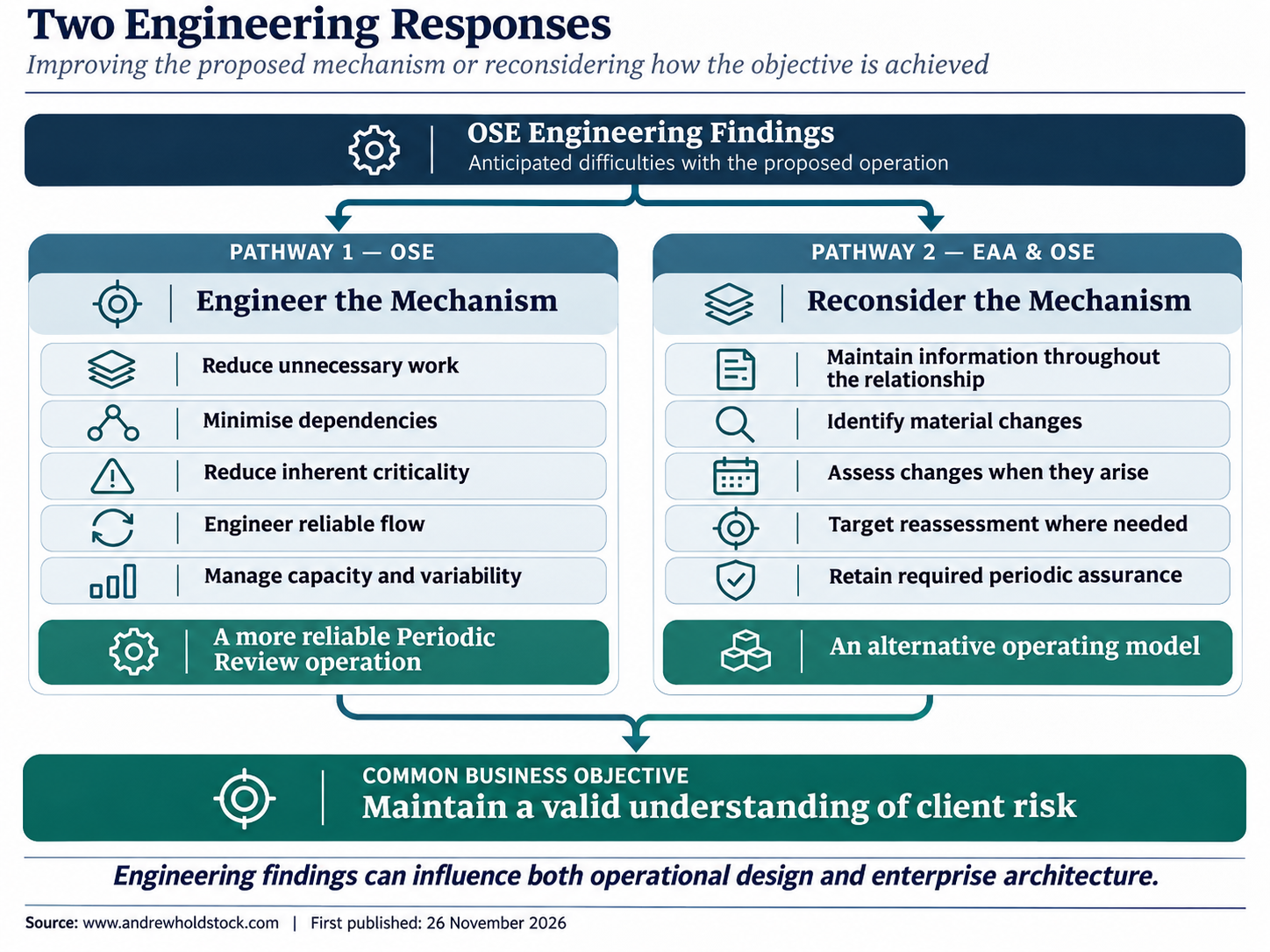
The value of OSE extends beyond engineering the operation initially envisaged. Its findings may provide the basis for reconsidering the architectural decisions that led to the proposed operation.
This interaction between OSE and EAA creates an opportunity to explore alternative ways of achieving the business objective before committing to substantial investment.
Engineering Before Investing
Making better-informed operating model decisions
Had we applied OSE when the conventional Periodic Review was first conceived, established scientific and engineering principles could have alerted us to its inherent operational challenges.
This understanding would have provided an opportunity to explore alternative designs, assess their likely behaviour and establish greater confidence in their ability to achieve the required business outcomes before committing to implementation.
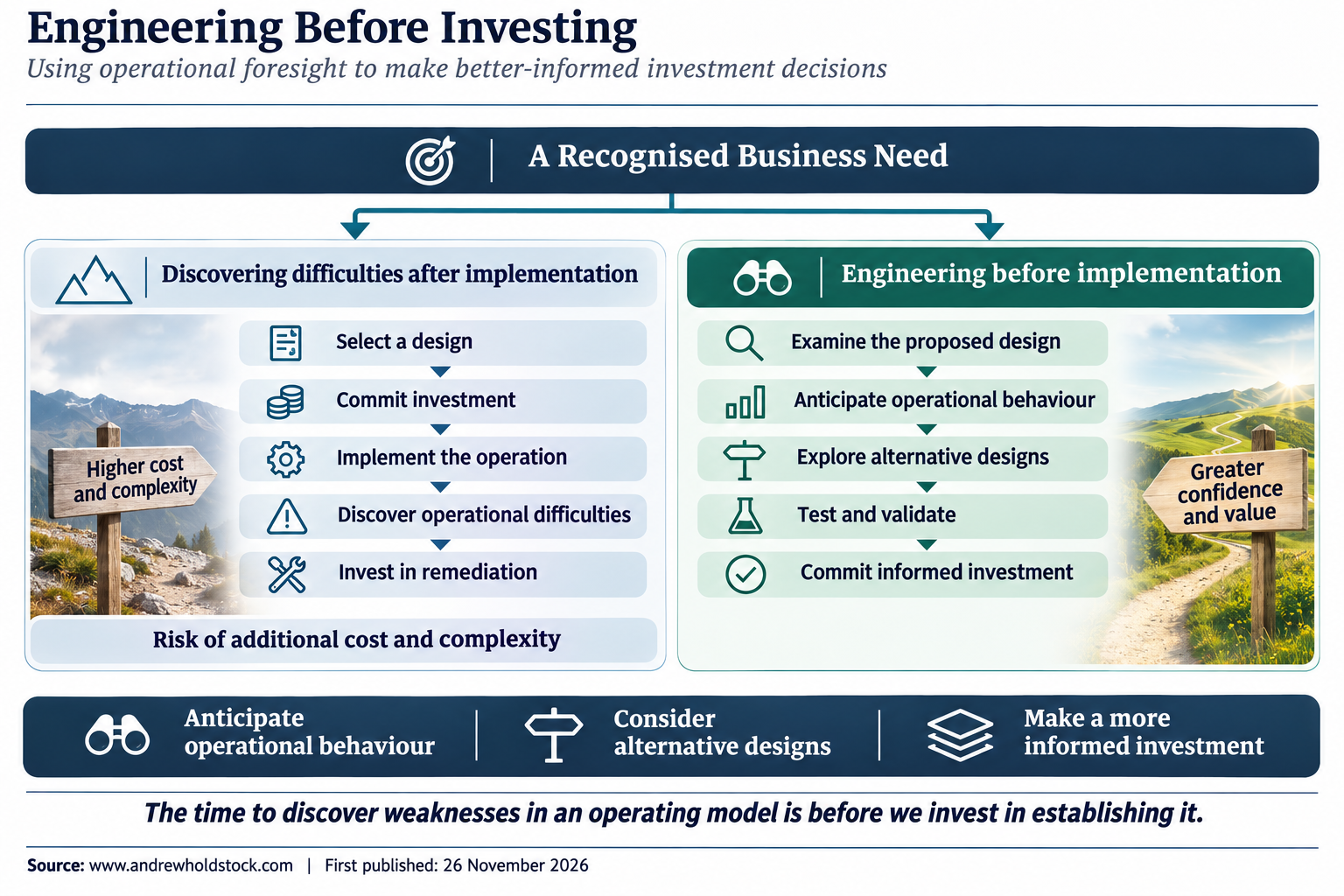
The opportunity extends well beyond KYC Periodic Reviews.
Applying operational engineering at the point of design could help banks avoid establishing operations that subsequently require substantial investment to address foreseeable difficulties.
The ambition is to establish greater confidence that investment in new enterprise abilities will deliver the intended business outcomes reliably and sustainably.
Engineering Operational Criticality
How design decisions influence operational reliability
The inherent criticality of a Periodic Review operation is influenced by both the requirements it must satisfy and the way it is designed to satisfy them.
Multiple booking locations may introduce additional requirements, approvals and dependencies. However, how these are accommodated within the operating model can significantly influence the likelihood of achieving the required outcomes.
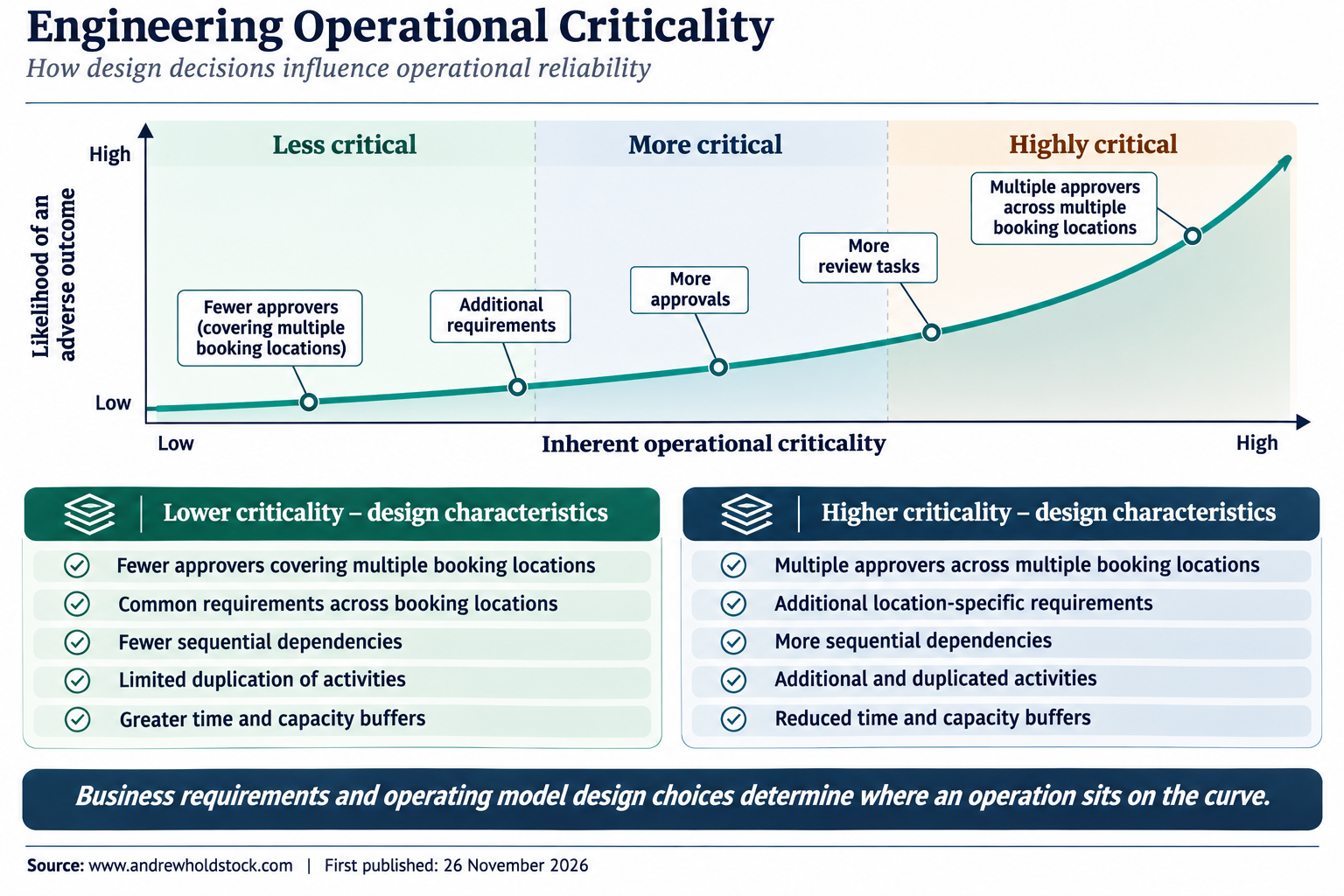
Individually reasonable design decisions can collectively establish an operation that is highly susceptible to delays and adverse outcomes.
OSE enables us to examine the engineering consequences of these decisions, identify opportunities to reduce inherent criticality and establish whether the proposed operation can reliably satisfy the bank's requirements.
Engineering Operational Reliability
Applying scientific principles to derive operating solutions
Where the bank is committed to retaining Periodic Reviews, the scientific and engineering principles that reveal the operational difficulties can also provide the basis for their resolution.
This involves engineering the operation to minimise inherent criticality, accommodate the criticality that cannot be eliminated, and maintain operational behaviour within acceptable limits.
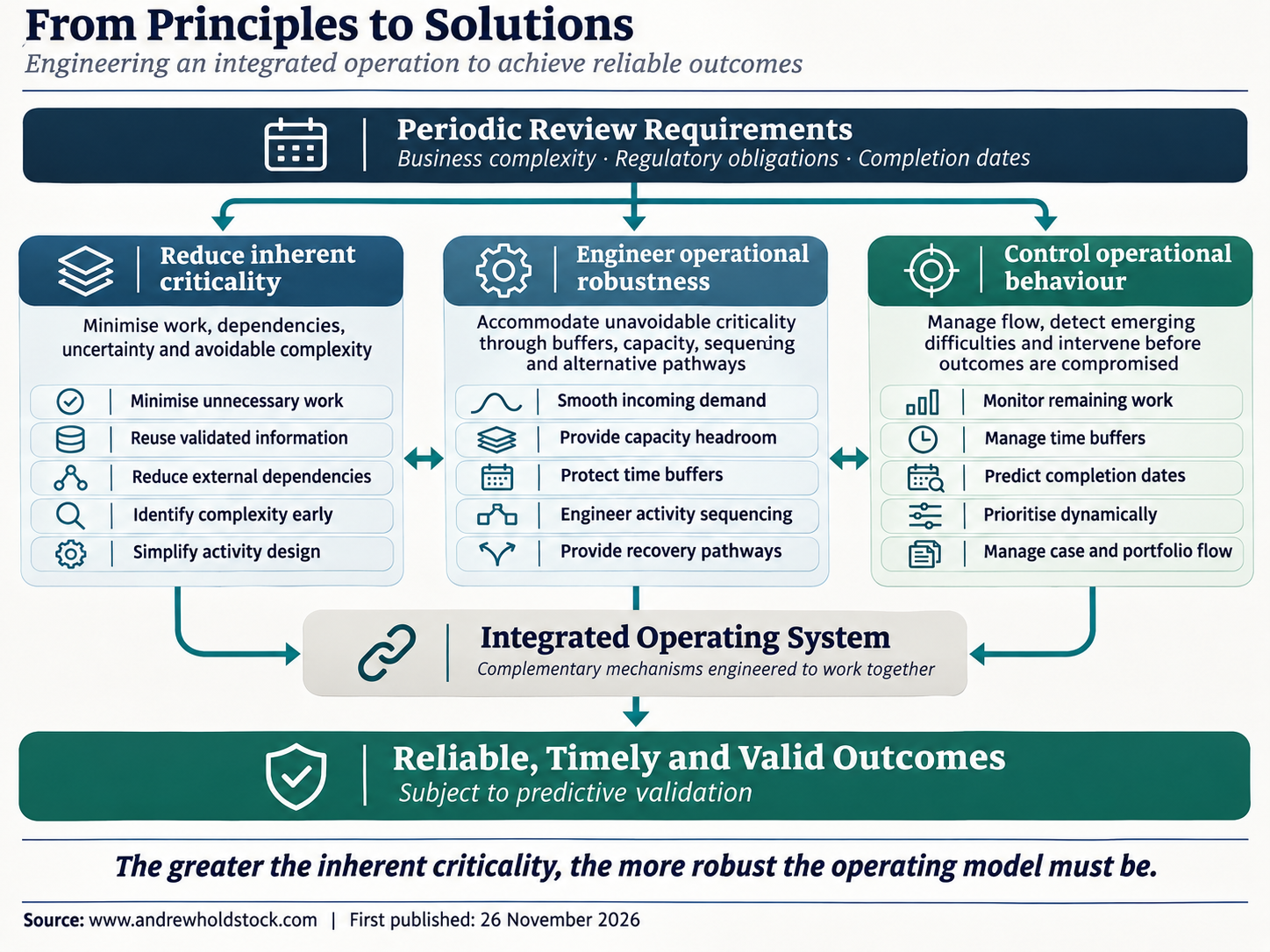
The greater the inherent criticality of the Periodic Review requirements, the more robust the operating model will need to be.
By applying established scientific and engineering principles, we can design complementary operating mechanisms that work together to achieve reliable flow, protect quality and meet required completion dates.
The resulting operating system can then be subjected to predictive modelling and validation.
The Economics of Engineering
A modest investment with potentially substantial returns
Research published by the Netherlands Court of Audit in March 2026 identified over €1 billion of anti-money laundering remediation expenditure across just eight Dutch banks over four years.
Given the relative size of the Dutch banking sector, the potential scale of comparable expenditure across the global banking industry warrants consideration.
How much of this expenditure might better operational engineering have avoided?
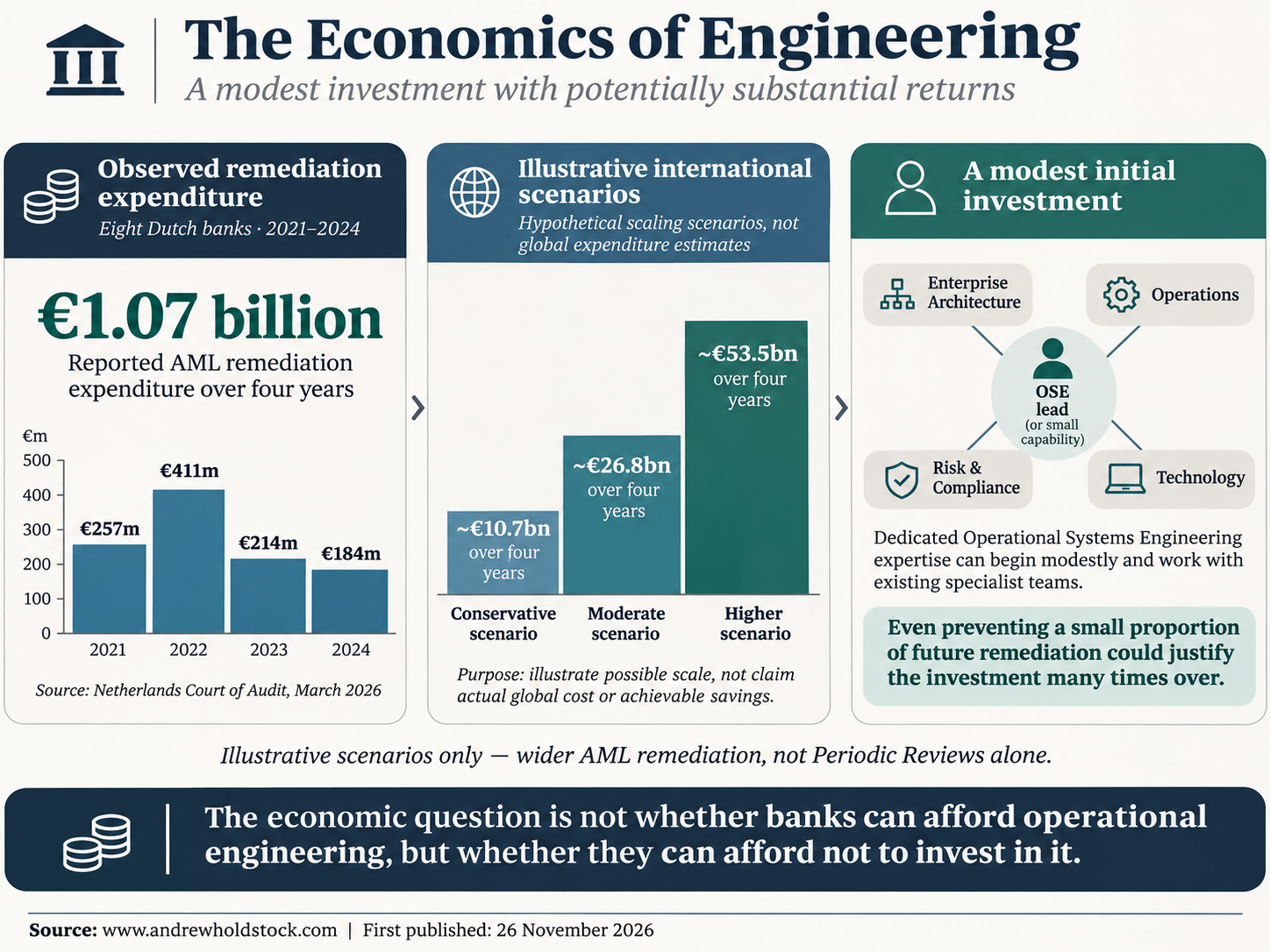
Many banks already recognise the value of dedicated Enterprise Architecture expertise. Establishing complementary expertise in Operational Systems Engineering could begin with a similarly modest investment.
Even if operational engineering prevented only a small proportion of future remediation expenditure, the economic benefits could be substantial.
The opportunity, however, extends far beyond financial crime operations.
First Published: 26-Nov-2026