Relationships


The Economy Runs on Relationships
Businesses create economic activity through relationships: buying, selling, employing, owning, funding, supplying, investing and partnering.
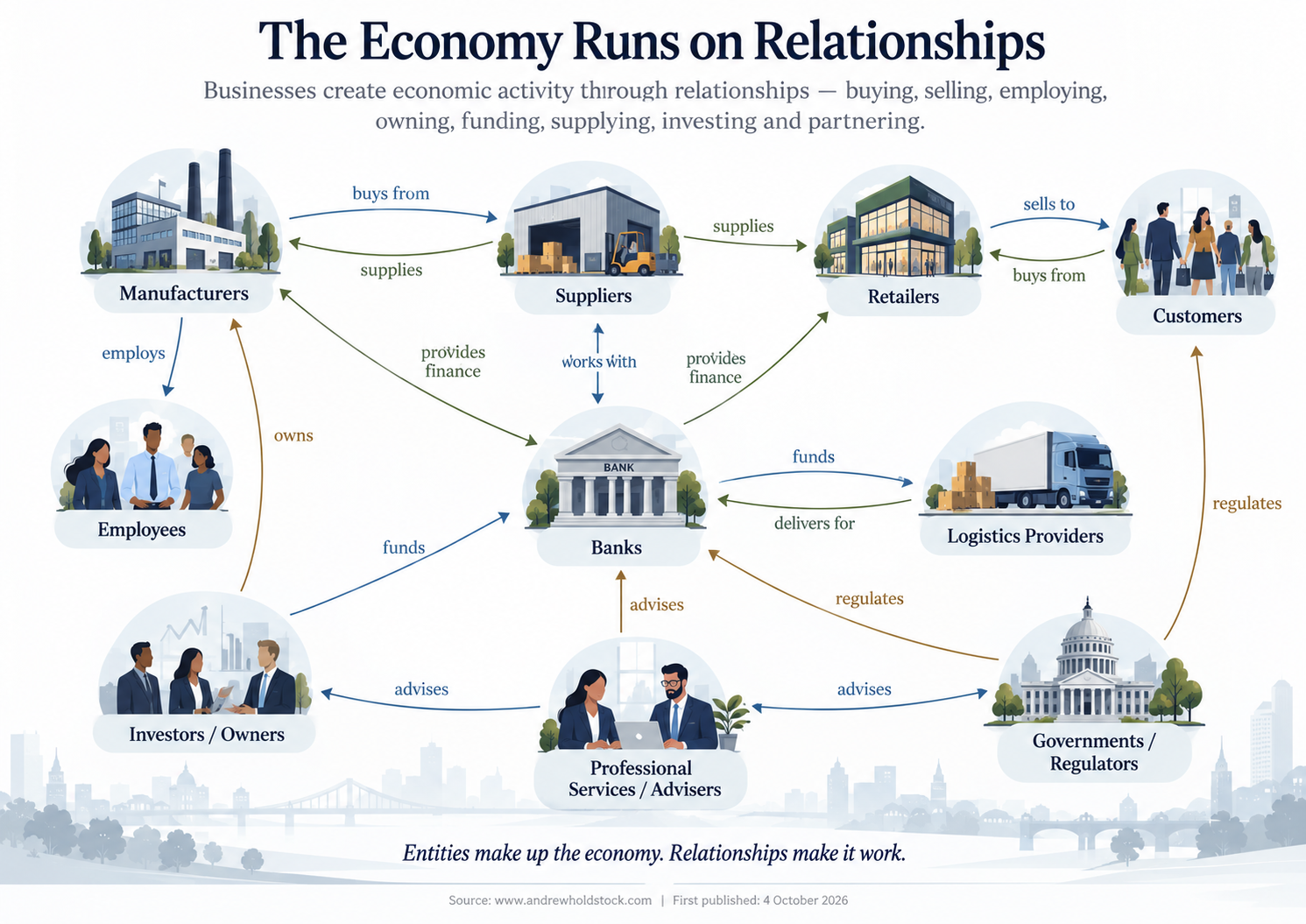
Those relationships connect organisations and people into the networks through which value, obligations, dependency and risk move.
Value and Exposure
Relationships create value, obligations and risk.
Businesses rely on relationships to sell, buy, employ, fund, own and operate.
Those same relationships can create rights, obligations, dependencies and exposures. A customer can become a concentration risk. A supplier can become a critical dependency. A lender creates funding, but also repayment obligations.
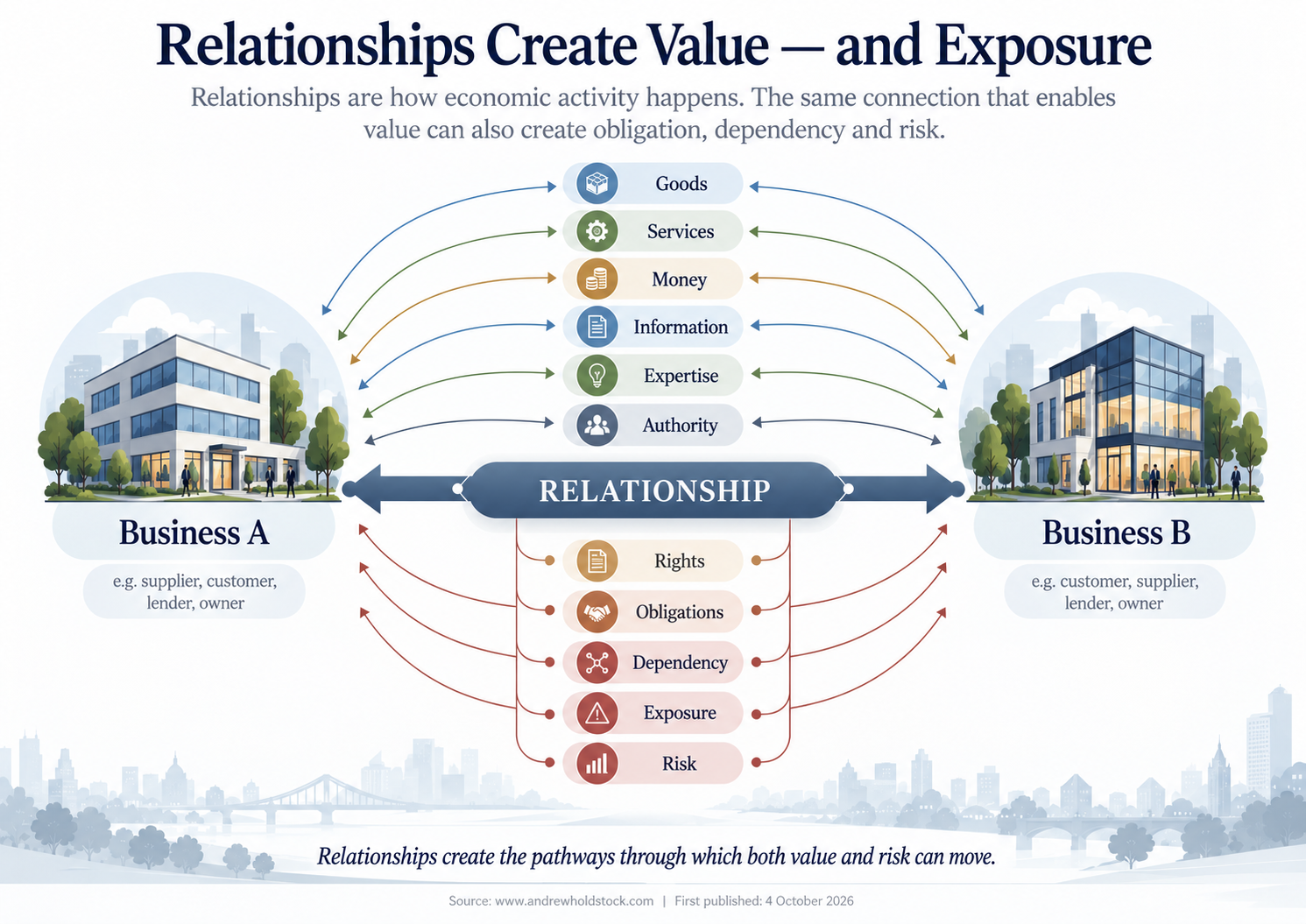
The relationship is not the risk. It is the connection through which value and risk can travel.
Understanding a business therefore means understanding not only the entities involved, but also the relationships between them.
Relationships Create Risk Pathways
Connections can transmit dependency, exposure and disruption.
A relationship does more than connect two parties. It creates a pathway through which the actions, condition or failure of one party can affect another.
The nature of that risk depends on the relationship. A business may rely heavily on a small number of customers or suppliers. It may depend on external funding, guarantees, technology providers, agents or other intermediaries. Ownership and control relationships can transmit influence and financial stress across a group.
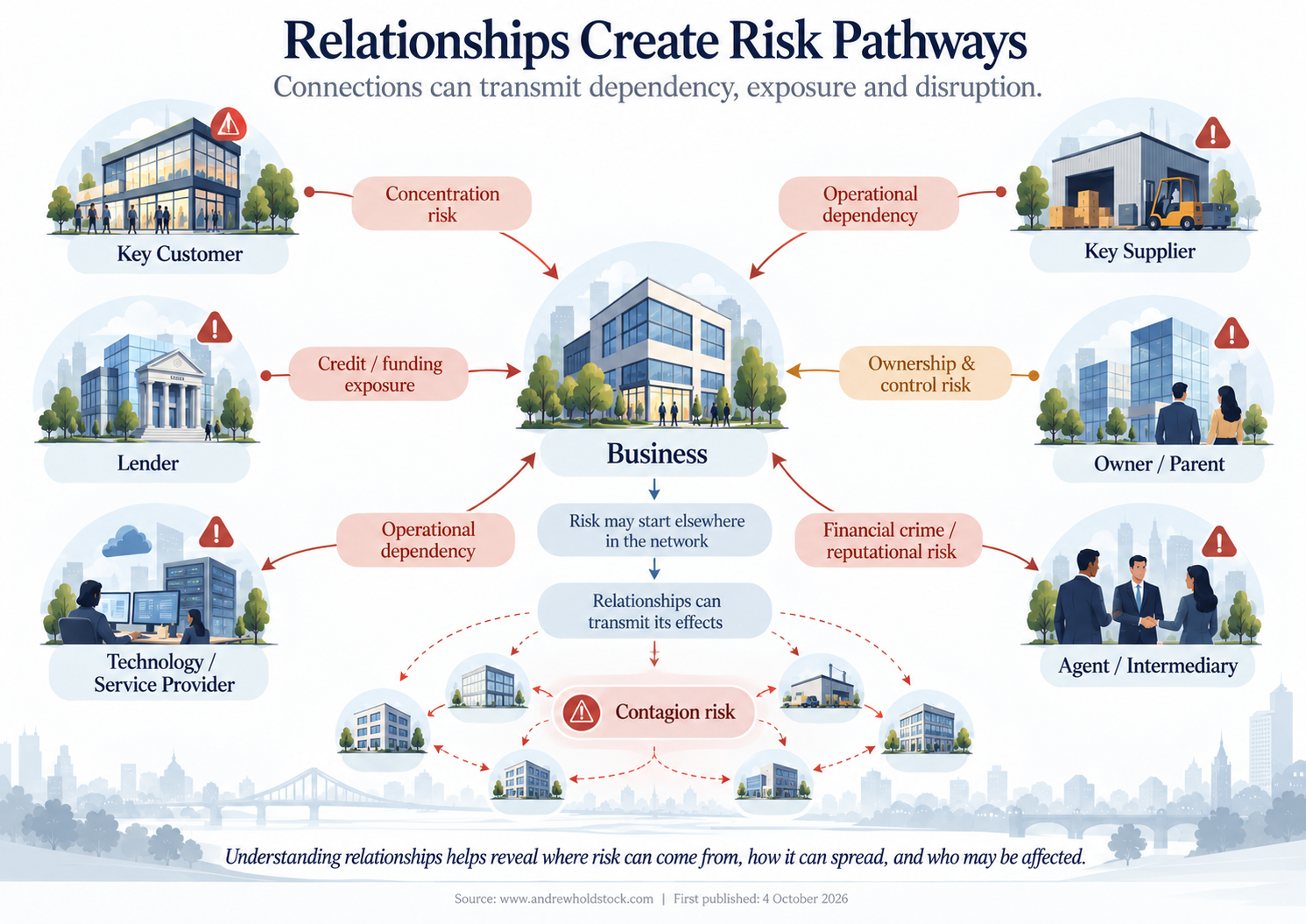
Relationships can therefore create or amplify:
Concentration risk through dependence on key customers, suppliers, funders or counterparties.
Credit and financial exposure through lending, guarantees, receivables and settlement obligations.
Operational dependency through reliance on suppliers, infrastructure, technology or service providers.
Ownership and control risk through influence, group structures and beneficial ownership.
Legal and contractual exposure through rights, commitments and obligations.
Reputational and financial crime risk through association with connected parties.
Contagion risk when problems spread through connected entities or dependencies.
The risk may originate elsewhere in the network. What matters is whether there is a relationship through which its effects can reach the business.
Understanding relationships is therefore essential to understanding where risk can come from, how it can spread, and who may ultimately be affected.

Which Relationships Matter to the Bank?
Banks needs to understand the relationships that can affect their business, obligations, decisions, and risk.
Not every relationship surrounding a client needs to be captured. What matters is whether the connection has significance for the bank.
Some relationships are direct. The bank may lend to an entity, provide transaction services, execute trades, hold assets or enter into other business arrangements with it.
Others matter because they help explain the parties with whom the bank is dealing:
Ownership and control — who ultimately owns, controls or influences an entity.
Authority and representation — who is permitted to act for another party.
Financial support — guarantees, funding and other forms of financial dependency.
Economic dependency — important customers, suppliers or other relationships whose failure could materially affect the client.
Operational dependency — agents, service providers, technology providers and other critical third parties.
Market and transaction relationships — counterparties, brokers, investment managers, issuers, agents and other participants required for business activity.
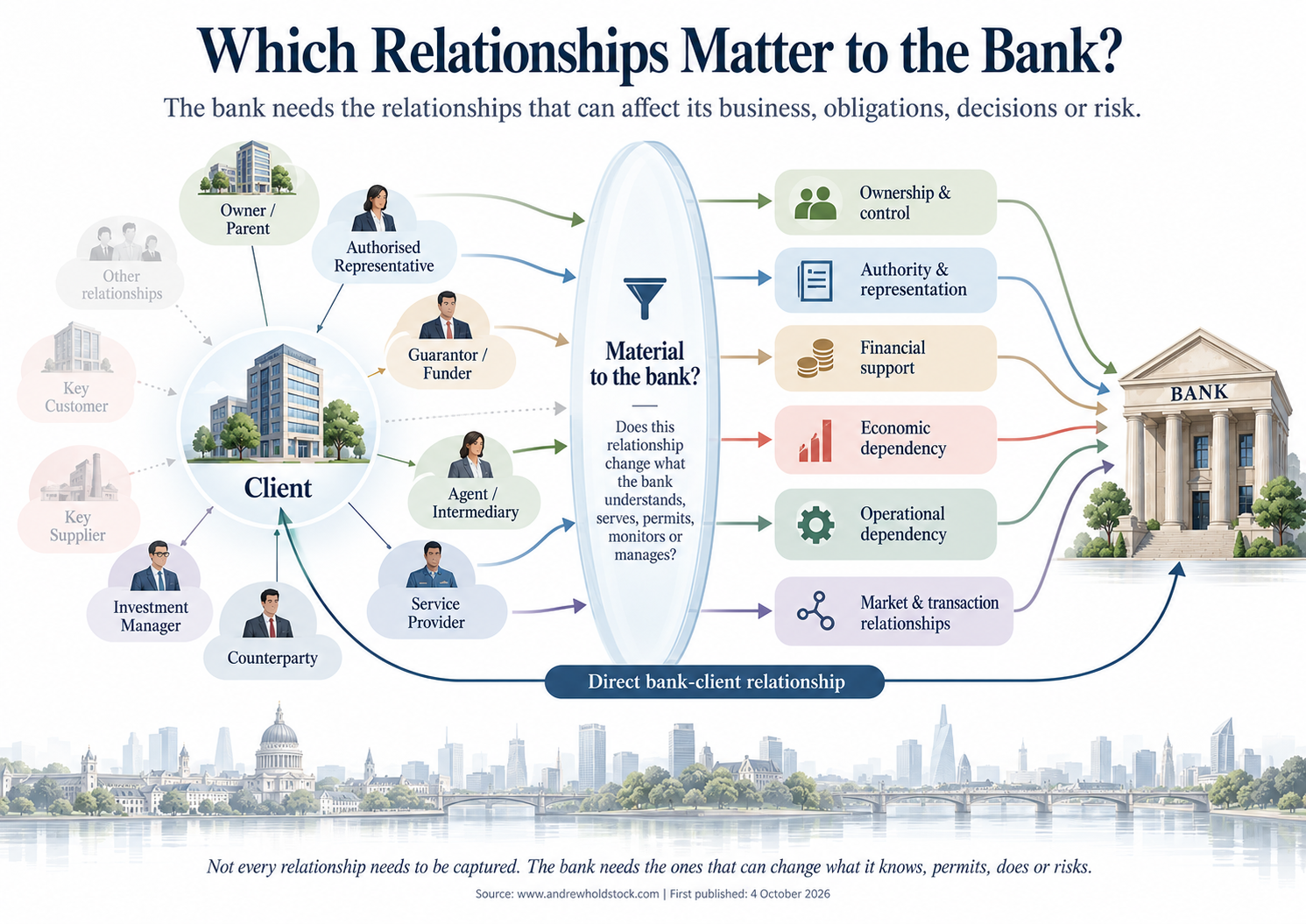
A relationship can therefore matter to the bank even when the bank is not itself one of the parties to it.
The question is not:
“What relationships does this entity have?”
It is:
“Which relationships could change how the bank understands, serves, permits, monitors or manages its relationship with this client?”
That is the point at which relationships become part of Client Lifecycle Management.
A Relationship Is More Than a Link
The connection itself has meaning, structure, and context.
Knowing that two entities are connected is not enough. The bank may also need to understand what the relationship is, how it works and why it matters.
A relationship can describe ownership, control, authority, funding, guarantee, supply, dependency, agency, management or another form of connection.
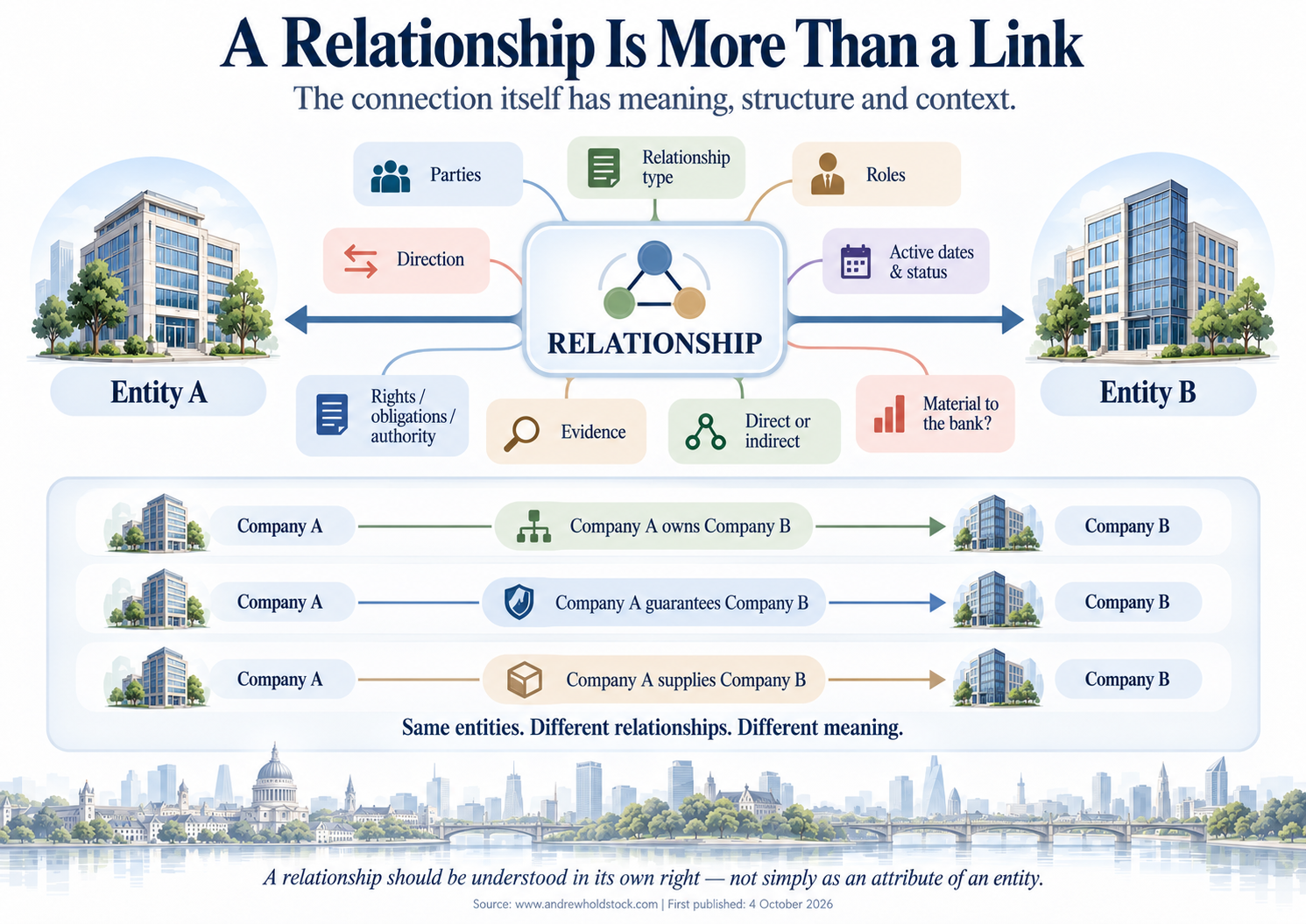
To understand a relationship properly, the bank may need to know:
who the parties are
what type of relationship exists
what role each party plays
whether the relationship is directional
when it started and whether it remains active
what rights, obligations or authority it creates
what evidence supports it
whether it is direct or indirect
whether it is material to the bank
The same two entities can have more than one relationship.
Company A → owns → Company B
is different from:
Company A → guarantees → Company B
and different again from:
Company A → supplies → Company B
The entities have not changed. The relationship has changed the meaning of the connection.
A relationship should therefore be understood as something in its own right and not only as an attribute attached to an entity.
Relationships Need to Be Visible
If important relationships are hidden or fragmented, the bank cannot use the effectively.
Relationships may already be known somewhere in the bank, but not in a form that is easy to see or act upon.
They may be buried in documents, recorded in case notes, held in separate systems, shown on organisation charts or captured only as individual fields on an entity record.
That can make it difficult to answer basic questions:
who is connected to whom
what the relationship is
what role each party plays
whether the relationship is current
why it matters to the bank
what risk, obligation or permission may follow.
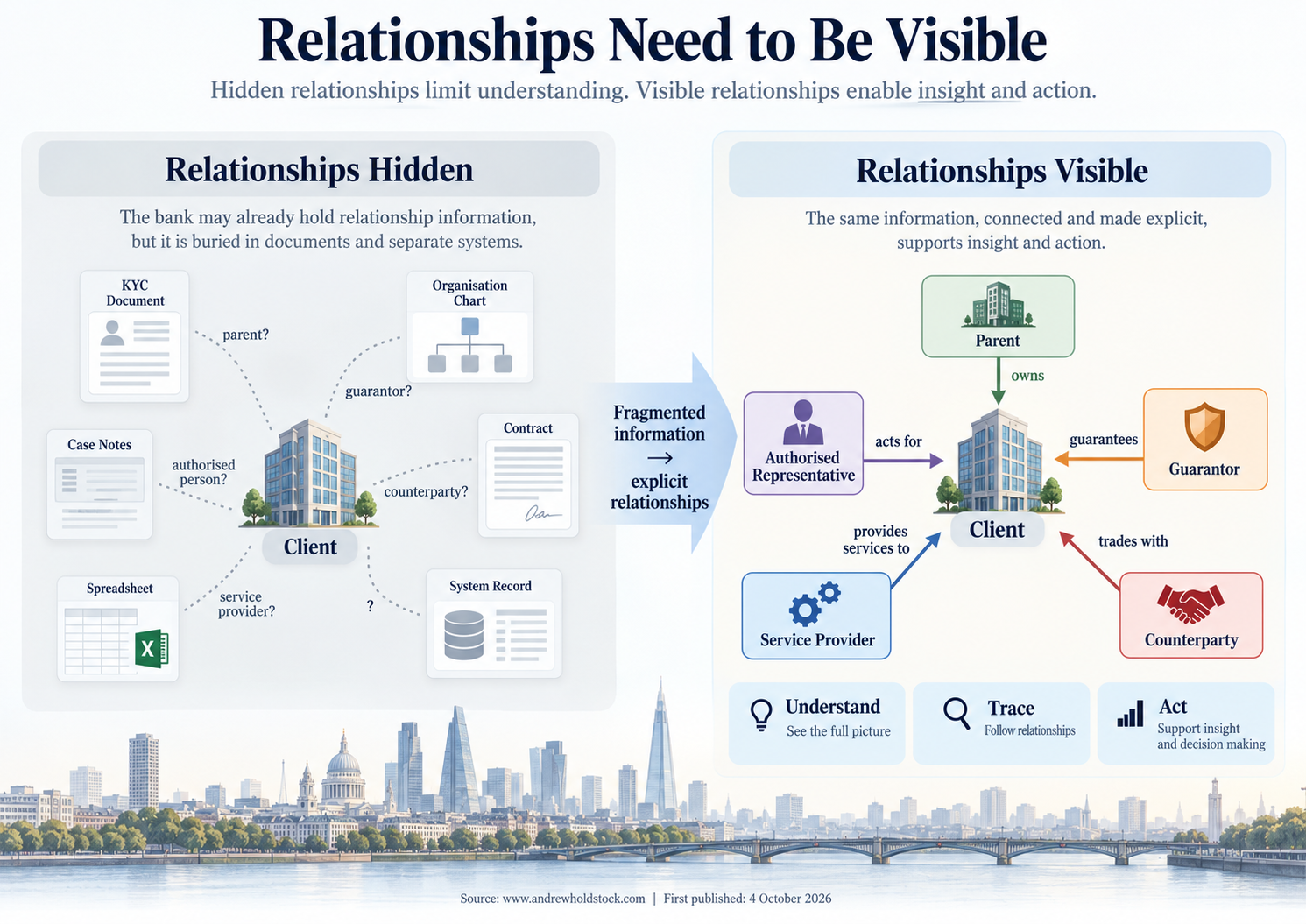
A relationship that is only implicit can be difficult to trace, reuse or monitor.
The bank therefore needs important relationships to be represented explicitly enough that they can be understood across the lifecycle and used in decision-making.
The bank does not just need relationship information. It needs relationships to be visible, connected and usable.
Not All Relationships Are Equal
What matters is not only that a relationship exists, but how significant it is.
Two entities may have the same type of relationship but very different levels of dependency, exposure or influence.
A supplier providing routine goods is different from a sole supplier of a critical component. A customer representing 1% of revenue is different from one representing 45%. A minority shareholder is different from a controlling owner. A small guarantee is different from one that could materially affect the guarantor.
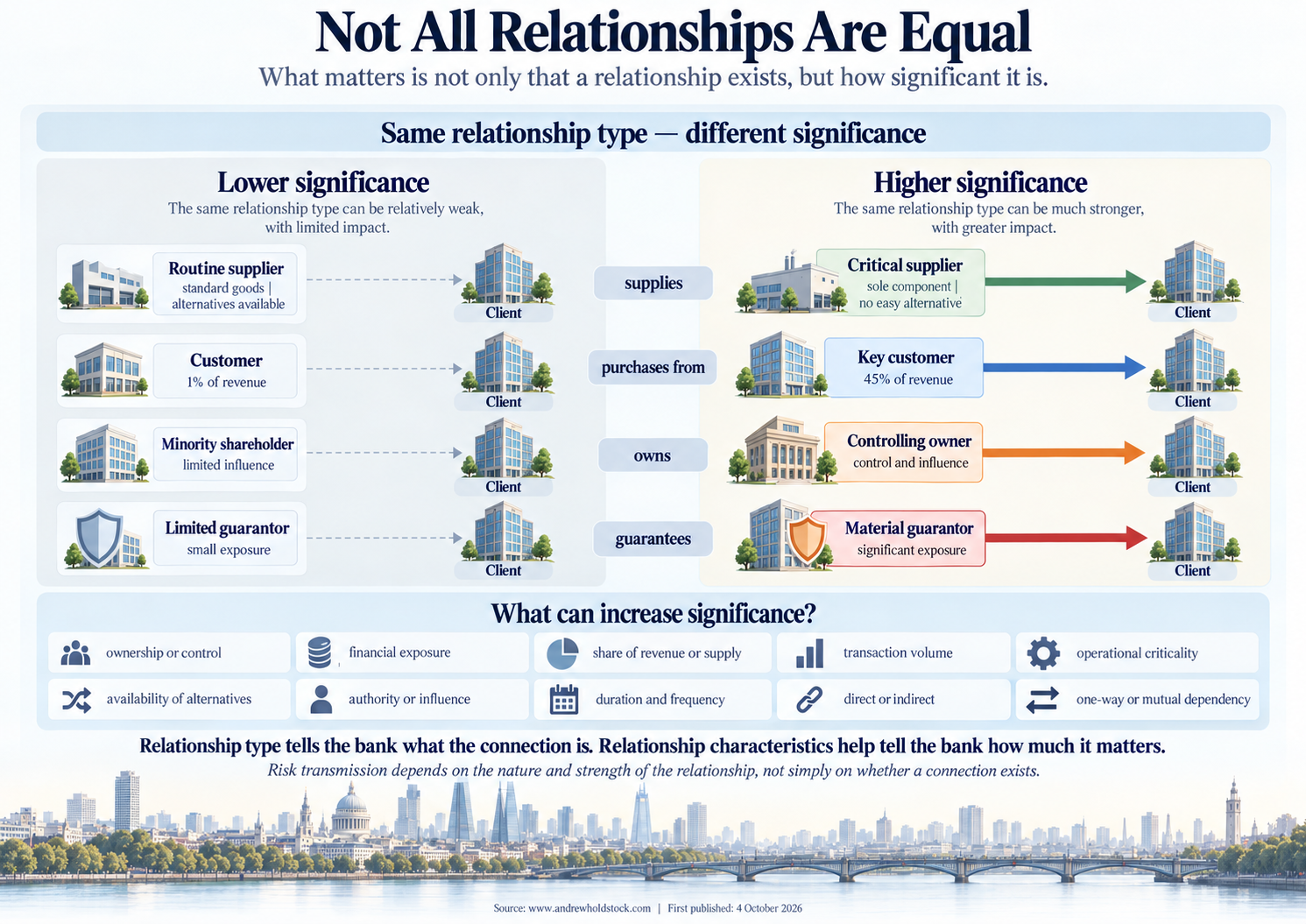
The strength and significance of a relationship can depend on factors such as:
ownership or control
financial exposure
share of revenue or supply
transaction volume
operational criticality
availability of alternatives
authority or influence
duration and frequency
whether dependency is one-way or mutual
whether the relationship is direct or indirect
Relationship type therefore tells the bank what the connection is.
Relationship characteristics help tell the bank how much that connection matters.
Risk transmission depends on the nature and strength of the relationship, not simply on whether a connection exists.
From Relationships to Networks
Seeing relationships together reveals patterns that individual records cannot.
Once important relationships are represented explicitly, they can be viewed together as a network.
In that network:
entities become nodes
relationships become connections
relationship type explains what the connection means
direction shows how the parties are connected
strength or materiality shows how significant the connection is
A network view can reveal things that are difficult to see when relationships are examined one at a time.
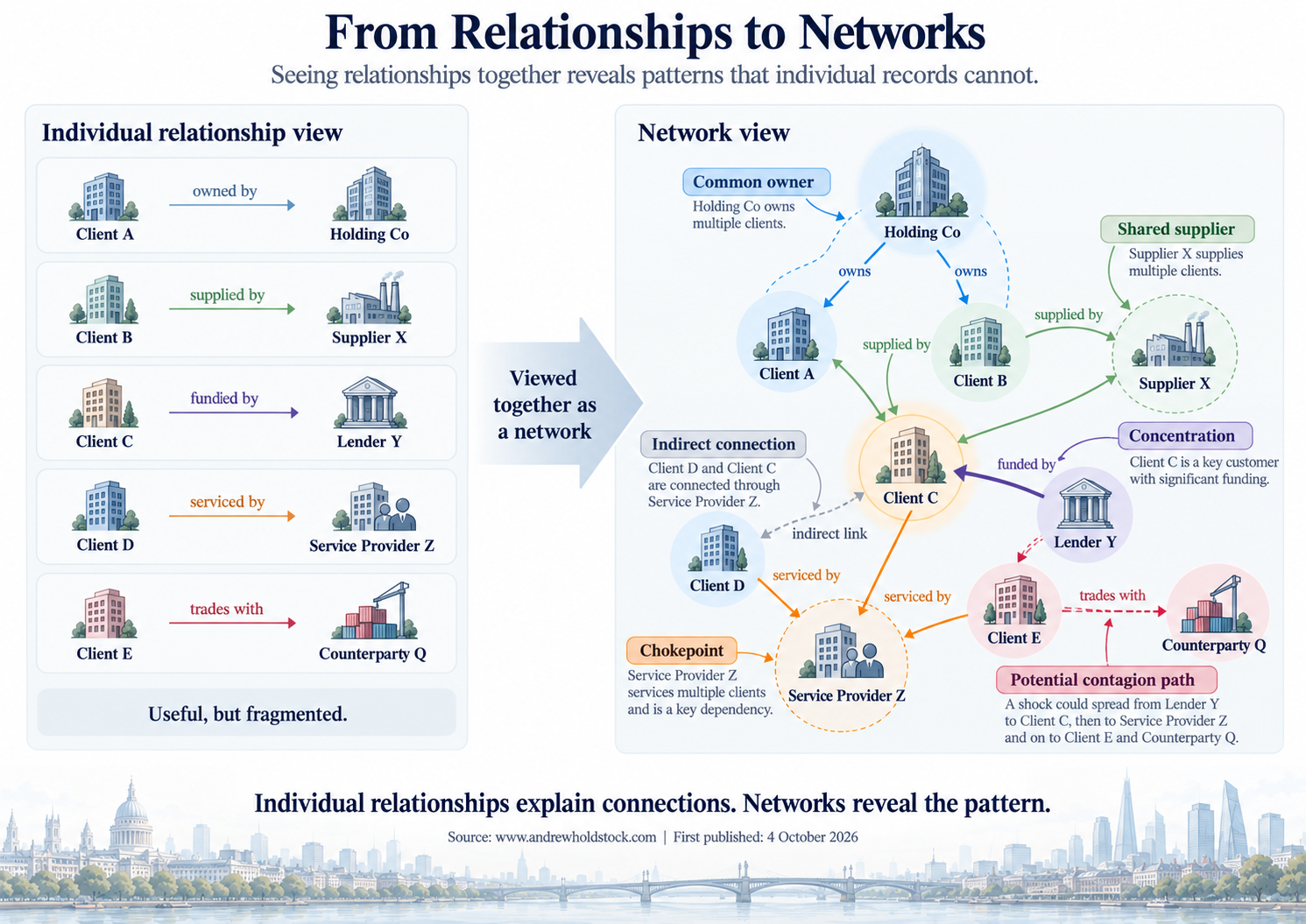
A network can expose:
common owners or controllers
concentration around a customer, supplier or funder
shared service providers or intermediaries
chains of ownership or dependency
indirect links between apparently separate clients
clusters of economically connected entities
potential contagion pathways
chokepoints where many relationships depend on one participant
The network graphic does not create these relationships. It makes the relationships already represented by the bank easier to understand.
Individual relationships explain connections. Networks reveal the pattern created by those connections.
Relationships Change
Relationships have lifecycles too.
A relationship is not a static fact. It can begin, develop, grow in importance, weaken, become inactive or end — even when the entities themselves remain unchanged.
A supplier may be appointed, become increasingly important, then become critical. A guarantee may be put in place, remain active for a period, and later expire. An authorised representative may be added, changed or removed. Ownership may pass from one party to another.
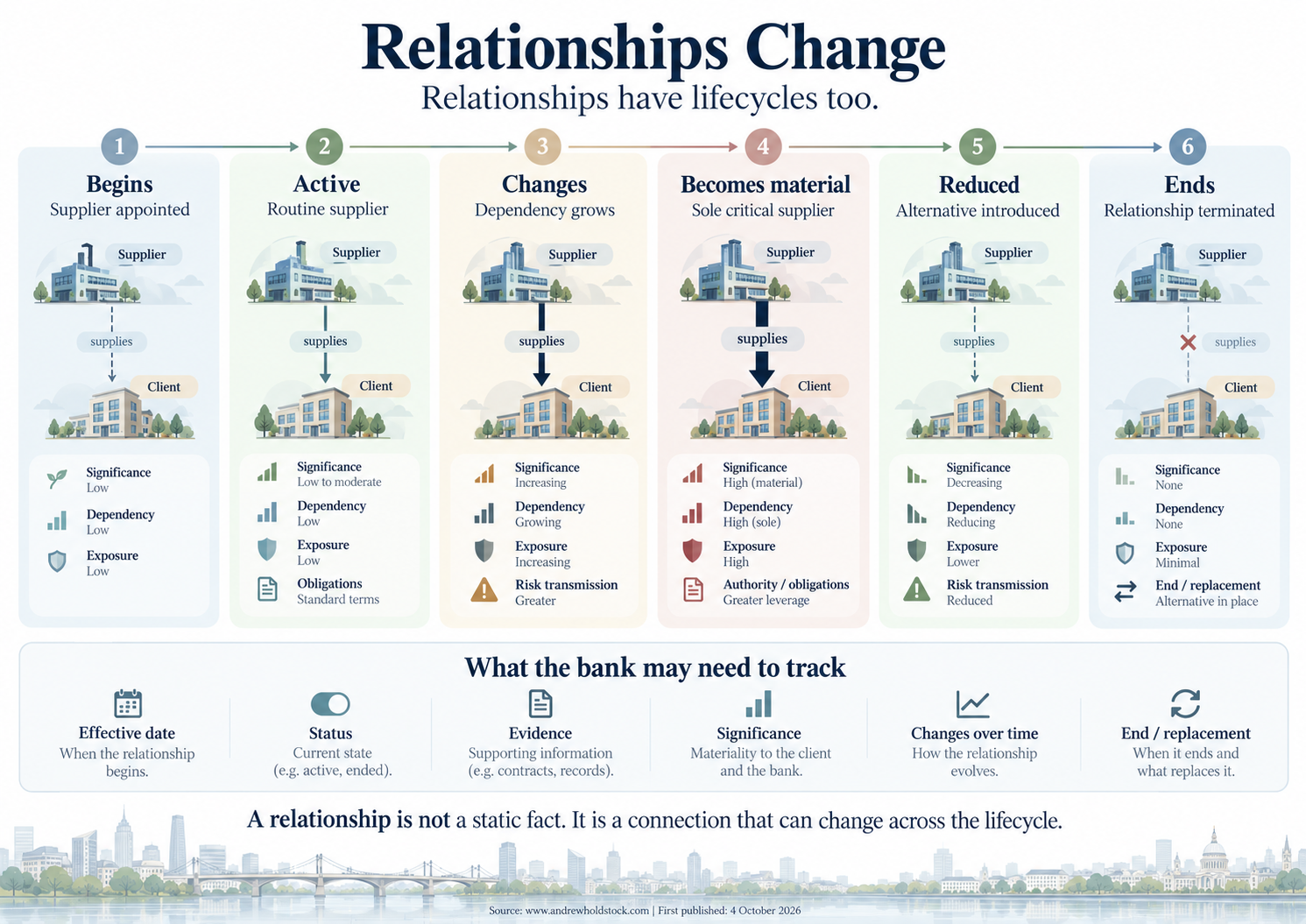
As relationships change, so can:
their significance
their rights and obligations
their authority or control
their dependency and exposure
their effect on the bank’s understanding, monitoring or decisions
The bank therefore needs to understand relationships not only as connections, but as connections moving through time.
That means knowing, for example:
when the relationship began
whether it is active
how it has changed
whether it has become more or less significant
when it ended or was replaced
A relationship should therefore be managed as something with its own status, history and lifecycle.
Managing relationships over time is part of managing the client lifecycle itself.